
Khan Capitals | August 2026
Key Takeaways
- Bitcoin has gained close to 20 per cent this week, touching $75,740 in Asian trading on Friday, its highest level since early June and, if held, its biggest weekly advance since March 2024.
- The move began as a bitcoin short squeeze: Wednesday’s 8 per cent surge forced more than $1 billion of short liquidations in about an hour, in a market that had been positioned for further declines after months of negative funding rates.
- Three catalysts converged: the US Treasury’s decision to double its long-dated bond buybacks, an SEC proposal for a digital asset “safe harbor” framework, and a White House meeting signalling further policy support for the industry.
- Real demand followed the squeeze: spot Bitcoin ETF inflows reached $517 million in a single day, a three-month high, suggesting the rally is not purely a positioning event.
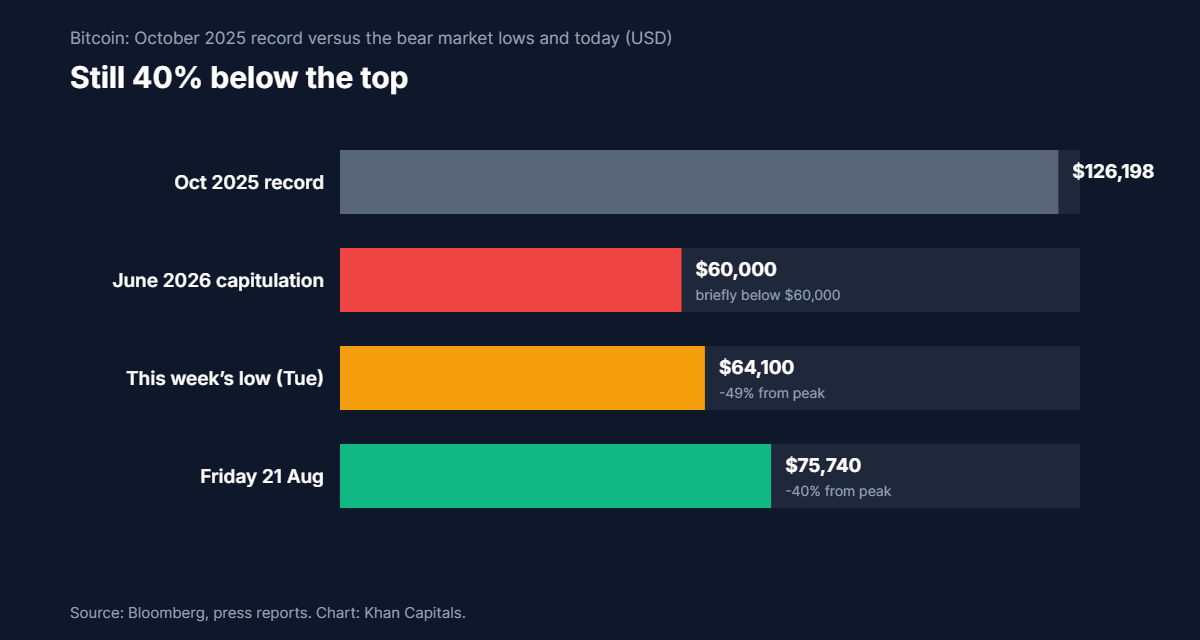
- The context is a ten-month bear market: Bitcoin remains roughly 40 per cent below its October 2025 record of $126,198, and the week’s question is whether a squeeze becomes a turn.
Part of: Crypto & Digital Assets – Khan Capital’s hub on crypto and digital assets.
The Week Crypto Woke Up
The most violent moves in markets tend to happen against the prevailing position, and this week’s bitcoin short squeeze was a textbook case. Bitcoin entered the week drifting in the mid-$60,000s, an unloved asset in a ten-month bear market, with derivatives markets paying shorts to stay short. By Friday morning it had touched $75,740, ether had jumped 18 per cent in a single session, and the asset was on track for its strongest week in nearly two and a half years. Nothing about the fundamentals of the protocol changed. What changed was the macro backdrop, the regulatory weather and, most immediately, the cost of being short.
The sequence matters for anyone trying to judge whether this is a durable turn. Monday and Tuesday were unremarkable, with bitcoin marking a low near $64,100 as the global bond selloff pressured every risk asset. Wednesday changed the tape: within hours of the US Treasury announcing expanded buybacks of long-dated bonds, bitcoin rose more than 8 per cent, its biggest one-day gain since March, forcing over $1 billion of short positions to cover in roughly an hour. Thursday extended the move through $72,950 as ETF money arrived in size. Today the rally reached $75,740 in Asia before consolidating. A squeeze started it; the question is what sustains it.

Anatomy of a Bitcoin Short Squeeze
Crypto is the most leveraged corner of liquid markets, and leverage is direction-agnostic: it amplifies whichever way the crowd leans. For much of the summer the crowd leaned short. Perpetual futures funding rates, the fee one side of the market pays the other, had spent extended stretches negative, meaning shorts were paying to hold their positions and were confident enough to do so. Open interest was elevated, spot volumes were thin, and every rally since June had been sold.
That structure is kindling. When Wednesday’s macro news lifted spot prices a few per cent, the first tier of short positions hit liquidation thresholds. Exchanges close such positions by buying the asset back automatically, which pushes the price into the next tier of liquidations, and the cascade feeds itself. Estimates of the damage vary by data provider, but the most conservative counts put more than $1 billion of shorts liquidated in about an hour on Wednesday, with materially larger totals across crypto derivatives over the full move. It was the mirror image of the cascade we documented in the June deleveraging, when the same mechanics operated downwards through long positions.
Catalyst One: The Treasury Moves the Discount Rate
The spark was an unlikely one: a debt management announcement. On Wednesday the Treasury said it would at least double its long-end buyback operations to $4 billion each, a response to 30-year yields at 19-year highs. Long-dated Treasury yields fell sharply on the news, and bitcoin moved almost immediately. The transmission is straightforward once stated: bitcoin is among the longest-duration assets in existence, a claim on adoption decades out with no cash flows in between, so it is exquisitely sensitive to the long-term cost of money. A Treasury seen to be capping long yields is, for crypto, a liquidity signal.
There is an irony worth naming. In equities, the buyback announcement produced a rally that faded within the session as investors judged $4 billion operations too small against a $1.8 trillion deficit. Crypto took the same headline and ran three days with it. Part of the difference is positioning, as described above. But part is that crypto has always traded the direction of liquidity rather than its quantity, and the direction, between buybacks, fading rate hike odds and a softening US consumer, has quietly turned supportive for the first time since the winter.
Catalyst Two: The SEC Offers a Safe Harbor
The week’s regulatory news would have mattered in any tape. The Securities and Exchange Commission proposed a formal “safe harbor” framework for digital assets, opening a comment period ahead of a final vote. The details will be argued over for months, but the significance is directional: a rules-based path for token projects and intermediaries, replacing the enforcement-led approach that defined the last cycle. Markets have long treated regulatory clarity as the binding constraint on institutional crypto allocation; each step towards it lowers the compliance cost of participation.
Alongside the proposal came a White House meeting at which the administration signalled support for making perpetual futures venues accessible to US traders, with the President namechecking the decentralised exchange Hyperliquid. Whatever one makes of the policy merits, the message received by markets was that Washington’s posture towards the industry remains constructive, extending the arc that began with the spot ETF approvals of January 2024. In a market positioned short, constructive was enough.
The Week in Numbers
| Day | Bitcoin level | Driver |
|---|---|---|
| Mon 17 to Tue 18 Aug | Low near $64,100 | Global bond selloff pressures risk assets |
| Wed 19 Aug | Surges over 8% towards $69,500 | Treasury buyback news; $1bn+ short liquidations; White House meeting |
| Thu 20 Aug | $72,950, highest since 1 June | Spot ETF inflows hit $517m, a three-month high |
| Fri 21 Aug | Touches $75,740 in Asia | Momentum and continued squeeze; best week since March 2024 |
The Bear Market This Rally Interrupts
None of this happened in a vacuum. Bitcoin set its record of $126,198 in October 2025 and has spent the ten months since in a grinding decline that took it briefly below $60,000 in the June capitulation. The bear market had identifiable authors: the January nomination of Kevin Warsh, an avowed inflation hawk, as Fed Chair, which repriced every speculative asset; the Iran conflict and its oil shock, which kept real yields elevated; and the reflexive unwind of the leverage that had built up during the 2025 advance, culminating in June’s deleveraging week, when Strategy made its first sale of bitcoin and the market’s most committed holders were tested.
Even after this week, bitcoin sits roughly 40 per cent below the peak. That arithmetic cuts two ways. Bears note that every major crypto winter has featured rallies of 20 per cent or more that ultimately failed, and that a squeeze-led move is by definition fuelled by forced buyers who eventually run out. Bulls counter that this drawdown has been unusually shallow and orderly by bitcoin’s standards, with no Terra, no FTX, no systemic failure, just a repricing of the discount rate; and that the asset held the $60,000 area three times without breaking, in what increasingly looks like a floor built by ETF-era buyers who did not exist in previous cycles.
Squeeze or Turn? How to Tell
Short squeezes end when the shorts are gone; trends continue when new demand replaces them. The most useful evidence this week is therefore not the price but the flows. Spot ETF inflows of $517 million in a day, the highest in three months, are actual capital commitments, not derivative mechanics. Funding rates flipping positive after months below zero show the derivatives market repricing rather than merely covering. If those flows persist into next week, the squeeze thesis weakens and the turn thesis strengthens; if they evaporate with the momentum, this week joins the list of bear market rallies.
The macro dependency is the honest caveat. This rally is, at root, a bet that long-term yields have peaked, taken through the most convex instrument available. If the bond market resumes its selloff, or Monday’s Iran sanctions package sends oil and inflation expectations higher again, the same duration sensitivity that lifted bitcoin this week will operate in reverse. Crypto has not decoupled from the macro; it has simply enjoyed a week when the macro finally blew in its direction.
Scenarios From Here
| Scenario | Range into Q4 | What has to happen |
|---|---|---|
| Bull (turn confirmed) | $85,000 to $100,000 | ETF inflows persist, the SEC framework advances, long yields stay capped, funding normalises without excess leverage |
| Base (wide range) | $65,000 to $80,000 | Squeeze fades but ETF floor holds; bitcoin consolidates while macro direction stays contested |
| Bear (rally fails) | $55,000 to $65,000 | Bond selloff resumes or sanctions spike oil; flows reverse and the June lows are retested |
Investor Implications
Digital assets. The instructive division this week is between spot and leverage. Investors who held spot positions through the bear market have seen a 20 per cent recovery with no path dependency; leveraged traders on both sides have been serially liquidated, longs in June and shorts this week. The ETF wrapper, now demonstrably capable of absorbing half a billion dollars in a day, continues to change the asset’s microstructure by adding a price-insensitive accumulation channel that previous cycles lacked. Equity proxies, from Strategy to the miners, delivered their usual amplified versions of the move in both directions this year, a reminder that they are leverage in drag rather than diversification.
Equities. The crypto bid is part of a broader pattern worth logging: in a week when bonds sold off and defensive retail stumbled, speculative assets caught strong bids on any hint of liquidity support. That is consistent with a market where cash on the sidelines is abundant and conviction is thin, conditions that produce sharp rotations rather than broad trends. Crypto-adjacent equities and fintech names will track the token complex with beta; treat their moves as derivative rather than independent signals.
Cross-asset. Bitcoin’s response to the Treasury buyback announcement was faster and more durable than the bond market’s own, which tells you which market is more starved of a liquidity narrative. Watch bitcoin as a high-beta read on global liquidity expectations into Jackson Hole and the September buyback operations: it will often move first, and this week it moved hardest.
What to Watch
- 24 August: Washington’s Iran sanctions package; an oil spike would test the rally’s macro foundation immediately.
- 27 to 29 August: Jackson Hole, where Chair Warsh’s tone on further tightening sets the discount rate narrative crypto is trading.
- 28 August: July core PCE; a soft print reinforces the liquidity turn, a hot one unwinds it.
- 9 September: the Treasury’s first upsized long-end buyback operation, the flow event behind this week’s spark.
- SEC comment period: responses to the safe harbor proposal and the timeline to a final vote will show whether the regulatory turn has substance.
Conclusion
A 20 per cent week in a ten-month bear market is either the beginning of the end or a particularly convincing trap, and the honest answer is that the evidence does not yet distinguish the two. What can be said is that this squeeze had better raw materials than its predecessors: a genuine macro catalyst in the Treasury’s buyback turn, a genuine regulatory catalyst in the SEC’s proposal, and, for the first time since the spring, genuine spot demand following the derivatives fireworks. The June lows were made by forced sellers; this week’s highs were made, at least initially, by forced buyers. Between those two poles of leverage sits the real market, and its verdict will be delivered by the ETF flow data over the next fortnight. Until then, the week’s lesson is older than crypto: when everyone is paid to lean one way, the exit is never wide enough.
Frequently Asked Questions
Why did bitcoin rise 20 per cent this week?
Three catalysts converged on a heavily shorted market: the US Treasury doubled its buybacks of long-dated bonds, which lowered long-term yields and signalled liquidity support; the SEC proposed a safe harbor framework for digital assets; and a White House meeting signalled continued policy support. The initial move forced over $1 billion of short positions to close, amplifying the rally, before spot ETF inflows of $517 million a day extended it.
What is a short squeeze in crypto?
Traders can bet on falling prices by selling borrowed or synthetic exposure, typically through perpetual futures. If the price rises instead, exchanges automatically close losing short positions by buying the asset back once margin thresholds are breached. Those forced purchases push the price higher, triggering the next tier of liquidations in a self-reinforcing cascade. This week more than $1 billion of bitcoin shorts were liquidated in about an hour on Wednesday.
Is the crypto bear market over?
It is too early to say. Bitcoin remains roughly 40 per cent below its October 2025 record of $126,198, and bear markets regularly produce failed rallies of this size. The strongest evidence for a durable turn would be persistent spot ETF inflows and positive funding rates after the squeeze fades; the strongest evidence against would be a renewed rise in long-term bond yields, to which bitcoin remains highly sensitive.
What is the SEC’s proposed safe harbor for digital assets?
It is a proposed framework, announced this week, that would give token projects and intermediaries a defined regulatory path rather than case-by-case enforcement. The proposal now enters a public comment period before any final vote. Markets treated it as a signal that US regulation is moving towards rules-based clarity, which lowers the compliance barrier that has constrained some larger investors’ participation in the asset class.
Sources: Bloomberg, Forbes, Bloomberg (White House), CNBC, Yahoo Finance, IG.
Related Reading: This week reverses the mechanics of the June 2026 crypto deleveraging, when the same liquidation cascades ran downwards. The macro spark is covered in our analysis of the global bond selloff and the Treasury’s buyback response. For the structural arc, see the spot ETF approvals of 2024 and bitcoin’s first pass of $100,000. For the fundamentals, start with what a short squeeze is and bitcoin, explained.

Leave a Reply