
Khan Capitals | August 2026
Key Takeaways
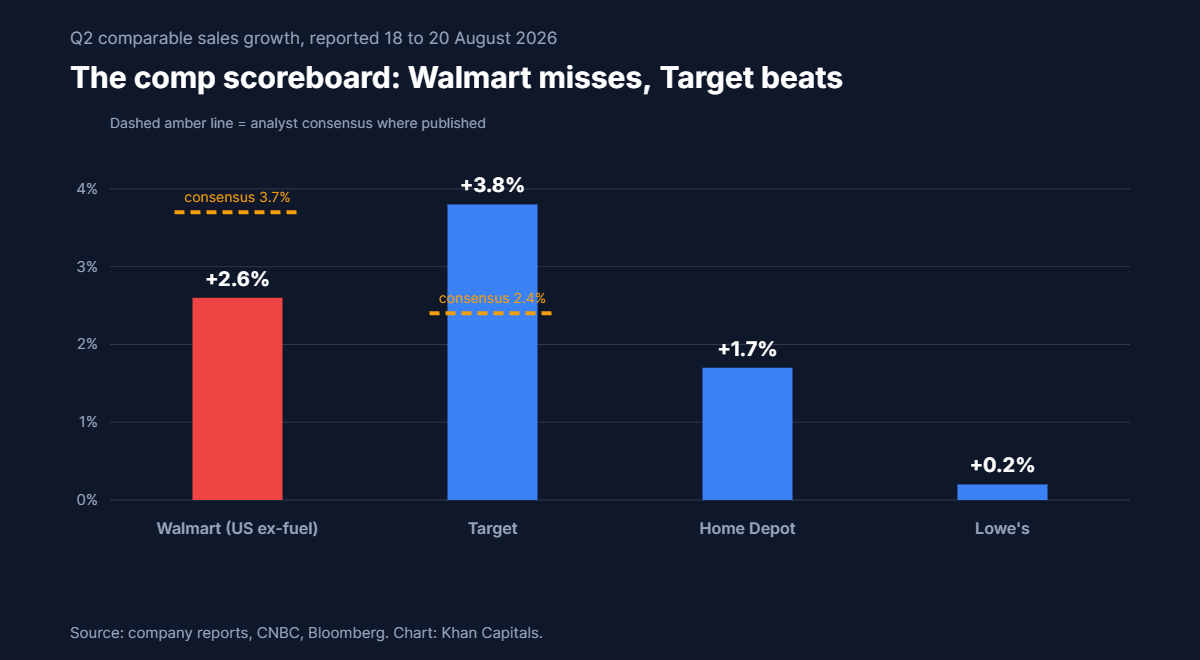
- Walmart posted its slowest US comparable sales growth in more than six years: up 2.6 per cent against the 3.7 per cent analysts expected, and the shares fell roughly 9 per cent, their worst day since May 2022, despite a headline beat and raised guidance.
- Target delivered the week’s cleanest demand signal: comparable sales up 3.8 per cent against a 2.4 per cent consensus, with traffic up 3.6 per cent, though $1.65 of its $4.11 reported earnings per share came from tariff refunds.
- Housing remains frozen: Home Depot’s comparable sales rose 1.7 per cent while Lowe’s managed just 0.2 per cent and cut its full-year outlook, the widest gap between the two in recent memory.
- Tariff refunds are the quarter’s great distortion: following the Supreme Court’s February IEEPA ruling, roughly $166 billion in duties is being returned to importers, with Walmart receiving about $2.9 billion and Target nearly $1 billion, flattering reported profits across the sector.
- The macro backdrop sharpened the reaction: Walmart’s print landed on a day the Dow fell 700 points as bond yields resumed rising, a week after July retail sales posted their largest monthly drop in over a year.
Part of: Tariffs and the Trade War — Khan Capital’s hub on trade policy and its market impact.
The Week the US Consumer Reported In
This was the retail earnings week the market had circled: tariff refunds distorting profits, a nervous bond market repricing multiples, and four bellwethers reporting straight into the consumer slowdown debate. Home Depot on Tuesday, Target and Lowe’s on Wednesday, and Walmart this morning gave investors their most detailed read on the American consumer since July retail sales fell 0.6 per cent, the largest monthly drop in over a year. The question going in was simple: would the companies confirm the slowdown the macro data described, or contradict it?
The answer was neither, and that is what makes this week worth careful reading. Demand is neither collapsing nor healthy; it is narrowing. Shoppers are still spending where value is obvious and deferring everywhere else. Meanwhile the sector’s reported profits are carrying an unusual passenger: billions of dollars of returned tariffs that have nothing to do with selling goods. Separating the consumer signal from the accounting noise is the real work of this earnings week, and the market spent it doing exactly that, often brutally.
Walmart: A Beat the Market Refused to Buy
On the surface, Walmart’s quarter looked strong. Revenue of $187.9 billion rose 5.9 per cent, ahead of consensus. Adjusted earnings of $0.81 per share beat the $0.74 expected. Operating income jumped 28.8 per cent, global e-commerce grew 23 per cent, and the company raised full-year guidance for both sales and earnings. In most quarters that combination produces a rally. Instead the stock fell roughly 9 per cent, its worst session in over four years.
The market’s objection sat one line below the headlines. US comparable sales excluding fuel rose 2.6 per cent, the slowest growth in more than six years and well short of the 3.7 per cent analysts expected. Management attributed much of the miss to pharmacy, where new federal prescription drug price negotiations are compressing prices; excluding that effect, comparable growth would have been around 3.4 per cent. But average spending per transaction declined, and the pharmacy explanation cuts both ways: it means a policy change, not a promotion, has removed a growth engine the company cannot easily replace.
There was also an earnings-quality question. Analysts spent the morning probing how much of the 28.8 per cent operating income jump reflected tariff refunds and how much reflected trading, and whether planned price investments will compress margins from here. When a company of Walmart’s quality beats, raises guidance and still loses a tenth of its value in a session, the message is not about the quarter that was reported. It is about how much of that quarter the market believes is repeatable.
Target: Traffic, Not Accounting
Target’s print on Wednesday was the mirror image: a quarter whose quality improved the closer you looked, up to a point. Comparable sales rose 3.8 per cent against a 2.4 per cent consensus, and crucially the growth came from traffic, up 3.6 per cent, rather than price. Store comparables rose 2.7 per cent, digital comparables 8.7 per cent, and same-day delivery grew more than 25 per cent. The company raised its full-year sales growth forecast to approximately 5 per cent. For a retailer that spent two years fighting traffic declines, a footfall-led beat is the strongest possible signal, and it extends a run that has the stock up more than 50 per cent this year.
The caveat is the income statement. Reported earnings per share of $4.11 doubled from $2.05 a year earlier, but $1.65 of it came from tariff refund benefits. Excluding refunds, earnings were $2.46 per share, a 20 per cent increase: genuinely strong, but a very different number. The shares slipped modestly as investors did that arithmetic. Target’s quarter was good; it simply was not twice-as-good, and the gap between the two is government money.
The Housing Freeze: Home Depot and Lowe’s Diverge
The home improvement pair told a third story: a housing market that remains, in Home Depot’s own words, in “frozen” conditions, with mortgage rates pinned near two-decade highs by the same bond selloff pressuring equity multiples. Home Depot grew sales 5.7 per cent to $47.86 billion with comparable sales up 1.7 per cent, and maintained full-year guidance. Customers are maintaining homes, not renovating them; the big-project recovery the sector has waited two years for did not arrive this quarter.
Lowe’s, reporting the next morning, showed what the same environment does to the weaker franchise. Comparable sales rose just 0.2 per cent, a 150 basis point gap to its rival that is the widest in recent memory, and management trimmed its full-year outlook to the bottom of every previously guided range. With a heavier skew to do-it-yourself customers and less exposure to professional contractors, Lowe’s is the purer read on discretionary household spending, and that read was flat.
The Retail Earnings Week Scoreboard
| Retailer | Revenue | Comparable sales | Versus expectations | Guidance |
|---|---|---|---|---|
| Walmart | $187.9bn, +5.9% | +2.6% US ex-fuel | Missed (3.7% expected) | Raised |
| Target | $26.5bn, +5.3% | +3.8% | Beat (2.4% expected) | Raised |
| Home Depot | $47.9bn, +5.7% | +1.7% | Broadly in line | Maintained |
| Lowe’s | $26.0bn, +8% | +0.2% | Soft | Trimmed |
History offers a useful frame for the divergence. In past consumer slowdowns, from 2008 through the inflation squeeze of 2022, the trade-down effect reliably shifted share towards value formats: discounters, warehouse clubs and off-price chains outperformed while mid-market discretionary retail absorbed the pain. This week fits the pattern with one twist. Walmart, usually the textbook trade-down winner, is being questioned precisely because its valuation already assumed that status, while Target, the mid-market operator the market had written off, is the one printing traffic gains. When the trade-down winner disappoints and the trade-down victim surprises, the tidy narrative of a consumer moving down the price ladder needs at least a footnote: execution, assortment and price perception are deciding winners within formats, not just between them.
The Tariff Refund Ledger
The quarter’s most unusual feature deserves its own accounting. When the Supreme Court ruled in February that the IEEPA tariff programme was unlawful, the Court of International Trade ordered US Customs to return roughly $166 billion in collected duties to the importers of record: the companies that paid at the border, which for consumer goods means retailers above all. Those refunds began flowing in the spring. Walmart has received about $2.9 billion and Target nearly $1 billion, and reporting this week suggests the largest retailers have already deployed around $5 billion of refunds in shareholder-friendly ways.
The distortion runs through every line of this week’s income statements, and it is the same money we flagged from the other side of the ledger in our coverage of the global bond selloff: the refunds that turned July’s federal customs revenue negative and helped produce a record monthly deficit are reappearing as retail profit. The transfer is also contested. A class action against Walmart argues that customers, who paid the tariff costs through higher prices in 2025, deserve a share of refunds the retailer now stands to keep. However that litigation resolves, investors should treat refund-driven earnings as what they are: a one-off return of capital from the government, not evidence of operating momentum. The cleanest way to read this quarter is to strip the refunds out, as Target helpfully disclosed and others did not.

| Company | Refund received | Reported effect | Underlying signal |
|---|---|---|---|
| Target | ~$1bn | $1.65 of $4.11 EPS | Ex-refund EPS $2.46, +20% |
| Walmart | ~$2.9bn | Flattered 28.8% operating income jump | Slowest US comps in 6+ years |
| Sector | ~$166bn ordered returned | ~$5bn deployed to buybacks and investor returns so far | One-off, contested in court |
Micro Meets Macro: Reconciling the Signals
A fortnight ago the macro data described a consumer stepping back: retail sales down 0.6 per cent in July, days after the first payrolls contraction in 53 months. This week’s earnings refine rather than refute that picture. Aggregate spending is still growing, but it is growing through value channels: traffic gains at Target, e-commerce and pickup at Walmart, off-price strength elsewhere. Average tickets are flat to down, big-ticket projects are deferred, and the growth that remains is concentrated among retailers who can win a price-focused shopper. As Bloomberg put it after Walmart and Target reported, consumers are still buying, for the right price.
The policy layer makes the reading harder. Pharmacy price negotiations shaved most of a point from Walmart’s comparables; tariff refunds inflated everyone’s earnings; and the tariffs themselves, which pushed prices up last year, are now being unwound through the courts. Very little in this quarter’s retail accounts is a clean read on demand. The traffic numbers are the closest thing, which is why Target’s 3.6 per cent footfall gain and Walmart’s declining ticket may be the two most honest data points of the week, pointing in opposite directions at a consumer who shows up more often and spends less each time.
There is also a channel story hiding in the aggregates. Walmart’s global e-commerce grew 23 per cent and Target’s digital comparables rose 8.7 per cent while store metrics softened, extending a migration that Amazon’s $3 trillion valuation already prices as permanent. Convenience spending, delivery and pickup, keeps growing through a slowdown that is squeezing in-store discretionary purchases. For the macro reader, that means the same consumer dollar is being counted in progressively lower-margin channels, which is one more reason reported retail profits are becoming a noisier proxy for consumer health than the traffic and volume figures underneath them.
Timing amplified everything. Walmart reported into a market already selling off, with the Dow finishing 700 points lower today, its worst session since late July, as long-dated Treasury yields resumed climbing, with yesterday’s Fed minutes, in which many participants assessed further tightening would likely be necessary if inflation did not decline, still weighing on sentiment. A defensive stock falling 9 per cent on its own earnings, on a day the index fell 1.3 per cent on rates, tells you how little patience this market has for ambiguity in either direction.
Investor Implications
Equities. The dispersion inside retail is now wider than the dispersion between retail and the market. Traffic-led franchises with value positioning (Target this quarter, the off-price group structurally) are being rewarded; anything reliant on ticket growth, discretionary big-ticket demand or housing turnover is being repriced. Walmart’s 9 per cent fall despite raised guidance is a warning about entry multiples across defensive quality: at more than 35 times forward earnings even after today’s fall, the market had priced flawless execution, and 2.6 per cent comps are not flawless. Earnings quality screens matter more than usual this season; any retailer’s beat should be checked for refund content before it is believed.
Fixed income. Retail’s message for rates investors is disinflationary at the margin: slowing ticket growth, price investments to come, and pharmacy deflation all argue against the further tightening some Fed officials still favour. That supports the front end of the curve, where September hike odds have already collapsed. The long end is a different matter: the same tariff refunds flattering retail earnings are widening the federal deficit, and this week showed the 30-year yield responds to fiscal arithmetic, not consumer softness.
Cross-asset. A narrowing consumer with policy distortion on both sides of the ledger argues for reading US growth through traffic, transactions and volumes rather than nominal sales for the next several quarters. Currency and commodity markets watching for American demand signals should discount headline retail figures accordingly. The cleanest cross-asset tell remains the two-year Treasury, which rallies on every piece of evidence that the consumer, 70 per cent of the economy, is downshifting.
What to Watch
- 28 August: July core PCE and personal spending, the first macro test of the value-narrowing thesis, alongside the BLS payrolls benchmark revision.
- Early September: August payrolls; after July’s contraction, a second negative print would move the Fed debate decisively.
- Mid-September: August retail sales, which will show whether July’s 0.6 per cent drop was a Prime Day distortion or a trend.
- Autumn court calendar: appeals and class actions over who keeps the IEEPA refunds; an adverse ruling would claw back a meaningful earnings tailwind.
Conclusion
This was the week the American consumer was supposed to be revealed, and instead the revelation was how hard revelation has become. Between pharmacy price controls, refunded tariffs and a bond market moving the ground under every multiple, the second quarter’s retail accounts are among the most distorted in years. Strip the noise and the picture is coherent: a consumer who still shows up but negotiates every basket, a housing complex waiting on rates that refuse to fall, and a sector whose reported profits owe billions to a court ruling rather than a till. The market’s verdicts were rational, rewarding traffic and punishing ambiguity. The next clean read arrives with August’s data; until then, treat every retail headline number, good or bad, as a claim to be audited rather than a fact to be traded.
Sources: CNBC (Walmart), Bloomberg, Target Corporation, CNBC (Target), CNBC (Lowe’s), Star Tribune, Bloomberg (consumer), Morgan Lewis.
Related Reading: This week’s results are best read against July’s 0.6 per cent retail sales fall, the macro print these earnings partly contradict. The refund story begins with the US tariff regime we covered in July, and the market backdrop is the global bond selloff now setting the discount rate for every retail multiple. For the Fed path these numbers feed into, see the collapse in September hike odds. For the fundamentals, start with how the retail sales report works and the IEEPA tariffs, explained. The starkest sequel came from Lululemon, whose refund-inflated beat met a 15 per cent sell-off. For the listing that put a public price on the tariff-era retail model, see Shein’s Hong Kong IPO. The tariff conflict has since widened north of the border; see the US-Canada trade war going kinetic.

Leave a Reply