
Khan Capitals | August 2026
Key Takeaways
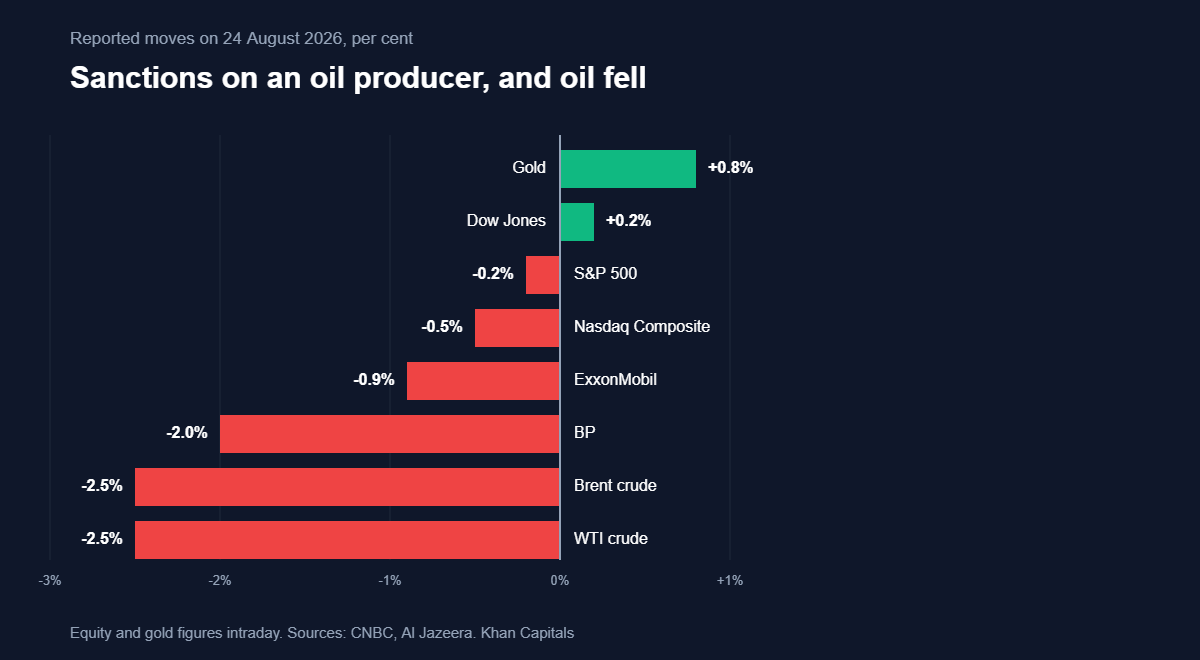
- Washington called it an economic D-Day; the oil market sold it. Treasury Secretary Scott Bessent announced sanctions spanning Iran’s oil and gas, aviation, shipping, technology, gold and digital asset sectors, with 60 named individuals and vessels. Brent fell 2.5 per cent to $92.06 and WTI 2.5 per cent to $84.89.
- Gold, not crude, took the escalation seriously. Bullion rose 0.8 per cent to $4,639.49 an ounce, its highest since mid-May, while the oil complex took profits after two weeks of gains. The two moves are not contradictory once you separate supply risk from systemic risk.
- The real instrument is secondary sanctions, not primary ones. Vessels linked to Singapore, China and Hong Kong were named, and the Treasury made explicit that Tehran’s remaining trading partners are now exposed. China takes roughly 90 per cent of Iran’s crude exports.
- The consumer bill is already visible. US average petrol has risen to $4.09 a gallon from $2.98 on 28 February, when the conflict began, a gain of more than 37 per cent that now sits inside every inflation print.
- Analysts are split on whether this is a step change or housekeeping. The Center for a New American Security’s Rachel Ziemba called the measures “mostly incremental” and aimed at intimidating third parties. Whether she is right is the question the price is answering.
Part of: The 2026 Iran Crisis, Khan Capital’s hub on the conflict, the oil market and the sanctions architecture around it.
A Declaration of Economic War, and a Falling Oil Price
Governments rarely use the language the Trump administration used on Monday. Standing at the Treasury Department, Scott Bessent described the latest US sanctions on Iran as an “economic D-Day”, unveiled alongside the continuing naval blockade of Iranian ports and roughly six months into a conflict that began on 28 February. He called on countries around the world to sever their remaining commercial ties with Tehran.
Brent crude fell 2.5 per cent.
That single fact is the most interesting thing about the day, and it is worth resisting the obvious explanations. This was not a market dismissing the news as irrelevant, nor one that had somehow failed to notice. Oil had risen for two consecutive weeks into the announcement, gaining roughly $5.50 a barrel on WTI in the prior week alone. The move on Monday was the unwinding of a position, not a verdict on Iran. When a market has spent a fortnight buying an expected event, the event itself is frequently the moment to sell.
Still, the sell-off would not have been possible had the package contained a genuine supply shock. It did not, and understanding why requires reading what was actually in it.
What Is Actually in the Package
The Treasury’s measures are unusually broad in sectoral coverage. They reach Iran’s oil and gas industry, its aviation sector, its shipping fleet, technology procurement, gold, and digital assets, and they name 60 specific individuals and vessels.
Each of those verticals maps to a documented evasion channel rather than to a headline. The shipping designations target the state-linked fleet that the Treasury says moves both crude and sensitive weapons components. The aviation designations target carriers alleged to move weapons, personnel and money to Iran’s regional partners. The technology measures aim at procurement for weapons programmes. Gold and digital assets are there because both have become the plumbing of sanctioned commerce: the Treasury has said Iran uses cryptocurrency to route transactions involving the Islamic Revolutionary Guard Corps, and gold to defend the rial.
Two elements matter more than the sector list. The first is the indefinite suspension of several long-standing general exceptions, including those covering academic exchange, personal remittances and certain sporting activity, with a wind-down deadline of 8 September. These are not revenue lines for the Iranian state. They are the humanitarian and civil-society carve-outs that have historically sat alongside sanctions programmes, and removing them signals an intent to make the pressure comprehensive rather than targeted. As Ziemba noted, measures of this kind “will have more effect on Iranians, not just the regime”.
The second is the explicit exposure of third parties to secondary penalties, which is where the economic force of the package actually lives.
Why US Sanctions on Iran Moved Gold, Not Oil
Monday produced an apparent contradiction: sanctions on a major oil producer sent oil down and gold up. Gold rose 0.8 per cent to $4,639.49 an ounce, its highest level since mid-May, while equities were mixed and the energy majors fell alongside crude.
| Asset | Move on 24 August | Level | What it is pricing |
|---|---|---|---|
| Gold | +0.8 per cent | $4,639.49/oz, highest since mid-May | Systemic and escalation risk |
| Brent crude | -2.5 per cent | $92.06/bbl | No incremental barrels removed |
| WTI crude | -2.5 per cent | $84.89/bbl | Profit-taking after a two-week rally |
| Dow Jones | +0.2 per cent | Intraday | Rotation, not risk aversion |
| S&P 500 | -0.2 per cent | Intraday | Mixed, with tariff news competing |
| Nasdaq Composite | -0.5 per cent | Intraday | Mixed, with tariff news competing |
| BP | -2.0 per cent | Intraday | Direct beta to the crude move |
| ExxonMobil | -0.9 per cent | Intraday | Direct beta to the crude move |
The resolution is that oil and gold were pricing different questions. Oil prices the physical balance: how many barrels reach how many refineries this quarter. On that measure the package changed almost nothing, because the barrels it targets were already constrained by the blockade and by the sanctions architecture built up since 2018. You cannot remove supply that has already been removed.
Gold prices something else: the probability that the dispute widens, that the financial system is used more aggressively as a weapon, and that the resulting fragmentation is durable. Every extension of secondary sanctions gives more countries a reason to hold reserves in an asset no one can freeze. Gold’s move was small, but it was in the direction that treats this as a structural development rather than a market event. Readers who followed our work on the war-risk insurance market repricing the Strait of Hormuz will recognise the pattern: the instruments that respond first to this conflict are rarely the obvious ones.
The Bill That Has Already Arrived
While the sanctions debate proceeds in the language of pressure and leverage, a more concrete number has been accumulating at American filling stations. The average US price for a gallon of petrol stands at $4.09, against $2.98 on 28 February when the conflict began. That is an increase of more than 37 per cent in under six months.
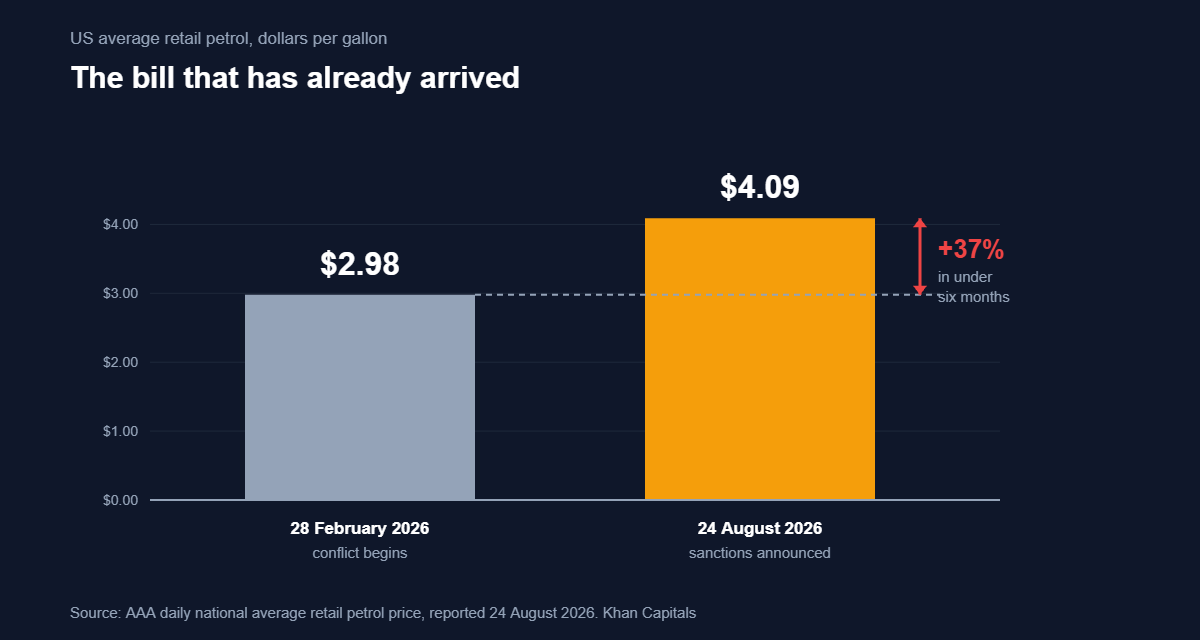
This matters analytically for two reasons. First, energy is the component of the consumer basket with the shortest transmission lag and the highest salience: households observe it several times a month and it shapes inflation expectations disproportionately. Second, it complicates monetary policy at a moment when the policy path was already contested. We wrote in July about a Fed that produced its most hawkish vote in a decade, and again this month about the eight-day repricing that halved September hike odds. A pump price up 37 per cent since February sits awkwardly with the more benign reading of that debate.
It also has a political dimension that investors should track without taking sides on it. Polling reported around the announcement suggested roughly a third of Americans supported the war, 28 per cent approved of the administration’s handling of Iran, and 32 per cent approved of its handling of the economy. In the same period, one survey showed the opposition party narrowly preferred on economic management for the first time in about a decade. Ahead of midterm elections, that configuration is a constraint on how long an economically costly campaign can be sustained, whichever party is in office. The relevant point for markets is not who benefits, but that the policy has a domestic clock attached to it.
The China Problem at the Centre of It
Roughly 90 per cent of Iran’s crude exports go to China, which bought about 1.4 million barrels a day in 2025. Any sanctions programme that seriously intends to eliminate Iranian oil revenue must therefore either persuade or penalise Chinese buyers, refiners, insurers and shipowners. There is no third route.
Monday’s designations gestured at this by naming vessels based in or associated with Singapore, China and Hong Kong, and by stating plainly that trading partners are exposed to secondary penalties. But naming individual ships is a very long way from sanctioning a large Chinese refiner or a major Chinese bank, and the gap between those two actions is the entire question. The first is enforcement housekeeping against a shadow fleet that reflags and reorganises continuously. The second would be a direct confrontation with the world’s second-largest economy, at a moment when Washington is simultaneously managing a broader trade agenda and announced fresh automotive tariffs on Canada the same day.
This is why the market’s muted reaction is more defensible than the rhetoric suggests. Investors are not pricing the announcement; they are pricing the probability that Washington follows it to the only conclusion that would actually stop the oil moving. On the evidence of Monday, that probability did not change much.
Incremental, or an Inflection?
The analytical community split cleanly, and both sides are arguing from real evidence.
Ziemba at the Center for a New American Security took the sceptical view, describing the measures as “mostly incremental” and part of an effort “trying to intimidate remaining trading partners into cutting ties”. She characterised much of the announcement as signalling aimed at third parties rather than new binding constraint. The market agreed with her on Monday.
The contrary case came from Tehran-based analyst Peiman Salehi, who observed that “Iran seems to have much less room than it did in previous years to simply work around sanctions”. That is a claim about cumulative effect rather than marginal effect, and it deserves weight. Evasion capacity is not rebuilt quickly. The successive campaigns of the past two years, from the 30 individuals and vessels designated in February 2025, to the 29 shadow-fleet vessels named that December, to the April 2026 action against the shipping network associated with Mohammad Hossein Shamkhani and a seizure of close to half a billion dollars from shadow banking channels, have each removed specific intermediaries. Sanctions of this type work by attrition, and attrition is invisible until it is not.
Both propositions can hold simultaneously. Monday may have added little on its own while the accumulated structure is genuinely biting. That combination, incremental announcements atop a tightening base, is precisely the configuration in which markets are most prone to being surprised, because each individual headline justifies inaction.
The Channel That Would Reprice Everything
If this package eventually matters to asset prices, the mechanism is unlikely to be the sanctions themselves. It will be the response to them.
John Deal of Post Oak Group set out the transmission chain with unusual precision: if sanctions “provoke Iranian retaliation against Gulf shipping, materially reduce oil exports, or cause insurers and shipping companies to avoid the region, then Americans could feel it very quickly through gasoline, diesel, airfares, freight costs and ultimately inflation”.
The third item in that list is the one to watch, because it does not require any state to act. Roughly a fifth of the world’s seaborne oil moved through the Strait of Hormuz before Iran constrained the route, and the decision to sail is made by a small number of underwriters pricing war risk, not by governments. An insurance market that withdraws cover achieves in days what a sanctions programme takes years to accomplish, and it does so on both sides of the ledger, restricting Iranian and Gulf cargoes alike. We examined that mechanism in detail when transits halved with no fleet blockading the strait, and it remains the most direct route from a political headline to a physical shortage.
| Scenario | Trigger | Oil implication | Cross-asset read |
|---|---|---|---|
| Attrition continues | Enforcement grinds on; no Chinese majors designated; no retaliation | Range holds; Brent trades on inventories rather than headlines | Gold drifts; energy equities track crude; inflation pressure persists but does not accelerate |
| Enforcement escalates | A large Chinese refiner, bank or insurer is designated | Genuine barrels at risk; curve backwardates | Gold higher, US-China trade relationship strained, freight and insurance costs rise |
| Retaliation or insurance withdrawal | Action against Gulf shipping, or underwriters pull cover | Fastest repricing available; supply constrained within days | Broad risk-off, energy outperforms, headline inflation forecasts revised upward |
Investor Implications
Commodities and energy equities. Monday illustrated a distinction worth holding onto: sanctions headlines are not supply events, and treating them as interchangeable has been an expensive habit this year. The oil price is currently governed by the blockade, by insurance availability and by Chinese purchasing behaviour, none of which changed on Monday. Energy equities fell with crude rather than rallying on geopolitical risk, which is the rational response to an announcement that removed no barrels. The asymmetry sits in the retaliation scenario, which is not in the price.
Fixed income and inflation-linked assets. A 37 per cent rise in pump prices since February is already in realised inflation and will keep headline prints above core for as long as it persists. That is uncomfortable for a Federal Reserve arguing about whether to hike, and it arrives while long-dated government bonds are under their own pressure, as we set out in the global bond selloff. The combination of an energy-driven headline and a heavy long end is the one that makes breakevens interesting and duration uncomfortable.
Cross-asset. Gold’s quiet new high since mid-May is the signal most worth logging from Monday. The steady expansion of secondary sanctions is an argument for reserve diversification that operates independently of any single conflict, and it has been a persistent bid under bullion through this year. Meanwhile the equity market’s ability to shrug at an “economic D-Day” while simultaneously absorbing new automotive tariffs reflects a tape that has become practised at discounting policy noise, a habit that works until one of the headlines turns out to be a supply event.
What to Watch
- 8 September, the wind-down deadline. Organisations operating under the suspended general exceptions must cease by this date. Compliance behaviour will indicate how broadly banks and institutions are interpreting the new perimeter.
- The next designation round, and whether it names a Chinese institution. The single most informative escalation marker available. Designating a vessel is routine; designating a refiner or a bank is a different policy.
- Jackson Hole, 27 to 29 August. The Federal Reserve’s symposium falls this week, with an energy-driven headline inflation problem sitting underneath the policy debate.
- War-risk insurance quotes for Gulf transits. The fastest available indicator of physical disruption, and one that moves before any official data.
- Chinese crude import data for August and September. The test of whether secondary-sanction threats change buying behaviour or merely reroute the paperwork.
Conclusion
The distance between “economic D-Day” and a 2.5 per cent fall in Brent is the distance between announcing pressure and applying it. Monday’s package is genuinely broad in its sectoral reach and genuinely aggressive in removing humanitarian carve-outs, and it may well accelerate an attrition that is already working. What it did not do is remove a single barrel that was still reaching a refinery, which is why the market that trades barrels declined to react.
The more useful framing is that this announcement was a message to Beijing, Singapore and Hong Kong rather than to Tehran, and its effect will be measured in the compliance decisions of foreign refiners, insurers and banks over the coming months rather than in Monday’s tape. Two indicators will reveal the answer well before the official data: the price of insuring a Gulf transit, and whether the next designation list contains a name large enough to make China respond. Until one of those moves, the market is entitled to its scepticism, and the $4.09 at the pump remains the clearest measure of what this conflict has cost so far.
Frequently Asked Questions
What do the new US sanctions on Iran actually cover?
They span Iran’s oil and gas industry, aviation, shipping, technology procurement, gold and digital assets, and name 60 specific individuals and vessels. They also indefinitely suspend several long-standing general exceptions, including those for academic exchange, personal money transfers and certain sporting activities, with a wind-down deadline of 8 September. Crucially, they restate that Iran’s remaining trading partners are exposed to secondary penalties.
Why did the oil price fall on sanctions against an oil producer?
Because the announcement did not remove barrels that were still reaching refineries. Iranian exports were already constrained by the naval blockade and by sanctions built up since 2018, so the package added little to the physical balance. Oil had also risen for two consecutive weeks into the announcement, so the move partly reflected profit-taking on an anticipated event rather than a judgement about Iran.
What are secondary sanctions and why do they matter here?
Primary sanctions restrict what American individuals and companies may do. Secondary sanctions threaten to penalise foreign parties, wherever they are based, for dealing with the sanctioned country. Because roughly 90 per cent of Iran’s crude exports go to China, the effectiveness of this programme depends almost entirely on whether foreign refiners, banks, shipowners and insurers judge the secondary-sanction risk to be real.
How much have the conflict and sanctions cost US consumers?
The most visible cost is at the fuel pump. The average US price for a gallon of petrol has risen to $4.09 from $2.98 on 28 February, when the conflict began, an increase of more than 37 per cent. Because energy feeds through quickly to headline inflation and shapes household inflation expectations, that increase carries weight in the monetary policy debate.
What would make markets take the sanctions seriously?
Three developments would change the picture: designation of a large Chinese refiner, bank or insurer rather than individual vessels; Iranian retaliation against Gulf shipping; or a withdrawal of war-risk insurance cover for regional transits. The third requires no government action at all and would constrain supply within days, which is why insurance quotes are a faster indicator than official trade data.
Sources: Al Jazeera, CNBC, US Department of the Treasury, Al Jazeera on the China dimension, Center for a New American Security, AAA fuel price data.
Related Reading: This package lands on top of the escalation we covered when the naval blockade of Iranian ports went indefinite, and it works through the channel described in war-risk insurance repricing the Strait of Hormuz. For the monetary policy backdrop, see the Fed’s triple dissent and the collapse in September hike odds; for the bond market absorbing all of it, the global bond selloff. For the fundamentals, start with how sanctions actually work and the difference between Brent and WTI. The stage all of this sets is examined in our preview of Warsh’s first Jackson Hole keynote. The same escalation is now strangling food supply: see the Black Sea grain crisis. The metal’s answer to all of it is charted in the gold price rally. For the latest, see Strait of Hormuz oil flows hit a wartime record as Brent neared $95.

Leave a Reply