
Khan Capitals | October 2026
Key Takeaways
- The build-out has its own financial system. The AI data centre expansion is increasingly funded not on hyperscaler balance sheets but through a purpose-built machine of joint ventures, special purpose vehicle debt, private credit and, soon, listed REIT wrappers for retail capital.
- Hyperion is the blueprint. Meta’s five-gigawatt Louisiana campus is held in a joint venture in which Blue Owl owns 80 per cent and Meta 20 per cent, financed with roughly 27.3 billion dollars of SPV debt that sits off Meta’s balance sheet, a structure industry awards have just crowned deal of the year.
- Record capital is queuing to fund it. Private infrastructure funds closed a record 221 billion dollars in 2025, Brookfield’s second Global Transition Fund closed at 20 billion dollars as the largest clean energy fund ever raised, and lenders report a wave of demand to finance every physical layer of the build-out.
- The next wrapper is retail. Blue Owl is reported to be planning a public data centre REIT, extending the packaging of AI infrastructure from private funds to listed vehicles that any investor can hold.
- Political risk has arrived first in the states. New York imposed the first statewide moratorium on new hyperscale data centre permits in July and Texas agencies reportedly paused approvals pending audits in August, while one tracker counts more than 500 US jurisdictions now blocking or restricting new facilities.
Part of: The AI Infrastructure Supercycle: Khan Capital’s hub on the capital cycle behind the AI build-out.
A Build-Out That Outgrew the Balance Sheet
The defining fact of the AI capital cycle in late 2026 is that the companies doing the building no longer want to carry the buildings. Data centre financing has evolved, in roughly eighteen months, from a line inside hyperscaler capital expenditure into a free-standing asset class with its own structures, lenders, funds and now political opponents. The numbers involved have outgrown even the largest corporate balance sheets: when a single campus costs as much as a mid-sized utility, the question of who holds the asset, and who holds the risk, becomes the story.
The answer the market has settled on is a machine with four moving parts: joint ventures that move assets off the sponsor’s balance sheet, special purpose vehicle debt placed with private credit and insurance capital, infrastructure funds raising record amounts to hold the equity, and listed wrappers being prepared to pass the exposure on to retail investors. Each part is individually conventional. Assembled at this scale and speed, they are something new, and the bond market’s October stress test was the first sign that the machine’s output is now large enough to move the whole credit market.
Hyperion: The Blueprint Everyone Is Copying
The reference transaction is Hyperion, Meta’s five-gigawatt campus in Louisiana. Rather than build it as corporate capex, Meta placed the project in a joint venture in which Blue Owl holds 80 per cent and Meta 20 per cent, with the project issuing roughly 27.3 billion dollars of special purpose vehicle debt that does not consolidate onto Meta’s balance sheet. Meta anchors the structure with long-term capacity commitments; the JV owns the asset; the debt sits against the project. The financing was recognised this month at the TMT Finance Awards as both data centre debt deal and M&A deal of the year, per Latham & Watkins, a sign of how quickly the template has become the industry standard to beat.
Meta’s own language makes the motive plain. The company’s director of corporate finance told an industry audience this month that it is, in his words, strategically incredibly important to secure access to capacity as quickly as possible, while keeping what he called long-term flexibility, per CFO Brew. Flexibility is the polite word for optionality: if AI demand compounds as hoped, Meta controls the capacity; if it does not, the equity and the debt belong mostly to someone else. The hyperscaler keeps the upside of the compute and transfers a large share of the asset risk.
| Hyperion structure | Detail |
|---|---|
| Asset | ~5 GW AI data centre campus, Louisiana |
| Ownership | Blue Owl 80%, Meta 20% (joint venture) |
| Debt | ~$27.3bn special purpose vehicle debt, off Meta’s balance sheet |
| Revenue support | Long-term Meta capacity commitments |
| Recognition | TMT Finance data centre debt deal and M&A deal of the year, October 2026 |
Why Private Credit Wants the Other Side of the Trade
For every sponsor shedding an asset there is a lender reaching for it. Specialist publications report lenders being met with a wave of demand for financing every physical aspect of the build-out, from land and shells to power infrastructure and the chips themselves, per Infrastructure Investor. The appeal is the shape of the cash flow: long-dated, contracted against investment-grade counterparties, secured on hard assets, and available in sizes that let a direct lender deploy a billion dollars in one underwrite rather than a hundred small ones.
The risk is the same thing seen from below. The contracted counterparty is strong, but the asset’s residual value depends on compute demand a decade out, on power prices, and on chips whose economic life keeps shortening. Anthropic’s IPO prospectus put 518 billion dollars of compute commitments into audited print last month, and the October credit repricing, with CoreWeave bonds trading towards 16 per cent yields, showed the market beginning to tier borrowers by balance sheet rather than by story. The machine keeps running; the price of running it is no longer uniform.
Record Funds, and the Retail Wrapper Coming Next
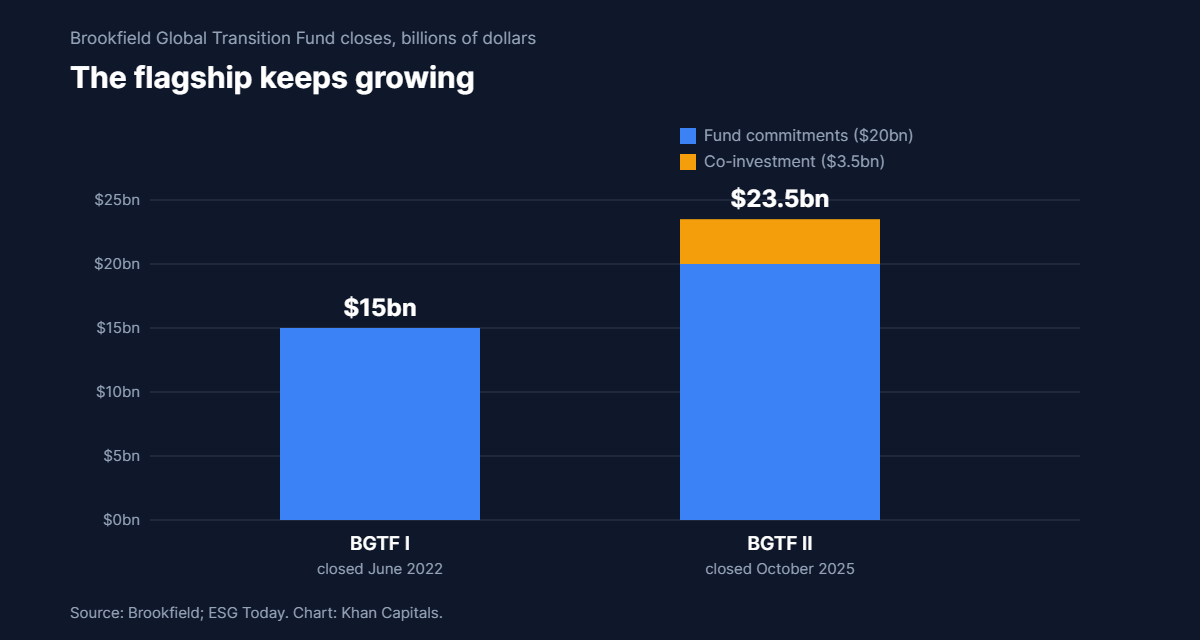
The equity side of the machine is being filled by the largest infrastructure fundraising on record. Private infrastructure funds closed 221 billion dollars in 2025, according to Hamilton Lane, and the flagship vehicles keep getting bigger: Brookfield’s second Global Transition Fund closed at 20 billion dollars, the largest private fund ever raised for the energy transition, against 15 billion dollars for its 2022 predecessor, with a further 3.5 billion dollars of co-investment alongside, per ESG Today. Power is the binding constraint on the data centre build-out, which makes energy transition capital and AI infrastructure capital increasingly the same money.
The final stage of any financing machine is distribution, and it is arriving on schedule. Blue Owl, having taken the private side of Hyperion, is reported by The Real Deal to be planning a public data centre REIT, joining a queue of alternative managers packaging the build-out for listed markets. Retail investors who sat out the private vintage will be offered the same assets in tradeable form. The history of infrastructure cycles suggests paying close attention to which assets are selected for the public wrapper, and at what valuation, because distribution usually accelerates when sophisticated holders want liquidity.
The First Political Risk Arrived in the States
While the capital stack was being assembled, the politics moved first at state level. In July, New York’s governor signed an executive order pausing discretionary environmental permits for new data centres of 50 megawatts or more for up to a year, the first statewide freeze in the country, alongside proposals to repeal sales tax exemptions for hyperscale facilities, per the Commercial Observer. In August, Texas agencies were reported to have halted new approvals pending audits, a striking turn in the state that courted the industry hardest. One industry tracker counts more than 500 US jurisdictions now blocking or restricting new facilities, with at least a dozen states weighing moratoria or strict conditions.
For financiers the moratoria matter less as lost sites than as a repricing of assumptions. Underwriting models for SPV debt and fund equity embed construction timelines, power purchase terms and local tax treatment; each is now a political variable. Existing permitted capacity becomes scarcer and more valuable, which flatters the assets already financed, while the pipeline’s cost of capital rises. Infrastructure investors have seen this sequence before, in wind, in solar, in pipelines: the capital arrives first, the backlash second, and the returns are made or lost in the gap between them.
| Jurisdiction | Action | Status |
|---|---|---|
| New York | Executive order pausing permits for data centres of 50 MW+ for up to a year; sales tax exemption repeal proposed | Signed 14 July 2026 |
| Texas | Agencies reported to have halted new approvals pending audits | Reported August 2026 |
| US-wide | 500+ jurisdictions blocking or restricting new facilities, per industry tracker; 12+ states weighing measures | Ongoing |
What the Machine Does to Risk
Off balance sheet is not off the hook. The SPV structure moves data centre risk out of hyperscaler accounts and into funds, credit vehicles and, soon, listed REITs, which means into pensions, insurance portfolios and retail savings. That is what financial systems are for, and there is nothing improper in it. But it changes who absorbs a disappointment. If AI demand underwhelms, the hyperscalers’ earnings suffer; the owners of the equity and debt in the machine suffer first and more. The parallel with previous cycles is imperfect but instructive: securitisation did not create the risk in housing, it distributed it to holders who believed the contracted cash flows made them safe.
What keeps the current machine sturdier than that comparison is the quality of the anchor tenants, investment-grade companies with enormous cash flows, and the genuine scarcity of power and permitted land, scarcity the moratoria are making more acute. What should keep holders attentive is concentration: the same handful of counterparties anchor most of the structures, the same few arrangers build them, and the fast money has already positioned for the possibility that the cycle’s assumptions get marked down together.
Investor Implications
Equities. The machine flatters hyperscaler earnings quality in the near term: capacity arrives while capex optics improve, which supports the multiple. The listed beneficiaries extend beyond the anchors, to the alternative managers earning fees on every layer, the utilities and power developers selling scarcity, and eventually the REIT vehicles themselves. The discipline is to distinguish businesses earning fees on the machine from businesses holding its residual risk; this week’s third-quarter results from the chip complex and the hyperscalers will show how much of the build-out is still being carried on corporate books.
Fixed income and private credit. SPV data centre paper now competes with corporate bonds for the same allocators, at spreads that October’s repricing has made more honest. The tiering the bond market applied to AI borrowers, strong balance sheets through weak ones, will be applied to project debt as structures season. Contracted cash flow against an investment-grade anchor is good collateral; residual value on specialised assets with shortening technology lives is the part of the underwrite that deserves the scepticism.
Private markets. Record dry powder meeting a politically constrained pipeline argues for discipline on entry price rather than enthusiasm for the theme. Permitted, powered sites are appreciating; greenfield assumptions are cheapening. For allocators offered the coming retail wrappers, the governing question is the oldest one in distribution: why is this asset being sold to me now, and at whose valuation?
What to Watch
- 28 to 29 October: third-quarter results from the largest hyperscalers, with capital expenditure guidance and any new off-balance-sheet structures the figures reveal.
- Q4 2026: the reported Blue Owl public data centre REIT, its asset selection and pricing, and any peers following it to market.
- Through winter: the New York permit pause’s first anniversary clock, the outcome of the Texas audits, and whether further states convert proposals into moratoria.
- Ongoing: spreads on SPV and AI-linked credit, the cleanest live measure of whether the machine’s cost of capital is rising.
Conclusion
Every great build-out eventually builds its own financial system, and the AI cycle now has one: joint ventures to hold the assets, SPV debt to fund them, record infrastructure funds to own the equity and listed wrappers to distribute the exposure. The machine is rational at every step, anchored by the strongest counterparties in corporate history, and it is moving risk steadily from the companies with the most information about AI demand to the holders with the least. That is not a prediction of failure; securitised plumbing can run for decades. It is a description of where the next cycle’s losses, if they come, will sit. The bond market began pricing that question this month. The moratoria ensure the politics will price it too.
Sources: Global Data Center Hub on the Hyperion financing; Latham & Watkins; CFO Brew; Infrastructure Investor; ESG Today; The Real Deal; Commercial Observer; With Intelligence infrastructure outlook.
Related Reading: The credit market’s verdict on this machine arrived in The AI Debt Selloff: Eight Red Days for Chips and a Bond Market That Said No, and the fast money’s response in The Hedge Fund Deleveraging: The Week Every Strategy Fell at Once. The commitments being financed are itemised in The Anthropic IPO Prospectus: A $2 Trillion Question Priced in $42 Billion of Losses, while TSMC’s record third quarter shows the demand side still compounding. For the fundamentals, start with what private credit is and capex versus opex. The third phase arrived days later: The SpaceX Apollo Chip Financing: $40 Billion and a New Asset Class.

Leave a Reply