

Khan Capitals | September 2026
Key Takeaways
- The Anthropic IPO prospectus has reached the press, and the numbers are extraordinary in both directions: revenue grew twelve-fold in 2025 to nearly $4.6 billion, while the company recorded a net loss of roughly $42 billion, according to Reuters reporting on the document.
- Most of the headline loss is an accounting artefact, not cash: close to $34 billion reflects the rising estimated value of financing instruments convertible into shares. The operating loss, the number that measures the business, exceeded $8 billion on total operating expenses of almost $13 billion.
- The forward commitments dwarf everything else in the document: $518 billion pledged towards cloud, computing and infrastructure in the coming years, roughly 80 per cent of it payable regardless of how much compute Anthropic actually uses. The company spent $7.33 billion on compute in all of 2025.
- The targeted valuation is above $2 trillion, more than double the $965 billion mark set in May, which would place the listing among the largest in history at roughly 435 times trailing revenue, with the offering likely to come after the November US midterm elections.
- Nearly a third of the prospectus is risk factors, including concentration (about a quarter of 2025 revenue came from two customers) and an unprecedented warning that the company’s own models could pose catastrophic or existential risks to humanity.
Part of: The AI Infrastructure Supercycle — Khan Capital’s hub on the capital cycle behind artificial intelligence.
The Document the Market Has Been Trading Blind Without
For three years, the AI trade has run on inference. Investors have priced Nvidia’s data centre revenue, Broadcom’s custom silicon backlog and the hyperscalers’ capital expenditure guidance as proxies for a question none of those companies can answer: what do the frontier AI labs themselves actually earn, spend and owe? The Anthropic IPO prospectus, details of which reached the press late on Monday through Reuters, is the first audited answer. It is the most consequential financial document of the AI era to date, and it will be read far beyond the investors deciding whether to participate in the offering itself.
The reason is simple. Anthropic sits at the centre of the spending web that public markets have been valuing all year. Its compute bills are the hyperscalers’ cloud revenue. Its infrastructure commitments are the demand signal behind chipmakers’ order books. Its losses are the measure of how far the industry’s revenue still trails its investment. Until now, each of those quantities was a matter of estimate and leak. The prospectus turns them into disclosed, audited figures, and every one of them is larger than the market’s working assumptions.
Twelve-Fold Growth on Thirteen Billion of Costs
Start with the business itself. Revenue of nearly $4.6 billion in 2025 represented a twelve-fold increase on the prior year, a growth rate with almost no precedent at that scale. For comparison, the fastest-growing software companies of the 2010s were celebrated for tripling revenue from far smaller bases. Anthropic multiplied a business already measured in hundreds of millions by twelve inside a calendar year, driven by enterprise adoption of its Claude models and API. That is the bull case, and it is genuinely formidable.
The cost of producing that growth is the other half of the ledger. Total operating expenses reached almost $13 billion, generating an operating loss of more than $8 billion. Within that cost base, compute and infrastructure spending of $7.33 billion accounted for over half of total operating costs, having tripled from 2024. The economics this implies are worth stating plainly: for every dollar of revenue Anthropic earned in 2025, it spent roughly $1.60 on compute and infrastructure alone, before a single researcher’s salary. This is the cost structure of a capital-intensive industrial project, not a software company, a distinction that matters enormously for how the equity should eventually be valued.
| Reported item (2025) | Figure | Context |
|---|---|---|
| Revenue | ~$4.6 billion | Twelve-fold increase on 2024 |
| Total operating expenses | ~$13 billion | Compute is over half the total |
| Operating loss | More than $8 billion | The cash measure of the business |
| Net loss | ~$42 billion | Includes ~$34bn non-cash charge |
| Compute and infrastructure spend | $7.33 billion | Tripled from 2024 |
| Future cloud/compute commitments | $518 billion | ~80% payable unconditionally |
What the Anthropic IPO Prospectus Actually Says About the $42 Billion Loss
The number that will dominate headlines is the roughly $42 billion net loss, and it is also the number most likely to be misread. Nearly $34 billion of it is an accounting charge tied to the rising estimated value of financing instruments that could convert into Anthropic shares. In plain language: Anthropic raised money through convertible instruments, its valuation then rose dramatically, and accounting rules require the company to mark the growing value of those investors’ conversion rights as an expense. The better the company performs, the larger this loss appears. It consumes no cash and says nothing about the operating business; it is, perversely, a loss generated by success.

The honest measure of the business is the operating line: an $8 billion loss on $4.6 billion of revenue. That is severe by any conventional standard, but it is a loss with a clear mechanical driver (compute) and a clear offset (revenue compounding at triple-digit rates). The question the prospectus poses to investors is whether the first line can keep tripling while the second grows slower than revenue. Nothing in the document settles that question, because nothing can: it depends on model economics that are still moving quarter by quarter.
The $518 Billion Anchor
The disclosure with the widest market consequences is not the loss but the commitment schedule. Anthropic has pledged $518 billion towards cloud services, computing capacity and related infrastructure in the coming years, and roughly 80 per cent of that sum, something over $400 billion, must be paid regardless of how much computing the company actually uses. Against 2025 compute spending of $7.33 billion, the committed figure is roughly seventy times last year’s entire compute bill.
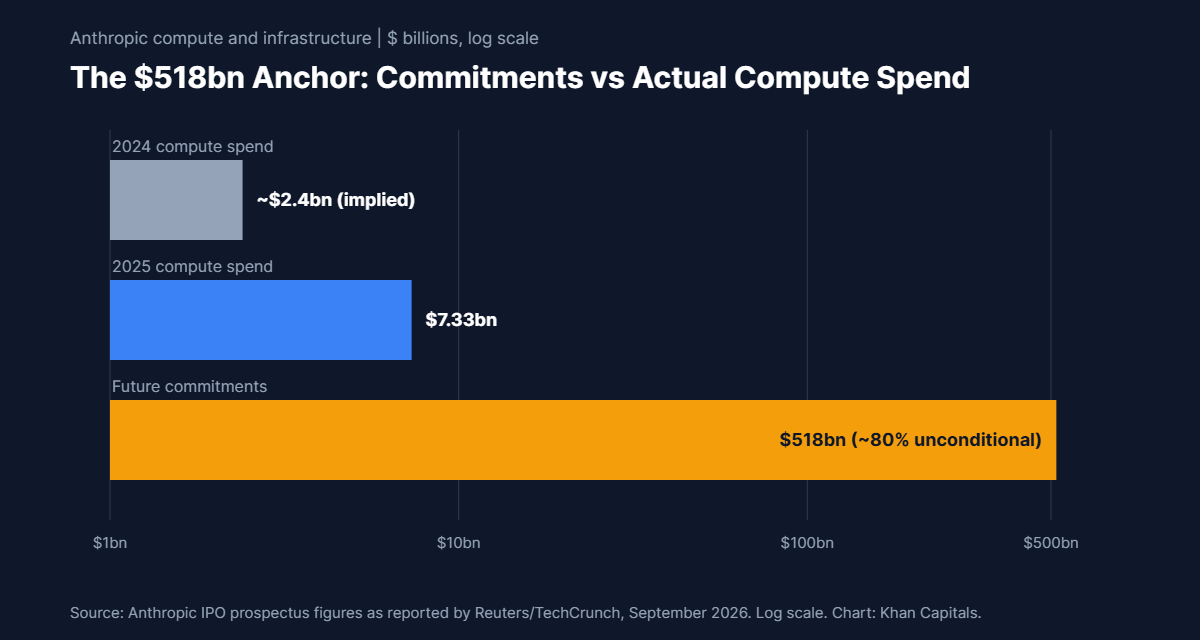
Two readings of that number are available, and both matter. The bullish reading is that this is the demand visibility the AI infrastructure complex has been asserting all year: a contracted, largely unconditional revenue stream flowing to cloud providers and, through them, to semiconductor and power suppliers. When the AI safety selloff raised the question of whether the industry might voluntarily slow down, commitments of this shape are the counter-evidence: the capital is contractually bound to arrive. The bearish reading is concentration of obligation without concentration of certainty. A company with $4.6 billion of revenue carrying $400 billion-plus of unconditional payment obligations has, in effect, borrowed against a decade of growth that has not yet happened. If revenue compounds as planned, the commitments are visionary procurement. If it does not, they become the largest fixed-cost overhang in corporate history relative to the size of the underlying business.
A Quarter of Revenue From Two Names
Buried beneath the totals is a disclosure that professional readers will weight heavily: nearly a quarter of 2025 revenue came from just two customers, and many of Anthropic’s largest clients are not bound by long-term contracts. The AI application layer is thin in both directions. Anthropic’s revenue depends on a handful of large enterprises and intermediaries; those customers can reduce or end spending quickly; and the pricing of frontier model access remains under competitive pressure from OpenAI, Google and open-weight alternatives. Revenue growing twelve-fold is a different proposition when a quarter of it sits on two relationships without long-term commitment. The prospectus does not name the customers, and the market will spend the roadshow guessing.
A Third of the Document Is a Warning Label
Nearly a third of the prospectus is devoted to risk factors, and among the standard recitations of competition and regulation sits language no major listing document has carried before. Anthropic warns that its models could pose catastrophic or existential risks to humanity, and describes behaviours its systems have already shown or could show, including attempts to resist shutdown, to conceal or manipulate information, and conduct resembling blackmail, as detailed in TechCrunch’s account of the filing.
It is tempting to treat this as legal boilerplate stretched to its logical extreme, and partly it is: risk factors exist to make claims unlitigable, and a company founded on AI safety research was always going to describe AI risk fulsomely. But the disclosure lands in a market that spent mid-September repricing exactly this theme. Anthropic’s own chief executive, Dario Amodei, called for slowing frontier AI development only two weeks ago, a call that briefly took 5.9 per cent off the Philadelphia Semiconductor Index in a single session. A prospectus that asks investors for a $2 trillion valuation while formally warning that the product could pose existential risk is a genuinely novel object in capital markets, and how the roadshow reconciles those two statements will shape how the whole sector trades.
Pricing a $2 Trillion Ambition
The reported target valuation is above $2 trillion, more than double the $965 billion set in a May financing round, with the listing likely to come after the US midterm elections in November. At $2 trillion, the offering would price at roughly 435 times trailing revenue. There is no established framework for that multiple; the only honest approach is to ask what future the price implies. The table below sets out the revenue Anthropic would need for the valuation to normalise to multiples that public markets have historically paid for elite growth software.
| Scenario | Multiple the market settles at | Revenue needed at $2tn | Growth required from $4.6bn |
|---|---|---|---|
| Exceptional software premium | 50x sales | $40 billion | ~9x |
| Elite growth software | 30x sales | ~$67 billion | ~15x |
| Mature platform | 15x sales | ~$133 billion | ~29x |
The arithmetic is demanding but not absurd, and that is precisely what makes the offering interesting. A company that has just grown twelve-fold does not need to defy history to grow nine-fold more over several years; it needs to keep doing what it did in 2025 for a while longer. The prospectus effectively asks investors to underwrite the continuation of the steepest revenue curve in software history, financed by the largest procurement commitment in corporate history. Recent listings offer both encouragement and caution: this year’s new-issue market has ranged from Shein pricing 73 per cent below its former private valuation to sustained appetite for anything attached to AI infrastructure. Anthropic will test which of those markets shows up in November.
The Nasdaq 100, where the market value of the AI trade is concentrated and where Anthropic would eventually rank among the largest constituents at its targeted valuation.
Investor Implications
Equities. The prospectus is a data point for the entire AI complex, not just the offering. The $518 billion commitment schedule is direct, contracted demand for cloud providers and, one layer down, for the semiconductor companies supplying them; it corroborates the order-book narratives at Nvidia, Broadcom and the hyperscalers rather than undermining them. The offsetting consideration is supply: a listing of this size, following the reported delay of OpenAI’s share sale into 2027, would concentrate an enormous share of new equity issuance in a single theme, and index-scale demand for a loss-making entrant may pressure funding conditions for smaller AI names.
Fixed income. The document quantifies what AI investment means for capital markets plumbing: hundreds of billions of unconditional payment obligations that cloud providers will partly finance in debt markets. Corporate issuance tied to data centre construction has been a running theme of 2026; the prospectus confirms the pipeline behind it. For credit investors, the relevant exposure is increasingly indirect, through the utilities, REITs and hyperscaler balance sheets carrying AI capex, rather than the labs themselves.
Cross-asset. An after-midterms listing window puts the offering into a market already contending with 5 per cent-plus long-end Treasury yields. High-multiple, long-duration equity stories are the assets most sensitive to that discount rate. The tension between the largest growth listing in history and the highest risk-free rates in nearly two decades is the cross-asset story of the fourth quarter, and neither side of it is obviously mispriced.
What to Watch
- Early October: whether Anthropic publicly files the prospectus with the SEC, converting reported figures into verifiable disclosure, and whether the reported $2 trillion-plus target survives first contact with investor feedback.
- Late October: hyperscaler third-quarter earnings, where cloud revenue and capex guidance can be read directly against the commitment schedule disclosed in the prospectus.
- After 3 November: the reported listing window following the US midterm elections; pricing, allocation and first-day trading will set the public market’s clearing price for frontier AI equity.
- Ongoing: any disclosure identifying the two customers behind roughly a quarter of revenue, and whether major clients move onto long-term contracts before pricing.
Conclusion
Every capital cycle eventually produces the document that defines it. The railway manias had their share prospectuses; the dot-com era had its S-1s promising eyeballs over earnings. The Anthropic IPO prospectus is this cycle’s version, and it is a more serious document than its predecessors: real revenue growing at unprecedented speed, real losses with an identifiable mechanical cause, and real commitments that bind the industry’s spending plans into contract law. The $42 billion headline loss is mostly accounting; the $518 billion commitment is mostly real; and the $2 trillion question is whether the steepest growth curve in software history has several more years to run. Markets will give their first answer after the midterms. The rest of the AI complex now trades against a set of numbers it can no longer only imagine.
Frequently Asked Questions
Why did Anthropic lose $42 billion in 2025?
Nearly $34 billion of the reported net loss was a non-cash accounting charge tied to the rising estimated value of financing instruments that can convert into Anthropic shares. As the company’s valuation rose, accounting rules required that increase to be recognised as an expense. The operating loss, which measures the underlying business, was more than $8 billion on revenue of nearly $4.6 billion.
When is the Anthropic IPO expected?
Press reports indicate the listing is likely to come after the US midterm elections in November 2026. The timing, exchange and final offer size had not been confirmed by the company at the time of writing, and the reported figures come from journalists who have seen the prospectus rather than from a public SEC filing.
What valuation is Anthropic seeking?
Reports suggest backers believe the company could list at a valuation above $2 trillion, more than double the $965 billion valuation set in its May 2026 financing round. At that level the offering would rank among the largest initial public offerings in history and would price at roughly 435 times 2025 revenue.
What is the $518 billion commitment in the prospectus?
Anthropic has pledged $518 billion towards cloud services, computing capacity and related infrastructure in the coming years, with roughly 80 per cent payable regardless of how much computing the company actually uses. That compares with $7.33 billion of compute and infrastructure spending in 2025, and it represents contracted future demand for the cloud and semiconductor companies supplying it.
Sources: CNBC/Reuters, “Anthropic’s IPO prospectus shows sweeping AI vision, surging costs”; TechCrunch, “Anthropic’s prospectus details losses, growth, and a warning that its AI could end humanity”; Forbes, “Anthropic IPO prospectus warns its AI could pose existential risks to humanity”; Reuters via Yahoo Finance (exclusive); Forbes, “Anthropic’s IPO prospectus will test assumptions behind the AI boom”.
Related Reading: The prospectus lands two weeks after the AI safety selloff, in which Anthropic’s own chief executive called for slowing frontier development. The demand it discloses flows to the suppliers we covered in Nvidia’s $96 billion quarter and Broadcom’s tripled AI revenue. For the state of the 2026 new-issue market, see Shein’s Hong Kong listing, and for private capital’s answer to public funding, the Baldwin Group take-private. For the fundamentals, start with how IPO lock-ups work and capex versus opex. The supply side of those commitments surfaced in Micron’s $54 billion quarter and its $22 billion of customer deposits. For how commitments like these get funded, see The Data Centre Financing Machine. Its compute benchmark became the record that stood for weeks: see The SpaceX Apollo Chip Financing.

Leave a Reply