
Khan Capitals | October 2026
Key Takeaways
- A first since the Covid crash. On 22 October, Goldman Sachs prime brokerage data showed fundamental equity long-short, systematic and multi-strategy hedge funds all losing more than 1 per cent on the same day, the first simultaneous drawdown across the three major strategies since the pandemic selloff of 2020.
- Two years of AI buying, unwound in five sessions. Goldman’s prime desk reported that hedge funds sold global AI-linked stocks for five consecutive sessions between 8 and 14 October, erasing their cumulative net purchases since the start of 2025.
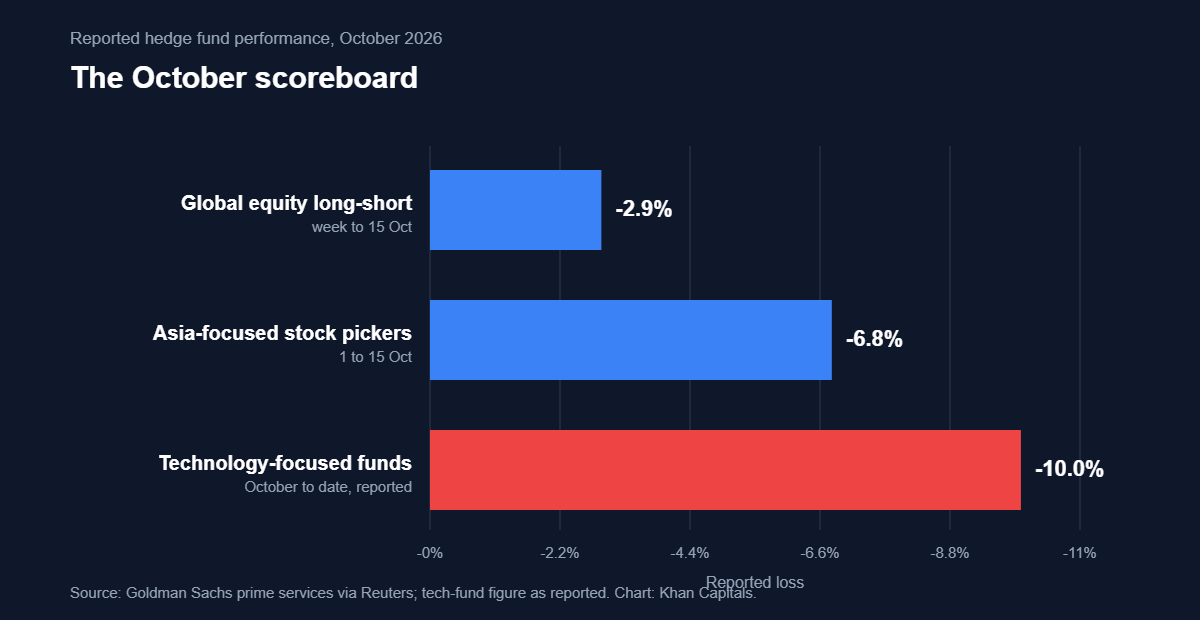
- The scoreboard is turning red. Global long-short funds lost 2.9 per cent in the week to 15 October, Asia-focused stock pickers were down 6.8 per cent in the first half of the month, and technology-focused funds were reported down roughly 10 per cent for October.
- Record shorting, one-year-low net exposure. Short sales exceeded long purchases by roughly five to one in October, short leverage in Goldman’s prime book reached the 99th percentile of its five-year history, and net leverage fell to a one-year low of 48.6 per cent even as gross leverage stayed near record highs at just over 310 per cent.
- The industry has never been bigger, or more divided. HFR puts industry assets at a record 5.63 trillion dollars, yet second-quarter dispersion was extreme: the top decile of managers returned 36.4 per cent on average while the bottom decile lost 8.2 per cent.
Three Strategies, One Direction
The hedge fund deleveraging that had been building through October stopped being a technical story on Wednesday 22 October. According to Goldman Sachs prime brokerage data first reported by Reuters, the three pillars of the modern hedge fund industry, fundamental equity long-short, systematic strategies and multi-strategy platforms, each lost more than 1 per cent on the same trading day. That has not happened since the Covid crash of early 2020. It did not happen in the gilt crisis of 2022, the regional bank failures of 2023 or the yen carry unwind of 2024. Strategies that are built to be uncorrelated with one another, and that market their diversification as the product itself, fell together.
The same day told the story in public markets. China’s CSI 300 entered a bear market after a record ten consecutive weekly declines, chip stocks were only days removed from their longest losing streak since 2008, and the quiet accumulation of shorts that prime brokers had been logging all month was suddenly visible in the tape. A simultaneous drawdown across strategies is the signature of positioning stress rather than fundamental news: when there is no headline to blame, the selling is the story.
Five Days That Unwound Two Years
The selling did not begin on the 22nd. Goldman’s prime desk, in a note by Vincent Lin reported by Reuters on 16 October, found that hedge funds had sold global AI-linked stocks for five consecutive sessions between 8 and 14 October, enough to erase their cumulative net buying of the theme since the start of 2025. Nearly two years of accumulated exposure to the market’s dominant trade was taken off in a single week. The trigger sat in plain sight: the hot September CPI print repriced the rate path, the bond market began asking harder questions of the half-trillion-dollar AI debt stack, and funds that had ridden the theme with leverage decided the risk-reward had inverted.
Cutting at this pace is a choice about liquidity, not conviction. A manager who merely turns cautious trims over weeks. A manager who needs gross exposure down before the next margin call sells what can be sold, which in 2026 means the most liquid AI complex: the megacap platforms, the chipmakers, the index futures that proxy them. That is why the unwind registered across strategies at once. The fundamental long-short funds were long the theme, the systematic funds were long its momentum, and the multi-strategy platforms were long it through both of those books at once, with centralised risk teams empowered to cut everything simultaneously.
Anatomy of a Hedge Fund Deleveraging
The mechanics matter because they decide what happens next. A hedge fund deleveraging has a defined sequence: losses raise the risk measured against each position, risk limits force gross exposure down, selling longs and covering shorts moves prices against whoever is slowest, and the price moves generate new losses for the next fund in the queue. The data from Goldman’s prime book describes a cycle that is well advanced but not complete. Net leverage, the difference between long and short exposure, has fallen to 48.6 per cent, its lowest in a year. Gross leverage, the sum of both books, remains near five-year highs at just over 310 per cent.
That combination, low net and high gross, is the industry crouching rather than retreating. Funds have not gone home; they have hedged. Short sales exceeded long purchases by roughly five to one in October, and short leverage reached the 99th percentile of its five-year range. The posture protects capital if the selloff extends, but it loads the market with a coiled spring: a positive catalyst would force the most crowded shorts to cover first, and the same risk machinery that amplified the downside would amplify a rally. Positioning this stretched rarely resolves quietly in either direction.
| Positioning measure | Reading | Context |
|---|---|---|
| Net leverage | 48.6% | One-year low |
| Gross leverage | ~310.3% | Near five-year highs |
| Short leverage | 99th percentile | Five-year history |
| October short sales vs long buys | ~5 to 1 | Near-record shorting pace |
The Scoreboard So Far
Performance numbers are arriving with a lag, and they are uneven in a way the averages disguise. Global equity long-short funds lost 2.9 per cent in the week to 15 October, their worst week of the year. Asia-focused stock pickers, caught between China’s grinding bear market and the Kospi’s AI-heavy drawdown, were down 6.8 per cent in the first half of the month. Technology-focused funds were reported down roughly 10 per cent for October, a number that, if it holds to month-end, would rank among the strategy’s worst months on record.
Idiosyncratic damage is surfacing too. Arini Capital, the London credit manager founded by Hamza Lemssouguer, has seen losses in its flagship fund deepen to about 26 per cent for the year as the European junk bond selloff accelerated, according to Bloomberg reporting cited by Hedgeweek. The detail that matters for the industry is what happened next: the firm still raised 1.5 billion dollars for its credit strategy. Capital keeps arriving even where performance has broken, because allocators are buying dispersion itself, the chance that this year’s loser is next year’s winner.
| Fund group | Reported move | Period |
|---|---|---|
| Global equity long-short | -2.9% | Week to 15 October |
| Asia-focused stock pickers | -6.8% | 1 to 15 October |
| Technology-focused funds | ~-10% (reported) | October to date |
| Arini flagship (credit) | ~-26% | 2026 year to date |
A 5.6 Trillion Dollar Industry, Split Down the Middle
The stress lands on an industry at peak size. HFR puts global hedge fund assets at a record 5.63 trillion dollars, even as the pace of fund formation slows sharply: roughly 100 new funds launched in the second quarter, down from 166 in the first, as rising global rates and volatile markets raised the bar for new entrants. Liquidations fell too, which is its own signal. In a normal shakeout, weak funds close. In this one, allocators appear content to leave capital with incumbents and let performance do the sorting.
And the sorting is brutal. In the second quarter, HFR’s dispersion data showed the top decile of managers returning an average of 36.4 per cent while the bottom decile lost 8.2 per cent, a 44.6 percentage point gap between the industry’s best and worst. That is what a market of violent rotations produces: the managers positioned with the AI trade on the way up, and short it on the way down, are compounding extraordinary numbers, while anyone whipsawed by the turn is bleeding in both directions. The average hedge fund return this year is close to meaningless; the distribution is the product.

What the Unwind Says About the AI Trade
Hedge funds are not the marginal owner of the AI theme; households, index funds and corporate treasuries hold far more of it. But they are the marginal price-setter in the short run, because they trade with leverage and they all read the same risk reports. Their October message is consistent with what the bond market said last week, when chip stocks fell for eight consecutive sessions and the debt financing the data centre build-out repriced sharply. The fastest money in the market has moved from maximum participation in the AI trade to a net-short tilt against its most crowded names in under a month.
That does not make the fast money right. Goldman’s own data shows hedge funds covering and re-shorting in bursts, and the five-to-one shorting pace of October is itself a crowded position now. What it does mean is that volatility is being manufactured inside the market’s plumbing: with gross leverage near records and net exposure at a one-year low, both tails have been fattened. The next major move in equities, in either direction, is likely to be amplified by the same machinery that produced the first simultaneous three-strategy drawdown since 2020.
Investor Implications
Equities. Positioning, not fundamentals, is setting the daily tape. With short leverage at the 99th percentile and net exposure at a one-year low, downside moves may find forced sellers exhausted sooner than headlines suggest, while any upside catalyst, a dovish surprise from the Federal Reserve or a strong set of megacap earnings, risks a disorderly short squeeze. Periods of extreme dispersion have historically favoured balance sheet quality and self-funded capital spending over leveraged growth stories, and liquidity in individual names can thin abruptly when multi-strategy platforms cut risk centrally.
Fixed income. The deleveraging began in credit adjacent to the AI build-out, and credit remains the pressure point. Arini’s losses show how quickly European high yield has repriced, and the funding programmes behind the data centre expansion keep the link between tech sentiment and credit spreads live. A hedged, high-gross industry also transmits stress into rates: when platforms cut, Treasury futures and swap spreads absorb the flow, adding noise to a long end already contending with multi-decade-high yields.
Cross-asset. The crouched posture, low net and record gross, is the textbook precondition for volatility clustering. Implied volatility that stays low while realised volatility rises is the gap to watch; strategies that sell volatility for carry are on the wrong side of that spread when three major hedge fund styles fall more than 1 per cent in a day. Dispersion at these levels also argues that manager selection, in any allocation to the sector, is currently a larger decision than the allocation itself.
What to Watch
- 28 October: the Federal Open Market Committee decision and press conference; a surprise in either direction would test record short positioning immediately.
- 28 to 29 October: megacap technology earnings, the heaviest week of the quarter; the names at the centre of the AI unwind report into a market positioned short.
- 31 October: month-end prime brokerage and performance data, which will show whether October’s reported tech-fund losses of roughly 10 per cent held and how far gross leverage came down.
- Mid-November: 13F filings for the third quarter, the first regulatory snapshot of how much AI exposure the largest funds carried into the drawdown.
Conclusion
Every deleveraging tells you what the market was leaning on. This one has revealed that the AI trade was not just the biggest position in equities but the common factor across strategies that advertise independence from one another. The simultaneous drawdown of 22 October was small in magnitude and large in meaning: it showed that fundamental stock pickers, trend-following machines and multi-strategy platforms were, in the end, holding versions of the same trade. The industry has responded by crouching, net exposure at a one-year low beneath record gross leverage, and that posture will shape the next move in markets more than most fundamentals will. Watch the leverage data as closely as the earnings calendar. The spring is loaded; the direction is not yet chosen.
Frequently Asked Questions
What is hedge fund deleveraging?
Deleveraging is the process of reducing positions funded with borrowed money. When losses or rising volatility push a fund against its risk limits, it sells long positions and buys back short positions to shrink its gross exposure. Because many funds use similar risk models, deleveraging tends to happen across the industry at once, which can move prices sharply without any new fundamental news.
Why did hedge funds sell AI stocks in October 2026?
Goldman Sachs prime brokerage data showed funds selling global AI-linked stocks for five consecutive sessions between 8 and 14 October, erasing their net buying since the start of 2025. The selling followed a hot September CPI print that repriced interest rate expectations and a sharp repricing of the debt financing the AI data centre build-out, which together worsened the risk-reward of the market’s most crowded trade.
How bad were hedge fund losses in October 2026?
Global equity long-short funds lost 2.9 per cent in the week to 15 October, Asia-focused stock pickers fell 6.8 per cent in the first half of the month, and technology-focused funds were reported down roughly 10 per cent for the month. On 22 October, fundamental long-short, systematic and multi-strategy funds all lost more than 1 per cent on the same day, the first time that had happened since the Covid crash of 2020.
Does record short selling mean hedge funds expect a crash?
Not necessarily. Short sales ran at roughly five times long purchases in October and short leverage reached the 99th percentile of its five-year range, but net exposure fell while gross exposure stayed near record highs, a hedged posture rather than an outright exit. It signals defensiveness and uncertainty; it also creates the fuel for a sharp rally if positive news forces crowded shorts to cover.
Sources: Yahoo Finance on the Goldman Sachs prime brokerage data; 24/7 Wall St on October short positioning; Hedgeweek on Arini Capital; Hedgeweek on HFR launch data; HFR market commentary; Goldman Sachs.
Related Reading: The unwind began in the credit markets, which we covered in The AI Debt Selloff: Eight Red Days for Chips and a Bond Market That Said No. The same week delivered China’s CSI 300 bear market after a record ten weekly declines, while the metals complex showed its own positioning stress in Why Is Gold Falling When Inflation Is Hot?. For the origins of the AI pacing debate, see The AI Safety Selloff: The Week the Builders Asked to Slow Down. For the fundamentals, start with how leverage works in markets and short selling explained. For the structures the fast money is trading against, see The Data Centre Financing Machine.

Leave a Reply