
Khan Capitals | October 2026
Key Takeaways
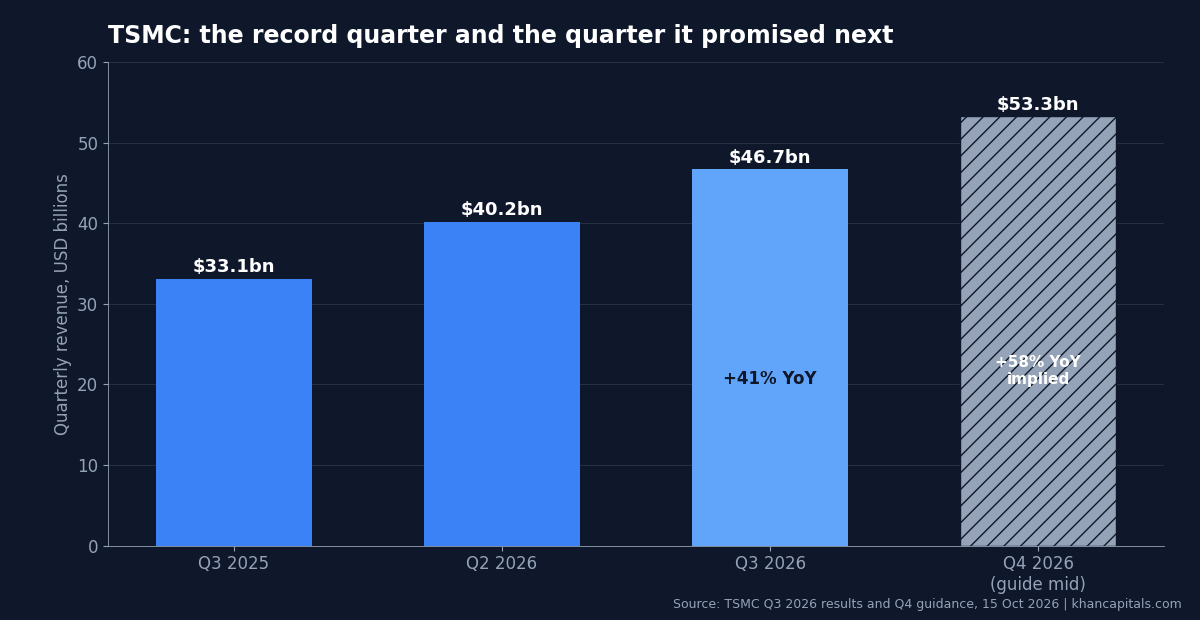
- TSMC’s third quarter broke every record the company keeps. Revenue of $46.7 billion beat the top of guidance, rose 41.2 per cent year on year, and net profit climbed 68.7 per cent to NT$763 billion, roughly $23.6 billion, ahead of consensus.
- The AI mix has taken over the company. High-performance computing revenue rose 22 per cent quarter on quarter to 68 per cent of sales, and management told analysts the gap between AI demand and supply is still quite big.
- The guide was the real headline. Fourth-quarter revenue guidance of $52.3 to $54.3 billion implies roughly 58 per cent growth on a year earlier, an acceleration from a company already running at record scale.
- The market sold it anyway. Gross margin of 66.4 per cent, down 1.3 points on the quarter as 2-nanometre production ramps and overseas fabs dilute, gave a nervous tape its excuse in a week when chip stocks fell for an eighth straight session.
- Capex discipline held. The 2026 budget stayed at $60 to $64 billion despite management calling tool price inflation real, with N2 family capacity still set to more than double in 2027.
Part of: The AI Infrastructure Supercycle – Khan Capital’s hub on the capex boom, the chips that power it and the capital that funds it.
The Beat That Could Not Clear the Week
TSMC Q3 2026 earnings arrived on Thursday carrying the heaviest burden in the sector: proving, in audited numbers, that AI demand is real while the market spent the week repricing how that demand is financed. The company delivered. Revenue, profit, and the mix all set records, and the fourth-quarter guide implied growth accelerating towards 58 per cent. The shares slipped anyway, which says less about the quarter than about the tape it landed on. In a normal week this print rallies the sector. In the week of the AI debt selloff, it could not even rally itself.
That tension, between the strongest fundamentals in the supply chain and the weakest sentiment of the cycle, makes the result worth close reading. TSMC is the tollbooth of the entire buildout: when the levered buyers of compute borrow at 16 per cent, much of the proceeds still arrive in Hsinchu as prepayments and wafer orders. The question the quarter poses is whether the tollbooth can keep compounding if the traffic behind it has to refinance.
The Numbers: A Sixth Straight Record
| Measure | Q3 2026 | Context |
|---|---|---|
| Revenue | $46.72bn | +41.2% YoY, +16.2% QoQ, above the $44.6-45.8bn guide |
| Net profit | NT$763.1bn (~$23.6bn) | +68.7% YoY, ahead of NT$746.3bn consensus |
| Gross margin | 66.4% | -1.3pp QoQ on the 2nm ramp and overseas fabs |
| HPC share of revenue | 68% | HPC revenue +22% QoQ |
| Q4 revenue guide | $52.3-54.3bn | Implies ~58% YoY growth at the midpoint |
| 2026 capex | $60-64bn | Unchanged despite tool price inflation |
Scale is the first thing to register. A year ago this was a $33 billion quarterly business; it is now a $47 billion one guiding to $53 billion. Growth of this kind at this size has few precedents outside the hyperscalers themselves, and TSMC is achieving it with pricing as much as volume: the 2-nanometre node commands premium wafer prices, and management’s remark that tool price inflation is real cuts both ways, since TSMC passes much of its own cost pressure through to customers who have nowhere else to go.
Sixty-Eight Per Cent: The Foundry Becomes an AI Company
High-performance computing, the bucket that holds AI accelerators and the CPUs that feed them, grew 22 per cent sequentially and now contributes 68 per cent of revenue. Smartphones, the franchise that built modern TSMC, are now barely a quarter of the business. The concentration is deliberate and, for now, wildly profitable, but it rewrites the company’s risk profile: TSMC’s cycle is no longer the consumer electronics cycle, it is the data centre capex cycle, with everything that implies about exposure to a handful of customers and their financing conditions.
Management’s answer to the concentration question was demand visibility. The gap between what AI customers want and what TSMC can supply remains, in its words, still quite big, which is why N2 family capacity is planned to more than double in 2027. That is the same supply-demand gap that Micron monetised to an 87 per cent gross margin in memory, and the same one Broadcom rode to $16.7 billion of AI revenue. All three prints tell a consistent story: at the supply end of the AI pipeline, demand still exceeds capacity by a wide margin.
The 1.3 Points the Market Chose to See
If the quarter was flawless, the margin line carried the flaw. Gross margin of 66.4 per cent was inside guidance but down 1.3 points sequentially, and management attributed the decline primarily to the initial mass production of the 2-nanometre process, with overseas fabs in Arizona and Japan adding structural dilution. Neither pressure is news, and both are the cost of the next leg of growth: new nodes always ramp dilutive, and geographic diversification was priced into the strategy the day the first Arizona shovel broke ground.
But in a week when the market was hunting for reasons to de-rate the AI complex, a 1.3-point margin fade was reason enough. The shares slipped after the print despite the beat, a reaction that rhymes with the pattern this publication has tracked all year: Broadcom fell on a record quarter over a guidance decimal, Micron barely moved on a tenfold profit rise. The grading curve for AI results is now brutal, and TSMC, the best-run company in the complex, could not escape it either.
The Tollbooth Economics of a Supply Gap
It is worth being precise about why TSMC’s position differs from everyone else reporting this season. The company does not take technology risk on AI models, does not carry inventory risk on GPUs, and does not fund data centres. It sells manufacturing capacity that is structurally scarce, at prices it largely sets, to customers who book it years ahead. When demand exceeds supply by the margin management describes, the foundry captures economics from both sides: volume growth from the buildout and price from the scramble for allocation. The 41 per cent revenue growth this quarter decomposes into both, and the pricing component is the more durable of the two.
The concentration of that privilege is the counterweight. A business that is 68 per cent high-performance computing is, in practice, a business whose five largest customers decide its growth rate. Nvidia’s accelerators, the custom silicon programmes at the hyperscalers, and the CPU roadmaps that feed the same data centres together account for the overwhelming share of leading-edge demand. Each of those customers is financially robust; it is their customers, the levered operators who buy the finished systems, where this week’s stress sits. The further down the chain the financing pressure stays, the longer TSMC’s pricing power holds. The history of capex cycles says the pressure eventually travels upstream; the size of the current order book says not yet, and not soon.
A $53 Billion Fourth Quarter and the Supply Gap
The forward numbers are the ones that matter for the sector. A $52.3 to $54.3 billion fourth quarter implies roughly 58 per cent year-on-year growth, an acceleration at record scale, and it is constrained by supply rather than demand. Capex holding at $60 to $64 billion, rather than chasing the gap higher, reads as discipline: TSMC is expanding into verified orders, not speculative capacity, and it is letting price do some of the rationing. For 2027, the commitment to more than doubling N2 family capacity gives the clearest available estimate of how much AI compute the industry’s anchor supplier actually believes in.
The scenarios from here hinge on whether the margin fade is a ramp artefact or a trend, and on whether customer financing stress ever reaches the order book.
| Scenario | What happens | Margin path | Signal to watch |
|---|---|---|---|
| Bull | 2nm yields mature fast; premium pricing offsets ramp costs | Back towards 68% through 2027 | Q4 margin guide and N2 wafer pricing |
| Base | Growth sustains; dilution from overseas fabs persists | Mid-60s, stable | Capex guide for 2027 in January |
| Bear | Levered customers slow orders as refinancing bites | Margin holds but volume guide softens | Any prepayment or order-timing language shift |
Pricing Power Meets a Credit Tape
The week’s context deserves to be read alongside the print. TSMC carries one of the cleanest balance sheets in global technology and funds its capex largely from cash flow; nothing in this quarter touches a refinancing market. But its customers’ customers increasingly do. CoreWeave’s bonds near 16 per cent, Oracle’s credit default swaps at 18-year highs, and roughly half a trillion dollars of AI-related debt all sit downstream of the wafers TSMC ships. If lenders force the levered tier of the buildout to slow, the order book that supports a 58 per cent growth guide becomes the transmission channel. Nothing in Thursday’s numbers shows that happening, and the supply gap gives TSMC more cushion than anyone in the chain. The risk is real but second-order, and the market priced it first.
Investor Implications
Equities. TSMC offers the AI theme’s growth with the least balance sheet risk in the complex, which is precisely why its post-earnings slip is informative: when the cleanest print in the sector cannot rally, positioning rather than fundamentals is setting prices. For investors distinguishing between the tiers of the AI trade, the foundry sits closer to the cash-rich hyperscalers than to the levered neoclouds, and its 58 per cent growth guide is contracted against real orders. The margin debate is worth following but should be sized honestly: a company compounding revenue at 40 per cent can afford a point of ramp dilution.
Fixed income. The read-through runs to the credit of TSMC’s customers rather than TSMC itself. A supplier guiding to 58 per cent growth implies sustained, and financed, buying from the names whose spreads widened this week; either the bond market is too pessimistic about the borrowers or the equity market is too optimistic about the schedule. The gap between those two views is the trade.
Cross-asset. Taiwan concentration risk remains the quiet tail: 68 per cent HPC share means the world’s AI capacity now runs through one island’s fabs to a degree even 2024 did not. The overseas fabs that dilute margin are the insurance premium against that tail, which is an argument for tolerating the dilution rather than resenting it.
What to Watch
- Mid-January 2027: Q4 results and the first 2027 capex guide; a number materially above $64 billion would signal the supply gap is widening again.
- Through Q4: N2 ramp commentary and wafer pricing; the bull case for margins rests on premium pricing arriving faster than ramp costs.
- November: Nvidia’s results, the demand-side check on TSMC’s supply-side claim that the gap is still quite big.
- Ongoing: any change in prepayment or order-timing language from levered AI customers; this is where credit stress would first touch the foundry.
Conclusion
TSMC’s third quarter was the strongest evidence yet that AI demand, at the point where it becomes silicon, remains far ahead of supply. A record $46.7 billion quarter, profit up 69 per cent, and a guide implying 58 per cent growth would in any other week have been the sector’s clearing event. Instead the market docked it 1.3 margin points and moved on, because this week the AI trade was being priced off its liabilities rather than its order books. Both views can be right: the buildout’s financing is getting more expensive even as its fundamentals strengthen. TSMC sits on the profitable side of that divergence, collecting tolls in cash from a queue that, for now, keeps lengthening.
Frequently Asked Questions
What did TSMC report for Q3 2026?
TSMC reported record Q3 2026 revenue of $46.72 billion, up 41.2 per cent year on year and above its own guidance, with net profit rising 68.7 per cent to NT$763 billion, about $23.6 billion. Gross margin was 66.4 per cent and high-performance computing reached 68 per cent of revenue.
Why did TSMC shares fall after strong results?
Gross margin declined 1.3 points on the quarter as 2-nanometre production ramped and overseas fabs added costs, and the results landed during a sector-wide selloff driven by concerns over AI-related debt. With chip stocks falling for an eighth straight session, even a record quarter with accelerating guidance could not reverse the tape.
What is TSMC’s guidance for Q4 2026?
TSMC guided fourth-quarter revenue to between $52.3 billion and $54.3 billion, implying roughly 58 per cent year-on-year growth at the midpoint. The company held its 2026 capital expenditure budget at $60 to $64 billion and plans to more than double N2 family capacity in 2027.
Sources: Investing.com, TSMC Q3 2026 results slides; Investing.com, TSMC Q3 2026 earnings call transcript; The Motley Fool, TSMC earnings call transcript; TradingView News, TSMC Q3 revenue and capex facts; Benzinga, TSMC beats Q3 estimates on AI demand; CNBC, global tech rout on AI funding worries.
Related Reading: The week that framed this print is analysed in the AI debt selloff of October 2026, and the pattern of record results sold anyway runs from Nvidia’s $96 billion quarter to the September selloff the builders started themselves. For how quickly sentiment can break at the sector’s record highs, see the $1 trillion AI semiconductor selloff of June. For the fundamentals, start with how the foundry model works and why capex intensity shapes chip margins.

Leave a Reply