
Khan Capitals | October 2026
Key Takeaways
- A 10 billion euro take-private. Qiagen’s boards have agreed a recommended all-cash offer of 46.50 euros per share from a consortium led by EQT Private Equity, valuing the molecular testing company at roughly 9.6 billion euros in equity terms and about 12 billion dollars including debt.
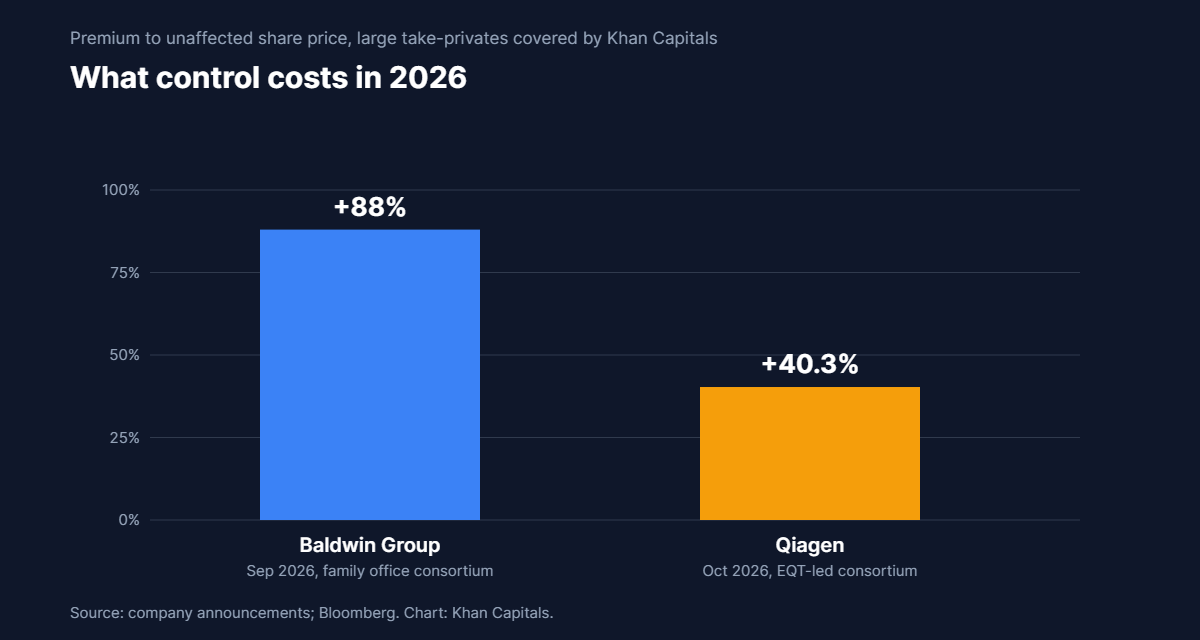
- A 40.3 per cent premium. The offer stands 40.3 per cent above Qiagen’s unaffected share price, a reminder of how far public markets had derated a profitable, cash-generative diagnostics franchise.
- Sovereign and pension capital inside the deal. The consortium includes the Abu Dhabi Investment Authority and the Canada Pension Plan Investment Board, continuing 2026’s pattern of the largest pools of patient capital buying alongside private equity rather than through it.
- Unanimous boards, long runway. Both Qiagen governing bodies unanimously recommend the bid; completion is expected in mid-2027, subject to shareholder acceptance, approval of the offer document by German regulator BaFin, merger control and foreign investment clearances.
- The take-private wave is broadening. After September’s 7.7 billion dollar Baldwin Group deal at an 88 per cent premium, large buyers are now reaching into healthcare and life sciences, where listed valuations have lagged the market’s AI-led leadership for two years.
Part of: Private Credit and Private Markets: Khan Capital’s hub on the private capital cycle.
What Was Announced
The EQT Qiagen takeover, announced on 21 October, is the largest European healthcare take-private of the year and one of the largest anywhere in this cycle. The structure is a recommended voluntary all-cash public takeover offer under German law: 46.50 euros per share, no financing condition flagged, both of Qiagen’s governing bodies unanimously behind it, per the joint announcement. Bloomberg puts the equity value at around 9.6 billion euros, or 10.8 billion dollars; including roughly 1.1 billion dollars of debt, the enterprise value comes to about 12 billion dollars.
Qiagen is not a distressed seller. The Dutch-listed, Germany-rooted company sells sample preparation and molecular diagnostics technology, the unglamorous plumbing of genomics labs, clinical testing and pharmaceutical research. It earned a pandemic windfall, suffered the sector-wide hangover that followed, and has spent three years as a steady mid-teens margin business whose share price went sideways while index-level returns concentrated in AI infrastructure. That is precisely the profile private equity has been hunting in 2026: quality franchises that public markets have stopped paying for.
| Deal term | Detail |
|---|---|
| Offer price | 46.50 euros per share, all cash |
| Premium to unaffected price | 40.3% |
| Equity value | ~9.6 billion euros (~$10.8bn) |
| Enterprise value | ~$12.1bn including ~$1.1bn debt |
| Buyers | EQT Private Equity, ADIA, CPP Investments |
| Board stance | Unanimous recommendation, both bodies |
| Expected completion | Mid-2027 |
| Key conditions | BaFin offer document approval, merger control, FDI clearances |
The Coalition Doing the Buying
The buyer list is as instructive as the price. EQT leads, but the Abu Dhabi Investment Authority and the Canada Pension Plan Investment Board sit inside the consortium as principals, not as fund investors receiving the deal second-hand. The world’s largest allocators have spent a decade paying management fees for exposure to exactly this kind of transaction; in 2026 they increasingly underwrite it directly, taking board-level governance and keeping the economics. For a 10 billion euro equity cheque, the arithmetic of fee savings alone is measured in hundreds of millions.
It is the same pattern this publication traced in Apollo and GIC’s near 10 billion dollar Atlantic Aviation investment and in the family-office-led Baldwin Group buyout: the line between the fund manager and the capital owner is blurring at the top of the market. Co-underwriting also solves a practical 2026 problem. With exit markets slow and traditional fund-raising long in the tooth, sponsors need partners who can fund a multi-year hold without redemption pressure. Sovereign wealth and pension capital is the only money with a natural horizon as long as the thesis.
Why a 40 Per Cent Premium Still Works
A 40.3 per cent premium sounds generous until it is set against where the stock has been. Qiagen shareholders are being paid a price the market itself was not willing to sustain, because public equity in 2026 pays up for AI exposure and applies a discount to nearly everything else. The private buyer’s bet is straightforward: the diagnostics installed base is sticky, consumables revenue recurs, and the derating reflects index flows rather than franchise decay. If that is right, the consortium is buying a compounder at a multiple the public market will eventually be embarrassed by.
The healthcare angle sharpens the point. Life sciences tools and diagnostics valuations have spent two years unwinding their pandemic premium, even as testing volumes and molecular workflows kept growing. Sponsors have circled the sector all year; Qiagen is the moment the circling turned into a 10 billion euro commitment. For listed peers, the read-across is immediate: every underperforming quality franchise in the sector now carries an implicit take-private floor under its valuation.
What the Consortium Is Actually Buying
Qiagen’s business is best understood as a razor and blade model applied to biology. The company sells instruments and, far more importantly, the consumable kits those instruments require: sample preparation chemistry that extracts and stabilises DNA and RNA, assay panels for infectious disease and oncology, and the QuantiFERON franchise in latent tuberculosis testing. Once a laboratory has validated its workflows on Qiagen chemistry, switching suppliers means re-validating everything, a cost few labs will pay to save a margin on kits. The result is the kind of recurring, regulation-protected revenue that reads as boring on a quarterly call and as compounding on a ten-year hold.
That annuity is also why the deal’s long regulatory runway should not obscure its logic. Diagnostics demand does not track the economic cycle; testing volumes grow with clinical guidelines, ageing populations and the migration of molecular methods from research into routine medicine. A buyer underwriting to 2035 cares little whether the next two quarters disappoint. The public market, benchmarked quarterly against an index led by AI infrastructure, structurally cannot price that indifference. The consortium can, which is the entire trade.
The German Mechanics, and Why They Take Until 2027
The transaction proceeds as a recommended voluntary public takeover offer rather than a scheme or a merger, which shapes both the timeline and the risks. The offer document must be approved by BaFin before shareholders can accept. Acceptance then runs for a defined period, and the consortium’s eventual ownership percentage determines what comes next: enough acceptance allows structural measures that simplify full ownership, while a lower tally leaves a listed stub and a longer path to integration. Arbitrageurs will therefore watch the acceptance rate as closely as the regulatory filings, because it sets the probability and timing of the end-state rather than the headline price.
Cross-border review adds the rest of the calendar. A life-sciences supplier with clinical and public-sector customers, bought by a consortium that includes Gulf and Canadian state-linked investors, will face foreign investment screening in several jurisdictions alongside routine merger control. Nothing disclosed suggests substantive concern, and the parties would not have guided to mid-2027 if they expected a faster path. The gap between signing and closing is simply the price of buying regulated assets with sovereign-adjacent money in 2026, and both the premium and the arbitrage spread already embed it.
The arithmetic of the premium is worth pausing on. An offer of 46.50 euros at a 40.3 per cent premium implies an unaffected price of roughly 33 euros, which is where the market valued this franchise in the weeks before the approach. The consortium is in effect paying what the shares traded at in more generous markets and still calling it a bargain on a decade view. Premiums of this size are not generosity; they are an argument about where the fair multiple sits, settled with cash.
The 2026 Take-Private Ledger
Qiagen extends a sequence rather than starting one. September brought the Baldwin Group’s 7.7 billion dollar take-private at an 88 per cent premium, funded by a family office coalition that wanted to invest in AI away from quarterly scrutiny. The Atlantic Aviation transaction showed sponsors manufacturing liquidity between themselves when exit markets stay shut. Each deal answers the same underlying question differently: when public markets concentrate their attention, and their multiple, on a single theme, who buys the companies left behind? Increasingly, the answer is the largest private pools of capital in the world, acting together.
| Transaction | Size | Buyers | Signal |
|---|---|---|---|
| Qiagen (Oct 2026) | ~$12.1bn EV, 40.3% premium | EQT, ADIA, CPP Investments | Sovereign and pension capital as co-principals |
| Baldwin Group (Sep 2026) | $7.7bn, 88% premium | Sequence Holdings, DFO Management | Family offices as control buyers |
| Atlantic Aviation (Sep 2026) | ~$10bn valuation | Apollo, GIC alongside KKR | Sponsors manufacturing liquidity internally |
The Regulatory Path to Mid-2027
The timetable is the deal’s main risk. Completion is not expected until mid-2027, an unusually long runway that reflects the offer’s German mechanics and its geography. BaFin must approve the offer document before shareholders can formally accept. Merger control filings will span multiple jurisdictions, and foreign direct investment screening applies to a life-sciences asset with government and clinical customers, bought by a consortium that includes Gulf and Canadian state-linked capital. None of these look like deal-breakers; all of them are time.
Time has a price. An eight-month gap between agreement and completion leaves room for a counter-bid, for market dislocation that tests the consortium’s resolve, and for the merger arbitrage community to earn its spread. The unanimous board recommendation and the consortium’s depth of capital argue for completion; the history of long-dated European take-privates argues for watching the acceptance threshold and any regulatory noise closely rather than treating the outcome as settled.
Investor Implications
Equities. The read-across runs through every derated quality franchise in healthcare and life sciences tools: large private capital has now put a reference price on the sector’s neglect. That does not make listed diagnostics names takeover targets by default, but it changes the downside asymmetry for patient holders, and it pressures boards of underperforming companies to articulate why independence serves shareholders better than 40 per cent today. Qiagen’s own shareholders face a cleaner question: the spread between the market price and 46.50 euros now prices regulatory time and completion risk, the classic merger arbitrage trade.
Fixed income and private credit. A 12 billion dollar enterprise purchase will carry an acquisition financing package into a credit market that has spent October repricing risk, as covered in the AI debt selloff. A diagnostics cash-flow profile is exactly what direct lenders say they want more of: recurring, non-cyclical, uncorrelated with the data centre complex that dominates new issuance. How this financing clears, in size and at what spread, will be a useful marker of private credit’s appetite beyond the AI trade.
Private markets. For allocators, the deal underlines two structural shifts: sovereign and pension investors co-underwriting control transactions rather than only committing to funds, and healthcare joining infrastructure and insurance as sectors where the largest cheques are now written privately. Both shifts compress the fee stack and lengthen holding periods, and both make the public market’s shrinking roster of mid-cap quality compounders shrink a little faster.
What to Watch
- Coming weeks: publication of the formal offer document and its approval by BaFin, which opens the acceptance period and sets the minimum acceptance threshold to track.
- Q4 2026 to Q1 2027: merger control and foreign investment filings across the EU, US and other jurisdictions; any extended review would widen the arbitrage spread.
- Through completion, expected mid-2027: the possibility of a competing proposal while the offer remains open, and the trajectory of listed diagnostics peers as the market reprices the sector’s take-private floor.
Conclusion
The EQT Qiagen takeover is a large deal that is most interesting for what it standardises: sovereign wealth and pension funds inside the consortium, a premium calibrated to a public market distracted by a single theme, and a completion runway measured in quarters rather than weeks. Public equity’s neglect of profitable, slow-compounding franchises has become the raw material of private markets’ 2026 vintage. Whether that vintage proves well-timed depends on an exit window nobody can yet see; what is already clear is that the buyers with the longest horizons keep arriving at the same conclusion about where the value sits.
Frequently Asked Questions
What are the terms of the EQT offer for Qiagen?
An EQT-led consortium including the Abu Dhabi Investment Authority and CPP Investments has agreed a recommended all-cash offer of 46.50 euros per Qiagen share, a 40.3 per cent premium to the unaffected price. The equity value is roughly 9.6 billion euros, or about 12 billion dollars including debt, and both Qiagen boards unanimously recommend acceptance.
When will the Qiagen takeover complete?
Completion is expected in mid-2027. The offer must first clear approval of the offer document by BaFin, the German financial regulator, then shareholder acceptance, merger control filings and foreign direct investment reviews across several jurisdictions. The long runway leaves room for competing bids and keeps a merger arbitrage spread in the shares until the conditions are met.
Why is Qiagen going private?
Qiagen’s steady diagnostics and sample-technology business has been derated by a public market concentrated on AI-linked stocks for two years. Private buyers believe the franchise’s recurring consumables revenue is worth more than its listed multiple implied, and the consortium structure lets sovereign and pension capital own that cash flow directly over a long horizon, without quarterly market scrutiny.
Sources: Qiagen and EQT joint announcement; Bloomberg; MedTech Dive; Seeking Alpha; GenomeWeb.
Related Reading: The autumn’s other landmark control deals frame this one: The Baldwin Group Take-Private: An 88 Per Cent Premium and the Rise of Family Office Capital and The Apollo Atlantic Aviation Deal: KKR Doubles Its Money Without Selling Out. For the credit backdrop any acquisition financing must clear, see The AI Debt Selloff: Eight Red Days for Chips and a Bond Market That Said No. For the fundamentals, start with how the main fund types differ.

Leave a Reply