Khan Capitals | September 2026
Key Takeaways
- The Baldwin Group take-private is a $7.7 billion all-cash deal at $32.50 per share, announced Monday, with an entity formed by Sequence Holdings and Michael Dell’s DFO Management acquiring a majority interest in the insurance broker, per the company’s announcement.
- The price represents a premium of roughly 88 per cent to Baldwin’s unaffected closing price on 17 June 2026, one of the largest premiums of the year, and a measure of how far public markets had marked the shares down before the buyers arrived.
- The stated rationale is unusual and very 2026: the buyers argue private ownership lets Baldwin fund expensive AI upgrades and accept a temporary hit to margins without quarterly earnings scrutiny. Eligible employees will retain a significant minority equity stake, and the deal is expected to close in the first quarter of 2027.
- The buyer type is the story for private markets. Two weeks after Aon’s $17 billion purchase of USI gave KKR a strategic exit, and three weeks after the $53 billion PayPal buyout collapsed, the equity cheque for one of the year’s biggest take-privates is coming from a family office, capital with no fund life, no exit clock and no LPs.
- Insurance distribution remains the private capital favourite: recurring commissions, low capital intensity and fragmented markets keep attracting buyers even with financing costs at two-decade highs, making this the second major insurance brokerage deal of the month.
Part of: Private Credit & Private Markets — Khan Capital’s hub on private capital, buyouts and the exit market.
An 88 Per Cent Premium, Explained
The Baldwin Group, the Tampa-based insurance distributor that listed in 2019 as BRP Group, agreed on Monday to be taken private at $32.50 per share in cash, an all-cash transaction valued at approximately $7.7 billion. The buyers are Sequence Holdings and DFO Management, the family investment office of Michael Dell, acting through a jointly formed entity that will hold a majority interest, with eligible Baldwin employees rolling into a significant minority stake alongside them. The board has approved the transaction, which is expected to close in the first quarter of 2027.
The headline premium, approximately 88 per cent to the unaffected close of 17 June, reads like a typographical error in a year of contested valuations. It is better read as two numbers in one. The first is what public markets had done to Baldwin: the unaffected price implies a market capitalisation that had fallen far below where the buyers, and evidently the board, judged the durable value of the business. The second is what it now costs to pry a founder-influenced, recurring-revenue business out of a market that has de-rated it. Premiums of this size are not generosity; they are the price of certainty, paid by buyers who believe the public quote was the anomaly rather than the offer.
| Term | Detail |
|---|---|
| Consideration | $32.50 per share, all cash |
| Transaction value | Approximately $7.7 billion |
| Premium | c. 88% to the unaffected close of 17 June 2026 |
| Buyers | Entity formed by Sequence Holdings and DFO Management (Dell family office), majority interest |
| Management and employees | Eligible colleagues retain a significant minority equity stake |
| Approvals and timing | Board approved; expected close in Q1 2027 |
Going Private to Spend on AI
Most take-private rationales are euphemisms for leverage. This one is more interesting. The buyers’ argument, as reported by Finimize and trade press, is that private ownership makes it easier to fund expensive artificial intelligence upgrades across Baldwin’s brokerage operations, because management can accept a temporary hit to profit margins without defending it to public shareholders every ninety days. Insurance distribution is, at bottom, a data and workflow business: submissions, quotes, renewals, claims advocacy. It is precisely the kind of operation where AI investment is plausibly transformative and where the spending shows up as margin erosion years before it shows up as revenue.
Public markets in 2026 have been unforgiving of exactly that trade-off. This is a year in which record AI-driven results have been sold on decimal-point guidance misses, and in which the market’s patience for spending ahead of proof has narrowed to a quarter at a time. The Baldwin thesis inverts the usual AI trade: rather than buying the companies that sell AI infrastructure, the Dell and Sequence capital is buying a company so it can become an AI customer at scale, away from the quote. If it works, expect the argument to be recycled across every professional services and distribution business with a depressed multiple.
The Family Office Steps Into Private Equity’s Shoes
Put this deal beside the month’s other headlines and a pattern emerges. In late August, Advent and Stripe walked away from a $53 billion pursuit of PayPal when a rally repriced the target out of reach: the traditional sponsor consortium could not make the maths work. Days later, Aon’s $17 billion cash purchase of USI showed that the widest-open exit door for private equity was a strategic buyer, not another fund. Then Apollo and GIC’s near $10 billion Atlantic Aviation investment demonstrated the sponsor-to-sponsor liquidity machine. Baldwin completes the set with a fourth buyer type: the family office writing a majority cheque on a $7.7 billion transaction.
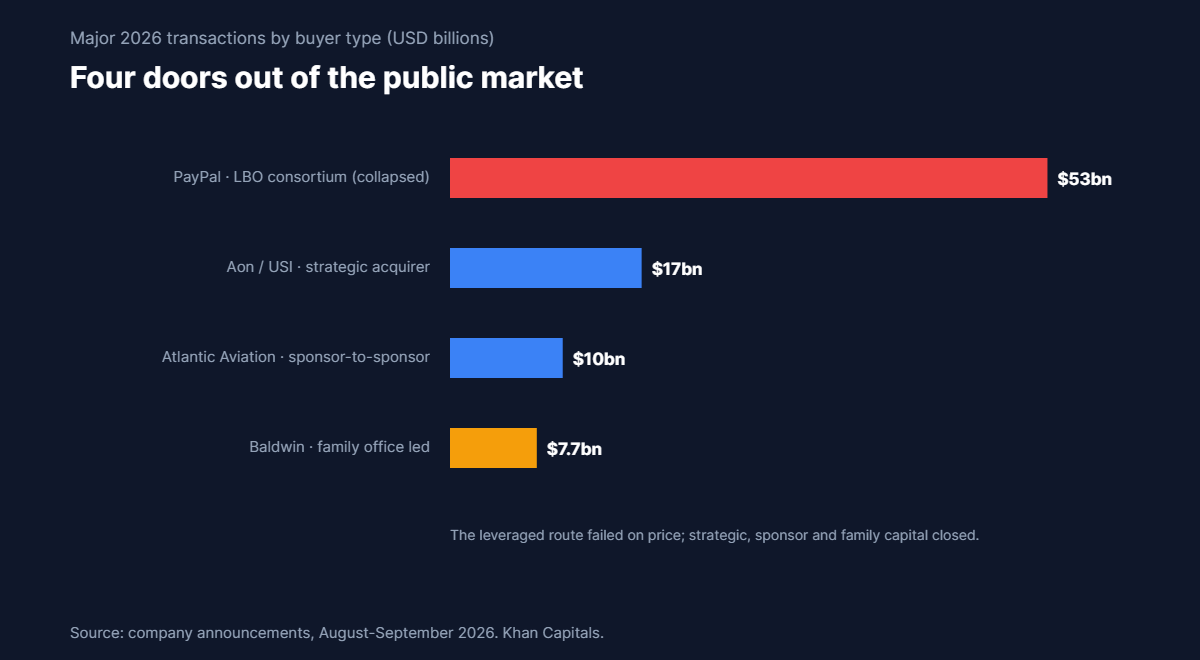
Family office capital differs from fund capital in three ways that matter to this deal. It has no fixed fund life, so a margin-eroding AI investment programme can run on a decade clock rather than a five-year one. It has no limited partners to report to, so the temporary-pain argument only has to convince the principals. And it pays no carry waterfall, which changes the return threshold at which an 88 per cent premium still clears. DFO has operated at this scale before; what is new is family office capital leading, rather than co-investing in, one of the year’s largest take-privates. In a market where traditional sponsors are struggling to exit and to underwrite, the deepest pools of patient capital are discovering they can simply do the deals themselves.
Why Insurance Brokerage, Again
This is the second major insurance distribution deal in a fortnight, and the through-line is the asset class’s peculiar durability. Brokers earn recurring commissions on policies that renew through recessions, carry almost no balance sheet risk of their own, and operate in a market fragmented enough that consolidation has run for two decades without exhausting itself. In a world of 4 per cent policy rates and a 5 per cent 10-year Treasury, businesses whose cash flows behave like indexed annuities command scarcity value. Aon paid 14.5 times synergised earnings for USI; Baldwin’s buyers are paying a premium that assumes similar durability plus an AI optionality the public market declined to price.
| Buyer type | 2026 example | Capital characteristics | What it solves |
|---|---|---|---|
| Strategic acquirer | Aon / USI ($17bn) | Corporate debt capacity; synergy maths | Sponsor exits at full price |
| Sponsor-to-sponsor | Apollo, GIC / Atlantic Aviation (c. $10bn) | Fund capital recycling between sponsors | Liquidity without an IPO window |
| Traditional LBO consortium | Advent, Stripe / PayPal ($53bn, collapsed) | Fund equity plus leveraged financing | Struggled at 2026 rates and prices |
| Family office led | Sequence, DFO / Baldwin ($7.7bn) | Permanent capital; no fund life, LPs or carry | Long-horizon investment behind closed doors |
The Roll-Up Decade Behind the Price
Baldwin’s path to this moment is itself a compressed history of the sector’s last cycle. The firm came to market in 2019 as BRP Group, a founder-led Florida brokerage with an aggressive acquisition programme, and spent its public years buying independent agencies at a pace that made it one of the fastest-growing distributors in the country. The model was standard for the era: cheap debt funded the roll-up, each acquired book of business brought recurring commissions, and the public multiple was meant to reward the compounding. What the strategy also produced was integration cost, earn-out liabilities and leverage, and when the rate environment turned, the public market’s enthusiasm for acquisition-driven growth stories turned with it. The share price that resulted is the unaffected number buried in Monday’s premium.
That history explains why this buyer pairing suits this asset. A roll-up’s value is realised in the years after the buying slows, when the acquired agencies are actually knitted into one operating platform, precisely the unglamorous, margin-suppressing work the AI investment case targets. It is also why the employee equity stake matters more here than in a typical take-private: in brokerage, the assets are relationships that leave in lifts, and a significant minority stake held by the people who own those relationships is not generosity but retention engineering. The buyers are, in effect, paying an 88 per cent premium for the right to finish building the company the public market only wanted to own while it was still under construction.
What the Public Market Loses
There is a quieter observation in this deal about the state of the equity market itself. A company listed in 2019, built through acquisition into a top-tier US broker, will spend barely seven years public before concluding, with its board’s blessing, that the quote does more harm than good. The 88 per cent premium is the arithmetic of that conclusion: whatever discipline public ownership imposed, it also priced the business nearly half off. Baldwin joins a growing list of mid-cap names for whom the listed market has become a place to be misunderstood expensively, while the depth of private capital, sponsor, strategic, sovereign and now familial, means the exit is always one phone call away. The de-equitisation of the American mid-cap continues, and it is being financed by exactly the pools of money the public market cannot see.
Investor Implications
Equities. Baldwin’s shareholders receive their answer in cash; the read-through runs to everything that resembles it. Listed insurance brokers and other recurring-revenue distributors with compressed multiples now trade with an implicit take-private floor, and an 88 per cent premium recalibrates what boards elsewhere consider an insultable offer. For the wider market, each departure of a quality mid-cap thins the opportunity set and concentrates the indices further in the mega-caps.
Private markets. The deal extends the year’s lesson that liquidity exists but arrives through unconventional doors. Family offices leading multi-billion take-privates compete directly with sponsor funds for assets, without the fee structures LPs pay for; expect that competition to show up in sponsor return underwriting. The employee equity rollover is worth watching as a template: retention economics in people businesses increasingly look like partial re-privatisation rather than options on a public stock.
Cross-asset. A $7.7 billion all-cash deal announced in the same week the 10-year Treasury touched its highest since 2007 is a statement about financing structure: permanent capital is displacing leverage where leverage no longer works. If policy rates keep rising, watch the buyer mix in large deals tilt further toward strategics, sovereigns and family offices, and watch private credit’s role shift from funding buyouts to refinancing the ones already done.
Conclusion
The Baldwin Group take-private will be recorded as an insurance sector transaction, but its significance sits elsewhere. It is the clearest evidence yet that in 2026’s deal market the binding constraint is not capital but capital structure: the traditional leveraged consortium failed at PayPal, while permanent family money cleared an 88 per cent premium at Baldwin in the same summer. And its rationale, going private in order to spend on AI without the quarterly meter running, says as much about the public market’s current temperament as any index level does.
The questions the deal leaves open are for the next cycle: whether AI spending behind closed doors produces the margins its sponsors expect, whether employee-owned minority stakes become the standard retention currency of people businesses, and whether the family office, having discovered it can lead, keeps leading. For now, the scoreboard reads simply: another quality mid-cap gone, another premium paid in full, and another signal that the most interesting buyers in this market do not run funds at all.
Sources: Business Wire (company announcement); Yahoo Finance; Finimize; Reinsurance News; ProgramBusiness.
Related Reading: The exit-door map this deal redraws was sketched in Aon’s $17 billion purchase of USI from KKR and Apollo’s Atlantic Aviation investment, while the leveraged route’s limits were on display in the collapse of the $53 billion PayPal buyout. The financing backdrop of two-decade-high yields is covered in the global bond selloff. For the fundamentals, start with fund types, explained.

Leave a Reply