

Khan Capitals | November 2026
Key Takeaways
- The SEC is reportedly investigating Nvidia. The Wall Street Journal reported on Monday that the regulator has opened a civil investigation examining, in part, whether the company’s disclosures misled investors; by Friday, further reports said the inquiry extends to accounting questions. Neither the SEC nor Nvidia has confirmed the existence of the probe.
- The stock had its worst week since the financial crisis. Nvidia fell roughly 14 per cent on Friday alone and about 23 per cent across the week, its largest weekly decline since October 2008, dragging the wider market with it.
- The legal perimeter is widening fast. California’s attorney general has said his office is looking into aspects of the affair, at least two shareholder lawsuits have been filed since 8 November, including a derivative suit against the directors, and the Justice Department is reportedly examining Megaspeed, the firm at the centre of the disclosure questions.
- Reporting focus: Asia revenue. Questions reportedly centre on the company’s relationships in Asia and earlier changes to how it reported geographic sales, including the removal of a line item for certain Singapore-related revenue.
- This all follows the governance shock. Jensen Huang resigned as chief executive on 12 November, effective immediately; finance chief Colette Kress is interim CEO and Harvey Jones became the company’s first board chair, days before a $115.8 billion quarter that the market sold anyway.
Part of: The AI Infrastructure Supercycle — Khan Capital’s hub on the capital cycle behind the build-out.
Ten days from governance shock to federal inquiry
The Nvidia SEC investigation reports arrived with brutal timing. On Monday 17 November, hours before the company posted a $115.8 billion quarter, the Wall Street Journal reported that the Securities and Exchange Commission had opened a civil investigation into whether Nvidia’s disclosures misled investors. The earnings, covered in our analysis of the quarter without Jensen Huang, were strong. It did not matter. By Friday, reports that the inquiry extends into accounting questions sent the shares down roughly 14 per cent in a single session, capping a 23 per cent weekly fall, the worst for the stock since October 2008.
A company that began November as the largest in the world by market value has, in ten days, lost its founder-chief executive, acquired an interim leadership structure, and become the subject of reported federal, state and private legal scrutiny. Markets can price earnings risk. Pricing an open-ended legal process around a $4 trillion balance sheet is harder, and the week’s tape showed it.
| Date | Development |
|---|---|
| 8 November onwards | First shareholder lawsuits filed, including a derivative suit against Nvidia’s directors |
| 12 November | Jensen Huang resigns as president, CEO and board member, effective immediately; Colette Kress named interim CEO; Harvey Jones becomes first board chair |
| 17 November | WSJ reports SEC civil investigation into disclosures; Q3 FY2027 results released the same day |
| Mid-week | California attorney general says his office is examining aspects of the matter; DOJ reportedly probing Megaspeed |
| 20 November | Reports the SEC inquiry extends to accounting questions; shares fall ~14 per cent, closing a ~23 per cent week |
What is reportedly being examined
The reporting, and it is important to say that this is reporting from unnamed sources rather than any formal enforcement action, points in two directions. The first is disclosure: whether what the company told investors, about its leadership situation and about its business relationships, was complete and accurate when it was told. The second is geography: questions are said to centre on Nvidia’s relationships in Asia and on earlier changes to the way it reported geographic sales, including the elimination of a specific line item for certain Singapore-related revenue.
Singapore has long been the asterisk in Nvidia’s filings. Billings routed through the city-state swelled during the export-control era, with the company consistently explaining that products invoiced there were largely destined elsewhere. That explanation may be entirely sound. The reported inquiry suggests the regulator wants to see the working, particularly given that the executive at the centre of the Huang affair was Singapore-based and employed by Megaspeed, a firm US intelligence officials reportedly suspect of ties to China, and which the Justice Department is now said to be examining separately.
Nvidia has a history here, modest in scale but relevant in kind. In May 2022 the company paid $5.5 million to settle SEC charges that it failed to tell investors that cryptomining was a significant driver of its gaming revenue. No admission, no restatement, a rounding-error fine. The precedent cuts both ways: it shows the SEC has looked at Nvidia’s revenue disclosure before, and it shows such inquiries can end quietly.
Reading the 23 per cent
A fall of this size is never one thing. The probe reports landed on a market already running from AI exposure: the Nasdaq lost around 10 per cent this week and the S&P 500 entered correction territory, a repricing whose mechanics we traced through the October AI debt selloff and the data-centre financing machine. Nvidia is the index’s largest AI position and its most crowded trade. Some of the week’s decline is simply that crowd leaving through a narrow door.
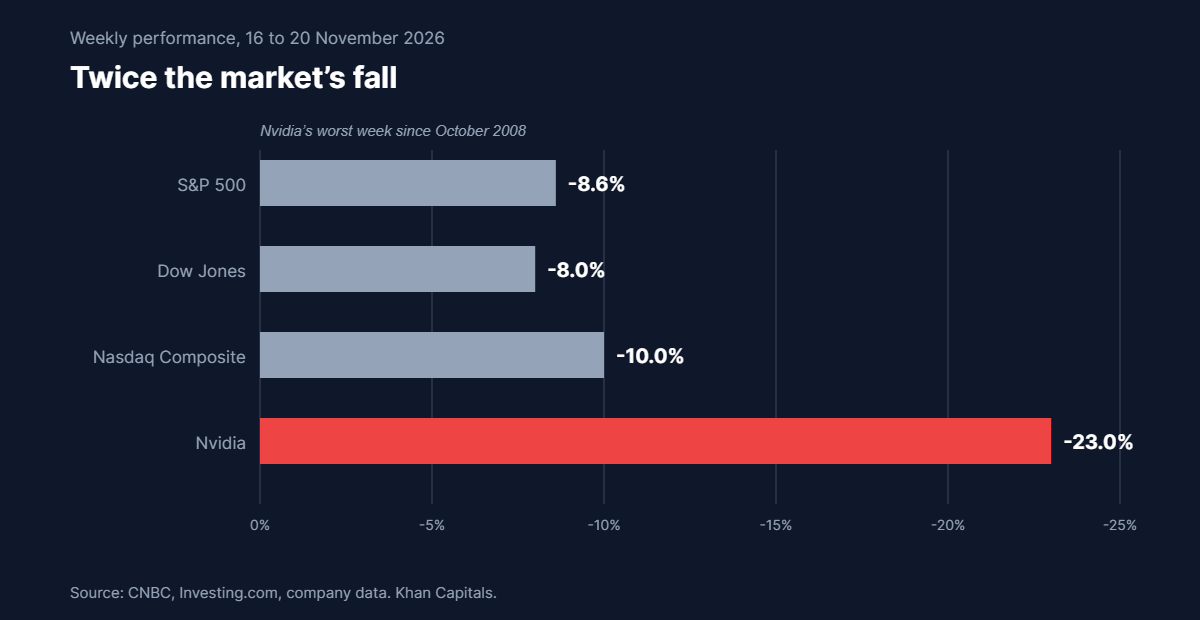
But the stock underperformed its own selloff by a wide margin, more than twice the Nasdaq’s weekly fall, and that excess is the legal discount. It contains at least three components: the probability-weighted cost of any eventual enforcement, which history suggests is small; the risk that discovery produces disclosures the market has not priced, which is unknowable; and the simplest one, the absence of a permanent chief executive to absorb the blow. Companies with founder-sized holes in the org chart trade badly in a crisis because nobody can credibly say the words “this ends here”.
What SEC inquiries of this kind usually become
Process matters more than headlines from here. A civil investigation is an evidence-gathering stage, not an accusation; the majority of such inquiries end without enforcement, and those that do produce action typically take a year or more to resolve. The staff would need to find not just imprecision but material misstatement or omission, and then the commission would need to vote to act. The 2022 case took roughly four years from conduct to settlement.
The scenarios worth holding in mind are therefore less about fines than about information. An inquiry that stays narrow, focused on the adequacy of leadership-related disclosure, is survivable noise. One that broadens into revenue recognition or customer-concentration disclosure would intersect with the questions the market is already asking about circular AI financing, and that combination, a legal process validating a market anxiety, is the genuinely dangerous version.
| Scenario | Character | Market relevance |
|---|---|---|
| Narrow and quiet | Inquiry confined to disclosure adequacy; closes without action or with a modest settlement | Legal discount decays; stock trades on fundamentals and CEO search |
| Formal and slow | Formal order, subpoenas, a year-plus of periodic headlines | Persistent overhang; every filing date becomes an event |
| Broad and compounding | Scope extends to revenue reporting; findings interact with AI financing concerns | Repricing extends beyond Nvidia to the whole AI complex |
The China question underneath
Strip away the personalities and the probe reports reduce to a question that has followed Nvidia since the export-control era began: how much of the company’s revenue depends, directly or indirectly, on Chinese demand it is not supposed to serve? Washington’s restrictions created a market in intermediaries, and Singapore’s outsized share of reported billings became the visible trace. Nvidia’s consistent explanation, that sales are invoiced where customers are headquartered rather than where chips end up, has always been plausible and has never fully satisfied sceptics.
The Megaspeed thread tightens that question rather than resolving it. A firm reportedly suspected by US intelligence officials of Chinese ties, employing an executive personally close to the former chief executive, is exactly the fact pattern that converts a trade-compliance debate into a disclosure one. The issue for the SEC, per the reporting, is not whether chips moved, that is the Justice Department’s lane, but whether shareholders were told what the company knew, and when.
For investors the distinction matters. Export-control findings, if any emerged, would mean a fine and a remediation programme. Disclosure failures on the scale implied by a 23 per cent weekly fall would need to touch the numbers themselves, and nothing reported so far alleges that. The gap between those two outcomes is where the stock now trades.
It is also where the hardest portfolio question sits. Nvidia’s index weighting means passive investors own this uncertainty whether they chose it or not, and the mechanical selling that follows from risk models rather than views has been part of every session this week. Crowding works both ways: the flows that amplified the rise are now amplifying the reassessment.
The governance vacuum underneath it
The probe reports would sting less with a permanent hand on the wheel. Colette Kress is a respected operator, and pairing the interim CEO role with the CFO seat concentrates both competence and workload in one person during the most scrutinised period in the company’s history. The board, now chaired for the first time by Harvey Jones, is reportedly weighing internal and external candidates, with public suggestions arriving from as far afield as the White House. Until that search concludes, every piece of bad news lands on a company whose answer to “who is in charge” is “for now”.
The derivative suit matters in this context too. It is aimed at the directors themselves, which tends to sharpen board risk aversion precisely when strategic decisions, about buybacks, about China exposure, about the CEO search, demand boldness. Governance risk is rarely about wrongdoing; it is about an institution’s capacity to act while defending itself.
Investor Implications
Within equities, the discipline is to separate three exposures that this week’s price action merged: Nvidia’s fundamental earnings power, which the Q3 report suggests remains formidable; the legal overhang, which history says is likely smaller than a 23 per cent week implies but which cannot be bounded until the scope is known; and the crowding unwind, which is a market-structure phenomenon that Nvidia happens to sit in the middle of. Investors may wish to note that the second and third tend to resolve on different clocks.
For credit and cross-asset investors, the channel is the AI capex chain. Nvidia’s customers and suppliers have financed an investment cycle against the assumption of uninterrupted momentum at its centre. A long legal overhang at the apex company raises the discount rate on the whole chain, from memory suppliers to the leveraged funds that carry the positions. The week showed how little new information that chain needs to reprice.
Conclusion
Nothing about the reported Nvidia SEC investigation is proven, confirmed or charged, and it may yet end the way the 2022 matter did, with a settlement smaller than a day of the company’s free cash flow. The market’s violence this week was less a verdict on legal risk than an admission about position size: when the most owned stock in the world acquires an unbounded unknown, the first response is to own less of it. The CEO search, the scope of the inquiry, and the December tape will decide whether this week was the repricing or merely the rehearsal.
Sources: InvestmentNews, Nvidia faces SEC probe; PYMNTS, SEC investigating whether Nvidia misled investors; Global Investigations Review, internal controls and disclosures likely focus; Nvidia Form 8-K, CEO transition, SEC EDGAR; The San Francisco Standard, Huang resignation.
Related Reading: The quarter itself is dissected in Nvidia Q3 earnings without Jensen Huang. The market structure behind the crowding is covered in the hedge fund deleveraging and the data-centre financing machine, while Micron’s blowout quarter the market would not chase shows how early the scepticism set in. For the week it all tipped over, see the November correction analysis.

Leave a Reply