

Khan Capitals | October 2026
Key Takeaways
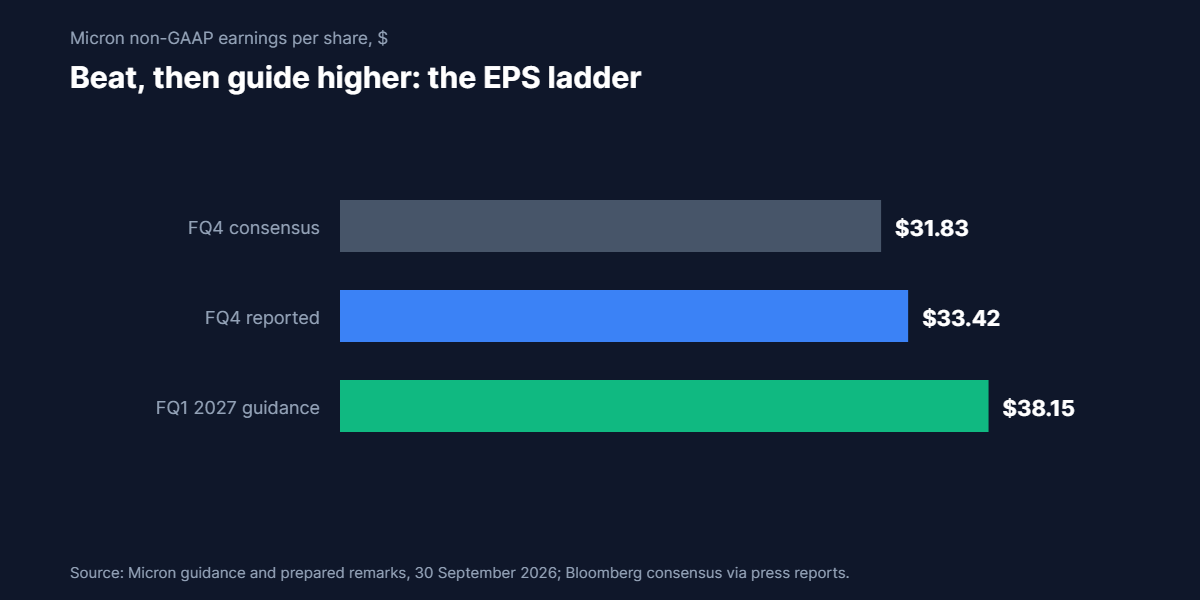
- A quarter with few precedents. Micron’s fiscal fourth quarter, reported on 30 September, delivered revenue of $54.2 billion, up 379 per cent year on year, with a non-GAAP gross margin of 87 per cent and earnings of $33.42 per share against consensus near $31.83, per the company’s prepared remarks and press coverage.
- Net income rose more than tenfold. Quarterly net income reached $37.7 billion against $3.2 billion a year earlier, with free cash flow of $33.2 billion. Full-year revenue hit a record $133.2 billion, and DRAM alone exceeded $100 billion.
- Guidance went higher still. Micron guided fiscal first-quarter revenue to roughly $61.5 billion and earnings near $38.15 per share, and said most of its calendar 2027 high-bandwidth memory supply is already under agreement at significantly higher prices.
- The market would not chase it. The shares eased after hours on the print and have barely rerated since, even after a 4 per cent rise on 7 October took the stock to $1,088, because investors are focused on a raised fiscal 2027 capex plan, roughly $2.5 billion of added operating expense and the eventual repayment of customer deposits.
- Pricing, not volume, is the engine. Analysts note the growth is driven almost entirely by selling prices under a worldwide memory supply crunch, which is why a stock up more than 500 per cent in a year now trades on the question of when the cycle peaks, not whether the demand is real.
Part of: The AI Infrastructure Supercycle — Khan Capital’s hub on the capital cycle behind artificial intelligence.
Micron Q4 Earnings: the Memory Cycle Goes Vertical
There is a version of this cycle in every commodity industry’s history: the moment the scarce input stops being priced like a component and starts being priced like a toll. Micron’s fiscal fourth quarter, published on 30 September, is that moment for memory. Revenue of $54.2 billion in thirteen weeks is more than the company generated in any full year before fiscal 2025. An 87 per cent non-GAAP gross margin, in an industry that spent 2023 selling DRAM below cost, has few parallels outside software. Micron Q4 earnings of $33.42 per share beat a consensus that had already been raised repeatedly through the quarter. And yet the stock’s reaction, a modest after-hours dip followed by a week of indecision, tells its own story about where the market believes we are in the cycle.
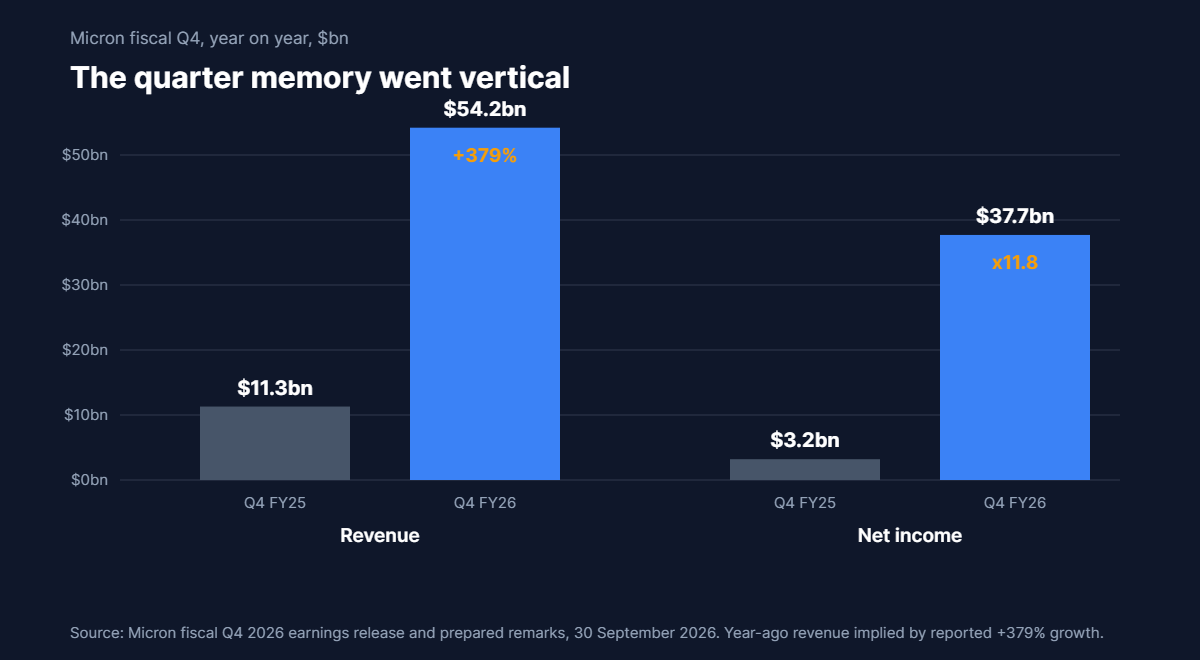
The scale of the year bears restating. Fiscal 2026 revenue of $133.2 billion is roughly three and a half times fiscal 2025. Data centre revenue grew about fourfold. Data centre SSD revenue alone reached nearly $10 billion in the quarter, more than ten times the year-ago level. Quarterly operating income of $44.6 billion exceeded the revenue of every semiconductor company bar a handful. For context within our own coverage, Nvidia’s $96 billion quarter in August was hailed as the AI trade’s proof of concept; Micron has now printed higher operating margins than the company that sits above it in the value chain.
How Memory Became the Bottleneck
The mechanics are worth separating from the euphoria. Memory was for decades the semiconductor industry’s most brutally cyclical segment: a commodity product, three large suppliers, demand that moved with PCs and phones, and margin cycles that regularly swung from 60 per cent to negative. Two things changed. First, AI training and inference turned out to be memory-bound as much as compute-bound: every accelerator needs a stack of high-bandwidth memory beside it, and every data centre needs an order of magnitude more conventional DRAM and NAND behind that. Second, the suppliers, scarred by the 2023 downturn, kept bit supply growth disciplined just as demand inflected.
The result is a genuine shortage. Micron’s management said on the call that it has no line of sight to when DRAM supply and demand will return to balance, and expects tightness to persist through fiscal 2027 and 2028. The clearest evidence is in the order book: most of Micron’s calendar 2027 high-bandwidth memory bit supply is already under agreement, at prices significantly higher year on year, and the company has begun ramping HBM4 while developing a custom HBM4E product with Nvidia. Customers are not negotiating price; they are paying deposits to reserve capacity, a practice more familiar from aircraft order books than from commodity silicon.
| Metric | Q4 FY2026 | Context |
|---|---|---|
| Revenue | $54.2bn | +379% year on year; FY26 total $133.2bn |
| Non-GAAP gross margin | 87% | Commodity memory at software margins |
| Operating income | $44.6bn | Quarterly figure; exceeds most chipmakers’ annual revenue |
| Net income | $37.7bn | Versus $3.2bn a year earlier |
| EPS (non-GAAP) | $33.42 | Consensus near $31.83 |
| Free cash flow | $33.2bn | Operating cash flow roughly $44bn |
| FQ1 2027 guidance | ~$61.5bn revenue, ~$38.15 EPS | Another ~13% sequential step-up at the midpoint |
The Print the Market Refused to Celebrate
By the standards of any earnings season, this was a blowout. By the standards the market now applies to the AI complex, it was merely sufficient. The shares slipped just under 1 per cent in after-hours trading on the night, to around $1,057, and spent the following week oscillating before a 4 per cent gain on 7 October carried them to $1,088. For a company that beat on both lines and guided 13 per cent higher sequentially, that is a conspicuously muted tape.
We have seen this grading curve before. Broadcom tripled its AI revenue in September and fell 5 per cent on a guidance figure fractionally light; Nvidia spent a year unable to rally on record quarters until August’s print finally cleared the bar. The pattern is consistent: when a stock has already priced a flawless future, the earnings report stops being information about the company and becomes a referendum on the multiple. Micron is up more than 500 per cent in a year, within sight of its 52-week high of $1,255 against a low of $165.50. At that altitude, an 87 per cent margin is not a surprise; it is the assumption.
What the Bears Heard: Capex, Costs and Deposits
Three details in the release gave the sceptics their material. First, capital expenditure is accelerating: roughly $11.5 billion in the current quarter, around $25 billion in the first half of fiscal 2027, and a raised full-year plan weighted towards construction, including cleanroom space that will not produce bits until late calendar 2028 and beyond. Second, operating expenses are set to rise by about $2.5 billion in fiscal 2027, driven by research and development and incentive pay. Third, and least discussed, Micron’s balance sheet carries roughly $22 billion of customer deposits, prepayments for future supply that will one day be worked off as discounted shipments or refunded if the demand behind them fades.
Each item is individually defensible. Capacity additions are sold out years in advance; opex growth trails revenue growth by an enormous margin; deposits are a sign of customer desperation, not weakness. Collectively, though, they describe a company spending into the boom at precisely the moment its customers, the hyperscalers whose compute commitments were laid bare in the Anthropic prospectus, face their own questions about the durability of AI revenue. The memory industry’s defining pathology has always been that supply arrives in lumps, timed for the peak. The bet embedded in Micron’s capex plan is that this time the demand curve keeps rising to meet it.
Pricing-Led Growth and the Question It Begs
The most important analytical point about this quarter is also the simplest: the growth is almost entirely price. Morningstar’s analysis notes that revenue growth was led nearly entirely by pricing, with bit shipments growing far more modestly. That is what a shortage looks like, and it cuts both ways. Price-led revenue converts to margin at an extraordinary rate on the way up, which is how a memory maker reaches 87 per cent gross margin. But it also means the revenue base rests on a spot-market condition rather than a volume franchise. When supply catches up, and the entire history of the industry says it eventually does, prices do not plateau; they revert.
The bulls’ counter is the contract structure. With most of calendar 2027 HBM supply pre-sold at higher prices, with deposits taken, the next two years of revenue are less spot-exposed than any prior cycle. The honest answer is that both things are true: the near-term numbers are substantially locked, and the terminal-value question, what a memory company earns in a balanced market, is entirely open. A $1,088 share price capitalises the locked years and then extrapolates them. DA Davidson’s price-target move on 7 October, from $2,100 to $3,000, is an explicit bet on extrapolation.
The Supercycle Thesis Meets Its Purest Test
Micron has become the cleanest single expression of the AI infrastructure trade, cleaner in some respects than Nvidia. Nvidia’s moat is architectural and could in principle be competed away; memory’s constraint is physical, measured in cleanrooms and lithography slots that take years to add. If one believes the data centre buildout continues on anything like its current trajectory, memory scarcity is the hardest bottleneck to relieve, and Micron, as the only US-headquartered DRAM maker, is structurally positioned within it. That is the thesis a 500 per cent rally has already priced.
The risk is symmetrical. Because Micron sits at the bottom of the AI value chain, it is the first to feel any deceleration above it. A hyperscaler pausing data centre starts shows up in GPU orders with a lag, but in memory spot prices almost immediately. September’s AI safety selloff was a reminder of how quickly the complex reprices when the narrative wobbles; the Philadelphia Semiconductor Index fell 5.9 per cent in a day on no change in fundamentals. A stock at 87 per cent gross margin with a 2028 construction pipeline is, in effect, a long-duration asset on AI demand, and it will trade with that duration in both directions.
Scenarios for the Cycle From Here
| Scenario | Mechanism | What it implies |
|---|---|---|
| Bull: shortage persists into 2028 | AI demand outruns disciplined supply additions; HBM4 ramps at premium pricing; deposits convert to locked revenue | Guidance keeps rising; the FQ1 $61.5bn becomes the new baseline; extrapolation targets like $3,000 stay in play |
| Base: tightness, then normalisation | Contracted 2027 holds, but new cleanroom capacity and competitor supply growth balance the market thereafter | Earnings stay elevated through FY27 while the multiple compresses; the stock ranges as locked years roll off |
| Bear: demand pause meets supply lump | Hyperscaler capex decelerates as new capacity lands; price-led revenue unwinds faster than volume grows | Margins mean-revert towards historic cycle peaks; deposits are refunded or worked off at lower prices; classic memory downcycle |
Investor Implications
Equities. Within the AI complex, the quarter reinforces the shift of value capture down the stack: from models to accelerators to, now, the raw inputs of memory and power. The second-order beneficiaries, memory-adjacent equipment makers, HBM packaging suppliers and the other two DRAM majors, offer the same cycle with different multiples attached. The discipline the moment demands is distinguishing between businesses whose revenue is contracted and those merely adjacent to the shortage. For the broader index, Micron’s result is a reminder that the earnings growth holding up the record-high market is real but concentrated; the S&P 500’s Q3 season, with close to 30 per cent earnings growth expected, leans heavily on this handful of names.
Fixed income. Memory pricing is quietly becoming a macro variable. Server DRAM and NAND costs feed data centre construction budgets, and ultimately the capex lines of the investment-grade issuers funding the buildout with debt. A persistent memory shortage raises the cost per megawatt of AI capacity at the same time as long-end yields near 2002 highs raise the cost of financing it, a squeeze that will eventually show in credit selection among hyperscaler and utility issuers.
Cross-asset. The quarter strengthens the case that the AI buildout is inflationary at the margin: scarce inputs repricing sharply, from memory to turbines to electricity. For a Federal Reserve already hiking against supply-driven inflation, a capital cycle this hot in the economy’s fastest-growing sector complicates any dovish turn. The AI trade and the rates market are no longer separable stories.
What to Watch
- 14 October: Micron trades ex-dividend ($0.15, payable 29 October), a token payout whose future growth, or conversion into buybacks, will signal how management intends to return the cash flood.
- Late October onwards: hyperscaler Q3 earnings and their capex guidance, the demand side of the memory equation. Any moderation in data centre spending plans hits memory pricing assumptions first.
- December 2026: Micron’s fiscal Q1 report, the first test of the $61.5 billion guidance and of whether HBM4 ramp costs begin to pressure the 87 per cent margin.
- Through Q4: competitor supply announcements from the other DRAM majors; the speed of industry capacity response is the single variable that ends pricing-led cycles.
Conclusion
Micron’s fiscal fourth quarter will be cited for years, either as the moment the memory supercycle proved itself or as the top ticket of the AI capital cycle. The numbers themselves are not in dispute: a 379 per cent revenue increase, an 87 per cent gross margin and a tenfold rise in net income describe a genuine, physical shortage of the commodity the AI economy runs on. What is in dispute is duration. The market’s refusal to rerate the stock on a historic beat says investors are already paying for the locked years and demanding proof of the unlocked ones. That proof will come not from Micron’s own releases but from its customers’ capex budgets and its competitors’ cleanroom schedules. In commodity cycles, the reported quarter is always the lagging indicator; the order book, and who is still paying deposits a year from now, is the leading one.
Sources: Micron Technology, Fiscal Q4 2026 Earnings Call Prepared Remarks; CNBC, Micron Q4 earnings report 2026; Yahoo Finance, Micron tops Q4 estimates; Investing.com, Micron Q4 2026 earnings call transcript; Morningstar, Micron Technology; StockAnalysis, MU overview.
Related Reading: The grading curve that met this quarter was set by Broadcom’s record print sold on a decimal and finally broken by Nvidia’s $96 billion quarter. The demand side of the memory shortage runs through the $518 billion of compute commitments in Anthropic’s IPO prospectus, while September’s AI safety selloff showed how fast the complex reprices. For the fundamentals, start with what high-bandwidth memory is and how earnings season works.

Leave a Reply