

Khan Capitals | October 2026
Key Takeaways
- Tesla beat on the headline and fell anyway. Adjusted earnings of 48 cents per share came in ahead of consensus estimates clustered between 43 and 45 cents, on revenue of $28.05 billion that was essentially flat year on year; the shares slipped after hours and were down around 4 per cent in Thursday’s pre-market.
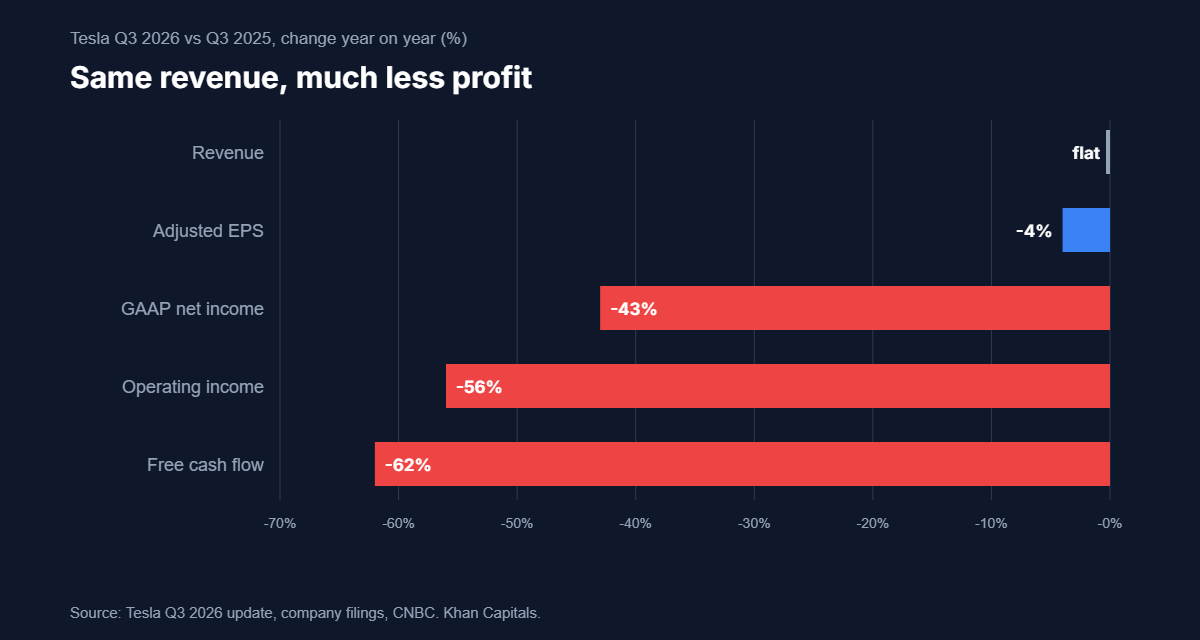
- The profit compression is severe. Operating income fell 56 per cent to $718 million, GAAP net income dropped 43 per cent to $787 million, and free cash flow fell 62 per cent to $1.53 billion, all on an unchanged top line.
- The money is going to superintelligence. Operating expenses rose on what Tesla calls super intelligence research, stock-based compensation and administrative costs, and the roughly $20 billion of 2026 capital spending, trimmed from $25 billion, is focused on AI compute infrastructure and new product capacity.
- The growth engine undershot. Energy storage deployments of 13.7 GWh grew 10 per cent year on year but missed consensus near 15.9 GWh, and energy revenue fell 16 per cent on tariff-related customer refunds; deliveries of 486,532 vehicles were slightly below a year earlier.
- Robotaxi is now an operating business. Cybercab operations began in Austin on 3 September within a company-owned fleet, with Dallas scheduled next month; the valuation question has shifted from whether the services launch to what they earn.
Part of: The AI Infrastructure Supercycle – Khan Capital’s hub on the AI build-out, its financing and its market consequences.
The Tesla Q3 2026 earnings report is a document about a company in the middle of changing what it is. The headline said beat: 48 cents of adjusted earnings against expectations in the mid-40s. The income statement underneath said something else: flat revenue, an operating margin compressed to around 2.6 per cent, and a free cash flow line one third of its year-ago level, with the difference consumed by a research programme Tesla now describes, without qualification, as super intelligence. The market read both messages and chose the second, selling the shares after hours and into Thursday’s pre-market. In a week when the bond market has already begun interrogating the AI capex cycle, Tesla volunteered itself as the clearest test of what investors will pay for conviction.
Tesla Q3 2026 Earnings by the Numbers
Revenue of $28.05 billion was little changed from a year earlier, held up by 486,532 vehicle deliveries, slightly below the 2025 quarter, and a services business that continues to grow around the core. Adjusted earnings per share of 48 cents beat consensus but fell 4 per cent from the 50 cents reported a year ago. The GAAP picture was harsher: net income of $787 million, down 43 per cent, and operating income of $718 million against $1.62 billion in the prior-year quarter, a 56 per cent decline that CNBC flagged as the quarter’s defining number. Free cash flow of $1.53 billion was down 62 per cent year on year even as the full-year capital spending guide was cut to roughly $20 billion from the $25 billion projected earlier.
A flat top line with a collapsing bottom line is normally a gross margin story. Here it is mostly an operating expense story. Tesla attributed the rise in costs to higher spending on super intelligence and other research projects, stock-based compensation and administrative expenses. In other words, the factories are not the problem; the ambitions are the expense. That distinction matters for how the quarter should be read, because research spending is discretionary in a way that production costs are not. Tesla is choosing this income statement.
| Metric | Q3 2026 | Change / context |
|---|---|---|
| Revenue | $28.05bn | Roughly flat year on year |
| Adjusted EPS | $0.48 | Beat consensus of $0.43-0.45; down 4% from $0.50 |
| GAAP net income | $787m | Down 43% year on year |
| Operating income | $718m | Down from $1.62bn: a 56% decline |
| Free cash flow | $1.53bn | Down 62% year on year |
| Vehicle deliveries | 486,532 | Slightly below Q3 2025 |
| Energy storage deployed | 13.7 GWh | Up from 12.5 GWh; consensus near 15.9 GWh |
| 2026 capex guide | About $20bn | Cut from $25bn; focused on super intelligence compute |
The Superintelligence Pivot
The most consequential line in the release is not a result but an allocation. Capital expenditure of roughly $20 billion this year is, in Tesla’s words, focused on super intelligence compute infrastructure and manufacturing capacity for new product lines. That sentence quietly reorders the company’s identity: the marginal Tesla dollar no longer buys vehicle capacity, it buys GPUs and the data centres to house them. The cut from $25 billion reads at first as discipline, and the market initially took it that way in Wednesday’s regular session, which closed higher. The after-hours reversal came as investors worked through the implication: lower capex with sharply higher research opex is not retrenchment, it is a transfer from the measurable business to the speculative one.
Tesla is making the same wager as the hyperscalers, that enormous near-term compute spending converts into a durable AI franchise, but it is making it from a smaller cash flow base. Alphabet, Microsoft and Meta fund their AI programmes from advertising and cloud annuities; Tesla is funding super intelligence from a car business whose operating income just printed $718 million for the quarter. The scale mismatch is the risk, and it is the same mismatch the credit market has been repricing across the AI complex, as we covered in the AI debt selloff and as Broadcom’s sold-off record quarter first signalled in September: the grading curve for AI spending has steepened everywhere. Separately, Quartz reported that a combination with SpaceX is being studied; the company did not address the report in its release, and we treat it as unconfirmed.
Energy: The Missing Gigawatt-Hours
The energy business was supposed to be the quarter’s engine, and it grew, just not by enough. Storage deployments of 13.7 GWh were up from 12.5 GWh a year earlier but well short of the roughly 15.9 GWh analysts expected, according to Electrek. Energy revenue fell 16 per cent to $2.9 billion, which Tesla attributed in part to tariff-related customer refunds, an echo of the trade frictions that have run through this earnings season. The segment’s reported gross margin actually rose to 33.1 per cent, flattered by those same tariff refunds and cell-related warranty cost reimbursements, a reminder that the cleanest-looking number in the release is also the most adjusted.

Robotaxi: Austin Live, Dallas Next Month
The quarter did deliver one unambiguous milestone: Cybercab operations began in Austin on 3 September, the first deployment of the purpose-built robotaxi into Tesla’s company-owned fleet, with Dallas scheduled for next month. For years the autonomy story was a slide; it is now a service with unit economics that will eventually appear in the segment disclosures. That cuts both ways. A live robotaxi business gives the superintelligence spending a visible commercial destination, and it also starts a clock: once the service reports, the market can price it on evidence rather than narrative, and the gap between the two is where the valuation risk lives.
How the Market Graded It
The shares rose 3.4 per cent in Wednesday’s regular session to $386.47, then gave it back and more: down between 2 and 3 per cent after hours as the call progressed, and around 4 per cent in Thursday’s pre-market, which CNBC tied to concern over the scale of investment in emerging technology. The pattern is now familiar across the AI complex. Broadcom fell on a record quarter in September; TSMC printed the strongest results of the cycle last week and was sold; Tesla beat and fell. The common thread is not the results, it is the discount rate the market now applies to promised AI returns, and Tesla’s quarter pushed more of its value into exactly that bucket. The reaction also fed a weak global tape, with Nasdaq futures down 1.2 per cent on Thursday morning as China’s CSI 300 confirmed a bear market.
Live Chart: Tesla (TSLA)
Investor Implications
Equities. Tesla has deliberately converted itself from a margin story into an optionality story, and optionality is the asset class this market is discounting hardest. The quarter establishes a cleaner framework than the old delivery-beat cadence: the bear case now has numbers (a 2.6 per cent operating margin, 62 per cent less free cash flow), and the bull case has dates (Dallas next month, superintelligence compute coming online through 2027). For the wider market, Tesla’s reaction confirms that even a beat cannot rescue AI-heavy spenders from the steepened grading curve, which matters for every Magnificent Seven report still to come this season.
Fixed income and credit. Tesla carries little debt relative to the AI build-out names, which is precisely why its pivot is informative: it shows the equity market repricing AI capex even where there is no credit channel to worry about. The read-across for the debt-funded tier, the neocloud operators and the hyperscaler bond complex, is that equity cushions for AI spending are being revalued downwards while yields sit at multi-decade highs, a combination that keeps refinancing risk the sector’s binding constraint.
Cross-asset. Tesla’s after-hours drop was one of the inputs that turned Thursday’s Asian session risk-off, feeding the session that confirmed China’s bear market. The AI trade increasingly behaves as one global position, and single-name earnings now carry index-level consequences in both directions. Volatility around the remaining megacap reports is likely to stay elevated into the 28 October FOMC decision.
What to Watch
- November: the Dallas robotaxi launch, the first expansion of Cybercab operations beyond Austin and the first test of how quickly the service scales across cities.
- 28 October: the FOMC decision; the discount rate applied to Tesla’s long-dated superintelligence returns is set in Washington as much as in Austin.
- Early January 2027: the Q4 production and deliveries release, which will show whether the vehicle base that funds the pivot is holding, and the full-year capex outturn against the $20 billion guide.
- Late January 2027: Q4 results, where the market will look for the first disclosure of robotaxi economics and the 2027 spending framework for super intelligence.
| Scenario | What it requires | What it implies |
|---|---|---|
| Bull: the pivot pays | Robotaxi scales across cities through 2027; superintelligence compute produces visible products; energy reaccelerates | Opex is re-read as investment; the multiple re-expands on a new franchise |
| Base: a long bridge | Autonomy grows city by city; core auto business stays flat; research spend persists | Earnings stay compressed for several quarters; the shares track evidence of robotaxi unit economics |
| Bear: the base erodes | Deliveries decline while research spending holds; storage keeps missing; rates stay high | Free cash flow approaches breakeven and the market prices the pivot as a cost, not an option |
Conclusion
Tesla’s third quarter was a beat in the narrowest sense and a repricing event in every other. The company told the market, more plainly than ever, that its future spending belongs to superintelligence rather than to the car business that still pays the bills, and the market responded by marking down the bills’ owner. None of this resolves the underlying question, which is whether $20 billion a year of compute and a live robotaxi fleet compound into a franchise worth more than the margin being sacrificed to build it. What the quarter does resolve is the standard of proof. With operating income at $718 million and free cash flow a third of last year’s, the era in which Tesla’s ambitions were funded by the benefit of the doubt has ended; from here, each city Cybercab enters and each superintelligence milestone will be priced against the cash it consumed. That is not a punishment unique to Tesla. It is the new rule for the whole AI trade, and this quarter made Tesla its most legible example.
Frequently Asked Questions
Did Tesla beat earnings expectations in Q3 2026?
Yes on the headline: adjusted earnings of 48 cents per share came in ahead of consensus estimates clustered between 43 and 45 cents, on revenue of about $28.05 billion. But adjusted EPS still fell 4 per cent year on year, GAAP net income dropped 43 per cent to $787 million, and operating income fell 56 per cent to $718 million.
Why did Tesla stock fall after the Q3 2026 earnings beat?
The market focused on the composition rather than the headline: flat revenue, sharply lower operating income and free cash flow down 62 per cent, with the difference going to super intelligence research, stock-based compensation and administrative costs. Investors are applying a steeper discount to promised AI returns across the sector, and Tesla moved more of its value into that bucket.
What is Tesla spending its capex on in 2026?
Tesla guided to roughly $20 billion of capital expenditure for 2026, cut from an earlier $25 billion projection, focused on super intelligence compute infrastructure and manufacturing capacity for new product lines. The reduction in capex is paired with higher research operating expenses, so total spending on the AI programme is rising rather than falling.
Is the Tesla robotaxi actually operating?
Yes. Cybercab operations began in Austin on 3 September 2026 within a company-owned fleet, and Tesla said the service will expand to Dallas next month. The business is live but its unit economics have not yet been separately disclosed, which is what investors will look for in coming quarters.
Sources: CNBC, Tesla Investor Relations, Electrek, The Motley Fool earnings call transcript, CNBC analyst roundup, Quartz.
Related Reading: The credit-market backdrop to the AI spending question is in The AI Debt Selloff: Eight Red Days for Chips and a Bond Market That Said No, and the grading curve that now meets every AI quarter was first visible in Broadcom AI Revenue Tripled to $16.7 Billion. The Stock Fell Anyway. For the supply side of the same trade, see TSMC Q3 2026 Earnings: A $46.7 Billion Record Sold Into the Chip Rout and Micron Q4 Earnings: An 87 Per Cent Margin and a Market That Would Not Chase It, while the global risk backdrop this quarter landed in is covered in China’s CSI 300 Enters a Bear Market. For the fundamentals, start with the difference between capex and opex and how revenue, profit and cash flow relate. The pattern extended beyond the AI complex in Netflix’s Q3 2026 beat at a 26-month low.

Leave a Reply