
Khan Capitals | September 2026
Key Takeaways
- Broadcom AI revenue reached $16.7 billion, up 221 per cent: Third-quarter consolidated revenue hit a record $29.6 billion, up 86 per cent, with artificial intelligence semiconductors accounting for 56 per cent of the total.
- The stock fell around 5 per cent on a guidance figure that was 0.7 per cent light: Broadcom guided fourth-quarter revenue to roughly $34.8 billion against an LSEG consensus near $35.03 billion, and the shares sold off in extended trading despite beating on both revenue and earnings.
- Custom accelerators are now the majority of the AI business: Management said custom XPUs represented roughly 73 per cent of AI semiconductor revenue, with Google’s Ironwood TPU shipping in volume and a first-generation OpenAI inference accelerator entering production.
- Gross margin is falling and operating margin is rising at the same time: Non-GAAP gross margin fell to 75.0 per cent from 78.4 per cent a year earlier as memory content increased, yet operating margin expanded to 67.9 per cent because operating expenses dropped to 7.1 per cent of revenue.
- The company put a $230 billion number on fiscal 2028: Broadcom said it has line of sight to approximately $115 billion of AI semiconductor revenue in fiscal 2027 and $230 billion in fiscal 2028, figures that depend on power, packaging and memory supply rather than on demand.
Part of: The AI Infrastructure Supercycle – Khan Capital’s hub on the AI infrastructure build-out.
A Quarter That Broke Its Own Scale
Broadcom AI revenue is now growing faster than most companies grow in a decade. In the three months to 2 August the company sold $16.7 billion of artificial intelligence semiconductors, a figure 221 per cent above the same quarter a year earlier and 54 per cent above the quarter immediately before it. Total revenue reached a record $29.6 billion, up 86 per cent. Non-GAAP earnings came in at $3.32 a share against a consensus near $3.24, and free cash flow of $13.7 billion equalled 46 per cent of revenue, a conversion rate that very few businesses of any size achieve.

The shares then fell roughly 5 per cent in extended trading. The proximate cause was a fourth-quarter revenue guide of approximately $34.8 billion against an analyst consensus around $35.03 billion, a shortfall of about $230 million, or seven tenths of one per cent, on a number that would still represent 93 per cent year-on-year growth. Put plainly, a company forecasting that it will almost double in size within a year was marked down because the doubling was not quite fast enough.
That reaction is the story, and it is not really a story about Broadcom. It is the latest data point in a pattern that has been building through this reporting season, visible in the way the market treated Samsung’s record guidance in July and, more recently, in the way it graded Nvidia’s $96 billion quarter. Beats are no longer sufficient. The market is running a grading curve on the artificial intelligence complex, and the curve moves with the bond market as much as with the order book.
Why $34.8 Billion Was Not Enough
A miss of seven tenths of one per cent on a forward revenue line is, in isolation, noise. Guidance at this scale is a judgement about shipment timing across a handful of enormous customers, and a fortnight of slippage on a single programme moves the figure by more than the gap in question. The reaction was disproportionate to the arithmetic, which usually means the arithmetic was not what moved the price.
Two things were doing the work. The first is positioning. Broadcom entered the print as one of the most crowded expressions of the artificial intelligence trade, carrying a valuation that priced acceleration rather than growth. When a stock is owned on the expectation of upward revisions, an in-line guide functions as a downgrade, because it removes the revision that was already in the price. This is the mechanism that turned IBM’s 3.7 per cent revenue miss into a $68 billion loss of market value in July, and it operates on the way up as well as the way down.
The second is the discount rate. The print landed in a week when the ten-year Treasury yield was pushing towards 4.80 per cent and the thirty-year was trading near multiyear highs, with traders buying protection against further losses in Treasuries. Long-duration equity, which is what a company priced on fiscal 2028 revenue is, becomes arithmetically less valuable when the rate used to discount those distant cash flows rises. The global bond selloff is not a separate story running alongside the artificial intelligence trade. It is the denominator underneath it.
Custom Silicon Stops Being a Side Bet
The more consequential disclosure had nothing to do with the guide. Management said custom accelerators, which Broadcom calls XPUs, made up roughly 73 per cent of AI semiconductor revenue in the quarter. On the reported figures that is something in the order of $12 billion of custom silicon in a single three-month period, from a product category that barely registered as a line item three years ago.
The customer detail matters more than the percentage. Broadcom shipped Google’s Ironwood tensor processing unit in high volume during the quarter and began production shipments of the following generation. It also shipped a first-generation custom inference accelerator for OpenAI, with further generations for OpenAI and Meta moving through development and production ramps. The Google relationship now sits inside a long-term agreement covering future accelerator generations and the networking that connects them.
This is the architecture question that the artificial intelligence build-out has been circling for two years. A general-purpose accelerator is the right answer when a buyer does not yet know what workload it will be running. Once a hyperscaler or a frontier laboratory has settled on a model family and can forecast inference volume, the economics change: silicon designed around one workload delivers more useful computation per watt and per dollar than silicon designed to do everything. Inference, which is repetitive and predictable in a way that training is not, is exactly the workload that rewards specialisation.
Broadcom’s position is not that it designs a better accelerator than the merchant alternative. It is that it supplies the design services, the high-speed interconnect, the memory integration and the packaging that a customer needs in order to build its own, and then sells that customer the Ethernet switching required to connect tens of thousands of the resulting chips. Management expects networking revenue to grow at a rate comparable to custom accelerators over the next several years. That combination is what makes the position defensible: a customer that switches accelerator vendors does not thereby switch the fabric.
The Margin Bill for Winning
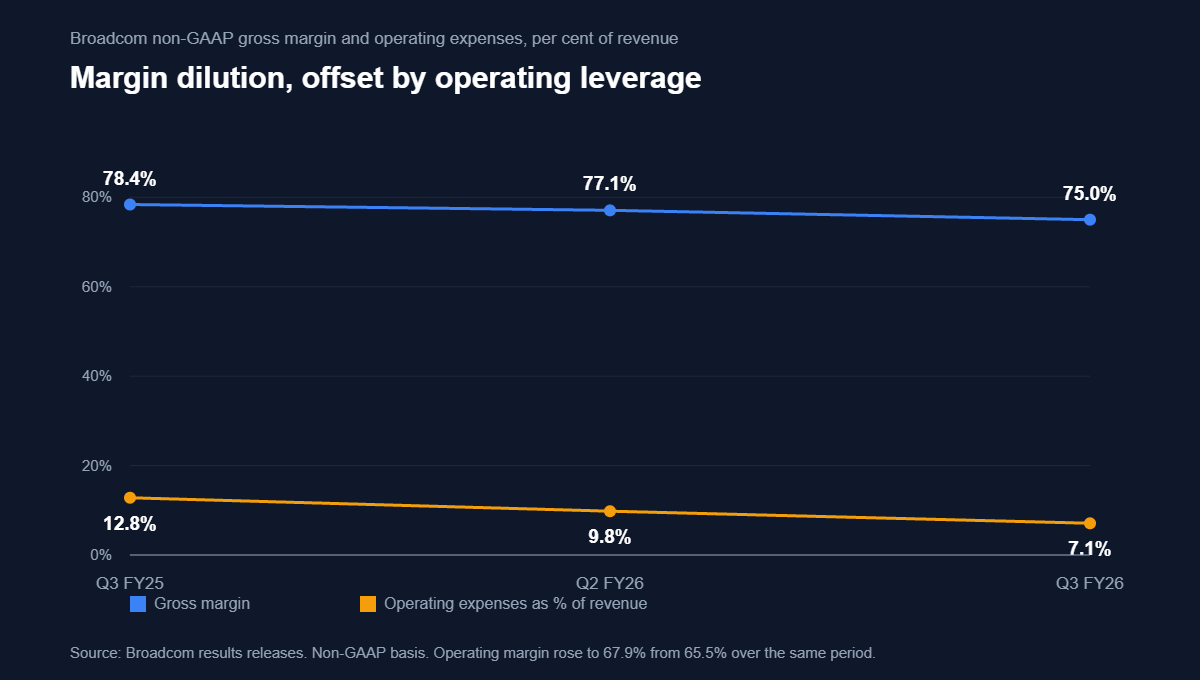
Winning this business costs something, and the cost is visible in the gross margin line. Non-GAAP gross margin was 75.0 per cent in the third quarter, down from 77.1 per cent in the second and 78.4 per cent a year earlier. Management was explicit about the driver: higher XPU volumes carry more high-bandwidth memory and more advanced packaging content, and that content passes through the income statement at a lower margin than the design and intellectual property that Broadcom has historically sold.
Read on its own, a 336 basis point fall in gross margin over twelve months looks like the classic warning sign of a business trading quality for volume. Read alongside the operating expense line, it looks like something else entirely. Non-GAAP operating expenses were $2.10 billion in the quarter, essentially unchanged from $2.04 billion a year earlier, while revenue rose by $13.6 billion. Operating expenses therefore fell from 12.8 per cent of revenue to 7.1 per cent. The result is that non-GAAP operating margin expanded to 67.9 per cent from 65.5 per cent, even as gross margin contracted sharply.
That is the real shape of this business at present: mix is diluting the top of the income statement and scale is more than repairing it further down. The question is how long the second effect outruns the first. The fourth-quarter guide offers a clue that received less attention than the revenue number. Management guided non-GAAP operating income to approximately 66 per cent of revenue, which on the guided revenue base implies roughly 190 basis points of sequential margin compression. Operating expenses cannot fall as a share of revenue indefinitely, and memory content per accelerator is going up, not down. Investors focused on the $230 million revenue gap arguably looked past the more informative disclosure.
The Half of the Company Nobody Discusses
Infrastructure software generated $8.75 billion in the quarter, up 29 per cent, and contributed 30 per cent of revenue. In any other company this would be the headline: a near $35 billion annualised software franchise growing at a pace most enterprise vendors would envy. Here it is a footnote, because the semiconductor segment grew 127 per cent and drowned it out.
It should not be a footnote, for two reasons. First, it is the part of the business that explains the cash conversion. Software revenue carries minimal incremental cost, requires no wafer allocation and consumes no capital expenditure, which is how a company can spend just $0.5 billion of capex against $14.2 billion of operating cash flow. Second, it is the part of the business that is not exposed to a handful of hyperscale customers making capital allocation decisions in unison. Enterprise virtualisation renewals do not cancel because a frontier laboratory changes its model roadmap.
The two halves are also starting to converge. Broadcom has been extending its virtualisation platform towards private artificial intelligence infrastructure, model serving and accelerator management for enterprises that will never buy a custom chip but will buy software to run someone else’s. Whether that becomes a material revenue line or remains a defensive feature is one of the more interesting open questions in the business, and it is not one the market spent any time on this week.
Reading a $230 Billion Line of Sight
Management said it expects approximately $115 billion of AI semiconductor revenue in fiscal 2027, that supply has been secured to support that figure, and that underlying customer demand is higher still. It went further and said it has line of sight to approximately $230 billion in fiscal 2028. Against fiscal 2026 AI revenue of around $58 billion, those numbers describe a business quadrupling in two years.
Numbers of that size deserve to be read carefully rather than dismissed or accepted. Three qualifications are worth holding onto. The first is that “line of sight” is not a backlog, and neither is it an order book in the contractual sense. It is a statement about identified programmes at identified customers, and programmes move.
The second is that management itself named the constraint, and it is not demand. Deployment depends on power availability, on data centre readiness, and on the supply of leading-edge wafers, advanced substrates and high-bandwidth memory. A chip that ships into a building without an electricity connection is revenue deferred, not revenue earned. The binding limit on the artificial intelligence build-out has been migrating steadily from silicon towards electricity and construction, a shift visible in CoreWeave’s backlog against its financing costs and in the capital expenditure lines of every hyperscaler.
The third is concentration. A small number of customers account for the overwhelming majority of this revenue, and those customers are among the few entities on earth capable of designing their own silicon and walking away. Broadcom’s defence is that it sits inside their design cycles for multiple generations and supplies the network as well as the compute. That is a genuine moat, but it is a moat around a very small number of castles.
| Measure | Q3 FY2026 | Q3 FY2025 | Change |
|---|---|---|---|
| Net revenue | $29,591m | $15,952m | +86% |
| AI semiconductor revenue | $16,700m | approx. $5,200m | +221% |
| Semiconductor solutions | $20,839m | $9,166m | +127% |
| Infrastructure software | $8,752m | $6,786m | +29% |
| Non-GAAP operating income | $20,095m | $10,455m | +92% |
| Non-GAAP diluted EPS | $3.32 | $1.69 | +96% |
| Free cash flow | $13,665m | $7,024m | +95% |
| Non-GAAP gross margin | 75.0% | 78.4% | -3.4pp |
Three Ways Fiscal 2027 Can Go
The gap between the $115 billion guide for fiscal 2027 and the $58 billion the company expects for fiscal 2026 is the single largest variable in the position. It is worth setting out what would have to be true in each direction, not to forecast a share price but to identify which evidence to watch.
| Scenario | FY2027 AI revenue | What would have to be true | Leading indicator |
|---|---|---|---|
| Upside | Above $125bn | Additional supply secured beyond the current plan; a further named custom customer converts to volume | New long-term agreements; memory and substrate pre-purchases |
| Central | Around $115bn | Existing programmes ramp on schedule and secured supply converts to shipments | Quarterly AI revenue tracking above $25bn through fiscal 2027 |
| Downside | $85bn to $100bn | Power and data centre readiness delay deployments; one large programme slips a generation | Hyperscaler capex guidance cuts; lengthening grid connection queues |
What the Selloff Actually Priced
It would be easy to characterise the reaction as irrational, and several commentators did. A more useful reading is that the market was pricing two things that the earnings release did not address. The first is the rate environment: the same session that produced this result also produced a bond market at multiyear yield highs and a Federal Reserve debate that has shifted, over a fortnight, from cuts towards a live September hike, a repricing that began when hot core inflation met the Jackson Hole keynote a week earlier. Every basis point on the long end reduces the present value of a business whose largest revenue years are being described in fiscal 2028 terms.
The second is the standard of proof. Through 2024 and much of 2025, the artificial intelligence complex was rewarded for growth of any description. Through 2026 it has been asked to demonstrate that the growth converts to cash, that the cash is not being recycled among a small circle of counterparties, and that the margins survive the mix. Broadcom answered the first question emphatically, with $13.7 billion of free cash flow, and answered the third question honestly, by admitting that gross margin is going down. Honest answers are not always rewarded on the day.
What to Watch
- 16 September: The Federal Open Market Committee decision, which sets the discount rate applied to every long-duration equity story including this one.
- Late October and early November: Hyperscaler third-quarter results and the capital expenditure guidance within them, the cleanest read on whether the deployment schedule behind the fiscal 2027 figure is holding.
- November: Nvidia’s next quarterly report, which will indicate whether custom silicon is taking share from merchant accelerators or whether both are simply riding the same expansion.
- December: Broadcom’s fourth-quarter results, where the guided 66 per cent operating margin becomes a reported figure and the memory dilution thesis is tested.
- Through the year: Any disclosure of new long-term custom silicon agreements, which is the mechanism by which the fiscal 2028 number either firms up or quietly recedes.
Investor Implications
Equities. The quarter reinforces a distinction that has been forming across the semiconductor complex all year, between businesses selling into the artificial intelligence build-out and businesses whose economics are set by it. Broadcom sits in the first group alongside the memory makers and the foundries, and its results tell investors more about the aggregate size of the build-out than about its own competitive position. For those tracking the sector, the margin trajectory is now at least as informative as the revenue trajectory, because it reveals how the value in an accelerator is being redistributed between design, memory and packaging. The concentration of revenue in a handful of buyers also means that position sizing across the complex may involve more correlated exposure than a sector-diversified holding suggests.
Fixed income. The financing of the artificial intelligence build-out has moved decisively into credit markets, and Broadcom sits inside that story as an issuer’s counterparty as much as a supplier: the largest private credit financing on record was arranged in part against artificial intelligence hardware, a transaction we covered when the $35 billion package began trading. Investors in that paper are, in economic substance, taking exposure to the same deployment schedule that underpins Broadcom’s fiscal 2027 figure. A slip in one is a slip in the other.
Cross-asset. The clearest lesson of the session is the sensitivity of long-duration equity to the long end of the curve. With the thirty-year Treasury near its highest since before the financial crisis, the artificial intelligence trade is being valued in an environment its 2023 and 2024 vintage was not. Observers may find that rate volatility now explains more of the daily variance in these names than company-specific news does, which argues for watching the auction calendar alongside the earnings calendar.
Conclusion
Broadcom delivered the largest quarter in its history, tripled its artificial intelligence revenue, converted nearly half of that revenue into free cash flow, and told investors it can see a business four times the current size within two years. It was marked down for a guidance figure that fell seven tenths of one per cent short of an estimate that did not exist three months ago.
The instinct is to call that absurd, and on the arithmetic it is. But the reaction is legible once the frame is widened. A stock priced for acceleration needs acceleration to be delivered continuously, and a stock whose value sits in cash flows two and three years out needs a discount rate that is falling rather than rising. Neither condition held this week. The build-out has not slowed; the terms on which the market is willing to finance it have tightened. Those are different things, and the distinction between them is likely to determine how the rest of this cycle is priced.
Frequently Asked Questions
What is an XPU and how does it differ from a GPU?
XPU is Broadcom’s term for a custom artificial intelligence accelerator designed for a specific customer and workload. A graphics processing unit is a general-purpose accelerator sold to many buyers, whereas an XPU is co-designed with one buyer around its own models. The trade-off is flexibility for efficiency: a custom part delivers more useful computation per watt on the workload it was built for, and rather less on anything else.
Why did Broadcom shares fall after such a large beat?
The fourth-quarter revenue guide of approximately $34.8 billion sat marginally below an analyst consensus near $35.03 billion. Because the shares had been priced for continued upward revisions, a guide in line with expectations removed the upgrade that was already embedded in the valuation. Rising long-term interest rates in the same week compounded the effect on a stock valued largely on distant cash flows.
Why is Broadcom’s gross margin falling while revenue grows?
Custom accelerators carry substantially more high-bandwidth memory and advanced packaging content than the design-led products Broadcom has historically sold, and that content passes through at a lower margin. Non-GAAP gross margin fell to 75.0 per cent from 78.4 per cent a year earlier for this reason. Operating margin nonetheless rose, because operating expenses grew far more slowly than revenue.
How reliable is the $230 billion fiscal 2028 figure?
It is a statement of identified customer programmes rather than a contracted backlog, and management has been clear that the constraint is deployment rather than demand: power availability, data centre readiness and the supply of leading-edge wafers, substrates and memory. It should be treated as a description of the opportunity the company can currently see, not as a commitment.
Sources: Broadcom third quarter fiscal 2026 results release · Broadcom investor relations · Broadcom Form 8-K exhibit, SEC EDGAR · CNBC on the guidance reaction · Converge Digest on the XPU and networking mix · Bloomberg on Treasury hedging demand · Broadcom leadership
Related Reading: This quarter belongs to a sequence we have tracked all year, beginning with the market’s decision to sell record results in Samsung’s ₩89 trillion quarter and continuing through Nvidia’s $96 billion print, the first in a year the market chose to buy. For the capital expenditure that funds all of it, see the week the market graded AI capex line by line, and for the debt-funded end of the build-out, CoreWeave’s $104 billion backlog and its $640 million interest bill. The rate backdrop that framed this week’s reaction is set out in the global bond selloff. For the fundamentals, start with high-bandwidth memory, explained. See also revenue, profit and cash flow.

Leave a Reply