
Khan Capitals | July 2026
Key Takeaways
- A bidding war is now live. The Apollo easyJet takeover bid of 715 pence per share, worth roughly £5.7 billion ($7.6 billion) fully diluted, has displaced Castlelake’s 690 pence proposal, with the board stating it is “minded to recommend” the higher offer.
- The clock is set by the Takeover Code. Castlelake must bid higher or withdraw by 3 August; Apollo faces a 7 August deadline to table a firm, fully funded offer. Neither proposal is yet binding.
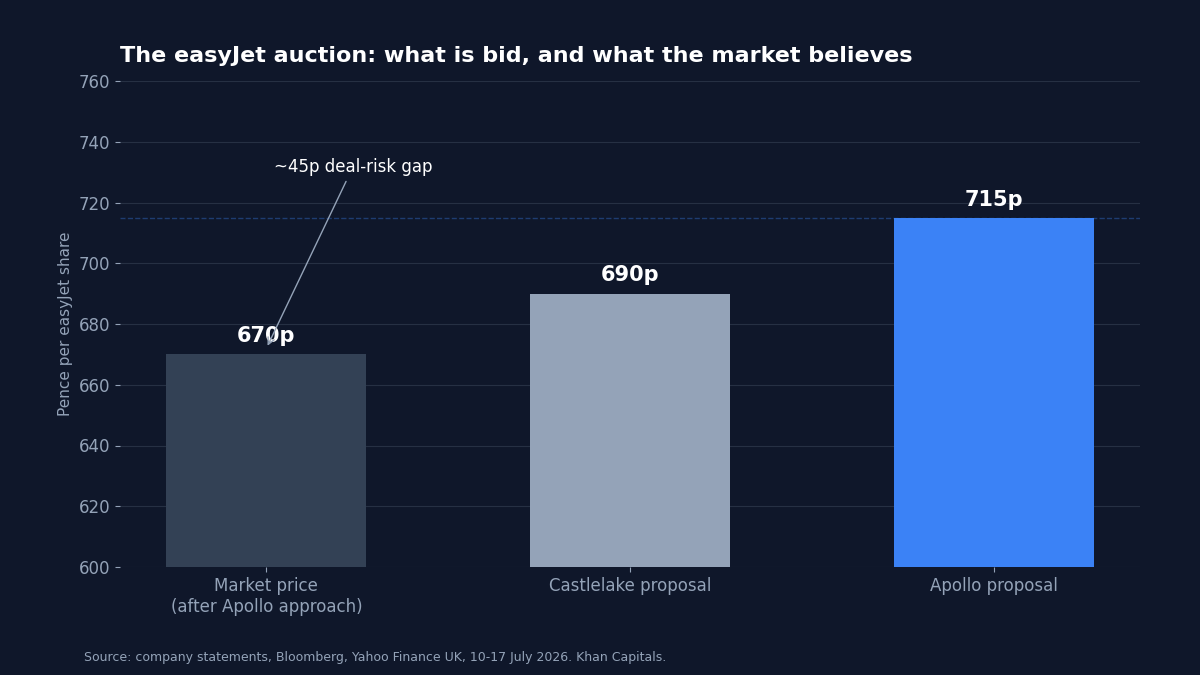
- The market believes, mostly. easyJet shares jumped roughly 14 to 15 per cent on the Apollo approach to trade near 670 pence, still well below the 715 pence on the table: a gap that prices regulatory, funding and execution risk.
- The assets explain the appetite. easyJet operates more than 360 Airbus A320-family jets with 277 aircraft on order at an estimated $18.3 billion delivery value, plus scarce slots at Gatwick, Geneva and Paris: hard collateral of the kind private capital prizes.
- London’s valuation problem is the subtext. That two US buyout firms are fighting over a FTSE airline at a premium the public market never paid is the latest data point in the UK’s long-running take-private wave.
Part of: Private Credit & Private Markets – Khan Capital’s hub on private credit and private markets.
Two Buyout Giants, One Orange Airline
Takeover battles for FTSE companies usually build slowly. This one detonated. On Friday 10 July, easyJet’s board disclosed that it had received a 715 pence per share proposal from Apollo Global Management, valuing the airline at about £5.7 billion on a fully diluted basis, and that it was consequently “no longer minded to recommend” the 690 pence offer from Castlelake it had agreed in principle only days earlier. The Apollo easyJet takeover bid, in a single announcement, turned an orderly take-private into a contested auction between two of the largest American alternative asset managers.
The shares responded the way shares do when a floor becomes a ladder: up roughly 14 to 15 per cent to around 670 pence, a level last seen in early 2022, per Yahoo Finance UK’s coverage. Under Britain’s takeover rules, Castlelake now has until 3 August to raise its proposal or walk away, and Apollo has until 7 August to convert its indication into a firm, fully funded offer. Nothing is signed. Both proposals could still evaporate. But the board’s public switch of allegiance makes 715 pence the reference price, and anything below it now reads as a discount.
| Term | Castlelake | Apollo |
|---|---|---|
| Latest proposal | 690p per share | 715p per share |
| Implied equity value | ~£5.5 billion | ~£5.7 billion ($7.6bn) |
| Board stance | No longer minded to recommend | Minded to recommend |
| Deadline | 3 August 2026 | 7 August 2026 |
| Brand commitment | n/a | Retain easyJet name via easyGroup licence |
What a Buyout Firm Sees in an Airline
Airlines were long considered private equity poison: cyclical, capital-hungry, unionised, and hostage to fuel prices. The interest in easyJet says something has changed in how private capital reads the sector, and the change is visible on the balance sheet. easyJet operates a fleet of more than 360 Airbus A320-family aircraft and holds orders for 277 more with an estimated delivery value of $18.3 billion, per Aerotime’s analysis. In a world where Airbus and Boeing delivery slots are rationed years ahead, an order book of that size is not a liability schedule; it is a scarce asset with a secondary-market value of its own.
Add the slot portfolio at capacity-constrained airports, Gatwick above all, plus Geneva and Paris, and the airline starts to resemble the kind of asset-backed, cash-generative business that firms like Apollo have spent a decade financing through their credit arms. Castlelake, for its part, is an aviation specialist that has spent twenty years buying, leasing and financing aircraft; it knows precisely what an A320 order book is worth. This is not tourist money discovering airlines. It is the aircraft-finance complex concluding that the equity is cheaper than the assets.
The operating model helps the arithmetic. Low-cost carriers of easyJet’s type earn a growing share of revenue from ancillaries, seat selection, bags, and, in easyJet’s case, a package holidays arm that has scaled rapidly on the back of the airline’s own seat inventory. Those revenue streams are higher-margin and less fuel-sensitive than the base fare, which flattens the cycle that historically frightened financial buyers away. A buyer underwriting the business today is underwriting a travel platform with an airline attached, funded at fixed prices through an order book negotiated before the current aircraft shortage repriced every delivery slot in the industry.
The Price of Being Public in London
The uncomfortable question for London is why the public market never paid what two private bidders are now competing to pay. Before the bid interest emerged, easyJet traded far below its pre-pandemic levels even as its fleet, network and balance sheet recovered. The pattern is familiar: UK-listed companies trading at persistent discounts to intrinsic value, followed by private capital arriving to close the gap, one delisting at a time. The London market has lost dozens of listed companies to take-privates and takeovers in the past few years, and the FTSE 250 in particular has functioned as a shopping aisle for dollar-funded buyers.
Sterling weakness, shallow domestic equity demand after years of pension de-equitisation, and a political backdrop that has kept the gilt market on edge all contribute to the discount. A contested auction for one of Britain’s best-known consumer brands, conducted entirely between two American buyers, is the kind of event that concentrates minds in Westminster and the City. Whatever the outcome, the message to other undervalued UK mid-caps is uncomfortable: if the market will not re-rate you, someone will re-rate you privately.
The precedents are not obscure. Morrisons went to Clayton, Dubilier & Rice in a contested 2021 auction. Darktrace left for Thoma Bravo in 2024, the same year CVC and the Abu Dhabi Investment Authority took Hargreaves Lansdown private and Daniel Kretinsky’s EP Group agreed to buy Royal Mail’s parent. Each deal followed the same script now playing out at easyJet: a persistent public-market discount, an approach rebuffed as opportunistic, a raised offer, and a board conceding that certainty of cash today beats a re-rating the market had years to deliver and did not. The stock exchange’s response, listing reform and pension consolidation, is moving; the buyers are moving faster.
Apollo’s Expanding Footprint
For Apollo, the easyJet approach lands in the same month its credit arm began trading the largest private credit deal on record, the $35 billion financing for AI chip infrastructure it co-led with Blackstone. The two transactions could hardly be more different, one a leveraged bet on European short-haul travel, the other on data centre silicon, and that is rather the point. The alternative asset manager model has evolved into a permanent-capital machine that shows up on both sides of almost every large transaction: lender here, owner there, counterparty everywhere.
A £5.7 billion equity cheque for an airline is, by Apollo standards, a mid-sized commitment, and the firm has promised continuity where it matters for the brand: it has agreed to retain the easyJet name by extending the licence with easyGroup, the vehicle of founder Sir Stelios Haji-Ioannou, whose family still owns roughly 15 per cent of the airline. That stake makes Stelios the swing constituency in any offer. A bidder who wins the board but not the founder buys itself a noisy minority; both suitors know the history of Stelios campaigns against easyJet boards well enough to price the goodwill.
Reading the 45 Pence Gap
With the shares near 670 pence against a 715 pence proposal, the market is discounting the offer by roughly 6 per cent. That gap is the collective judgement on three risks. First, deal completion: neither proposal is a firm offer yet, and possible offers die quietly all the time. Second, financing: a buyout of this size requires a debt package assembled in a market that has spent the summer repricing risk around private credit redemptions and a live rate-hike debate. Third, regulatory friction: a US take-private of a major European carrier touches ownership-and-control rules for airline operating licences, which cap non-European ownership and have complicated airline deals before.
Set against those risks is the possibility the gap understates the upside: a genuine bidding war has its own momentum, and Castlelake, having been publicly outbid after agreeing terms in principle, must now decide whether to concede a two-decade specialism to a generalist rival or pay up. Auctions between a specialist who knows the assets and a giant with cheaper capital tend to end above the opening exchange, though there is no guarantee this one follows the pattern.
There is also a scenario the spread does not capture cleanly: a carve-up. Aviation deals of this size have historically attracted consortium structures, with one party taking the operating company and another financing the fleet. Castlelake’s two decades in aircraft leasing make it a natural fleet counterparty even in an Apollo-led outcome, and nothing in the Takeover Code prevents yesterday’s rivals from becoming tomorrow’s co-investors once a firm offer exists. Investors watching only the headline price may find the more interesting information in the structure that eventually surrounds it.
| Scenario | Path | Signal to watch |
|---|---|---|
| Castlelake counters | A raised bid above 715p by 3 August extends the auction | Any statement before the 3 August deadline |
| Apollo firms up | A binding 715p offer by 7 August; scheme timetable begins | Financing detail and easyGroup licence terms |
| Both walk | Shares likely retrace toward pre-approach levels | Deadline lapses without a firm offer |
Investor Implications
Equities. The 45 pence spread between the market price and the Apollo proposal is a classic merger-arbitrage setup with UK characteristics: binary around two dated deadlines, exposed to financing conditions, and with a founder stake large enough to shape the endgame. More broadly, the episode invites a re-screen of the UK mid-cap universe for asset-heavy names trading below replacement value; the private bid for easyJet will not be the last of its kind.
Fixed income. If a firm offer lands, the debt package will be a bellwether for European leveraged finance appetite in the second half, particularly for cyclical credits. The pricing and structure, bank-led, private credit, or a hybrid, will say a great deal about where the balance of power sits between syndicated markets and direct lenders after a turbulent summer.
Cross-asset. A completed deal would remove another sizeable equity from London’s shrinking market and add to the evidence that sterling assets are cheap to dollar-funded buyers. Positioning should reflect the persistent flow: UK public equity supply is contracting through takeovers faster than new listings replace it, a slow structural bid under the FTSE’s valuation floor.
What to Watch
- Late July 2026: easyJet’s third-quarter trading update, the last scheduled look at the operating business before the bid deadlines.
- 3 August 2026: Castlelake’s put-up-or-shut-up deadline: a higher bid extends the auction, a withdrawal leaves Apollo bidding against itself.
- 7 August 2026: Apollo’s deadline to table a firm, fully funded offer, including the financing detail the market needs to close the discount.
- Thereafter: any statement from easyGroup or Sir Stelios Haji-Ioannou, whose roughly 15 per cent family stake can accelerate or entangle either bid.
Conclusion
The Apollo easyJet takeover bid is three stories wearing one orange livery. It is a merger-arbitrage situation with clean deadlines and a knowable spread. It is a verdict on the London market, where a household-name airline had to attract two American buyout firms before the value of its fleet, slots and order book was marked anywhere near fair. And it is another exhibit in the file on private capital’s reach, with Apollo bidding for a European carrier in the same month it began trading the largest private credit deal ever printed. However the auction resolves by the August deadlines, the direction of travel is the same: assets the public market prices lazily are being repriced, permanently, in private.
Frequently Asked Questions
Who is trying to buy easyJet?
Two US investment firms are competing. Castlelake, an aviation-finance specialist, had agreed a proposal in principle at 690 pence per share, before Apollo Global Management tabled a higher 715 pence proposal worth about £5.7 billion that the easyJet board says it is minded to recommend. Neither is yet a binding offer.
What happens to easyJet shares if the takeover completes?
If a firm offer succeeds, shareholders would receive the offer price in cash for each share, currently indicated at 715 pence under the Apollo proposal, and the company would be delisted from the London Stock Exchange. Until an offer becomes binding and completes, the shares continue to trade normally and the outcome is not guaranteed.
Will easyJet keep its name under new ownership?
Apollo has said it intends to retain the easyJet brand by extending the existing licence with easyGroup, the company of founder Sir Stelios Haji-Ioannou, whose family owns roughly 15 per cent of the airline. The brand licence and the founder’s stake are both likely to feature in any final agreement.
Sources: Bloomberg; Euronews; Yahoo Finance UK; Aerotime; Aviation Week; easyJet newsroom.
Related Reading: Apollo’s twin engagements this month are best read together, starting with the $35 billion private credit deal that began trading last week and the longer view in our analysis of the alternative asset manager model under pressure. On the exit environment shaping private markets, see the reopened IPO window, and for the UK backdrop, the gilt market’s repricing of British fiscal credibility. For the fundamentals, start with how private equity differs from other funds. See also what private credit is. Apollo’s aviation push continued with its $10 billion Atlantic Aviation investment.

Leave a Reply