
Khan Capitals | July 2026
Key Takeaways
- A record by a wide margin. The SK Hynix Nasdaq listing raised $26.5 billion on 9 July, the largest first-time US share sale ever completed by a foreign company, surpassing the $25 billion Alibaba raised in 2014.
- Demand overwhelmed supply. The 177.9 million American depositary receipts, priced at $149 each, drew orders reportedly covering seven times the shares on offer; the ADRs opened at $170 on Friday 10 July and closed their first session at $168.01, a 13 per cent debut gain.
- This is a dual listing, not an IPO. SK Hynix has traded in Seoul since 1996; the Nasdaq line removes an access barrier for US investors rather than creating a new company, with each ADR representing one tenth of a Seoul-traded common share.
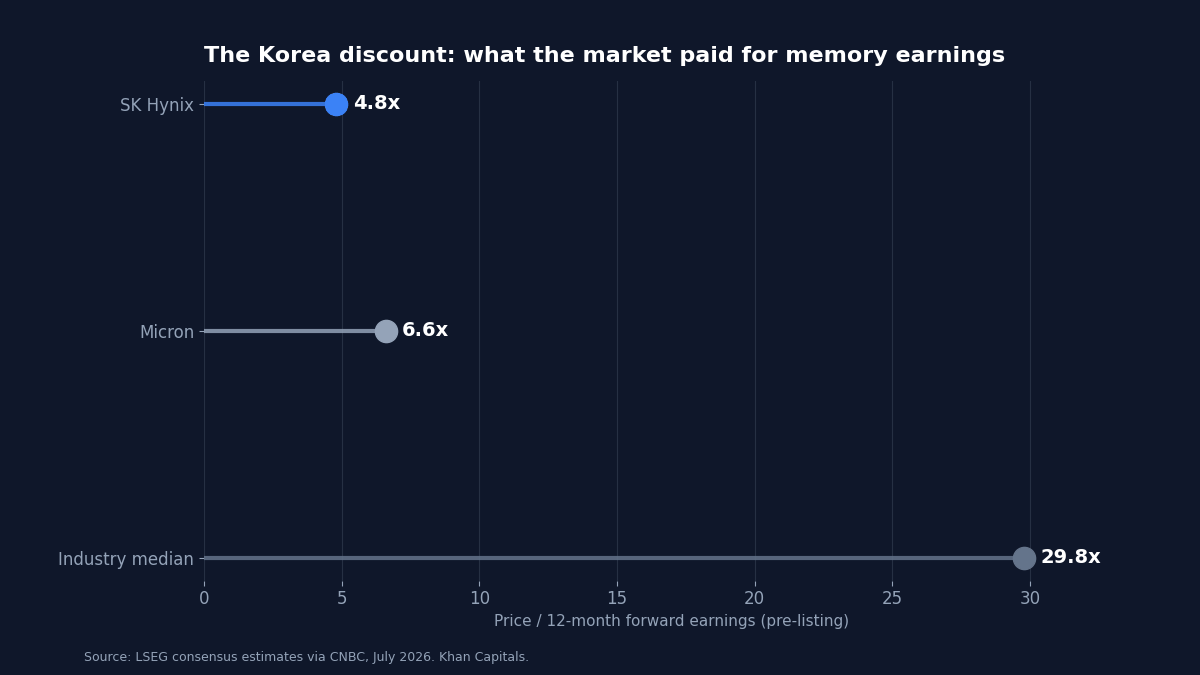
- The valuation gap is the story. The world’s dominant supplier of high-bandwidth memory came into the deal at roughly 4.8 times forward earnings, against 6.6 times for Micron and an industry median near 30 times: the “Korea discount” this listing is designed to close.
- Proceeds feed the supercycle. The company has earmarked the money for expanding its South Korean fabs and buying equipment, including extreme ultraviolet lithography scanners, capacity that arrives into the tightest memory market in the industry’s history.
Part of: The AI Infrastructure Supercycle – Khan Capital’s hub on the AI infrastructure build-out.
The Largest Foreign Debut in US Market History
Records in capital markets tend to be broken at the top of cycles, which is precisely why they deserve scrutiny rather than applause. On Thursday 9 July, SK Hynix priced 177.9 million American depositary receipts at $149 apiece, raising $26.5 billion in the largest first-time share sale a foreign company has ever completed in the United States. The previous record, Alibaba’s $25 billion New York debut, had stood since 2014. On Friday 10 July the ADRs opened on the Nasdaq at $170 under the ticker SKHY and closed at $168.01, a first-day gain of 13 per cent that added roughly $3.4 billion of paper profit for allocation holders in a single session.
The scale is easier to grasp in context. The SK Hynix Nasdaq listing raised more in one transaction than the entire US IPO market managed in some of the leaner quarters of 2022 and 2023. It landed barely a week after we noted that the IPO window had reopened on record first-half issuance, and it did so in a week when semiconductor shares were wobbling, not rallying. An offer of this size clearing at seven times oversubscription, per Bloomberg’s reporting of the order book, says the money queuing for AI infrastructure exposure remains far larger than the supply of instruments that provide it.

| Offering detail | Figure |
|---|---|
| Pricing date | Thursday 9 July 2026 |
| ADRs sold | 177.9 million (1 ADR = 1/10 common share) |
| Offer price | $149 per ADR |
| Proceeds | $26.5 billion |
| Reported oversubscription | ~7x before pricing |
| First trade / first close (10 July) | $170.00 / $168.01 (+13%) |
| Prior record (foreign US debut) | Alibaba, $25 billion (2014) |
A Thirty-Year Listing Problem, Solved in a Week
It is worth being precise about what this transaction is not. SK Hynix did not go public last week. The company has traded on the Korea Exchange since 1996, and its Seoul line continues alongside the new one. What priced on 9 July is a dual listing: a block of depositary receipts, each representing a tenth of a common share, that gives US and global investors a dollar-denominated, US-settled instrument in a company most of them could not previously hold without navigating Korean custody arrangements and won exposure.
The timing is not incidental either. Seoul’s market has spent two years debating corporate governance reform aimed precisely at closing the valuation gap on Korean assets, and SK Hynix has chosen the more direct route: rather than waiting for the discount to be legislated away, take the shares to where the marginal buyer lives. It is a template other Korean exporters will study closely. If a Nasdaq line meaningfully re-rates the country’s most profitable company, the pressure on Samsung and the rest of the large-capitalisation cohort to follow will be considerable, and the Korea Exchange will find itself competing for the liquidity of its own champions. Record proceeds are the headline; the precedent may matter more.
That access barrier was never a technicality. It shaped the shareholder register, and through the register, the valuation. Large pools of US capital, from index-constrained funds to retail platforms, simply never held the stock. The result was a persistent gap between what the company earned and what the market paid for those earnings, a gap wide enough that CNBC’s coverage of the debut led not with the record proceeds but with the question of whether the listing can finally close it.
The Korea Discount, Quantified
Coming into the offering, SK Hynix traded at roughly 4.8 times twelve-month forward earnings. Micron, its closest listed comparator and a company it out-earns and out-ships in high-bandwidth memory, traded at 6.6 times. The broader semiconductor industry median sat near 30 times. Micron has commanded an average 35 per cent premium to SK Hynix over the past thirteen years, a spread analysts attribute to easier US investor access, more shareholder-friendly capital returns, and the structural governance concerns that travel under the shorthand “Korea discount”.
What makes the discount remarkable in 2026 is the earnings base it is applied to. SK Hynix controls roughly 60 per cent of the market for high-bandwidth memory, the stacked DRAM that feeds every serious AI accelerator, and its annual revenue nearly tripled between 2023 and 2025 to about $65 billion. Analysts polled by LSEG expect revenue to more than triple again in 2026 as HBM contracts signed at supercycle prices flow through. A company with that profile trading below five times forward earnings is either the cheapest large-capitalisation growth story in the world or a warning that the market does not believe the earnings will persist. The listing forces a verdict: with the access excuse removed, whatever discount remains after the register rebuilds will be a judgement about memory cyclicality and governance, not plumbing.
| Company | Forward P/E (pre-listing) | HBM position | Listing access for US investors |
|---|---|---|---|
| SK Hynix | ~4.8x | ~60% share, lead supplier to NVIDIA | Seoul only until 10 July; now Nasdaq ADR |
| Micron | ~6.6x | Third supplier, ramping | Nasdaq (native) |
| Industry median | ~29.8x | n/a | n/a |
What $26.5 Billion Buys in a Memory Supercycle
The use of proceeds is unglamorous and deliberate: expansion of the company’s South Korean fabrication plants and equipment purchases, including extreme ultraviolet lithography scanners. In an ordinary cycle that would read as boilerplate. In this one it is the point of the exercise. High-bandwidth memory is the scarcest input in AI infrastructure, scarce enough that NVIDIA moved last month to lock up SK Hynix HBM supply directly, and scarce enough that memory pricing has begun to pass through to consumer device prices.
The capital raise therefore does two things at once. It funds the capacity that the entire AI complex, from hyperscalers to TSMC’s record backlog, is implicitly counting on. And it does so with equity rather than debt, at a moment when the offer could clear seven times over. Management sold shares into the strongest demand environment memory has ever seen, which is exactly when a cyclical company should sell them. The chairman told CNBC on debut day that demand is “enormous”; the balance sheet now reflects a decision to monetise that enthusiasm rather than merely enjoy it.
Reading the Order Book Against a Nervous Tape
The context for the debut makes the demand more interesting, not less. The listing landed in a week when the AI trade was anything but euphoric. Samsung had just guided to a record quarter and sold off anyway, and semiconductor indices spent the week under pressure. Seven-times oversubscription for a memory company, in a tape that was actively selling memory-adjacent records, is a revealed preference worth taking seriously: allocators wanted the asset, not the sector beta.
Part of the answer is structural. There are very few ways to own the AI memory bottleneck directly. Samsung is a conglomerate where memory shares the register with phones and appliances. Micron is the smaller player in HBM. SK Hynix is the pure exposure, and until Friday it was the pure exposure US capital could not easily hold. The order book was, in effect, a decade of pent-up demand clearing at once, the same dynamic that made the tech sector the best performer of the week at 3.4 per cent once the debut landed.
A Barometer for the Whole AI Trade
Record listings carry information beyond the issuer. Alibaba’s 2014 record marked peak enthusiasm for China internet exposure; the Deutsche Telekom and ENEL mega-listings of the late 1990s marked the top of the privatisation wave. The honest reading of history is that record-sized share sales cluster near the top of the theme that enables them, because that is when issuers are best paid to sell. That does not make SK Hynix a short; it makes the listing a timestamp. The AI infrastructure trade is now mature enough, and confident enough, to absorb a $26.5 billion single-name equity raise in a soft week for the sector.
The counterpoint is that this record, unlike Alibaba’s, is attached to delivered earnings rather than projected ones. The company sold $26.5 billion of new equity at under five times forward earnings; Alibaba listed at multiples several times richer. If the memory supercycle holds even approximately, the deal will look less like a top-tick and more like the moment the world’s cheapest AI major repriced. Which of those readings prevails is, in a real sense, the single most important open question in equities this year, and the aftermarket price of SKHY is now a daily, liquid referendum on it.
Investor Implications
Equities. The listing creates a new, liquid instrument at the centre of the AI complex and a clean pair against Micron. The valuation gap between the two is now a live trade rather than an academic observation: if the discount closes from the SK Hynix side, the re-rating case has legs; if it closes from the Micron side, the memory cycle is being marked down everywhere. Investors may also wish to monitor index eligibility, as inclusion decisions for the major benchmarks would trigger mechanical passive demand for the ADR line.
Fixed income. A $26.5 billion equity raise is capital structure de-risking on a grand scale. Funding fab expansion with equity rather than won-denominated debt is supportive for the company’s credit profile and, at the margin, for the broader complex of AI infrastructure borrowers whose spreads have been the market’s chosen worry since the $35 billion Apollo-Blackstone financing began trading.
Cross-asset. The deal is a data point on risk appetite that sits awkwardly with the caution visible elsewhere: record oversubscription for cyclical tech equity in the same fortnight that gold holds a bear market and rate-hike odds swing on every print. Positioning should reflect that capital is still chasing the AI theme through any instrument that offers it, and that the supply of such instruments is finally growing, which historically is how hot themes cool.
What to Watch
- Late July 2026: SK Hynix reports second-quarter results, its first print as a US-listed name, with the aftermarket’s verdict on the $149 offer price hanging on HBM shipment guidance.
- August-September 2026: index committee decisions on benchmark eligibility for the ADR line, the trigger for any mechanical passive bid.
- 16 September 2026: the FOMC decision, with a live hike debate that sets the discount rate against which all long-duration AI earnings are valued.
- Around year-end 2026: expiry of the customary post-offering lock-up window, the first scheduled test of insider supply against the new register.
Conclusion
The SK Hynix Nasdaq listing is the largest capital-markets expression yet of the AI infrastructure supercycle, and the most falsifiable. A record $26.5 billion raise, seven times covered, priced at under five times forward earnings, is simultaneously evidence of extraordinary demand and a company selling into it. The Korea discount now has nowhere to hide: with the access barrier gone, the market’s ongoing valuation of SKHY against Micron will reveal, week by week, how much of the gap was plumbing and how much was doubt. Records like this one tend to mark chapters. Whether this chapter is the middle of the supercycle or its late innings is the question the aftermarket has just been hired to answer.
Frequently Asked Questions
Can US investors now buy SK Hynix shares?
Yes. Since 10 July 2026, SK Hynix American depositary receipts trade on the Nasdaq under the ticker SKHY. Each ADR represents one tenth of a common share listed in Seoul, and the ADRs settle in dollars through US brokerage accounts like any domestic stock.
Was the SK Hynix Nasdaq listing an IPO?
Not in the strict sense. SK Hynix has been publicly traded in Seoul since 1996, so this was a dual listing of new American depositary receipts rather than a first sale of shares by a private company. It was, however, the largest first-time US share sale ever completed by a foreign company, exceeding Alibaba’s $25 billion debut in 2014.
Why did SK Hynix list in the United States?
Two reasons dominated: access and valuation. A Nasdaq line lets US institutional and retail capital hold the stock without Korean custody arrangements, and the company came into the deal at roughly 4.8 times forward earnings against 6.6 times for Micron, a gap known as the Korea discount that wider ownership is expected to narrow. The proceeds also fund fab expansion and equipment purchases in South Korea.
What does the listing mean for the AI memory market?
SK Hynix supplies roughly 60 per cent of high-bandwidth memory, the critical input for AI accelerators. The $26.5 billion raised is earmarked for capacity expansion, which the entire AI supply chain needs, and the listing gives investors a direct, liquid way to own that bottleneck for the first time on a US exchange.
Sources: Bloomberg; Bloomberg (debut); CNBC; CNBC (Korea discount); CNBC (profile); Al Jazeera; Fortune.
Related Reading: The listing caps a run of memory-market coverage that began with NVIDIA’s move to lock up SK hynix HBM supply and continued through Micron’s record quarter, Samsung’s ₩89 trillion quarter the market sold, and TSMC’s Q2 confirmation of the AI build-out. For the capital-markets backdrop, see our analysis of the reopened IPO window. For the fundamentals, start with high-bandwidth memory, explained and what an IPO actually is. The week’s other chip story was policy: Nvidia’s H200 shipments to China began. The sector-wide unwind that followed is analysed in The Semiconductor Bear Market.

Leave a Reply