
Khan Capitals | June 2026
Key Takeaways
- Prime Minister Keir Starmer announced his resignation on 22 June, with a successor expected by September. Sterling slipped to around $1.319, the 10-year gilt yield edged up to 4.85% and the FTSE 100 finished marginally lower: a strikingly muted reaction.
- The muted move is the story. The pound had already lost roughly 3% since February and 30-year gilt yields had touched levels last seen in 1998 near 5.85% in May, before retreating about 30 basis points. Markets had spent months pricing the political risk in advance.
- The Bank of England held Bank Rate at 3.75% on 18 June, but the vote split 7-2, with two members pushing for an immediate hike, up from one dissent at the previous meeting. Money markets price a rate rise as early as October or November.
- The succession matters less than the fiscal framework. Prediction markets make Andy Burnham the clear favourite, and he has indicated he would respect the existing fiscal rules. For gilts, the chancellorship and the autumn Budget arithmetic matter more than the name in Number 10.
- The long end is the pressure point. With inflation at 2.8% and forecast to rise above 3% by year-end, the 30-year gilt near 5.45% carries a term premium that reflects both a global long-bond repricing and a specifically British credibility test.
The Resignation the UK Gilt Market Saw Coming
When a British prime minister resigns, the textbook says sterling should lurch and gilts should gap. On 22 June, the UK gilt market did neither. The 10-year yield edged up to 4.85%, the pound eased to about $1.319, and the FTSE 100 drifted to a marginally lower close. For an event that ends a premiership barely two years old, the price action was closer to a shrug than a shock.
That calm was not complacency. It was the arithmetic of a risk that had been priced continuously for months. Sterling had already surrendered roughly 3% since February as the prime minister’s position weakened, and gilt yields had done their repricing in the spring, when the 30-year touched highs last seen in 1998. By the time the announcement came, confirmation had replaced surprise. The interesting question for investors is not why markets moved so little on the day, but what the slow repricing that preceded it says about how the UK now borrows, and what could disturb the uneasy equilibrium between now and the autumn.
From 1998-Era Highs to a Cautious Retreat
The spring set the scale. In May, 30-year gilt yields reached approximately 5.85%, their highest level since 1998, as a global long-bond selloff met a domestic political premium. The move was not uniquely British: Japanese and American long bonds broke down in the same window, a synchronised episode we examined in The Synchronised Sovereign Rout. But the UK sat at the sharp end of it, because it combines high debt issuance, a thin domestic buyer base after years of pension de-risking, and a political calendar that kept refreshing the uncertainty.
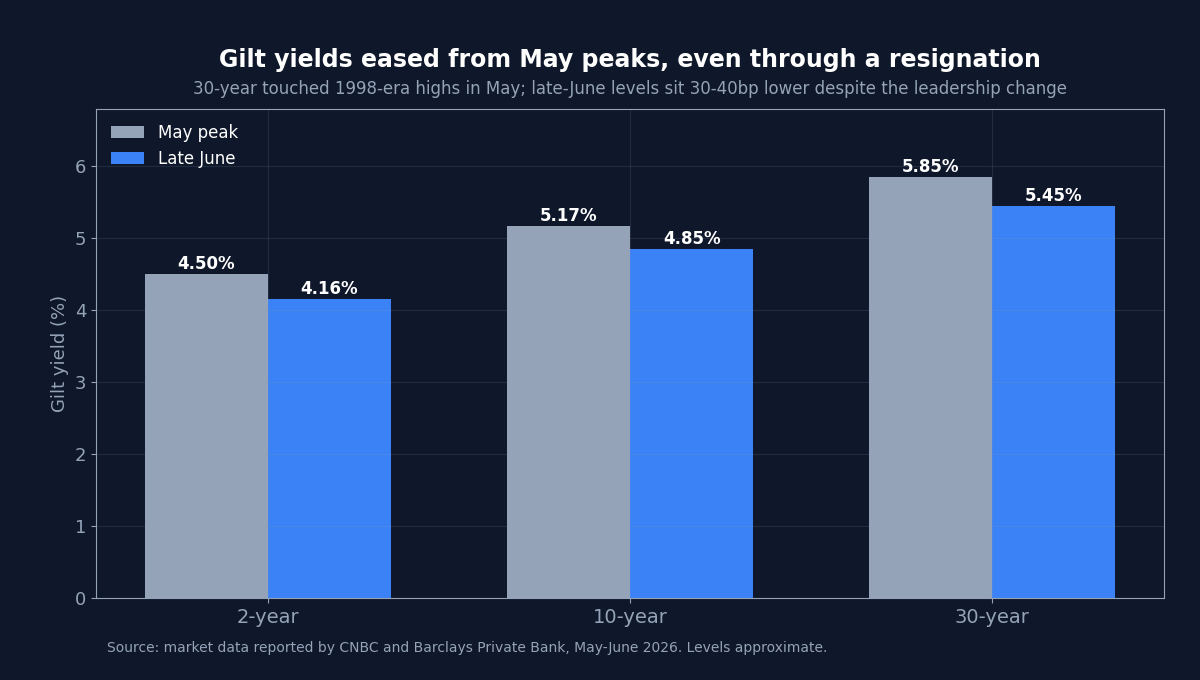
By late June the picture had improved at the margin. The 30-year had retreated to roughly 5.45%, the 10-year to the high 4s and the 2-year to around 4.16%, helped by the drop in oil prices after the US-Iran peace framework and by a global easing in yields. Even the resignation itself only nudged the 10-year to 4.85%. Yields sitting 30 to 40 basis points below their May peaks through a change of prime minister is, on its own terms, a vote of qualified confidence: the market’s stress case was tested and did not materialise.
Who absorbs the supply matters as much as the level. The gilt market’s traditional anchor buyers have been retreating for years: defined-benefit pension schemes, once price-insensitive accumulators of long-dated paper, are largely funded and de-risking, while the Bank of England has moved from the largest buyer in the market to a steady seller. Their replacements, overseas investors and leveraged funds, are price-sensitive and quicker to demand compensation for uncertainty. A market that once absorbed political noise through inertia now reprices it in real time, which is why each episode of Westminster drama since 2022 has left a visible mark on the curve even when the eventual outcome proved benign.
| Market | May peak | Late June | Reading |
|---|---|---|---|
| 2-year gilt | ~4.50% | ~4.16% | Hike pricing pared but alive |
| 10-year gilt | ~5.17% | 4.85% | Modest political premium |
| 30-year gilt | ~5.85% (1998-era high) | ~5.45% | Term premium still elevated |
| Sterling (GBP/USD) | Drifting from February | ~$1.319 | Roughly 3% lower since February |
The Bank of England’s Split Hold
Four days before the resignation, the Bank of England delivered its own signal. The Monetary Policy Committee held Bank Rate at 3.75% on 18 June, but the vote split 7-2, with two members arguing for an immediate quarter-point increase, up from a single dissent at the previous meeting. The direction of travel inside the committee is not towards easing.
The inflation backdrop explains the hawks. CPI held at 2.8% in May, below the 3% consensus expected, but the Bank’s own projections have inflation a little under 3% in the third quarter and slightly above 3.25% in the fourth, driven in part by the energy pass-through from the year’s earlier oil shock. A central bank that expects inflation to rise for two more quarters, with wage growth still firm, has little room to reassure the gilt market with dovish language. Money markets accordingly price the first hike of this cycle as early as October or November, a repricing that rhymes with the one that has taken hold in the United States, where the Federal Reserve’s path has shifted from expected cuts to a live hike debate.
Quantitative tightening compounds the supply picture. The Bank is still selling gilts from its Asset Purchase Facility, per its June market notice, at the same time as the Treasury runs heavy issuance. Every buyer of a long gilt today knows that the two largest holders of the past decade, the Bank and defined-benefit pension schemes, are both structural sellers or shrinking buyers. That is the quiet mechanical reason the long end trades with a fatter premium than the short end, before politics is even considered.
The Question Markets Are Actually Asking About the Succession
The succession contest will dominate headlines through the summer, but the gilt market’s question is narrower and more technical: does the fiscal framework survive the transition intact? Prediction markets currently make Andy Burnham, the former Mayor of Greater Manchester who returned to Parliament through the Makerfield by-election, the strong favourite, and he has publicly indicated that he would respect the existing fiscal rules. That assurance, whatever one makes of it politically, is precisely the kind of signal bond investors listen for.
The sharper market sensitivity sits with the chancellorship. Analysts have been explicit that a move away from the current fiscal leadership towards a candidate perceived as less committed to the rules would command a permanently higher risk premium on gilts. The 2022 precedent looms over every scenario: the mini-Budget episode demonstrated how quickly the gilt market can move from orderly repricing to dysfunction when fiscal credibility is questioned, and how expensive the round trip is. The current episode has been described by Barclays Private Bank as an echo of that period on a much smaller scale, which is accurate in both directions: the mechanism is the same, and so far the magnitude is not.
The timetable itself carries risk. A contest that runs through the summer leaves the government in a holding pattern for two months in which spending decisions drift, departmental bargaining stalls and the Treasury’s Budget preparation proceeds without a settled political owner. Gilt issuance does not pause for politics: the remit continues week by week regardless of who is in Number 10, which means the market will be asked to absorb duration through the entire interregnum. Quiet auctions through July and August would themselves be information, evidence that the buyer base is treating continuity as the base case rather than demanding concessions to carry the uncertainty.
Political neutrality is the only sensible posture for an investor here. What matters for pricing is not which faction prevails but three observable variables: the successor’s stated fiscal stance, the identity and credibility of the chancellor, and the arithmetic of the autumn Budget against the fiscal rules. Each has a direct yield translation; everything else is noise.
The Term Premium Is the Message
Step back from the day count of the leadership contest and the structural story is starker. A 30-year gilt near 5.45%, against inflation of 2.8%, embeds a real yield and a term premium that would have seemed implausible for most of the past two decades. Some of that is global: long bonds everywhere are repricing the end of quantitative easing, heavier issuance and a world where central banks are debating hikes rather than cuts. And some of it is local: a market charging the UK specifically for political uncertainty layered on a full issuance calendar.
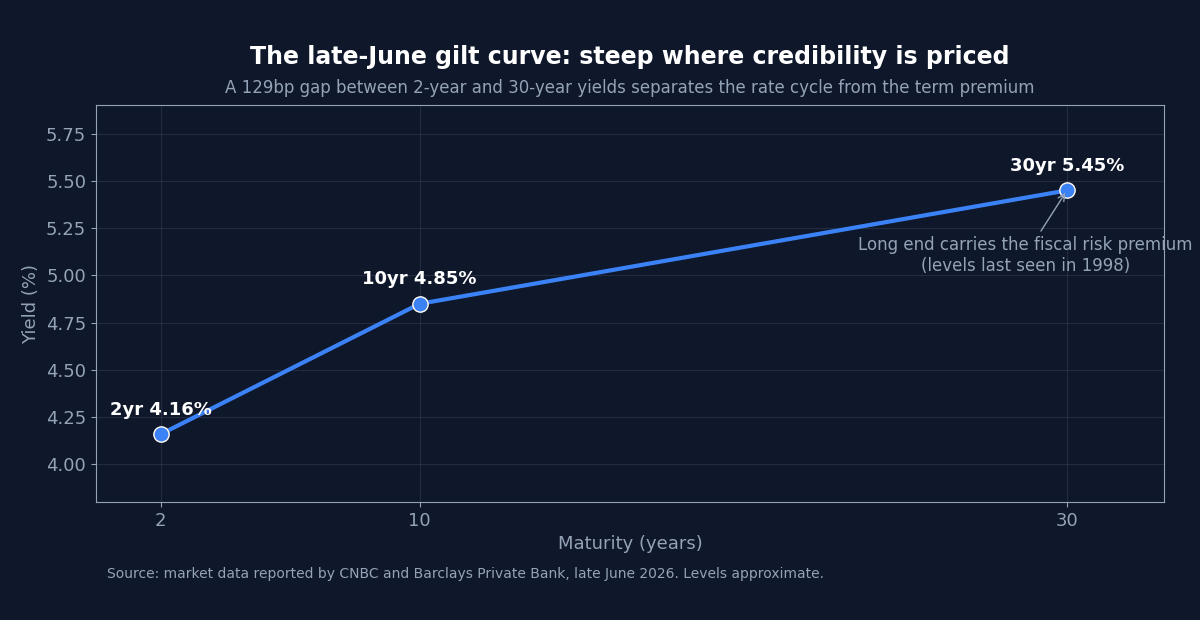
The composition matters because the two components resolve differently. The global term premium will move with the Federal Reserve, the Bank of Japan’s retreat from its own bond market and the broader supply picture; no British government can legislate it away. The local premium, by contrast, is responsive to domestic choices, which is why the May peak partially unwound as political clarity improved and oil fell. The autumn Budget is therefore the real event risk on the UK calendar: it is the moment the local premium gets marked to market against actual fiscal decisions rather than campaign language.
Investor Implications
Fixed income. Gilts now offer some of the highest nominal and real yields in the developed world, and the market has just absorbed a prime ministerial resignation without dislocation. For long-horizon investors the compensation on offer at the long end is substantial; the offsetting risk is concentrated in the autumn Budget and the chancellor question, either of which could reprice the local component of the premium quickly. The short end is a cleaner expression of the rate cycle: a 2-year around 4.16% against a possible October or November hike prices a path, not a promise.
Equities. The FTSE 100’s marginal reaction reflects its composition: a dollar-earning, internationally weighted index is partially hedged against its own domestic politics, and a softer pound flatters overseas earnings in sterling terms. Domestically exposed mid-caps carry the political and rate risk more directly, which is where any Budget surprise would show first.
Cross-asset. Sterling has become the real-time gauge of the transition. A currency that has already drifted 3% lower since February will respond more to the fiscal signals of July and August than to the personality contest. The pairing to watch is sterling against gilt yields: a falling pound alongside rising long yields is the 2022 signature of credibility stress, while a stable pound with easing yields would confirm the market’s base case of continuity.
What to Watch
- July-August: the Labour leadership timetable, and above all the fiscal commitments made by the leading candidates; the chancellor question is the single most yield-sensitive variable.
- 6 August: the next Bank of England decision. A third dissent, or a hike, would confirm the market’s October-November pricing; the accompanying projections will update the inflation path that currently peaks above 3.25% in Q4.
- September: the expected arrival of a new prime minister, and with it clarity on the Treasury team ahead of the autumn Budget.
- The autumn Budget: the event where the fiscal rules meet the arithmetic. This is where the local component of the gilt term premium gets repriced, in either direction.
Conclusion
The UK gilt market has spent 2026 conducting a slow, continuous referendum on British fiscal credibility, and the resignation of a prime minister barely moved the needle because the vote had already been cast in instalments. That is both reassuring and sobering. Reassuring, because the stress case arrived and the market absorbed it; the 30-year sits meaningfully below its May peak and sterling’s decline has been a drift, not a run. Sobering, because yields at these levels are not an anomaly to be waited out but a price: for issuance without a captive buyer, for inflation that is rising into year-end rather than falling, and for a political system asked to prove its fiscal arithmetic afresh each autumn. The summer will be loud. The signal will be in three quiet places: the fiscal language of the next leader, the name at the Treasury, and the long end of the curve.
Frequently Asked Questions
Why did gilt yields barely move when Starmer resigned?
Markets had priced the political risk gradually over several months. Sterling had already fallen roughly 3% since February and 30-year gilt yields had touched 1998-era highs in May before easing. By 22 June the resignation was widely anticipated, so the announcement confirmed existing positioning rather than forcing new selling.
Why are UK long-term gilt yields so high?
Two forces overlap. Globally, long bonds have repriced as quantitative easing ends, issuance rises and central banks debate hikes rather than cuts. Locally, the UK adds heavy gilt supply, a shrinking natural buyer base as the Bank of England sells holdings and pension schemes de-risk, and a political premium tied to fiscal credibility. The 30-year near 5.45% reflects both components.
Will the Bank of England raise rates in 2026?
The June meeting held Bank Rate at 3.75% but the vote was 7-2, with two members favouring an immediate rise, and the Bank projects inflation above 3% by the fourth quarter. Money markets price a possible hike in October or November. That path is data-dependent and not guaranteed.
What would change the gilt market’s view of the UK?
Three variables carry most of the weight: the fiscal stance of the next prime minister, the credibility of the chancellor, and the autumn Budget’s arithmetic against the fiscal rules. Signals of continuity would support the recent easing in yields, while a perceived weakening of the fiscal framework would rebuild the political premium, as the 2022 episode demonstrated.
Sources: Bank of England, Monetary Policy; Bank of England, APF Gilt Sales Market Notice, 19 June 2026; ONS, Consumer Price Inflation, May 2026; CNBC, UK inflation holds steady at 2.8% in May; CNBC, UK gilt yields retreat from multi-decade highs; Barclays Private Bank, UK gilts: pricing another change in Westminster; Global Banking and Finance Review, Keir Starmer to Resign: Pound, FTSE and UK Markets React.
Related Reading: The global backdrop to the gilt move is set out in The Synchronised Sovereign Rout, which covered the May breakdown in Japanese, UK and US long bonds. The parallel repricing of the US policy path is analysed in From Cuts to Hikes: The Fed Rate Hike Repricing, and the oil shock that fed the UK’s inflation path is covered in The US Iran Peace Deal and the Unwinding of the 2026 Risk Premium. For the fundamentals, start with our explainer on the term premium and quantitative tightening. The UK discount theme resurfaced in the bidding war for easyJet. The next chapter, Burnham taking office and the 10-year moving back through 5 per cent, is covered in UK Gilt Yields Above 5%. The property-market consequences are examined in UK property investment under PM Burnham. For where the Bank landed in July, see the 6-3 hold that buried the hike.

Leave a Reply