Khan Capitals | July 2026
Key Takeaways
- The largest private credit deal on record is about to meet a market. The $35 billion financing arranged by Apollo and Blackstone for Broadcom and Anthropic’s AI infrastructure expansion is set to begin trading, Bloomberg reported this week.
- The structure is a machine for converting chips into credit. A special-purpose vehicle buys custom AI accelerators designed by Google and Broadcom, then leases the hardware to Anthropic, with Broadcom backstopping payment obligations on $30 billion of senior notes.
- Liquidity arrives in stages. Debt becomes eligible for trading as it is drawn, with roughly 16 separate releases over a little more than a year and about $15 billion expected to be tradeable by early next year.
- Price discovery is the real event. For the first time, the market will put a continuous, observable price on large-scale AI infrastructure credit risk. Where these notes trade will discipline, or embolden, every future compute financing.
- The line between private and public credit keeps blurring. A record-sized private deal that becomes tradeable within months is private credit in name and syndicated market in behaviour; the distinction that once defined the asset class is dissolving at the top end.
Part of: Private Credit & Private Markets — Khan Capital’s hub on private credit and private markets.
From Record Cheque to Tradeable Paper
When Apollo Global Management and Blackstone wrapped up the $35 billion debt package for Broadcom and Anthropic in early June, the deal was described, accurately, as the largest private credit deal on record. This week brought the development that matters more for markets: a portion of that debt is expected to be drawn over the coming months, and once drawn, it becomes eligible for trading. By early next year, roughly $15 billion of the paper should be available to change hands, released in around 16 tranches over a little more than a year as chips are produced and delivered.
That timetable converts a private placement into something closer to a public market in instalments. The buyers of this debt, insurers, pension funds and credit funds among them, will shortly have a screen price against which their positions are marked, and the rest of the market will have something it has never had before: a continuous, observable price for concentrated AI infrastructure credit risk at scale.
Anatomy of the Largest Private Credit Deal on Record
The structure repays study, because it is likely to become a template. At the centre sits a special-purpose vehicle that uses the borrowed money to buy custom AI accelerator chips, silicon co-designed by Google and Broadcom, and then leases that hardware to Anthropic, the AI developer whose computing demand the whole arrangement serves. Anthropic gets compute without carrying the debt on its own balance sheet; Broadcom gets a funded order book; the lenders get a claim on lease payments from one of the fastest-growing companies in the world, wrapped in hardware collateral.
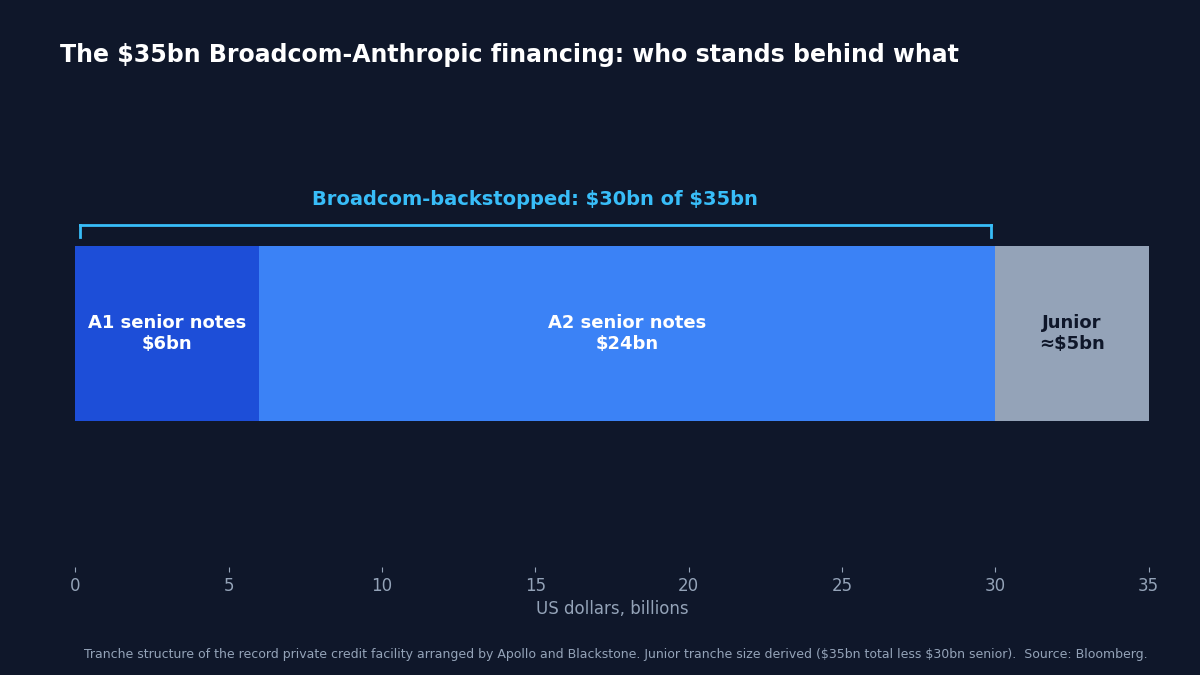
The credit support is layered. The facility was structured across three tranches, with the two senior layers, $6 billion of A1 notes and $24 billion of A2 notes, backstopped by Broadcom, meaning the chipmaker stands behind Anthropic’s payment obligations on $30 billion of the $35 billion stack. The remaining tranche, roughly $5 billion by arithmetic, sits below the backstop and carries the purest exposure to the lessee. In effect, senior investors are lending against Broadcom’s investment-grade balance sheet with AI upside; junior investors are underwriting Anthropic’s revenue trajectory directly.
| Deal element | Detail |
|---|---|
| Total size | $35bn, the largest private credit deal on record |
| Arrangers | Apollo Global Management and Blackstone |
| Structure | SPV buys Google and Broadcom-designed AI chips, leases them to Anthropic |
| Senior tranches | $6bn A1 and $24bn A2 notes, backstopped by Broadcom |
| Trading timeline | ~16 releases over a year as debt is drawn; ~$15bn tradeable by early 2027 |
| Deal closed | Early June 2026 |
Why Trading Changes Everything
Private credit’s defining feature, and its defining criticism, has always been the absence of a market price. Loans are held at model-based marks, volatility is smoothed away, and investors accept illiquidity in exchange for yield. That bargain has been under strain all year: as we documented in The $14 Billion Gate, the semi-liquid vehicles that brought private credit to individual investors are enforcing redemption caps precisely because their assets cannot be sold at their marks on demand, and PIMCO has warned of a widening confidence gap between managers whose valuations the market trusts and those it does not.
Against that backdrop, the largest deal in the asset class’s history becoming tradeable is not a detail; it is a philosophical event. Once $15 billion of Broadcom-Anthropic paper has a screen price, every holder of similar exposure has a benchmark against which their own marks can be checked. If the notes trade at or above par, the AI credit complex gets external validation and the next mega-financing prices tighter. If they trade meaningfully below, the smoothed valuations across private AI lending acquire a visible, uncomfortable comparator. Either way, the asset class learns something about itself that model marks cannot teach.
The AI Capex Machine Finds Its Financing Model
The deal also answers a question that has hung over the AI build-out: who funds the hardware when the numbers outgrow even hyperscaler balance sheets? The compute requirements of frontier AI development have reached a scale where equity funding rounds and operating cash flow no longer suffice, and this week’s other market story, Samsung’s record memory-driven quarter and the selloff it triggered, showed how violently the equity market now debates the sustainability of that spending.
Credit markets have answered with structure. Chip leasing through backstopped SPVs does for AI compute what aircraft leasing did for aviation: it moves long-lived, revenue-producing hardware onto specialist balance sheets funded by long-duration capital, the insurers and pension funds hungry for investment-grade yield with a spread. Aircraft leasing took two decades and several cycles to mature into a trillion-dollar financing channel; compute leasing is attempting the same evolution in roughly three years, against collateral that ages far less gracefully than an A320. Apollo and Blackstone are not lending to a startup; they are manufacturing an asset class. The 16-tranche release schedule, the Broadcom backstop, the lease-based cash flows: each element is designed to make $35 billion of exposure to a single AI company digestible to the most conservative capital in the system.
What the Bulls and the Sceptics Will Each Watch
The optimistic reading is straightforward. Demand for Anthropic’s models is growing fast enough that leasing compute against contracted usage is conservative lending; the Broadcom backstop makes the senior stack nearly a corporate credit; and staged tradeability adds liquidity to an asset class accused of having none. On this view, the deal is the moment private credit graduated from refinancing leveraged buyouts to funding the industrial build-out of the decade, extending the story we told in The Rise of Private Credit.
The sceptical reading concentrates on three points. First, collateral: AI accelerators depreciate on a technology curve, not an aircraft curve, and the residual value of custom silicon three years from now is genuinely unknowable. Second, concentration: the deal stacks exposure to a single lessee, a single chip design and a single demand thesis, however strong each looks today. Third, circularity: Broadcom backstops debt whose proceeds buy Broadcom-designed chips, revenue that flows back into the guarantor’s results, a loop that works beautifully while AI demand compounds and becomes reflexive if it stalls. The scenario table below translates these readings into observable outcomes.
| Trading outcome | What it would signal | Knock-on effects |
|---|---|---|
| At or above par | Market validates AI lease credit; backstop treated as near-corporate risk | Next compute financings price tighter; more insurers enter; template replicated |
| Modest discount | Liquidity premium and novelty discount, not credit doubt | Secondary buyers step in; private marks broadly defensible |
| Deep discount | Market questions residual values or lessee demand | Visible comparator pressures marks across private AI credit; new deals stall |
The Same Asset Class, Two Different Stories
Step back and the juxtaposition inside private credit this month is striking. At the retail end, roughly $14 billion sits behind redemption gates and managers are selling assets to meet withdrawal queues. At the top end, the industry has just written the largest cheque in its history and is inventing the secondary market to carry it. These are not contradictory facts; they are the same fact viewed from different ends of the capital structure. Money is leaving the smoothed, semi-liquid vehicles built for individuals and concentrating in scaled, structured, increasingly tradeable transactions built for insurers and pensions, the sorting we flagged when the liquidity illusion first cracked.
The direction of travel is toward convergence with public markets: bigger deals, ratings, backstops, staged liquidity, screen prices. The industry called that evolution impossible for years, on the grounds that illiquidity was the source of the return premium. The Broadcom-Anthropic deal quietly concedes the point. If the paper trades well, the premium was never about illiquidity; it was about origination and structuring, and those survive a screen price. If it trades poorly, the marks were the premium. Either answer reshapes how the next trillion dollars into this asset class gets priced.
Investor Implications
Equities. For the listed alternative managers, Apollo and Blackstone above all, the deal is high-margin validation of the origination franchise, and fee-related earnings from structures like this are exactly what their shareholders pay up for. For Broadcom, the backstop is a contingent liability the equity market has so far treated as free; its earnings calls deserve closer reading on that point. For AI-exposed equities generally, the existence of a $35 billion debt market for compute is bullish infrastructure spending capacity, whatever the equity tape did to chip stocks this week.
Fixed income. The trading levels of the A1 and A2 notes, once visible, become the reference curve for AI infrastructure credit. Credit investors who own nothing in this deal should still watch it: a liquid benchmark for AI lease risk will reprice adjacent private positions, data centre securitisations and even parts of the investment-grade tech complex. The junior tranche, unbackstopped, is the purest publicly observable bet on frontier AI cash flows in existence.
Cross-asset. The deal deepens the entanglement of credit markets with the AI cycle. A slowdown in AI demand now transmits not only through equity multiples but through lease coverage ratios, residual values and backstop triggers, channels that move slower but bite harder. Conversely, the successful distribution of $35 billion in AI credit is itself evidence that the build-out has secured a funding base beyond the equity market’s mood swings.
What to Watch
- Coming months: The first draws under the facility, the point at which the initial tranche of notes becomes eligible to trade and the first prices print.
- Early August: Apollo and Blackstone second-quarter earnings, where management commentary on distribution and demand for the paper will signal how the placement is being absorbed.
- September: Broadcom’s next earnings report, for any disclosure on the backstop’s accounting treatment and the chip delivery schedule that drives the release calendar.
- Early 2027: The point by which roughly $15 billion should be tradeable, enough float for the market’s verdict on AI lease credit to be considered definitive.
Conclusion
Records in private credit have arrived so frequently that the headline number, $35 billion, is almost the least interesting thing about this deal. What matters is what happens next: the largest transaction in the asset class’s history is about to acquire a price it did not choose, updated continuously, visible to everyone. For an industry whose central controversy in 2026 has been whether its marks can be believed, that is either a vindication waiting to happen or a stress test it did not volunteer for. The chips will be delivered, the tranches will be released, and sometime in the coming months a trader will type the first bid. Quite a lot of the private capital industry’s next chapter depends on what that number turns out to be.
Frequently Asked Questions
What is the largest private credit deal on record?
The $35 billion financing arranged by Apollo and Blackstone in June 2026 for Broadcom and Anthropic’s AI infrastructure expansion. A special-purpose vehicle borrows the money to buy custom AI chips and leases them to Anthropic, with Broadcom backstopping $30 billion of senior notes.
How does the Broadcom-Anthropic chip financing work?
The structure is a leasing model. The SPV owns the chips, Anthropic pays to use them, and those lease payments service the debt. The facility has three tranches: $6 billion of A1 notes and $24 billion of A2 notes carry a Broadcom backstop, while the remaining junior portion is exposed directly to Anthropic’s payments.
Why does it matter that the deal is starting to trade?
Private credit is usually held at model-based valuations with no market price. As this debt is drawn, it becomes tradeable, in roughly 16 releases over a year, with about $15 billion expected to be available by early 2027. The resulting prices will provide the first continuous market benchmark for AI infrastructure credit risk.
Sources: Bloomberg, Apollo’s $35 billion AI chip credit deal is set to begin trading; Bloomberg, Apollo wraps up $35 billion chip deal for Anthropic; Benzinga, Apollo and Blackstone turned the AI chip bet into somebody else’s debt; The Motley Fool, Apollo and Blackstone closed a $35 billion private credit deal.
Related Reading: For the stress at the other end of the asset class, read The $14 Billion Gate alongside The Private Credit Crackup. The Rise of Private Credit traces how the asset class reached this scale, Private Credit and AI Disruption examines the sector’s exposure to the technology cycle, and The IPO Window Reopens covers the exit markets reviving alongside it. For the fundamentals, start with what private credit actually is and how credit spreads price risk. Apollo’s reach extended the same month to a contested £5.7bn bid for easyJet. The buyer base for deals like this now includes BlackRock’s rapidly growing private markets arm. The cash-flow turn that makes such financings structural is covered in Alphabet’s negative free cash flow quarter, and the valuation backdrop in credit spreads at record tights.

Leave a Reply