

Khan Capitals | July 2026
Key Takeaways
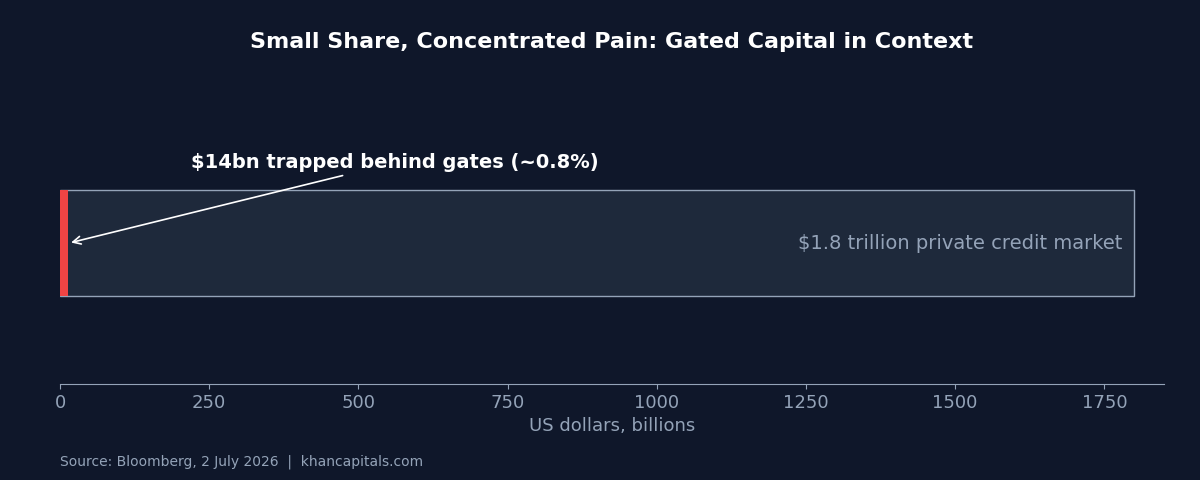
- $14 billion and counting. Bloomberg reports that private credit funds have now trapped roughly $14 billion of investor capital as redemption requests outpace payouts across the $1.8 trillion market.
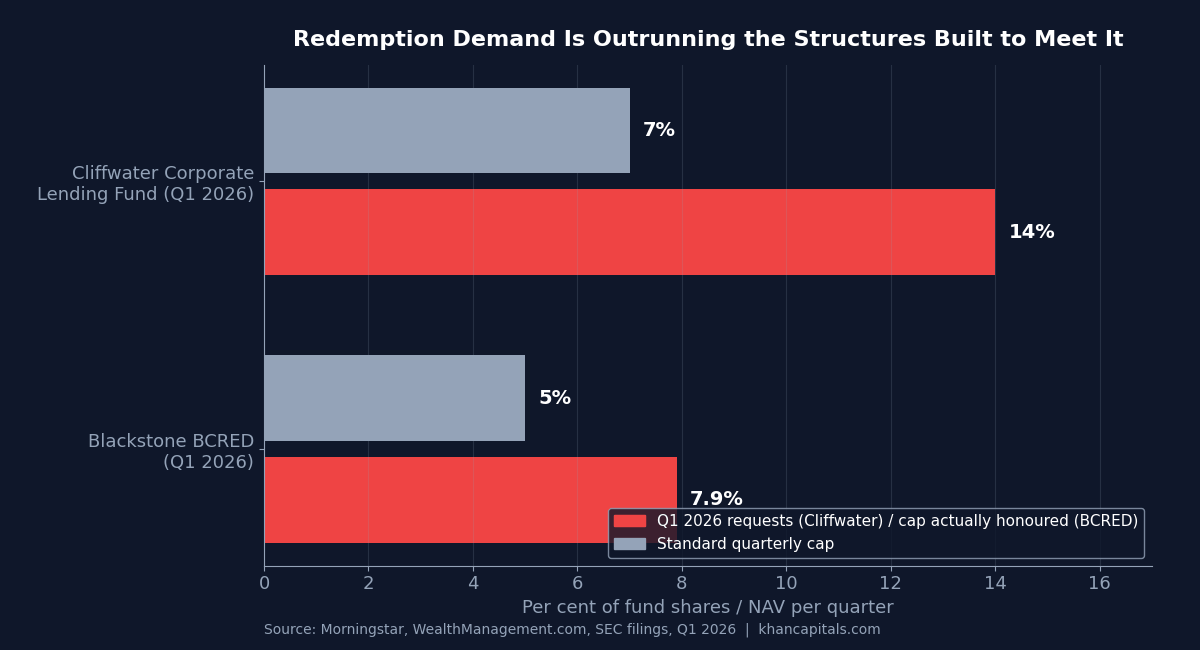
- Requests are overwhelming structures. The $33 billion Cliffwater Corporate Lending Fund received first-quarter redemption requests on 14 per cent of its shares, double its 7 per cent quarterly cap, while non-traded BDC redemptions nearly tripled quarter on quarter to 4.71 per cent of NAV in late 2025.
- The managers are diverging. Blue Owl permanently closed the gates on its $1.6 billion OBDC II fund and sold $1.4 billion of loans, while Blackstone lifted BCRED’s redemption cap from 5 to 7.9 per cent to pay investors out in full.
- PIMCO calls it a confidence gap. With NAVs increasingly set by manager-specific assumptions rather than market-clearing prices, PIMCO warns that valuation dispersion is widening and that redemption caps do not fix the underlying problem.
- Small in aggregate, decisive at the margin. $14 billion is under 1 per cent of the asset class, but the gating cycle is reshaping fundraising, forcing asset sales, and sorting managers into those who can meet the storm and those who must wait it out.
Part of: Private Credit & Private Markets – Khan Capital’s hub on private credit and private markets.
A Storm the Managers Chose to Outlast
Halfway through 2026, the defining fact of the private credit redemptions story is its persistence. When the first gates went up around the turn of the year, the industry’s message was that this was a passing squall: a repricing of expectations after two extraordinary fundraising years, concentrated in a handful of retail-facing vehicles. Six months on, the squall has not passed. Bloomberg calculates that roughly $14 billion of investor capital is now trapped inside private credit funds whose redemption requests exceed what the vehicles will pay out, and direct lenders are conceding that the pressure is unlikely to abate quickly as the second half begins.
The word trapped deserves precision. Nothing has defaulted; no fund has suspended its NAV. The capital is trapped in the specific sense that the semi-liquid structures through which wealthy individuals entered the asset class, non-traded business development companies and interval funds, are exercising exactly the redemption limits their documents always contained. As we argued in our May analysis of the BDC redemption wave, the reflexive logic of these vehicles means queues create queues: an investor who fears being behind the gate files a request ahead of it, swelling the very numbers that make gating more likely. That mechanism has now run for three consecutive quarters.
The Arithmetic of Private Credit Redemptions
The numbers describe demand for liquidity running well ahead of what the structures were built to supply. The Cliffwater Corporate Lending Fund, at $33 billion the largest private credit interval fund in the United States, received first-quarter redemption requests covering 14 per cent of its shares, double its 7 per cent quarterly maximum. In the non-traded BDC space, redemptions as a share of beginning-quarter NAV nearly tripled quarter on quarter to 4.71 per cent in the final quarter of 2025, and among BDCs with more than $1 billion of assets the increase was 217 per cent. Requests have kept arriving through 2026’s first half.
| Indicator | Reading | Context |
|---|---|---|
| Capital trapped behind gates | ~$14bn | Requests outpacing payouts (Bloomberg, 2 July 2026) |
| Cliffwater CLF Q1 requests | 14% of shares | Double the 7% quarterly cap; largest US interval fund ($33bn) |
| Non-traded BDC redemptions, Q4 2025 | 4.71% of NAV | Nearly tripled quarter on quarter |
| Blue Owl OBDC II | Gates closed permanently | $1.6bn fund; $1.4bn of loans sold to raise liquidity |
| Blackstone BCRED cap | Raised 5% to 7.9% | Q1 2026, to meet elevated requests in full |
Two details in that table matter more than the headline. The first is that the largest vehicles are the ones straining: Cliffwater’s fund is not a niche product but the flagship of the interval fund format. The second is the divergence in manager behaviour. Blackstone chose to lift BCRED’s cap and pay out 7.9 per cent of the fund in a quarter, an implicit statement that its book could stand the liquidation. Blue Owl chose the opposite: OBDC II’s quarterly tenders were halted and the fund moved $1.4 billion of loans to meet obligations, a decision Morningstar described as a harsh lesson for semi-liquid fund investors. Same asset class, same quarter, opposite answers.
Gates That Work as Designed
It is tempting to describe the gates as a failure. Legally and mechanically, they are the opposite: every cap being enforced was disclosed, and the structures are performing precisely as designed. The failure, to the extent there is one, is in the expectations that were sold alongside them. Semi-liquid vehicles marketed quarterly liquidity as a feature while holding assets that take quarters to sell at par. That asymmetry is survivable so long as inflows exceed outflows, which they did for a decade. The moment the flow reversed, as we anticipated when examining the rise of semi-liquid funds, the liquidity promise reverted to what it always was: a best-efforts arrangement subordinated to the health of the portfolio.
The industry’s response has been to reach for the tools of an older cycle: selling assets, as Blue Owl did; borrowing against portfolios; and slowing new deployment to conserve cash. Each is individually rational. Collectively they transmit the retail redemption cycle into the underlying loan market, because a lender managing for liquidity is a lender less willing to extend, amend and pretend with a stressed borrower. The Congressional Research Service has now published on redemption restrictions in the sector, a reliable sign that the policy world has noticed what the marketing world called an alternative to money markets.
PIMCO’s Confidence Gap
The most useful analytical frame for what happens next came this week from PIMCO, which argues that the sector is developing a confidence gap: a widening dispersion between managers driven not by realised losses but by the credibility of their marks. Because private credit NAVs are set by each manager’s own assumptions rather than a market-clearing price, two funds holding similar loans can report meaningfully different valuations. In benign conditions that dispersion is invisible. In a redemption cycle it becomes the whole game, because an investor’s decision to stay or queue depends on whether they believe the NAV they would be paid out at.
PIMCO’s warning has a sharp edge for the gating funds specifically: smoothed valuations support reported NAVs today, but they reduce transparency, and as confidence erodes, redemption pressure intensifies, forcing the very liquidity raises that crystallise the gap. Redemption caps, on this view, treat the symptom. The disease is valuation credibility, and it resolves in one of three ways: NAV markdowns, wider discounts in the secondary market, or realised losses as assets are sold. Blue Owl’s $1.4 billion loan sale is an early data point on where marks meet money.
The Sorting Begins
What the confidence gap produces is a sorting mechanism. Managers with strong loan books, conservative marks and diversified funding are being rewarded: they can meet redemptions in full, as Blackstone did, and every honoured tender is an advertisement. Managers whose marks were generous are being found out, not by auditors but by their own investors’ withdrawal requests. This is the process we described in The Private Credit Crackup as the liquidity illusion unwinding, and it is proceeding exactly as reflexive processes do: slowly, then all at once, fund by fund.
It is worth stating the other side plainly, because the bear case is routinely overwritten. The asset class is not collapsing. Defaults remain contained, the underlying loans are largely senior and floating-rate, and new capital is still arriving: private credit firms spent the same week striking multibillion dollar agreements to buy consumer loans, including the buy now, pay later receivables Bloomberg documented, before they have even been originated. Institutional vehicles with locked capital face no redemption mechanics at all. The stress is concentrated in one funding channel, the semi-liquid retail wrapper, and that concentration is precisely what makes the episode informative rather than systemic.
Small Numbers, Large Consequences
Fourteen billion dollars is a large amount of money and a small share of a $1.8 trillion asset class: a little under 0.8 per cent. Judged by that ratio alone, the gating cycle is a rounding error. Judged by what it changes, it is anything but. The semi-liquid channel was the industry’s growth engine, the mechanism by which private credit was to be democratised into wealth portfolios globally. That engine runs on the belief that quarterly liquidity is real. Every quarter in which requests exceed caps recalibrates that belief, and with it the fundraising arithmetic of every manager who built expansion plans on retail flows. A survey by PwC this year found 93 per cent of respondents expecting flat or lower private credit returns in 2026; a channel that once grew regardless of returns is now shrinking because of them.
There is also a market-structure consequence. Trapped capital does not disappear; it queues, and queued capital is motivated to find the exit that works. Secondary markets in fund stakes are deepening at meaningful discounts, listed vehicles have repriced, and specialist buyers are circling gated assets. Meanwhile the healthier part of the exit ecosystem is genuinely improving: as we covered this week in The IPO Window Reopens, distributions are finally flowing back to private markets investors through listings, which over time eases the cash famine that fed redemption requests in the first place. The race between those two forces, confidence eroding in the wrappers while cash returns through exits, will decide whether 2026 is remembered as private credit’s stress test or its turning point.
Scenario Paths for the Redemption Cycle
| Scenario | What it looks like | Signposts to monitor |
|---|---|---|
| Orderly absorption | Requests plateau; strong managers pay out; queues clear over 3-4 quarters | Falling request ratios at Cliffwater and BCRED; secondary discounts narrowing |
| Forced convergence | Markdowns and asset sales close the gap between marks and market prices | Further loan sales at discounts; NAV cuts at gated funds; PIMCO-style dispersion narrowing from below |
| Channel contagion | Gating spreads to larger flagships; retail flows stop industry-wide | A top-five non-traded BDC halting tenders; regulatory intervention; sponsor equity weakness |
Investor Implications
Equities. The listed alternative asset managers now trade as two distinct groups: those whose semi-liquid vehicles are honouring redemptions and those associated with gates. The divergence in fee-related earnings expectations is real, because gated funds do not raise new money easily. For the wider market, the sector’s troubles remain idiosyncratic; the transmission to bank balance sheets is limited by the sector’s unlevered equity capital, which is the structural argument the industry’s defenders continue to win.
Fixed income. The confidence gap is, at bottom, a valuation-methodology story, and it strengthens the case for public credit at current spreads: liquid high yield and broadly syndicated loans offer transparent pricing at yields that no longer trail private equivalents by much. Within private credit, seniority and vintage matter more than manager brand; 2026-vintage lending on reset terms is a different proposition from a 2021 book being marked to hope.
Cross-asset. The episode is a live experiment in what happens when illiquid assets meet liquid wrappers, and its lessons transfer: property funds, infrastructure vehicles and any structure promising periodic liquidity against slow assets reprice on the same logic. Watching the private credit queue-clearing rate is a cheap early indicator for stress in every other semi-liquid corner of the market.
What to Watch
- July-August 2026: Q2 reporting for non-traded BDCs and interval funds. The single most important series is the ratio of redemption requests to caps; a second consecutive quarter above 2x at major funds would signal the queue is compounding.
- 30 September 2026: The next quarterly tender window across the sector. Whether Blackstone maintains full payouts and whether any additional funds move to permanent gate closures.
- H2 2026: Evidence of PIMCO’s convergence: NAV markdowns at gated funds, loan sales priced below carrying value, or widening secondary-market discounts on fund stakes.
- Ongoing: Washington’s interest. The Congressional Research Service note is the first step; hearings or SEC rule proposals on semi-liquid fund liquidity would change the structural economics of the retail channel.
Conclusion
The $14 billion now sitting behind private credit’s gates is not a crisis number; it is a verdict number. It tells us the redemption wave that began as a Q1 story has hardened into a regime, that the semi-liquid wrapper has failed its first sustained stress test in the narrow sense that its liquidity promise is being rationed, and that the industry is being sorted by the credibility of its marks rather than the size of its brands. The sorting is healthy for the asset class and uncomfortable for individual managers, which is roughly the definition of a functioning market. The questions that matter from here are empirical: whether request ratios fall as exits return cash to investors, whether marks converge to market prices gently or abruptly, and whether the retail channel that built the last five years of growth can be rebuilt on honest liquidity terms. On the answers hangs not the survival of private credit, but the shape and speed of its next decade.
Frequently Asked Questions
What is a redemption gate in private credit?
A redemption gate is a contractual limit on how much investor capital a fund will return in a given period, typically 5 to 7 per cent of net assets per quarter in non-traded BDCs and interval funds. When requests exceed the cap, the excess is deferred, creating a queue of unmet withdrawals.
How much money is trapped in private credit funds in 2026?
Bloomberg reported in July 2026 that roughly $14 billion of investor capital is trapped in private credit funds whose redemption requests exceed payouts. That is a little under 1 per cent of the $1.8 trillion asset class, concentrated in semi-liquid retail vehicles.
Does the redemption wave mean private credit is collapsing?
No. Defaults remain contained and most private credit capital sits in institutional vehicles with no redemption rights at all. The stress is concentrated in the semi-liquid retail channel, where the mismatch between quarterly liquidity promises and illiquid loans is being tested for the first time at scale.
Sources: Bloomberg, Private Credit Funds Trap $14 Billion; Bloomberg, PIMCO Confidence Gap Warning; PIMCO, The Credit Market Lens; Morningstar; WealthManagement.com; Congressional Research Service; PwC Private Credit Survey 2026.
The Khan Capital Brief
Understand what moves markets
Analysis like this, free in your inbox. No spam, unsubscribe any time.
Related Reading: This piece extends our running coverage of the redemption cycle, beginning with The Private Credit Crackup and Private Credit Faces Its First Real Test. The structural background is set out in The Rise of Semi-Liquid Funds, the reflexive mechanics in The Q2 Reflexivity Trap, and the improving exit environment in The IPO Window Reopens. For the fundamentals, start with what private credit is. At the other end of the asset class, the largest private credit deal on record began trading in July. What the gates mean for the serenity of public markets is examined in credit spreads at record tights. See also how BDCs work.

Leave a Reply