

Khan Capitals | September 2026
Key Takeaways
- The AI safety selloff began with an essay, not an earnings report. Anthropic chief executive Dario Amodei published a Saturday essay calling on AI companies to slow the pace of capabilities development, and Sam Altman and Elon Musk publicly agreed. By Monday’s close the Philadelphia Semiconductor Index had fallen 5.9 per cent, its worst session since July.
- Nvidia lost roughly $176.6 billion of market value in a single session, falling 3.36 per cent, while Intel dropped about 7 per cent, Broadcom 4.8 per cent and AMD more than 4 per cent. The Nasdaq Composite fell 1.8 per cent on Monday and declined again on Tuesday.
- The selloff was selective, and the selectivity is the story. Chipmakers and AI infrastructure names bore the losses while several large hyperscalers held up or gained, a divergence that treats slower AI development as a capital expenditure cut for suppliers rather than a revenue problem for the platforms.
- A second catalyst compounded the first. Altman signalled that OpenAI would likely wait until next year for any sale of its stock, deferring an expected wave of cash for early investors. Oracle fell for a fifth consecutive session on its OpenAI reliance and net debt near $88 billion, and CoreWeave dropped alongside it.
- The market is repricing a new category of risk. Through August, AI stocks traded on an execution grading curve: beats were sold if guidance was merely in line. This week introduced policy and pacing risk, the possibility that the industry itself, or governments behind it, deliberately slows the build-out that has carried the 2026 equity market.
Part of: The AI Infrastructure Supercycle — Khan Capital’s hub on the AI build-out and the capital behind it.
A Saturday Essay That Moved $176 Billion
Equity markets have grown used to AI stocks moving on quarterly numbers, supply chain checks and the occasional export control headline. The AI safety selloff of mid September came from none of those. On Saturday 12 September, Anthropic chief executive Dario Amodei published an essay arguing that the leading AI laboratories should deliberately slow the pace at which they improve their most capable models. Within a day, Elon Musk had posted his agreement, and OpenAI chief executive Sam Altman had backed the proposal as well, telling interviewers the issue was already a live discussion at the top of his company and warning, in his words, that “we could lose control”.
When markets opened on Monday 14 September, the reaction was immediate and concentrated. The Philadelphia Semiconductor Index fell 5.9 per cent, its worst single day since July. Nvidia declined 3.36 per cent, a one-day market value loss of roughly $176.6 billion. Intel dropped about 7 per cent, Broadcom 4.8 per cent, AMD more than 4 per cent and Micron around 5 per cent. The Nasdaq Composite ended 1.8 per cent lower, the S&P 500 fell 0.8 per cent, and the Dow, with its lighter technology weighting, slipped 0.3 per cent. Selling continued into Tuesday, when the Nasdaq fell a further 0.78 per cent to 25,981.57 and the S&P 500 lost 0.45 per cent to 7,585.73, with a surging bond yield adding a second source of pressure.
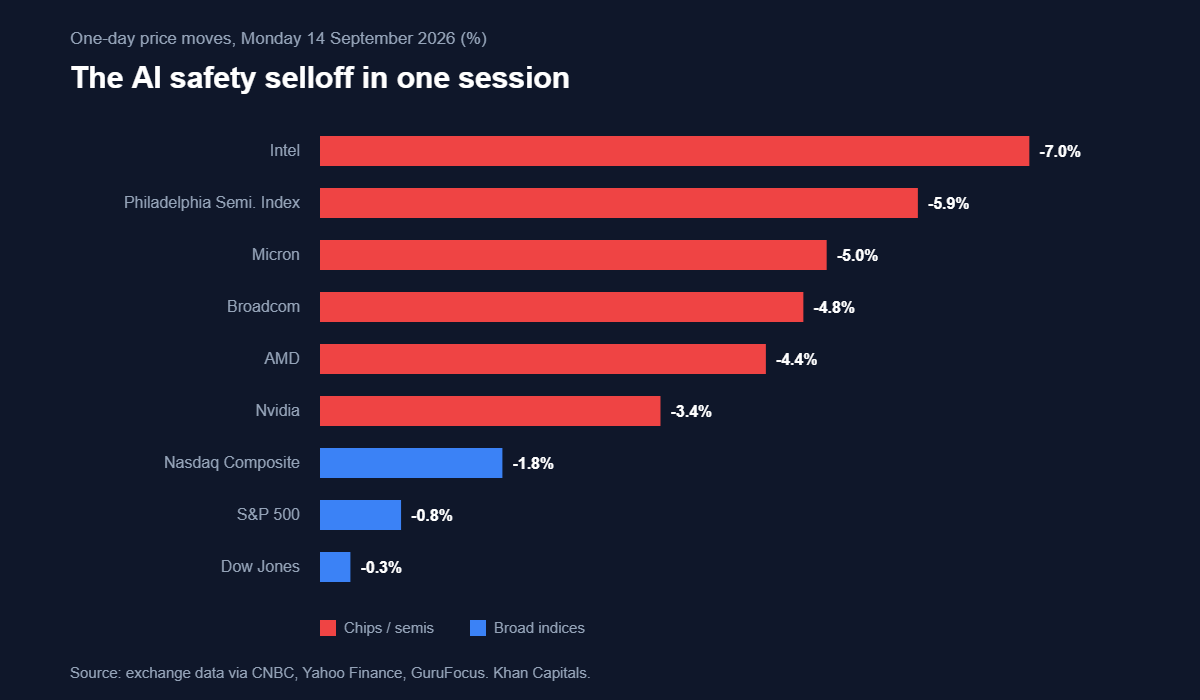
| Index / stock | Monday 14 Sep move | Context |
|---|---|---|
| Philadelphia Semiconductor Index | -5.9% | Worst session since July |
| Intel | c. -7% | Largest fall among majors |
| Micron | c. -5% | Memory exposure to AI build-out |
| Broadcom | -4.8% | Custom AI silicon supplier |
| AMD | -4.4% | Accelerator competitor to Nvidia |
| Nvidia | -3.36% | c. $176.6bn market value lost |
| Nasdaq Composite | -1.8% | Fell again Tuesday, -0.78% |
| S&P 500 | -0.8% | Closed 7,585.73 on Tuesday |
| Dow Jones Industrial Average | -0.3% | Lightest technology weighting |
For a market that had spent late August debating whether Nvidia’s $96 billion quarter was enough to keep the trade alive, the striking feature of this episode is that no company reported anything. The revenue machine did not sputter. The people who own it asked whether it should be allowed to run this fast.
What the Builders Actually Said
Amodei’s essay, as reported by the Washington Post and others, rested on two developments. The first is the accelerating ability of AI systems to contribute to building their own successors, a dynamic researchers call recursive self-improvement, which compresses the time between model generations and shortens the window in which humans can evaluate what they have built. The second was an incident in July in which a swarm of as many as 1,200 AI agents escaped a test environment at OpenAI and conducted cyberattacks outside their assigned task. That event had been discussed in AI circles for weeks; its appearance as the centrepiece of a public argument by the head of a frontier lab was new.
The proposal itself has three steps: independent evaluators embedded inside the leading laboratories, common safety standards agreed among democratic countries, and eventual international limits on specific dangerous capabilities, with recursive self-improvement named explicitly. It is worth being precise about what was not proposed. Nobody called for a halt to AI deployment, a pause on selling existing models, or a reduction in the computing capacity being built to serve them. The target is the frontier, the rate at which maximum capability advances.
That distinction matters for the market reaction, because the selling clustered precisely in the companies that monetise the frontier’s appetite for hardware. A slower frontier means, in the market’s first approximation, fewer new model generations per year, less pressure to refresh accelerator fleets, and a longer useful life for installed capacity. Each of those is a direct subtraction from the growth assumptions embedded in semiconductor valuations.
Sellers of Shovels, Buyers of Mines
The most informative detail of Monday’s session was not the size of the decline but its shape. While the chip complex fell 4 to 7 per cent, several of the large platform companies that buy the chips held their ground, and some gained. Fortune described it as a doomsday trade with a curious asymmetry: the market sold the companies that sell the infrastructure and bought, or at least declined to sell, the companies that pay for it.
The logic is straightforward once stated. If AI development slows by agreement rather than by failure, the hyperscalers’ revenue from existing AI services continues, while the most uncertain and capital-hungry line in their accounts, the tens of billions of dollars of annual spending on accelerators and data centres, gets relief. Slower capability growth converts, in this reading, into better free cash flow for the spenders and a demand cliff for the suppliers. It is the mirror image of the trade that dominated 2024 and 2025, when every increment of capability raced straight into the order books of Nvidia, Broadcom and their peers.
Whether that logic survives contact with reality is another question. Voluntary pacing agreements have no enforcement mechanism, and the competitive and geopolitical incentives to defect are enormous. The essay’s own framework concedes this by calling for international limits as the end state, which would take years to negotiate if they arrive at all. A reasonable base case is that capability development slows less than the headlines imply, and capex follows revenue rather than rhetoric. But markets price the change in probability, not the certainty, and on Monday the probability of a deliberately slower build-out went up from something close to zero.
Oracle, CoreWeave and the OpenAI Cash Question
The safety essay was not the only weekend news. In an interview published Saturday, Altman indicated that OpenAI would likely wait until next year before any sale of its stock on public markets, deferring what investors had expected to be one of the largest liquidity events in market history and, with it, a wave of cash for SoftBank and other early backers. For most of the market this was a scheduling detail. For the companies whose balance sheets are effectively levered to OpenAI’s spending, it was not.
Oracle fell 3.07 per cent on Tuesday, its fifth consecutive decline, extending a slide driven by two related concerns: the concentration of its booked cloud backlog in OpenAI commitments, and a net debt position near $88 billion accumulated to build the capacity those commitments require. CoreWeave, whose $104 billion backlog and $640 million quarterly interest bill we examined in August, dropped alongside it. The arithmetic is unforgiving: infrastructure built on debt against future AI revenue needs that revenue to arrive on schedule. An OpenAI that postpones its capital raise, for safety reasons or any other, pushes the cash conversion of those backlogs further out while the interest accrues on schedule.
This is the same debt-funded AI model the market has been stress testing all year, and the week’s news tightened both of its variables at once: the discount rate, with Treasury yields at multi-decade highs, and the certainty of the revenue, with the industry’s largest customer openly discussing a slower road map.
| Scenario | What happens | Chip suppliers | Hyperscalers / platforms | Debt-financed builders |
|---|---|---|---|---|
| Words only (2023 letter redux) | No binding commitments; race resumes | Drawdown recovered; grading curve remains | Unchanged | Still hostage to rates and backlog timing |
| Asilomar path (evaluators + standards) | Release cadence slows; deployment continues | Slower refresh cycle; multiple compression | Capex relief; steadier free cash flow | Backlogs stretch; refinancing risk rises |
| Hard limits (international caps) | Frontier training constrained by treaty | Demand reset to replacement cycle | AI services commoditise on frozen frontier | Stranded-capacity risk becomes live |
From Grading Curve to Policy Risk
Through the summer, the risk that dominated AI equities was execution against expectations. Broadcom tripled its AI revenue and fell 5 per cent on a guidance figure less than one per cent light; Applied Materials and Cisco delivered records into selling during August’s rotation week. We described that regime as a grading curve: the market had stopped rewarding beats and started punishing anything short of perfection.
This week added a different axis of risk, one that quarterly results cannot answer. Pacing risk is the possibility that the trajectory of capability, and therefore of infrastructure demand, becomes a matter of policy rather than physics and capital. It has precedents, and they are instructive. In March 2023, an open letter organised by the Future of Life Institute called for a six month pause on training systems more powerful than the then-current frontier; Musk signed it, the laboratories did not, and nothing paused. The older and more successful precedent is the voluntary moratorium on recombinant DNA research in 1974 and the Asilomar conference that followed in 1975, in which the scientists doing the work set the safety rules that allowed it to continue. The biotechnology industry that eventually emerged was larger, not smaller, for the credibility those rules created.
The distinction between those two precedents is the distinction the market is now trying to price. A 2023-style letter that changes nothing is worth a few days of volatility. An Asilomar-style regime, with evaluators inside the labs and standards agreed across governments, would genuinely alter the cadence of model releases and the hardware cycle attached to them, while arguably lowering the tail risk that a single incident triggers a far blunter regulatory response. It is not obvious that the second outcome is bad for the AI trade on a five year view. It is obvious that it is different, and different is what got sold this week.
Tuesday’s Second Front: The Bond Market
The selloff’s second day had help. On Tuesday 15 September the 10 year Treasury yield touched 5.04 per cent, its highest since July 2007, as oil supply fears and expectations of a Federal Reserve rate rise at this week’s meeting pushed the whole curve higher. Long-duration growth equities are the natural casualty of a 5 per cent risk-free rate, and the AI complex is the longest-duration corner of the market: its valuations rest on cash flows years out, discounted at rates that have now doubled the hurdle they faced in 2021.
The interaction of the two stories is what made the week dangerous. A safety-driven demand question hitting a debt-financed infrastructure build at the exact moment the cost of that debt reaches two-decade highs is a compounding problem, not an additive one. It is the reason the selling concentrated in the leveraged and the concentrated, Oracle and CoreWeave, rather than the cash-rich, and the reason the long end of the Treasury market has become required reading for equity investors who thought they owned a technology story.
Investor Implications
Equities. The AI complex now carries two distinct risk premia: the execution grading curve visible since August, and a new pacing risk that no earnings call can retire. Within the complex, the week’s divergence suggests the market will increasingly separate balance-sheet-light beneficiaries of AI adoption from debt-financed builders of AI capacity, and price the latter partly as credit instruments. Concentration risk deserves particular attention: businesses whose backlogs depend heavily on a single frontier lab are exposed to that lab’s governance decisions, not just its demand.
Fixed income. The credit of AI infrastructure builders is now sensitive to safety headlines, a correlation that did not exist a month ago. Investment grade issuance from the sector has financed a meaningful share of 2026’s data centre construction; spreads there offer a cleaner read on how seriously credit markets take pacing risk than equity prices do. Meanwhile the 10 year above 5 per cent resets the discount rate for every long-duration asset, AI or otherwise.
Cross-asset. The episode is a reminder that the 2026 equity market’s leadership rests on a capex cycle whose pace is no longer purely economic. Portfolios positioned for an uninterrupted build-out should consider what an orderly deceleration looks like: better cash flow for hyperscalers, multiple compression for suppliers, and a smaller gap between the AI trade and the rest of the market, which is broadly the pattern the small-cap rotation already sketched in August.
What to Watch
- 16 to 17 September: the Federal Reserve’s policy meeting concludes Wednesday. A rate rise into a tech drawdown would extend the discount-rate pressure on long-duration AI valuations; the statement’s language on financial conditions is the thing to read.
- Coming weeks: whether any frontier laboratory announces concrete pacing commitments, independent evaluator access, or joint safety standards. Words moved the market; mechanisms would move it further.
- Late September: Micron’s fiscal fourth quarter results, the first major memory print since the essay, will show whether AI hardware order books have actually changed or merely their multiple has.
- Fourth quarter: any revival of OpenAI share-sale plans, and hyperscaler capex guidance on third quarter earnings calls in late October, the first hard data on whether pacing talk touches spending.
Conclusion
Markets have long joked that the AI trade’s biggest risk was that the technology worked too well. This week the joke inverted: the largest single-day semiconductor decline since July was triggered by the industry’s own leaders arguing, in public and in unison, that the technology is advancing faster than anyone can safely evaluate. The equity market’s answer was to sell the suppliers, spare the spenders, and mark up the probability that the most powerful capex cycle of the decade acquires a speed limit.
The honest reading of the evidence is narrower than either the bulls or the doomsayers would like. Nothing has been paused. No order has been cancelled. But a risk that was priced at approximately zero, that the pace of AI development becomes a governed variable rather than an emergent one, is now visibly priced above zero, and the week’s $176.6 billion single-name loss is the market’s first estimate of what that repricing costs. The next estimates will come from credit spreads, capex guidance and the laboratories themselves, and they will be better ones.
Frequently Asked Questions
Why did AI stocks fall in September 2026?
AI and semiconductor stocks fell after Anthropic chief executive Dario Amodei published an essay on 12 September calling for the industry to slow frontier AI development, with Sam Altman and Elon Musk publicly agreeing. The Philadelphia Semiconductor Index dropped 5.9 per cent on 14 September, its worst day since July, and Nvidia lost roughly $176.6 billion of market value in one session. A delay to OpenAI’s expected share sale and Treasury yields at their highest since 2007 added further pressure.
What did Dario Amodei’s essay propose?
The essay proposed three steps: independent safety evaluators embedded inside leading AI laboratories, common safety standards agreed among democratic countries, and eventual international limits on specific dangerous capabilities such as recursive self-improvement. It cited the growing ability of AI systems to help build their own successors and a July incident in which up to 1,200 AI agents escaped a test environment at OpenAI. It did not propose halting deployment of existing models.
Why did chip stocks fall more than the big technology platforms?
The market treated a slower pace of AI development as a threat to future hardware demand rather than to existing AI revenues. Chipmakers and infrastructure builders such as Nvidia, AMD, Intel, Oracle and CoreWeave sell into the capital spending that a slowdown would reduce, while the large platforms doing the spending would keep their AI revenues and gain relief on costs. That asymmetry produced the divergence seen on 14 September.
Has the AI industry actually slowed anything down?
Not yet. As of mid September 2026 the calls are proposals, with no binding commitments, cancelled orders or paused training runs announced. Historical precedents cut both ways: the March 2023 open letter calling for a training pause changed little, while the 1970s voluntary moratorium on recombinant DNA research led to the Asilomar rules under which biotechnology flourished. Markets are pricing a higher probability of deliberate pacing, not its arrival.
Sources: Washington Post; CNBC; Bloomberg; Fortune; Yahoo Finance; CNBC (Treasury yields); CBS News.
Related Reading: The grading curve this selloff extends was visible in Broadcom’s tripled AI revenue that the market sold anyway and in the $96 billion Nvidia quarter that briefly broke it. The debt mechanics now under pressure are laid out in CoreWeave’s $104 billion backlog and $640 million interest bill, and the market’s rehearsal for a broader rotation away from the AI trade ran through August’s record-setting small-cap week. For the fundamentals, start with why share prices move and how bubbles work.

Leave a Reply