
Khan Capitals | September 2026
Key Takeaways
- The 30-year Treasury yield touched 5.62 per cent this week, its highest since 2002, after six consecutive days of selling at the long end, with the 10-year reaching around 5.29 per cent, its highest since 2007, per CNBC.
- This is a global event, not an American one: 30-year gilts have traded at their highest since 1998, Japan’s 10-year yield crossed 3 per cent for the first time since 1996 this month, and German yields have reached post-2011 highs, pushing the average yield on global government debt towards 4 per cent for the first time since 2007.
- US Treasuries are closing their worst September since 2023, with the long end bearing the losses: at a duration near 20, the roughly 35 basis point rise in the 30-year yield since late August translates into a price decline in the region of 6 to 7 per cent in about a month.
- The causes are fiscal and inflationary at once: heavy government issuance, deteriorating public finances, oil above $100 for much of the month and markets pricing roughly a 70 per cent chance of another Federal Reserve hike in October.
- The long end is repricing the price of time, not just the path of policy: term premium, not rate expectations, is doing the work, which is why curves are steepening globally even as further hikes are priced in.
Part of: Rates, Bonds & the Macro Picture — Khan Capital’s hub on the yield curve, the bond market and the forces driving the global cycle.
Six Days That Took the Long Bond Back to 2002
Last week, in covering the failed five-year auction that pushed the 10-year Treasury yield through 5 per cent, we argued that the question had shifted from whether yields would reach these levels to whether they would stay. The market has spent the days since answering with the long bond. The 30-year Treasury yield rose for a sixth consecutive session on Tuesday and briefly touched 5.62 per cent, a level last seen in 2002, before settling near 5.57 per cent. The 10-year reached roughly 5.29 per cent, its highest since 2007. What began as an auction accident has become a sustained repricing of the longest-dated claims on the US government, and it is happening in every major bond market at once.
The 30-year Treasury yield matters beyond its symbolism. It anchors US mortgage rates, corporate long-bond issuance and the discount rates applied to pensions and long-duration equities. A 24-year high in the price of 30-year money is a 24-year high in the cost of the future, and every asset with cash flows stretching decades ahead has to renegotiate its value against it.
A Worldwide Auction of Government Promises
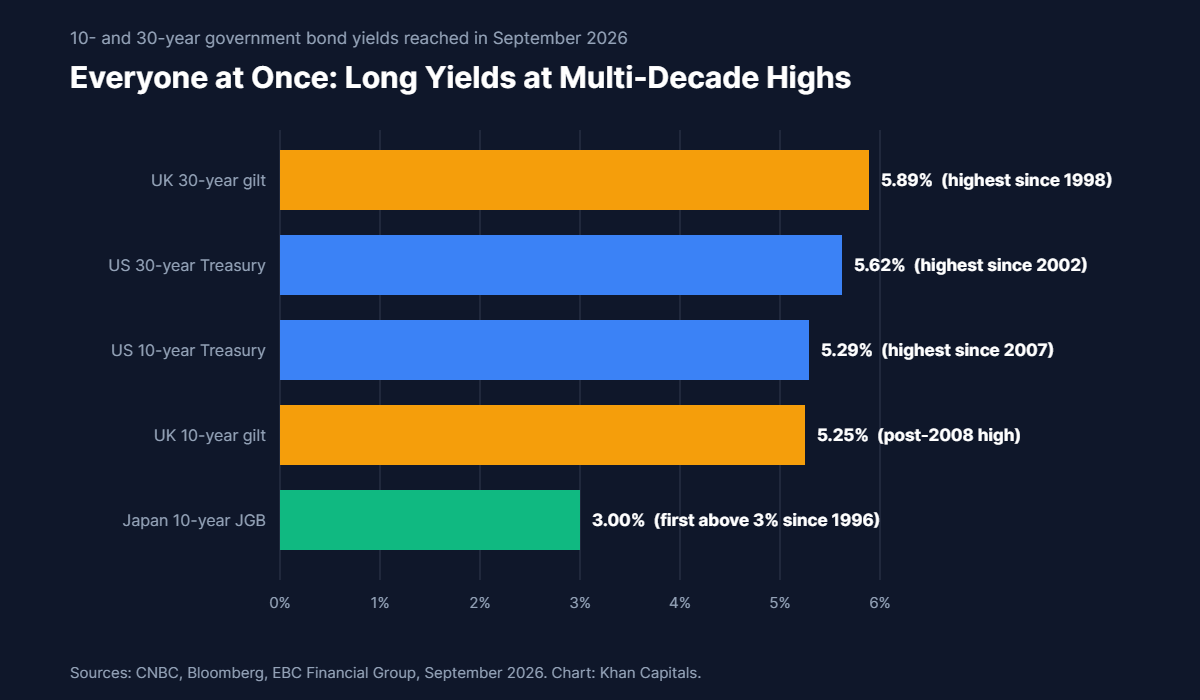
The synchronisation is the tell. Thirty-year gilts have traded at 5.89 per cent this month, their highest since May 1998, with the 10-year gilt around 5.25 per cent. Japan’s 10-year government bond yield crossed 3 per cent at the start of September for the first time since 1996 and has held above it, even after the Bank of Japan’s hike to a 31-year high. German 10-year yields have reached levels last seen in 2011. Bloomberg calculates that the average yield on global government debt has been pushed to the brink of 4 per cent, a threshold last crossed in 2007.
| Market | Yield reached in September | Highest since |
|---|---|---|
| US 30-year Treasury | 5.62% | 2002 |
| US 10-year Treasury | ~5.29% | 2007 |
| UK 30-year gilt | 5.89% | May 1998 |
| UK 10-year gilt | ~5.25% | Post-2008 peak |
| Japan 10-year JGB | Above 3% | 1996 |
| Germany 10-year bund | Cycle high | 2011 |
When one bond market sells off, the explanation is local. When every developed bond market sells off together, to multi-decade extremes, the explanation is a common factor. Three are in play: inflation that has been reignited by oil and tariffs; government borrowing that has expanded everywhere at once, from American deficits to European rearmament to Japan’s fiscal packages; and the withdrawal of the price-insensitive buyers, central banks and Japanese institutions above all, that spent a decade absorbing this paper. One analysis circulating this week attributes part of the move to the unwinding of the yen carry trade, which for years allowed governments to run deficits without upward pressure on their yields; whatever weight one gives that channel, the direction is the same. The marginal buyer of duration now demands to be paid properly for it.
What the 30-Year Treasury Yield Is Actually Pricing
Decompose the move and the story is not chiefly about the Federal Reserve’s next meeting. Markets price roughly a 70 per cent probability of a further quarter-point hike in October, per prediction markets and futures, and the September dot plot’s median points to a year-end rate of 4 to 4.25 per cent. But another 25 or 50 basis points of policy cannot arithmetically justify a 30-year yield at 5.6 per cent unless investors also believe one of two things: that short rates will average far higher for far longer than previously assumed, or that owning long-dated government debt deserves substantially more compensation for its risks. The second, the term premium, is doing most of the work.
Term premium rises when the supply of duration outruns the demand for it and when inflation outcomes become harder to insure. Both conditions are now visible weekly: auction sizes have grown, the Treasury’s own buyback operations have proven too small to steady the tape, and the inflation mix (petrol-led headline with a firm core) is the kind that most punishes fixed coupons. The bruising arithmetic falls on holders: at the long bond’s duration of roughly 20, the rise of around 35 basis points in the 30-year yield since late August implies a price loss in the region of 6 to 7 per cent, in about a month, on the asset conventionally treated as the safest in the world.

Who Is Selling, and Who Has Stopped Buying
Flows explain the violence of the move better than fundamentals alone. For most of the past fifteen years, the marginal buyers of long-dated government debt were institutions that did not much care about price: central banks running asset purchase programmes, commercial banks warehousing bonds under liquidity rules, and Japanese life insurers and pension funds exporting their savings surplus into foreign duration. Each of those bids has weakened simultaneously. Quantitative tightening has central banks shrinking rather than growing their holdings. Japanese institutions, offered more than 3 per cent at home for the first time in three decades, have less reason to buy Treasuries or gilts hedged at punitive costs; the same repatriation logic pressures every market they once supported. And the banking system, still nursing the unrealised losses of the 2022-2023 rate shock, has little appetite to add duration into a falling market.
Who replaces them? Price-sensitive buyers: households, asset managers and hedge funds who buy when compensation is adequate and demand more when it is not. The transition from captive to discretionary demand is the structural story beneath every failed auction and every basis point of new term premium. It does not mean bonds cannot rally; it means rallies now need a reason, and the reason has to be paid for in yield first. That is a healthier market than the one central banks administered for a decade, but the toll for crossing from one regime to the other is being charged this month, at the long end, in every currency at once.
The Quarter-End Complication
The timing adds mechanical pressure to fundamental repricing. Wednesday is simultaneously quarter-end, with its rebalancing flows and window-dressing, and the release date for the August personal consumption expenditures price index, the Federal Reserve’s preferred inflation measure. Bond desks describe an unusually binary setup: a benign core PCE print into quarter-end could trigger the sharpest relief rally in months from these yield levels, while a firm one, with positioning already bruised, risks extending the run towards levels that force broader deleveraging. Friday’s September employment report then completes the sequence. Rarely has one week’s data carried this much duration risk.
Equities Can No Longer Look Away
Stock markets spent much of 2026 treating rising yields as background noise; that indulgence ended this week. US and world equities fell for a second consecutive day on Tuesday, with the Dow losing 347 points, as elevated yields collided with a 12-year low in consumer confidence. The transmission runs through three channels: valuation, as a 5.29 per cent 10-year makes the earnings yield on richly priced equities look thin; competition, as cash and short bonds now pay more than the dividend yield of every major index; and credit, as refinancing walls in property and leveraged balance sheets reprice against a long end that refuses to rally. The equity story of the autumn is being written in the bond market’s hand.
The 30-year US Treasury yield, trading at levels last seen in 2002.
Scenarios for the Long End
| Scenario | Conditions | Plausible 30-year range |
|---|---|---|
| Relief | Core PCE cools, payrolls soften, oil de-escalates | Back below 5.25% |
| Grind (base) | October hike delivered, data mixed, issuance heavy | 5.25% to 5.75% |
| Overshoot | Firm PCE, oil above $110, hawkish October guidance | A test of 6% |
Investor Implications
Fixed income. The long end now offers the highest nominal starting yields in a generation, and starting yield is historically the dominant driver of medium-term bond returns. The trade-off is that the same fiscal and inflation dynamics that created these yields could carry them higher still; the scenario table above is a reminder that 5.6 per cent is a level, not a ceiling. Intermediate maturities offer much of the yield with a fraction of the duration risk, which is why the belly of the curve has been the consensus refuge; the contrarian observation is that consensus refuges get crowded, and a genuine growth scare would reward the long bond most.
Equities. Duration discipline applies to stocks as much as bonds. The most rate-sensitive equity classes, unprofitable growth, long-dated infrastructure, REITs and utilities financed at yesterday’s rates, face the stiffest valuation headwind, while banks and insurers holding short-duration books earn their way through. The AI complex is the great test case: it is simultaneously the market’s longest-duration story and its strongest earnings compounder, and a 5.29 per cent 10-year forces investors to decide which description dominates.
Cross-asset. Bond volatility of this order historically leaks into everything: wider credit spreads, a stronger dollar against carry currencies, and pressure on any structure that borrows short against long assets. Gold’s resilience alongside rising real yields this year suggests investors are paying for insurance against fiscal outcomes, not just inflation ones. Sterling investors carry a double exposure, with gilts at generation highs of their own and UK mortgage pricing tied to them.
What to Watch
- Today, 30 September: August core PCE inflation and quarter-end flows; the most binary session for duration this month.
- 2 October: the September US employment report, the first payrolls print since the Fed resumed hiking.
- 27-28 October: the Federal Reserve meeting, with roughly 70 per cent odds of a further hike priced; the dots’ 2027 path matters more to the long end than the decision itself.
- Late October: the US Treasury’s quarterly refunding announcement, which sets auction sizes into 2027; long-end supply is now the market’s most sensitive variable.
Conclusion
September’s bond rout closes a chapter that began with a failed auction and has ended with the 30-year Treasury yield at a 24-year high, gilts at levels unseen since the 1990s and global government debt yielding what it last did before the financial crisis. The repricing is coherent: more inflation, more issuance and fewer captive buyers should cost governments more, and now they do. The unresolved question is whether 5.5 to 6 per cent long rates are a destination or a passage, and it will be answered not by auctions but by the real economy’s tolerance for them. A consumer already at twelve-year lows in confidence, and a corporate sector facing its refinancing calendar, will deliver the verdict over the coming quarters. Bondholders have finally been offered yields worth arguing about; the argument now begins.
Frequently Asked Questions
Why are bond yields rising around the world in 2026?
Three forces are working together: inflation reignited by oil prices and tariffs, heavy government borrowing across the US, Europe and Japan, and reduced buying from the central banks and institutions that previously absorbed government debt at any price. Together they have pushed the average yield on global government bonds towards 4 per cent, the highest since 2007.
What does a higher 30-year Treasury yield mean for ordinary borrowers?
Long-dated Treasury yields anchor the pricing of US mortgages and long-term corporate borrowing, and gilt yields play the same role for UK fixed-rate mortgage pricing. A 30-year Treasury at its highest since 2002 therefore feeds through to dearer home loans and costlier long-term financing for companies, which is one of the main channels through which bond markets slow an economy.
Is this like the 2022 UK gilt crisis?
It rhymes but differs in kind. The 2022 episode was a sudden, leverage-driven dislocation concentrated in UK pension strategies and was resolved by central bank intervention within weeks. 2026’s move is slower, global and driven by fundamentals: inflation, issuance and the withdrawal of price-insensitive buyers. That makes it less acute but potentially far more durable.
Could the Federal Reserve stop the rise in long-term yields?
Not easily with its policy rate, which mainly steers short maturities. The long end is moved by expected inflation, debt supply and term premium. The tools that address those, slower issuance, buybacks or renewed asset purchases, sit awkwardly with a central bank that is currently raising rates to fight inflation, which is why the Treasury’s buyback operations have so far had limited effect.
Sources: CNBC, “30-year Treasury bond yield scales to highest level since 2002”; Bloomberg, “US 30-Year Treasury Yield Rises to Highest Level Since 2002”; Bloomberg, “Tumbling Global Government Bonds Put Yields on Brink of 4%”; Reuters via US News, “Bonds Set for Bruising September”; Federal Reserve Bank of St. Louis, 30-Year Treasury Constant Maturity (DGS30); EBC Financial Group, “What Is Driving the Global Bond Selloff?”.
Related Reading: This piece continues the thread from the failed auction that took the 10-year through 5 per cent. The policy backdrop is set out in the Fed’s September hike and the Bank of Japan’s move to a 31-year high, while the Treasury’s $6 billion buyback operations explain why official intervention has struggled to steady the long end. For the fundamentals, start with duration, the number that runs fixed income and the term premium.

Leave a Reply