
Khan Capitals | July 2026
Key Takeaways
- Meta broke the premise. Meta unveiled plans for a cloud business to sell excess AI computing capacity to outside customers, an admission that one of the largest buyers of AI infrastructure has more compute than it needs.
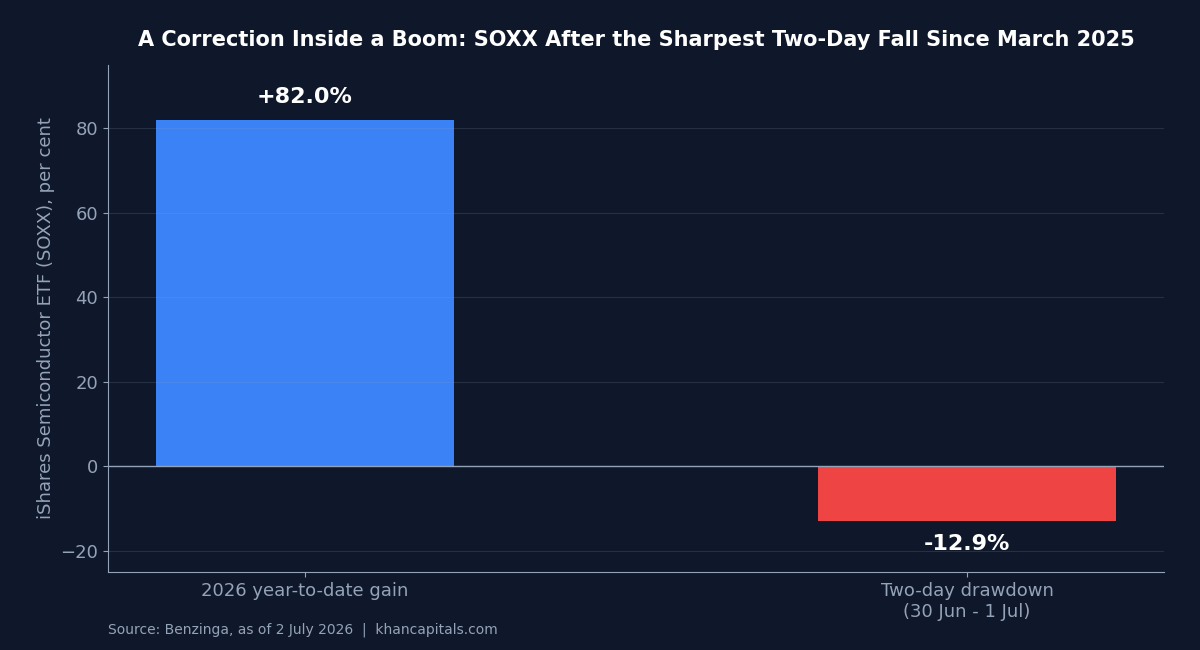
- The suppliers paid for it. The Philadelphia Semiconductor Index fell 6.3 per cent on 1 July and the iShares Semiconductor ETF lost 12.9 per cent over two sessions, the sharpest two-day decline since March 2025, while Meta itself rose 8.8 per cent to $612.91.
- Efficiency compounded the shock. OpenAI engineers found software optimisations capable of cutting inference costs by more than half, reducing the number of GPUs needed for some ChatGPT traffic just as Meta’s spare capacity came to light.
- The pain was precisely targeted. Micron sank more than 10 per cent, GPU cloud specialists CoreWeave and Nebius fell 14 and 17 per cent, yet Nvidia slipped just 1.25 per cent: the market repriced capacity resellers and marginal suppliers, not the ecosystem’s core.
- Correction within a boom. Even after the fall, the semiconductor ETF remains up 82 per cent in 2026; the question the week posed is not whether AI demand is real but who captures it when compute stops being scarce.
Part of: The AI Infrastructure Supercycle – Khan Capital’s hub on the AI infrastructure build-out.
The Assumption That Priced a Supercycle
Every capital cycle rests on one load-bearing assumption, and for three years the AI build-out’s has been simple: demand for computing power will always exceed supply. That premise justified the $725 billion hyperscaler capex wave, underwrote record memory pricing, and turned every megawatt of data centre capacity into a pre-sold asset. This week the Meta AI cloud announcement put the first visible crack in it. When one of the world’s largest buyers of GPUs starts building a business to sell computing power it does not need, the scarcity story acquires an asterisk, and markets spent two violent sessions repricing what that asterisk is worth.
What the Meta AI Cloud Move Actually Is
Bloomberg reported on 1 July that Meta is developing plans for a cloud infrastructure business selling access to AI computing power and models, a direct new front against Amazon Web Services, Microsoft Azure and Google Cloud. An internal group named Meta Compute, involving infrastructure head Santosh Janardhan, Superintelligence Labs executive Daniel Goss and Meta president Dina Powell McCormick, is leading the effort. Among the options under consideration is a service letting outside developers pay to run queries against AI models, including Meta’s own Muse Spark, on infrastructure the company owns and operates.
Investors in Meta loved it: the shares jumped 8.8 per cent to $612.91 on nearly triple their average volume, because monetising idle capacity converts a sunk cost into a revenue line. But the same fact reads very differently from the supplier side. Excess capacity at a hyperscaler means the capex that built it ran ahead of internal demand, and capacity that is resold competes with capacity that would otherwise have been bought new. GPU cloud specialists whose business is renting out computing power took the point immediately: CoreWeave fell 14 per cent and Nebius 17 per cent on the day. What was a customer is now, at the margin, a competitor.
Two Catalysts, One Message
The second blow came from the software layer. OpenAI engineers found optimisations capable of cutting inference costs by more than half, reducing the number of Nvidia GPUs required to serve some non-logged-in ChatGPT traffic. In isolation, an efficiency gain is unremarkable; software has been squeezing more out of silicon since the industry existed. Arriving in the same week as Meta’s excess-capacity admission, it completed a syllogism the market could not ignore: the largest buyers have spare compute, and the largest workloads are learning to use less of it. Both statements can be true and benign individually. Together they attack the scarcity premium embedded in every AI infrastructure valuation.
The selling that followed was notable for its precision. The Philadelphia Semiconductor Index dropped 6.3 per cent on Wednesday, and the iShares Semiconductor ETF plunged 12.9 per cent over two sessions, its sharpest two-day fall since March 2025. Micron, the purest play on AI memory scarcity, sank more than 10 per cent; SanDisk, Intel and AMD lost between 6.9 and 10.6 per cent. Nvidia, by contrast, slipped just 1.25 per cent. The market was not abandoning AI; it was surgically removing the excess-scarcity premium from the names that had been priced as if supply could never catch up, a distinction that also caught the memory names we covered in Micron’s record quarter at the top of their run.
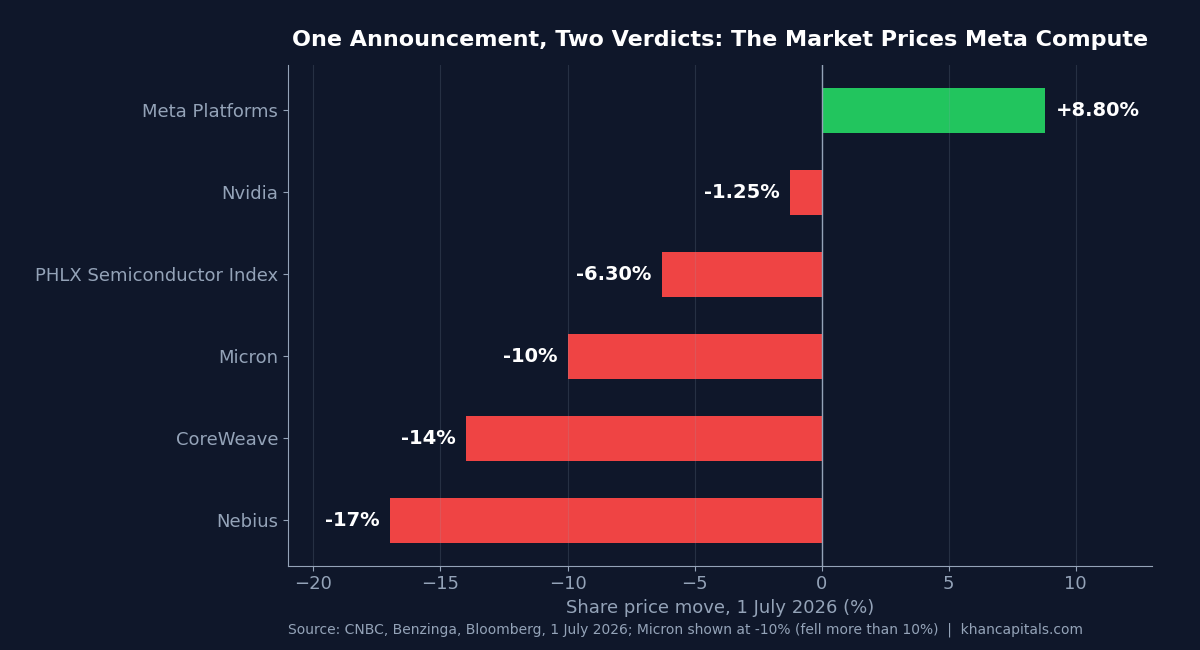
| Instrument | Move | Detail |
|---|---|---|
| Meta Platforms | +8.8% (1 Jul) | Closed $612.91, volume ~3x daily average |
| PHLX Semiconductor Index (SOX) | -6.3% (1 Jul) | Broad supplier repricing |
| iShares Semiconductor ETF (SOXX) | -12.9% (two sessions) | Sharpest two-day fall since March 2025; still +82% YTD |
| Micron | -10%+ (1 Jul) | SanDisk, Intel, AMD lost 6.9-10.6% |
| Nvidia | -1.25% (1 Jul) | Core ecosystem largely spared |
| CoreWeave / Nebius | -14% / -17% (1 Jul) | GPU cloud resellers facing a new competitor |
From Shortage to Glut, or Just to Normal?
The bear reading is straightforward: this is how gluts announce themselves. Capacity built for a demand curve that was extrapolated rather than observed eventually exceeds it, the marginal buyer becomes a seller, and pricing power reverses down the supply chain, first in resold compute, then in new hardware orders, last in the memory and components that fed them. Every commodity cycle in history, from fibre in 2001 to DRAM repeatedly, has followed the same choreography. On this reading, the week’s headlines from Meta about AI agent development failing to accelerate as expected over the past four months, which pressed semiconductor names again on Thursday, are early confirmations that usage is not growing into the capacity being built for it.
The bull reading is equally coherent, and it has a name: Jevons paradox. When the cost of a resource falls, consumption of it tends to rise more than proportionally. Halving inference costs makes thousands of marginal AI applications economic that were not economic last month; Meta selling compute at market rates expands access to capacity that was previously locked inside one company’s walls. On this reading, cheaper and more available compute is how the AI market broadens beyond a handful of hyperscalers, and the scarcity premium was always going to be a phase, not a permanent feature. The 82 per cent year-to-date gain that survives the drawdown suggests most investors still lean this way.
What the week genuinely changed is narrower and more important than either slogan. The burden of proof has moved. Since 2023, AI infrastructure names have been priced on the assumption that every chip made would be bought, an assumption strong enough to survive June’s $1 trillion selloff, which was triggered by good news being priced as bad. This time the news itself was different in kind: a primary buyer disclosed surplus. From here, capex guidance, order books and utilisation disclosures will be read for confirmation of excess rather than confirmation of scarcity, and that asymmetry in interpretation is what a broken premise looks like in practice.
The Supply Chain Reads the Memo
The differentiated market reaction sketches the new pecking order. Nvidia’s resilience says the market still believes frontier training demand, the deepest moat in the stack, is intact; its move to reserve SK hynix memory supply weeks ago now reads as insurance against exactly this kind of demand repricing. Memory, the scarcest input a month ago, is the most exposed: if hyperscaler capacity is running ahead of workloads, the frantic bidding for HBM and DRAM that produced the AI memory price shock cools first. And the GPU cloud middle layer faces the hardest question, because its business model rents scarcity, and Meta just demonstrated that the scarcity can be manufactured away by a single balance sheet with spare racks.
It is worth keeping the scale honest. Meta has not cancelled capex; it has proposed to monetise a slice of what it already built, and one option among several at that. OpenAI’s optimisation applies to some traffic, not all workloads. No hyperscaler has guided infrastructure spending down. The evidence of glut is, for now, one disclosure and one engineering memo. But markets price direction before magnitude, and the direction of surprise flipped this week for the first time since the supercycle began.
Scenarios for the Supply Premise
| Scenario | Mechanism | Likely leadership |
|---|---|---|
| Jevons rebound | Cheaper compute expands the application layer; demand refills capacity within quarters | Software and inference-heavy names lead; semis recover with a lag |
| Digestion pause | Capex growth flattens while workloads catch up; orders slip one to two quarters | Nvidia and TSMC hold; memory and second-tier suppliers underperform |
| Capacity glut | More hyperscalers resell surplus; hardware pricing power reverses broadly | Defensive rotation out of the complex; cloud consumers benefit over suppliers |
Investor Implications
Equities. The week argues for discriminating within the AI complex rather than exiting it. The moat hierarchy the selloff revealed, frontier training silicon first, foundry second, memory and capacity resellers last, is a reasonable template for how future demand scares will be distributed. Hyperscalers with excess capacity are, perversely, winners twice over: their capex bought optionality, and monetising it creates a revenue line competitors must now price against. The index-level question is concentration: semiconductors led the market’s first half, and a leadership handoff, if the digestion scenario runs, historically favours equal-weight over cap-weight exposure.
Fixed income. The AI capex boom has been financed increasingly in credit markets, from hyperscaler issuance to data centre project finance and GPU-backed lending. A demand premise under review widens the dispersion there too: paper backed by long-term hyperscaler leases is a different risk from paper backed by spot GPU rental rates, and the CoreWeave and Nebius equity moves suggest the market has started making that distinction.
Cross-asset. The episode landed in the same week as a soft US jobs report, leaving the market’s two pillars, AI earnings momentum and a patient Federal Reserve, both looking less solid than they did a fortnight ago. Volatility in the semiconductor complex has historically led index volatility during this cycle; the VIX complex and semiconductor implieds are worth watching together into the July earnings gauntlet.
What to Watch
- Mid-July 2026: TSMC’s second-quarter results and monthly revenue prints, the cleanest read on whether real silicon orders have slowed or the repricing is running ahead of the physical cycle.
- Late July 2026: Hyperscaler earnings from Microsoft, Alphabet, Amazon and Meta itself. Capex guidance and any disclosure on Meta Compute’s scope, pricing or customers will define the excess-capacity narrative.
- August 2026: Nvidia’s results and, as importantly, its commentary on order visibility; memory pricing data from the DRAM and HBM spot markets as the first sign of scarcity premiums fading.
- Ongoing: Whether other hyperscalers follow Meta into reselling capacity. A second such announcement would convert an idiosyncratic story into a structural one.
Conclusion
The Meta AI cloud announcement will be remembered less for what it did to one week’s prices than for what it did to a three-year-old assumption. The AI infrastructure trade was built on the premise that compute demand permanently exceeds supply; this week the market learned that at least one giant buyer has surplus, and that the software layer is actively engineering demand per query lower. Neither fact ends the supercycle. Both change how it must be underwritten: from faith in scarcity to evidence of utilisation. The names that survive that shift in burden of proof are the ones selling something scarcer than computing power, whether frontier silicon, foundry capacity or the models themselves. For everyone else in the stack, the free ride on the shortage narrative ended on the first of July, and the July earnings season has just become the most consequential of the cycle.
Frequently Asked Questions
Why did semiconductor stocks fall in early July 2026?
Two catalysts hit together: Meta announced plans to sell its excess AI computing capacity through a new cloud business, and OpenAI engineers found optimisations cutting inference costs by more than half. Both undermined the assumption that AI compute demand always exceeds supply, and the SOXX ETF fell 12.9 per cent over two sessions.
What is Meta Compute?
Meta Compute is an internal Meta group developing a cloud infrastructure business that would sell access to AI computing power and models, including letting outside developers pay to run queries on Meta-owned infrastructure. It would compete with Amazon Web Services, Microsoft Azure and Google Cloud.
Does the selloff mean the AI boom is over?
Not on the evidence so far. The semiconductor ETF remains up 82 per cent in 2026, no hyperscaler has cut capex guidance, and cheaper compute may expand demand rather than shrink it. What changed is the burden of proof: markets will now read order books and utilisation data for signs of excess rather than assuming scarcity.
Why did Nvidia fall less than other chip stocks?
Nvidia slipped just 1.25 per cent while Micron lost more than 10 per cent because the repricing targeted scarcity plays, not the ecosystem’s core. Frontier training demand for Nvidia’s chips is seen as the most durable part of the stack, while memory suppliers and GPU cloud resellers are most exposed to any excess capacity.
Sources: Bloomberg, Meta Is Planning a Cloud Business; CNBC; TechCrunch; Yahoo Finance, OpenAI Efficiency Gains; Benzinga; Axios.
The Khan Capital Brief
Understand what moves markets
Analysis like this, free in your inbox. No spam, unsubscribe any time.
Related Reading: The supply side of this story runs through The AI Memory Price Shock, Micron’s Record Quarter and The NVIDIA SK hynix Memory Deal. For the demand side and the capex arithmetic, see AI Capex Hits $725bn, and for June’s very different selloff, The $1 Trillion AI Semiconductor Selloff. The next leg arrived when Samsung’s record Q2 guidance was met with selling. For what the scarcity premise costs the vendors on the other side of it, see IBM’s worst day on record. For the counter-evidence from the constraint itself, see TSMC’s Q2 2026 earnings. The China licence turn added a new variable, covered in Nvidia’s H200 exports analysis. The repricing culminated in the semiconductor bear market of July 2026. Where the spending line went next is covered in Alphabet’s $205 billion capex quarter. For the fundamentals, start with how earnings season moves stocks. See also the accounting behind the AI build-out.

Leave a Reply