

Khan Capitals | July 2026
Key Takeaways
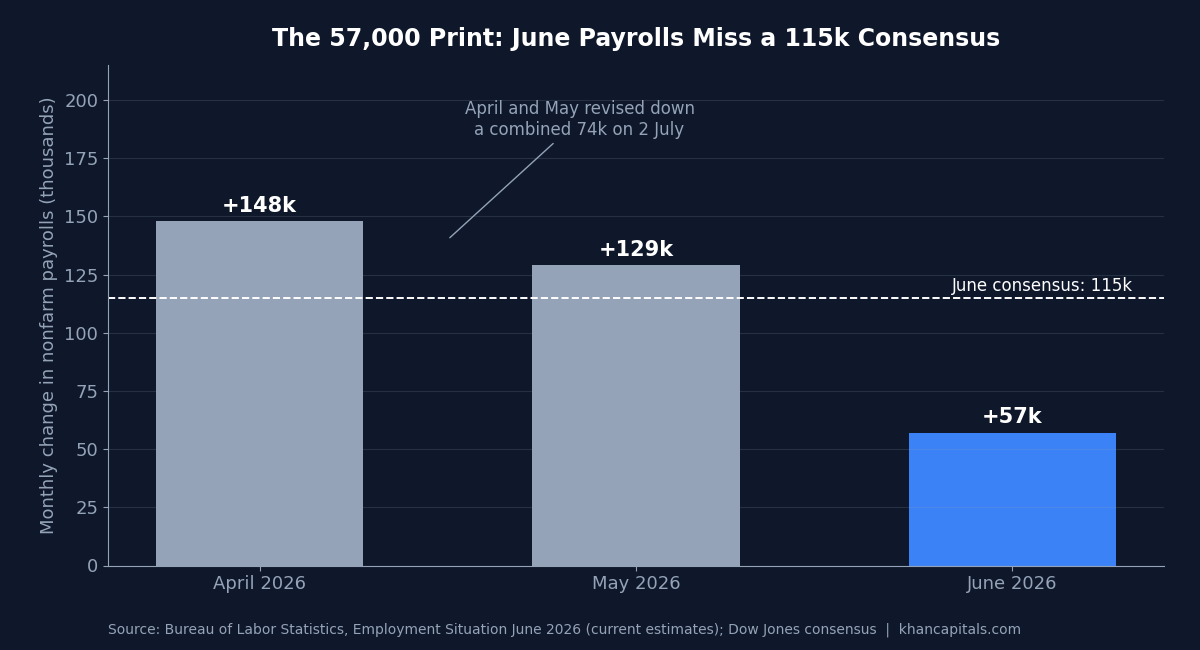
- A clear miss. The Bureau of Labor Statistics reported that US nonfarm payrolls rose by just 57,000 in June, well below the 115,000 consensus and down from a revised 129,000 in May.
- The revisions matter as much as the print. April was cut by 31,000 and May by 43,000, leaving the two-month total 74,000 lighter than previously reported and confirming a labour market that has been cooling for longer than the headlines suggested.
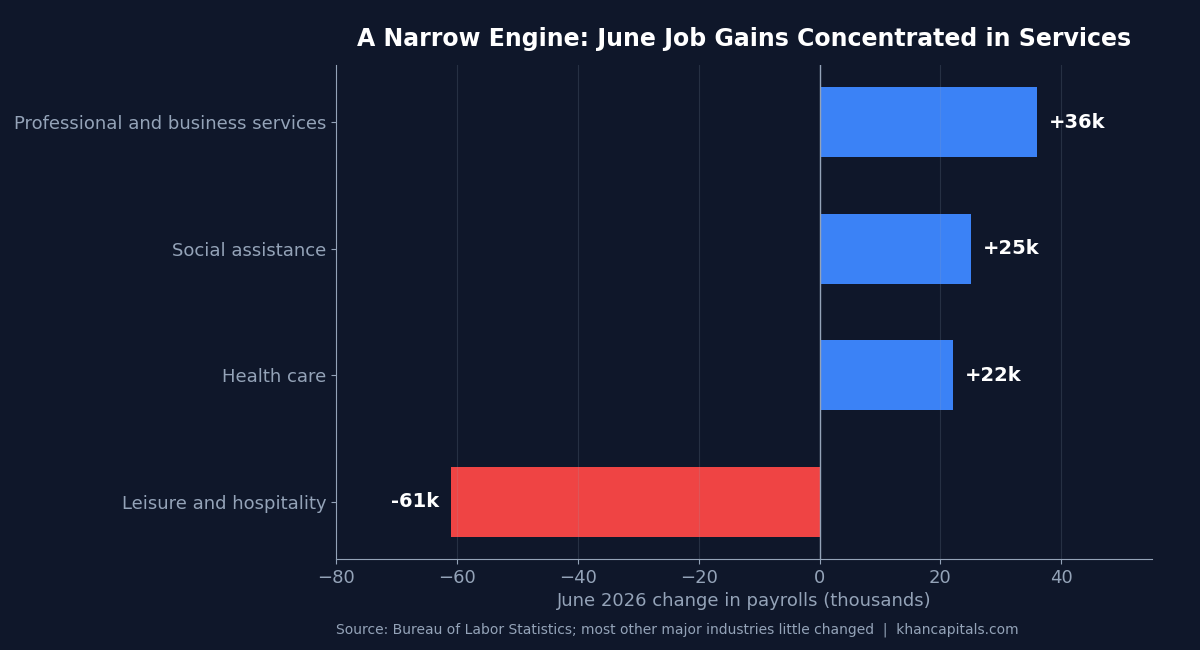
- Breadth is the real story. Leisure and hospitality shed 61,000 jobs while gains concentrated in professional and business services, health care and social assistance; most other major industries were flat.
- The hike debate lost steam. Market-implied odds of a July rate increase fell to roughly 20 per cent from 30 per cent a week earlier, and the two-year Treasury yield eased to 4.137 per cent as traders trimmed tightening bets.
- The paradox persists. Unemployment edged down to 4.2 per cent, its lowest in a year, and wages grew 3.5 per cent annually, giving the Federal Reserve evidence for both patience and vigilance at once.
Part of: The Fed’s Regime Change – Khan Capital’s hub on the Fed’s 2026 regime change.
What the June Jobs Report Actually Showed
The June jobs report landed on Thursday 2 July with a headline that required no interpretation: 57,000 new nonfarm payrolls against a consensus forecast of 115,000. In a normal cycle, a miss of that size would be read as noise, one soft print in a volatile series. What makes this one different is the context around it. The Bureau of Labor Statistics itself noted that June’s gain was roughly in line with the average monthly change over the prior twelve months, which now stands at just 36,000. The miss, in other words, was not the labour market departing from trend. It was the consensus discovering what the trend has quietly become.
That distinction matters for how the print should be read. Forecasters had extrapolated from May’s apparent reacceleration, which showed 172,000 jobs when first reported. Thursday’s release revised that figure down to 129,000, and April’s down to 148,000. The labour market that economists were modelling in June did not exist. The one that does exist is adding jobs at a pace that, before the pandemic, would have been associated with an economy near stall speed on hiring, even as output and equity markets tell a very different story.
| Measure | June 2026 | Consensus | Prior (revised) |
|---|---|---|---|
| Nonfarm payrolls | +57,000 | +115,000 | +129,000 (May) |
| Unemployment rate | 4.2% | 4.3% | 4.3% (May) |
| Average hourly earnings (m/m) | +0.3% | +0.3% | +0.3% (May) |
| Average hourly earnings (y/y) | +3.5% | +3.5% | +3.5% (May) |
| Two-month net revision | -74,000 | n/a | April -31k, May -43k |
The Revisions Beneath the Revisions
Every payrolls cycle has a lesson, and the lesson of 2026 so far is that first prints have been systematically too optimistic. The 74,000 jobs subtracted from April and May continue a pattern that has run through much of the year: initial releases that support a resilient-labour-market narrative, followed by downward revisions that arrive too late to change the story the market has already told itself. Anyone who traded the May report on its original 172,000 reading was trading a number that no longer exists.
There is a mechanical explanation and a structural one. Mechanically, the BLS birth-death model and falling survey response rates have made early estimates noisier, a problem the agency has acknowledged for several years. Structurally, revisions tend to turn persistently negative at labour-market turning points, because the model extrapolates business formation from a past that no longer describes the present. That was the experience of 2007 and again of 2019. It does not mean a recession follows; 2019 resolved into a mid-cycle adjustment rather than a downturn. But it does mean the balance of information risk sits to the downside of each first print, a fact that should discipline how much weight any single beat is given from here.
A Three-Sector Economy
Underneath the headline, the June jobs report describes an economy in which hiring has narrowed to a handful of sectors. Private education and health services added 69,000 positions, professional and business services 36,000, and social assistance 25,000. Against that, leisure and hospitality lost 61,000 jobs, reversing most of its 70,000 gain in May on weaker than usual seasonal hiring. Nearly everything else, construction, manufacturing, retail, transportation, information, financial activities and government, was effectively unchanged.
Concentration of this kind is not a new feature, but it is an intensifying one. Health care and its adjacent categories have carried a disproportionate share of US job creation since 2023, and they are the sectors least sensitive to interest rates and least connected to the corporate profit cycle. What the private cyclical economy is doing, stripped of health and education, is close to nothing. Indeed’s Hiring Lab described the report as “an unmoving tide”, and the phrase captures something important: this is not a labour market shedding workers, it is one that has largely stopped absorbing them.
Fewer Jobs, Lower Unemployment
The most analytically awkward line in the release is the unemployment rate, which edged down to 4.2 per cent, its lowest in a year, even as payroll growth stalled. The two numbers come from different surveys, and the divergence between them has become a defining feature of this cycle. The establishment survey counts jobs; the household survey counts people. When the two part company for months at a time, the usual reconciliation runs through labour supply: a workforce that is growing more slowly, whether through demographics or reduced immigration, requires far fewer new jobs to hold the unemployment rate steady.
This is the detail that keeps the Federal Reserve’s hawks in the argument. If the economy’s break-even pace of job creation has fallen from the roughly 100,000 per month of the last decade to something closer to 50,000, then June’s 57,000 is not weakness at all; it is equilibrium. Wage growth of 3.5 per cent, comfortably above the pace consistent with 2 per cent inflation at current productivity trends, supports that reading. On this view the labour market is not deteriorating, it is tight and small, and the correct policy response to a tight and small labour market with core PCE inflation at 3.4 per cent is not easier money.
The Hike That Faded
Markets, however, traded the other side of the argument. By Thursday’s close, the probability of a 25 basis point increase at the July meeting had fallen to roughly 20 per cent from 30 per cent a week earlier, and the two-year Treasury yield slipped more than 2 basis points to 4.137 per cent while the ten-year edged up to 4.485 per cent. The curve steepened modestly, the classic signature of a market removing near-term tightening risk while leaving longer-run inflation uncertainty in place.
The move extends a repricing that has been running in both directions all summer. As covered in our analysis of the June shift from cuts to hikes, the rates market entered June pricing a genuine chance of tightening this year, a reversal almost without precedent this deep into a hold. The June FOMC, Chair Kevin Warsh’s first, reinforced that pricing by removing forward guidance and revealing nine officials pencilling in at least one increase in 2026. One soft payrolls print has not unwound the regime change, but it has taken the July meeting off the table in the market’s eyes: traders now assign roughly 80 per cent probability to no move, and the consensus of zero cuts in 2026 remains intact.
Warsh’s Asymmetry Problem
For the new Fed chair, the June jobs report crystallises an uncomfortable asymmetry. The case for hiking rests on inflation that has stopped falling: core PCE at 3.4 per cent, wage growth at 3.5 per cent, financial conditions loose enough to support record equity prices. The case against rests on a labour market whose trend pace of job creation has slowed to 36,000 a month and whose first prints keep being revised down. Tighten into that and the Fed risks discovering that the labour market was closer to the edge than the unemployment rate implied. Hold, and it risks validating an inflation plateau well above target in the first year of a chairmanship that was explicitly framed around restoring credibility.
History offers an imperfect but instructive parallel in 1995 and 1996, when the Greenspan Fed managed a soft landing by treating slowing payrolls as evidence of equilibrium rather than decay, easing slightly and then holding for an extended period. The difference is that inflation then was converging on target from above; today it has stalled more than a full point above it. Warsh does not have Greenspan’s luxury of declaring victory. The most likely outcome, and the one markets now price, is an extended hawkish hold in which every payrolls Friday and every CPI Tuesday carries policy weight it would not carry in a settled regime.
A Tape That Refused to Flinch
Equities, for their part, treated the report as good news. The Dow Jones Industrial Average rose 1.07 per cent to a record close of 52,900 on Thursday, capping the holiday-shortened week, while the S&P 500 finished flat as weakness in semiconductors offset gains across eight of the remaining sectors. The market’s logic is familiar: a labour market soft enough to remove hikes but not weak enough to threaten earnings is the narrow corridor in which risk assets have thrived all year, as we examined in our review of the best quarter since 2020.
The corridor, though, is narrower than the index level suggests. A payrolls trend of 36,000 a month leaves little cushion before soft becomes weak, and the revision pattern means the market will learn about any deterioration with a lag. Meanwhile the equity leadership that carried the first half is itself under strain from an entirely separate direction, with the semiconductor complex enduring its sharpest two-day fall since March 2025 in the same week. A tape at record highs, priced for a policy pause and fed by increasingly narrow employment growth, is a tape whose margin for macro error has quietly compressed.
Scenarios Into Year-End
The policy path from here reduces to three broad scenarios, each with distinct market signatures. Their probabilities will move with every data release, but the June jobs report has shifted weight decisively toward the middle path.
| Scenario | Trigger conditions | Likely market response |
|---|---|---|
| Late hike | June/July CPI reaccelerates; payrolls rebound above 100k; wages firm | Curve flattens, two-year above 4.5%, pressure on long-duration equities |
| Extended hold (market base case) | Inflation plateaus near 3%, payrolls trend 30-80k, unemployment stable | Range-bound rates, carry-friendly, equity leadership rotates with earnings |
| Easing pivot | Payrolls turn negative; unemployment rises through 4.5%; credit stress | Bull steepening, gold and quality bid, cyclical equity drawdown first |
Investor Implications
Equities. The removal of near-term hike risk supports the multiple, but the earnings story now carries more of the load. Sectors levered to the health and services hiring engine retain an employment tailwind that cyclicals lack, and the narrowness of job creation argues for attention to revenue breadth rather than index-level exposure. A record Dow alongside a 57,000 payrolls print is not a contradiction, but it is a combination that rewards selectivity.
Fixed income. The front end has repriced towards a hold, leaving two-year yields near 4.1 per cent with asymmetric risk: a hawkish CPI surprise on 14 July would hurt more than a soft one would help, given how far hike odds have already fallen. Further out the curve, stalled disinflation and heavy supply keep the term premium argument alive; the modest steepening on jobs day is consistent with a market that trusts the Fed to resist cuts but not to conquer the last mile of inflation.
Cross-asset. A slowing labour market with a patient Fed and falling oil prices is, historically, a benign mix for carry strategies and a difficult one for the dollar. The larger cross-asset question is sequencing: if the next shoe is inflation, rates lead equities lower; if it is employment, credit leads. Watching weekly claims alongside high-yield spreads offers an earlier read than the monthly payrolls cycle itself.
What to Watch
- 14 July 2026: June CPI. The single largest input into the July FOMC decision; a core print above 0.3 per cent month on month would revive the hike debate the jobs report just quieted.
- 28-29 July 2026: FOMC meeting. Markets price roughly 80 per cent probability of no change; the statement language around labour market “solidity” will be scrutinised for any shift.
- Weekly, Thursdays: Initial jobless claims. With payrolls breadth this narrow, claims are the highest-frequency check on whether flat hiring is tipping into net firing.
- 7 August 2026: July Employment Situation. The revision pattern matters as much as the print; a third consecutive downward revision month would confirm the softening trend.
Conclusion
The June jobs report did not break the labour market narrative; it corrected it. An economy adding 36,000 jobs a month on trend, with hiring concentrated in a few rate-insensitive sectors and first prints that keep revising lower, was always a weaker underlying picture than the headline series implied. What changed on 2 July is that the correction became consensus, and the rate hike that markets had spent June learning to fear moved to the sidelines. The unemployment rate at a one-year low and wages at 3.5 per cent ensure the Fed cannot declare the inflation fight finished, so the hold extends and the data dependence deepens. For investors, the report resolves one uncertainty and replaces it with another: the question is no longer whether the Warsh Fed hikes in July, but how long an equity market at record highs can coexist with an employment engine running this close to idle.
Frequently Asked Questions
How many jobs were added in the June 2026 jobs report?
US nonfarm payrolls rose by 57,000 in June 2026, well below the consensus forecast of 115,000. April and May were also revised down by a combined 74,000 jobs, and the unemployment rate edged down to 4.2 per cent.
Why did unemployment fall if job growth was weak?
The unemployment rate comes from the household survey while payrolls come from the establishment survey. When the labour force grows slowly, fewer new jobs are needed to keep the rate stable, so a soft payrolls number can coexist with falling unemployment.
Will the Federal Reserve raise rates in July 2026?
Markets now assign roughly 80 per cent probability to no change at the July meeting, with hike odds falling to about 20 per cent after the jobs report. The decision will depend heavily on the June CPI release on 14 July.
Which sectors added jobs in June 2026?
Private education and health services added 69,000 jobs, professional and business services 36,000 and social assistance 25,000. Leisure and hospitality lost 61,000 positions, and most other major industries were broadly unchanged.
Sources: Bureau of Labor Statistics, Employment Situation June 2026; Morningstar; CNBC; Indeed Hiring Lab; CNN Business; Federal Reserve H.15 Selected Interest Rates.
The Khan Capital Brief
Understand what moves markets
Analysis like this, free in your inbox. No spam, unsubscribe any time.
Related Reading: For the policy backdrop to this report, see our coverage of Warsh’s first FOMC and the end of forward guidance and the June repricing from cuts to hikes. The inflation side of the Fed’s dilemma is examined in Core PCE at 3.4%, while our April jobs report analysis traced the earlier cracks in the payrolls data. For the market context, see The Best Quarter Since 2020. The fade proved brief: within a week, the September hike bet was back at 64 per cent. The inflation half of the same debate is covered in the June CPI report. For where the hike debate went next, see the Fed’s 9-3 July hold. For the fundamentals, start with the term premium, explained. See also how to read the US jobs report.

Leave a Reply