
Khan Capitals | September 2026
Key Takeaways
- The Saudi East-West pipeline attack removed the oil market’s last redundancy. Last Thursday’s strike knocked out the pipeline that had allowed tankers to load on the Red Sea and bypass the blockaded Strait of Hormuz, threatening up to 4 per cent of global oil supply.
- The war has widened into Saudi Arabia itself. Iran-aligned Houthi forces fired dozens of missiles and drones at Khamis Mushait, Abha and Taif, Riyadh reportedly cancelled some crude cargoes, and Tehran vowed to strike energy infrastructure across the region in response to further US attacks.
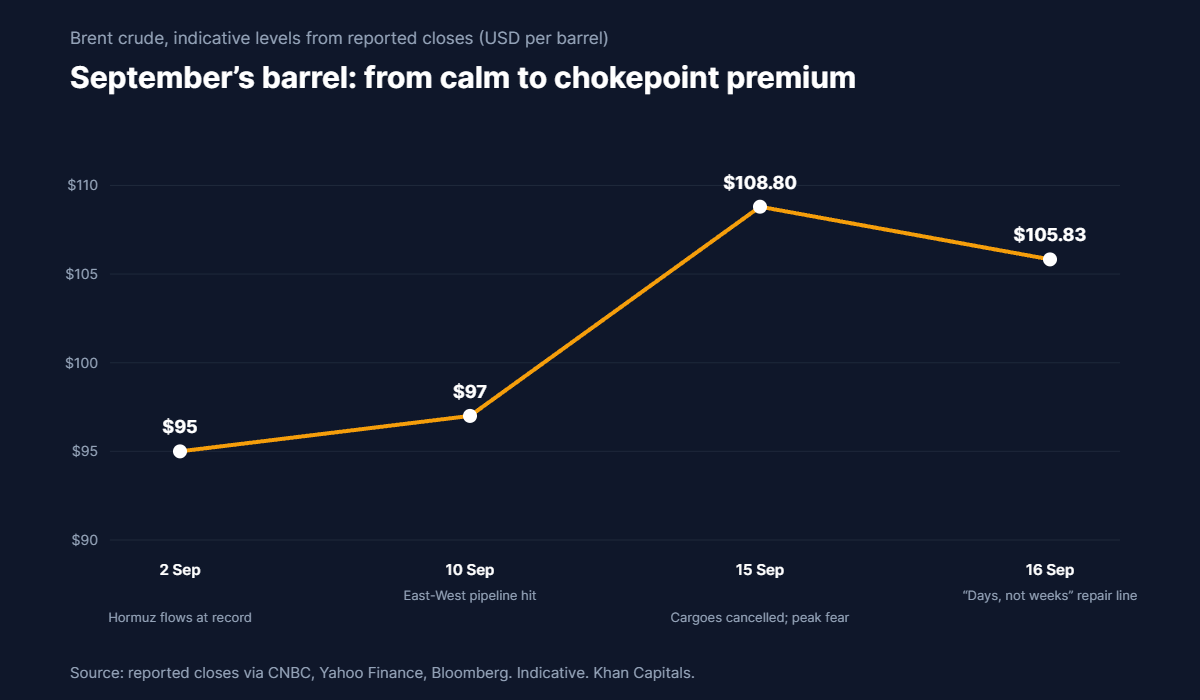
- Crude finally broke out of its wartime calm. WTI topped $105 and Brent rose above $108, taking the month’s gain past 16 per cent, before Brent settled at $105.83 on Wednesday, down 2.7 per cent, after US Energy Secretary Chris Wright called the outage a “brief and temporary interruption” measured in days.
- Analysts have begun sketching the ceiling: if inventory depletion sets in, some estimate Brent may need to reach around $150 to force demand destruction in emerging Asia, above the $147 record of July 2008.
- The macro loop is now closed. Petrol supplied over a third of August’s US CPI increase, the 10-year Treasury yield touched its highest since 2007 partly on oil, and the Federal Reserve raised rates on Wednesday citing exactly the risk that energy prices broaden into everything else.
Part of: The 2026 Iran Crisis — Khan Capital’s hub on the Gulf war and the oil market.
The Bypass Was the Story. Now It Is the Target.
For months, the strangest feature of the Gulf war has been the oil market’s composure. Through a naval blockade of Iranian ports, drone strikes on tankers and missiles landing in four countries, Brent spent late summer in the mid $90s, and we devoted an entire piece to the escalation paradox: record volumes were still transiting the Strait of Hormuz even as the war around it intensified. Part of the answer to that puzzle ran overland. Saudi Arabia’s East-West pipeline, from its eastern fields to the Red Sea port of Yanbu, let the kingdom load tankers on the far side of the chokepoint entirely, and its availability was one of the main reasons the market could price a widening war with a single-digit risk premium.
That assumption ended last Thursday, when an attack knocked the pipeline out of service. The strike was followed over the weekend by renewed Houthi barrages: dozens of missiles and drones aimed at the military air base at Khamis Mushait and at Abha and Taif, as fighting between the Iran-aligned Houthis and Yemeni government forces backed by Riyadh reignited. The Strait of Hormuz, the Red Sea and now inland Saudi Arabia are active war zones simultaneously, and the workaround that made the first two survivable runs through the third.
Four Days That Repriced the Barrel
The market’s response was the sharpest of the war so far. By Tuesday, WTI had topped $105 as reports emerged that Saudi Arabia was cancelling some crude cargoes, and Brent traded above $108, extending September’s advance beyond 16 per cent. On Wednesday the move partially unwound: Brent settled 2.7 per cent lower at $105.83 after US Energy Secretary Chris Wright said the pipeline outage would prove a “brief and temporary interruption” whose duration “will be measured in days”, and further reports suggested Riyadh was offering ship-to-ship transfers to keep committed barrels moving.
| Date | Event | Market response |
|---|---|---|
| Thu 10 Sep | Attack takes the East-West pipeline offline | Crude begins climbing from the mid $90s |
| Weekend 12-14 Sep | Houthi missile and drone barrages on Khamis Mushait, Abha and Taif; Iran vows to hit regional energy infrastructure | Risk premium widens; six-week highs |
| Tue 15 Sep | Saudi Arabia reportedly cancels some crude cargoes | WTI tops $105; Brent above $108; 10-year Treasury yield hits highest since 2007 |
| Wed 16 Sep | US says pipeline restart is days away; ship-to-ship transfers reported; Fed raises rates | Brent settles -2.7% at $105.83 |
Note the asymmetry in what moves this market now. Missiles hitting Saudi cities added a few dollars. A single verbal assurance from an energy secretary about repair timelines removed almost three. After months in which the market shrugged at escalation headlines, the barrel’s marginal price-setter has become an engineering estimate: how many days from damage to flow. That is what happens when the buffer between a regional war and the global consumer stops being political and becomes physical.
The Arithmetic of a Lost Bypass
Roughly a fifth of the world’s oil normally moves through the Strait of Hormuz. With Iranian exports already at zero under the blockade and Hormuz transit hostage to daily military conditions, the East-West line’s several million barrels a day of capacity, up to 4 per cent of global supply by CBS News’s estimate, had become the system’s safety valve: the one large route from Gulf fields to open water that no warship could close. Losing it does three things at once. It forces more Saudi barrels back toward Hormuz precisely when Iran is promising to strike energy infrastructure across the region. It converts scheduled exports into logistics improvisation, the cargo cancellations and ship-to-ship transfers of the past two days. And it teaches every trader that infrastructure previously considered out of the war’s reach is not.
The third effect is the one with a lasting price. Pipelines can be repaired in days; assumptions cannot. Since April the market has treated Saudi territory as effectively sanctuary, in the way it treated tanker traffic as sanctuary before the ADNOC strikes and Iranian exports as replaceable before the blockade proved durable. Each time a sanctuary assumption dies, the equilibrium risk premium steps up, whatever the repair crews do. The 2019 Abqaiq attack is the template: flows were restored within weeks, but the world learned that half of Saudi processing could be interrupted in one night, and the market has priced Saudi infrastructure risk differently ever since.

How High Is the Ceiling?
With the war now touching supply rather than merely threatening it, analysts have begun estimating where prices would need to go if the loss persisted. The mechanism is inventories. Global stocks have cushioned every disruption so far; if depletion sets in, the market must find the price at which demand, rather than supply, gives way. Analysts cited by the ABC put that level around $150 per barrel for Brent, the price judged necessary to force uncontrolled demand destruction across emerging Asia, and above the nominal record of $147 set in July 2008. That is a scenario, not a forecast: it assumes the pipeline stays down or is re-hit, Hormuz remains constrained, and strategic reserves fail to bridge the gap. But the fact that demand destruction is the analytical frame at all marks how far the discussion has moved since summer, when the debate was whether the war justified $95.
| Scenario | Supply condition | Indicative price regime | Macro read-through |
|---|---|---|---|
| Quick repair (days, as Washington asserts) | Bypass restored; cargo schedule normalises | Brent settles back toward $95-105 with a fatter tail | CPI energy pressure persists but stabilises |
| Extended outage (weeks) | More barrels forced through Hormuz; inventories drawn | $110-130 as stocks deplete | Headline inflation re-accelerates; October Fed hike odds harden |
| Re-attack / widening | Repaired capacity struck again; other Gulf infrastructure hit | Path toward the $150 demand-destruction estimate | Stagflationary shock; central banks face 1970s test in earnest |
The Loop Into Rates Is No Longer Theoretical
What distinguishes this oil episode from every earlier leg of the war is that it arrived simultaneously with the macro bill for the previous ones. August’s US inflation report showed petrol supplying over a third of the monthly increase, with gasoline up 27.4 per cent on the year. On Tuesday the 10-year Treasury yield touched 5.04 per cent, its highest since July 2007, with the bond selloff explicitly attributed in part to oil’s latest jump. And on Wednesday the Federal Reserve raised rates for the first time since 2023, with Chair Kevin Warsh framing the move as ensuring that changes in relative prices, oil above all, do not broaden into second and third order effects.
The energy market and the rates market are now feeding each other. Higher crude lifts headline inflation, which hardens central bank resolve, which lifts yields and the dollar, which tightens conditions for the emerging economies that are also the marginal oil demand. A war that for months was a regional tragedy with a contained financial footprint has become the primary input into the price of money. That, more than any single day’s move in Brent, is what changed this week.
Investor Implications
Equities. Energy remains the one sector whose earnings power rises with the risk premium, and refining margins in importing regions bear watching as crude approaches demand-relevant levels. The losers are concentrated where fuel is a direct cost, airlines, shipping, chemicals, and, at one remove, every long-duration valuation exposed to the yields oil is dragging higher. European and Asian equity markets carry more energy-import sensitivity than the US, a divergence that widens with every dollar on the barrel.
Fixed income. Oil is now a rates input. Breakeven inflation rates are the cleanest expression of the supply scenarios above; the long end’s response to Tuesday’s price spike showed the transmission is live. A quick repair supports the case that Wednesday’s Fed hike is close to the last; an extended outage puts October firmly in play and keeps the global bond selloff supplied with fresh ammunition.
Cross-asset. The war-hedge complex, gold above all, retains its bid even into a hawkish Fed, because the scenarios that hurt bonds and equities are the ones that help the hedges. Volatility in crude itself has repriced: the days of selling oil vol against a becalmed wartime range ended when the range broke. For most portfolios the practical question is not predicting the repair timeline but ensuring that a $130 or $150 print, should it come, is survivable rather than thesis-breaking.
What to Watch
- Coming days: whether the East-West pipeline restarts on the timeline Washington asserts. Satellite imagery and Saudi export loadings at Yanbu will tell the truth before any statement does.
- Daily: Hormuz transit volumes and tanker insurance quotes, the two live gauges of whether the remaining route is absorbing the diverted barrels.
- Next EIA and IEA inventory data: the first hard evidence of whether the outage is drawing global stocks, the variable on which the $150 scenario turns.
- Tehran’s follow-through: Iran has vowed to strike energy infrastructure across the region after further US attacks; any hit on a second Gulf facility would validate the re-attack scenario and reprice the ceiling.
Conclusion
Every war teaches the oil market one lesson at a time. This one has now taught three: that a blockade can be absolute, that a chokepoint can stay open under fire, and, as of last Thursday, that the infrastructure built to make the chokepoint irrelevant is itself within reach. The price action of the past four days, a 16 per cent monthly surge unwound by 2.7 per cent on a repair estimate, shows a market still willing to believe in engineering, but no longer willing to believe in sanctuaries.
The repair crews will probably win this round; Washington says days, and Washington has been right about timelines before. But the East-West pipeline attack has done its structural work regardless. The redundancy that kept Brent in the $90s through a summer of escalation now carries a demonstrated bullseye, the demand-destruction maths has entered mainstream analysis, and the Federal Reserve has started charging the world interest on the war. The barrel is no longer just a commodity price. It is the transmission mechanism.
Sources: CBS News; CNBC (15 Sep); CNBC (16 Sep); ABC News; The Hill; Bloomberg; OilPrice.com.
Related Reading: The calm this week ended is documented in the escalation paradox of record Hormuz flows and the blockade the market priced at under $88. The sanctions architecture behind the conflict is covered in Washington’s “economic D-Day”, the hedge that keeps working in gold’s run at $4,700, and the policy consequence in the Fed’s first hike since 2023. For the fundamentals, start with Brent vs WTI, explained and war-risk insurance.

Leave a Reply