
Khan Capitals | September 2026
Key Takeaways
- The Fed rate hike arrived on 16 September: 25 basis points to 3.75 to 4 per cent, the first increase since 2023 and a unanimous decision, two months after a 9 to 3 vote to hold. Chair Kevin Warsh vowed a “timelier return” to 2 per cent inflation.
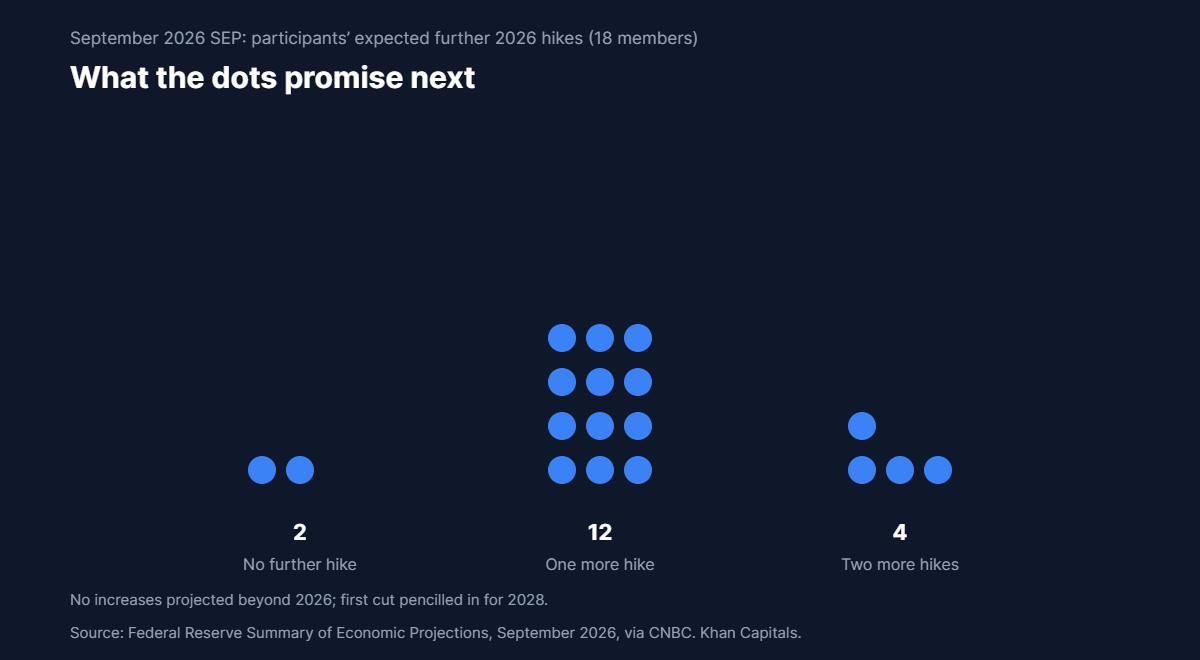
- The dots say this is a campaign, not a correction. Sixteen of eighteen participants pencilled in at least one further increase, four of them two, with no rises projected beyond this year and the first cuts not appearing until 2028. The committee does not expect inflation back at target until 2029.
- The Fed is tightening into a divergence, not a straightforward overheat. August CPI held at 3.4 per cent on the year while core inflation eased to 2.4 per cent, its lowest since March 2021, with gasoline, up 27.4 per cent on the year, supplying over a third of the monthly increase. Warsh framed the hike as insurance against the oil shock broadening.
- Markets took it badly at the long end and the short end alike. The Dow fell 631 points, the two-year yield jumped to 4.736 per cent, its highest since 2024, the 10-year climbed back to 5 per cent having touched its highest since 2007 the day before, and the dollar index rose 0.6 per cent to 100.30.
- The projections embed a hard trade-off: personal consumption expenditures inflation was revised up to 3.7 per cent for 2026 with core at 3.4 per cent, both a tenth higher than June, while the committee still projects both measures falling sharply in 2027. The market’s question, visible in the curve, is whether growth survives the wait.
Part of: The Fed’s Regime Change — Khan Capital’s hub on the Warsh Fed and the return of the hiking cycle.
Three Years of Waiting Ends in One Sentence
The Federal Reserve raised its benchmark federal funds rate by a quarter point on Wednesday to a target range of 3.75 to 4 per cent. It was the first Fed rate hike since 2023, the first policy move of any kind under Chair Kevin Warsh, and the moment a possibility this publication has tracked since Jackson Hole became policy. The vote was unanimous. In July, three members had dissented in favour of a hike while the committee held; in September, nobody dissented in favour of holding.
The journey to the decision was the story of the late summer. Hike odds collapsed to near 20 per cent after tame July inflation met a payrolls contraction in mid August, rebuilt to 46 per cent after hot core PCE and Warsh’s Jackson Hole warning, reached 60 per cent when August payrolls tripled forecasts and revised the July decline away, and settled above 90 per cent once August CPI printed in line. By Tuesday night the market assigned the hike a 94 per cent probability. The Fed delivered exactly what was priced and the Dow still fell 631 points, which tells you the information was not in the hike. It was in the dots and the press conference.

What the Dots Actually Promise
The Summary of Economic Projections is where this meeting earned its hawkish reputation. Sixteen of the eighteen participants pencilled in at least one more rate increase, and four of those saw two more as possible; only two expected the committee to stop here. Beyond this year the picture inverts: no further increases are projected for subsequent years, one cut apiece appears in 2028 and at least one more in 2029, and the committee does not expect inflation to reach its 2 per cent target until 2029.
The inflation forecasts moved with the policy path. Headline personal consumption expenditures inflation for 2026 was revised up a tenth to 3.7 per cent, with core, excluding food and energy, at 3.4 per cent, also a tenth higher than June’s projection. For 2027 the committee sees a steep decline, to 2.3 per cent headline and 2.5 per cent core. That profile, elevated now, sharply lower next year, target only by decade’s end, is the numerical form of Warsh’s central claim: the Fed cannot stop an oil shock, but it can decide how long the shock’s second-round effects are allowed to live.
| Measure | 2026 | 2027 | 2028-29 |
|---|---|---|---|
| Federal funds rate path (dots) | One more hike expected by 16 of 18; four see two | No change projected | One cut in 2028; at least one in 2029 |
| PCE inflation (headline) | 3.7% (up from 3.6%) | 2.3% | 2% reached in 2029 |
| PCE inflation (core) | 3.4% (up from 3.3%) | 2.5% | Converging to target |
| Policy rate after this meeting | 3.75% to 4.00%, unanimous 25bp increase, first since 2023 | ||
The Inflation the Fed Is Actually Fighting
Look closely at the price data that justified the move and the picture is stranger than a simple overheat. August CPI, released five days before the meeting, showed headline inflation steady at 3.4 per cent on the year while core inflation, excluding food and energy, eased to 2.4 per cent, its lowest annual rate since March 2021. Gasoline rose 3.9 per cent in the month and 27.4 per cent on the year, and the Bureau of Labor Statistics noted that petrol alone supplied over a third of the monthly all-items increase. Fuel oil is up 52 per cent on the year. Shelter, the great engine of the 2021 to 2024 inflation, has cooled to 3 per cent.

This is a war-price inflation, the domestic bill for a Gulf conflict that has taken Iranian supply offline and, as of this week, reached Saudi infrastructure. A textbook central bank looks through a relative price shock. Warsh’s answer, delivered in his taciturn style on Wednesday, was that the Fed “cannot single-handedly stop price shocks” on items like oil, but it can ensure changes in relative prices “don’t broaden out” into second and third order effects. The unspoken referent is the 1970s, when energy shocks were accommodated and became a wage-price spiral, and the ECB’s 2022 experience of waiting a year too long, a lesson Frankfurt itself acted on when it hiked into its own oil shock last week.
The counterargument is written in the same release: core at 2.4 per cent is not a spiral, it is the closest the underlying trend has been to target in five years. The committee is, on its own numbers, tightening against a forecast of what energy prices might do to expectations, not against observed broadening. That is a defensible insurance policy. It is also, as the bond market noticed, a policy with a visible cost attached.
A 631-Point Answer From Markets
Equities were lower into the meeting and fell harder through the press conference. The Dow closed down 631.21 points, or 1.21 per cent, at 51,461.90; the S&P 500 lost 0.45 per cent to 7,551.81; the Nasdaq, already two sessions into an AI-driven drawdown, finished flat at 25,978.42. The two-year Treasury yield jumped more than 7 basis points to 4.736 per cent, its highest since 2024, as the short end priced the next hike. The 10-year, which had touched 5.04 per cent on Tuesday, its highest since July 2007, settled back to 5 per cent. The dollar index rose 0.6 per cent to 100.30, and Asian equities opened lower on Thursday.
| Market | 16 Sep close / level | Move |
|---|---|---|
| Dow Jones Industrial Average | 51,461.90 | -631.21 points (-1.21%) |
| S&P 500 | 7,551.81 | -0.45% |
| Nasdaq Composite | 25,978.42 | -0.01% |
| 2-year Treasury yield | 4.736% | +7bp, highest since 2024 |
| 10-year Treasury yield | 5.00% | Tuesday peak 5.04%, highest since July 2007 |
| US dollar index (DXY) | 100.30 | +0.6% |
The configuration is worth naming precisely, because it is rare: the Fed began tightening with the 10-year already at a two-decade high, the long end driven by deficits and a global bond selloff rather than by policy expectations, and the Treasury already intervening with buybacks to steady the market the Fed is now leaning against. Warsh inherits a curve where the term premium has done a full tightening cycle’s work before his first hike. That is the regime change in one image: in the last cycle the Fed dragged yields up; in this one it is chasing them.
Hiking Into a Slowing Consumer
The awkward fact under the decision is that the real economy’s momentum is ambiguous at best. July delivered the first payrolls contraction in 53 months, later revised away, and the largest monthly retail sales fall in over a year; August payrolls then tripled forecasts at 162,000. The committee is reading that sequence as resilience. An alternative reading is that the labour market is noisy around a stall, and that a central bank tightening into $95 Brent and a 5 per cent 10-year is applying the brake at the moment the road tilts uphill.
Warsh’s bet is that acting early and visibly is what keeps the campaign short. The 1970s Fed eased into oil shocks and bought a decade of inflation; Volcker’s Fed then needed 19 per cent rates to end it. Acting at 3.4 per cent headline with core falling is, on this reading, how you avoid ever needing to act at 6 per cent. The risk, which the flat Nasdaq and a two-day equity slide have started to price, is that the insurance premium is paid by growth: mortgage rates repriced off a 5 per cent 10-year, corporate refinancing into the highest all-in yields since 2007, and an AI capital cycle that is already questioning its own pace now facing a rising cost of capital as well.
Scenarios: One and Done, or the Full Dots
| Scenario | Path | Likely conditions | First-order market read |
|---|---|---|---|
| One and done | Hold at 3.75-4% from October | Oil retreats; core stays at or below 2.4%; labour data softens | Short end rallies; curve steepens; relief for long-duration equities |
| The dots’ path | One more hike, to 4-4.25%, then a long hold | Headline sticky near 3.5%; expectations measures drift up | Two-year toward 5%; dollar strength extends; equity multiples compress |
| Shock broadens | Two or more further hikes into 2027 | Energy passes into wages and services; core re-accelerates | Bear flattening; credit spreads widen; recession odds reprice sharply |
The middle scenario is the committee’s own, and the market closed Wednesday roughly halfway between the first and the second, with about even odds on an October move. What separates the paths is not the next CPI print’s headline but its composition: the moment services and wage measures start absorbing the energy shock, the third scenario stops being a tail.
Investor Implications
Equities. A tightening Fed with a 5 per cent 10-year resets the valuation maths for the whole market, but not evenly. Long-duration growth, the AI complex above all, faces the double squeeze of higher discount rates and its own capex questions, while banks gain margin room and energy remains the year’s cash flow story. The Dow’s 631-point fall on a fully priced decision suggests positioning, not information, is now the marginal seller; that tends to exhaust itself, but rarely at the first attempt.
Fixed income. The short end is the cleanest expression of the dots: a two-year at 4.736 per cent still sits below the committee’s implied terminal range, leaving room for a further repricing if October firms up. The long end is a different animal, driven by supply, term premium and oil; a hiking Fed adds a hawkish anchor but the 5 per cent 10-year was made by deficits, not dots. Curve steepeners premised on early cuts now fight the committee’s own 2028 timeline.
Cross-asset. The dollar at 100.30 and rising is the pressure valve: it tightens conditions for emerging markets and commodity importers and mechanically restrains the gold and crypto rallies built on easing expectations. Oil remains the master variable. Every scenario in the table above is conditional on what Gulf supply does next, which is why the hedges that ran hardest in August retain their logic even into a hawkish Fed.
What to Watch
- Late September: August personal consumption expenditures data, the Fed’s preferred gauge, last seen with core stuck at 3.3 per cent. A print that echoes CPI’s cooling core would strengthen the one-and-done case.
- 2 October: September payrolls. The committee read August’s 162,000 as resilience; a second strong month locks the October debate onto inflation alone.
- 14 October: September CPI. Watch services ex-shelter and wage-sensitive categories for any sign the energy shock is broadening; that composition, not the headline, is the trigger in the dots.
- 27 to 28 October: the next FOMC meeting, priced near a coin toss for the second hike as of Wednesday’s close.
Conclusion
The September 2026 Fed rate hike will be remembered less for its size than for its signature: a unanimous committee, a new chair spending his first move on inflation insurance, and a dot plot that promises more while conceding the target is three years away. Warsh has chosen the ECB’s 2026 playbook over the Fed’s 1970s one, tightening into an energy shock on the argument that credibility bought early is cheaper than credibility bought late.
The bond market has, in a sense, already run ahead of him: a 5 per cent 10-year and a 4.7 per cent two-year are doing restrictive work no 25 basis point move can match. The question that decides this cycle is whether the inflation being fought, a petrol-led headline sitting on the coolest core since 2021, needed the fight, or whether the Fed is buying insurance against a fire the fire brigade of higher long yields had already surrounded. The answer arrives in the composition of the next two inflation reports, and October’s meeting will not wait for certainty.
Frequently Asked Questions
What did the Fed decide in September 2026?
The Federal Open Market Committee raised the federal funds rate by 25 basis points to a target range of 3.75 to 4 per cent on 16 September 2026. It was the first increase since 2023 and the first policy move under Chair Kevin Warsh. The decision was unanimous, after three members had dissented in favour of a hike at the July meeting.
Will the Fed raise rates again in 2026?
The September projections suggest it is likely: sixteen of eighteen participants pencilled in at least one further increase, and four saw two more as possible. Market pricing after the meeting put roughly even odds on a second hike at the 27 to 28 October meeting. The path depends chiefly on whether energy-driven inflation shows signs of broadening into services and wages.
Why is the Fed hiking when core inflation is falling?
Headline inflation is 3.4 per cent, held up by war-driven energy prices, while core CPI has eased to 2.4 per cent, the lowest since March 2021. Chair Warsh argued the Fed cannot stop an oil price shock but can prevent it broadening into second and third order effects across the economy. The hike is insurance against a repeat of the 1970s, when accommodated energy shocks became entrenched inflation.
How did markets react to the September 2026 Fed decision?
The Dow fell 631.21 points, or 1.21 per cent, with losses accelerating during the press conference, while the S&P 500 lost 0.45 per cent and the Nasdaq closed flat. The two-year Treasury yield rose to 4.736 per cent, its highest since 2024, the 10-year held at 5 per cent after touching its highest since 2007, and the dollar index climbed 0.6 per cent to 100.30.
Sources: Federal Reserve; CNBC (decision); CNBC (Warsh remarks); Yahoo Finance; Bloomberg; Bureau of Labor Statistics; US Inflation Calculator; CNBC (yields).
Related Reading: The road to this decision ran through August’s collapse in hike odds, the hot PCE print that reopened the question and Warsh’s Jackson Hole warning. The bond market the Fed now tightens into is mapped in the Treasury’s $6 billion buyback experiment, and Frankfurt’s parallel move is covered in the ECB’s September hike. For the fundamentals, start with the Fed dot plot, explained and what the Fed does.

Leave a Reply