

Khan Capitals | August 2026
Key Takeaways
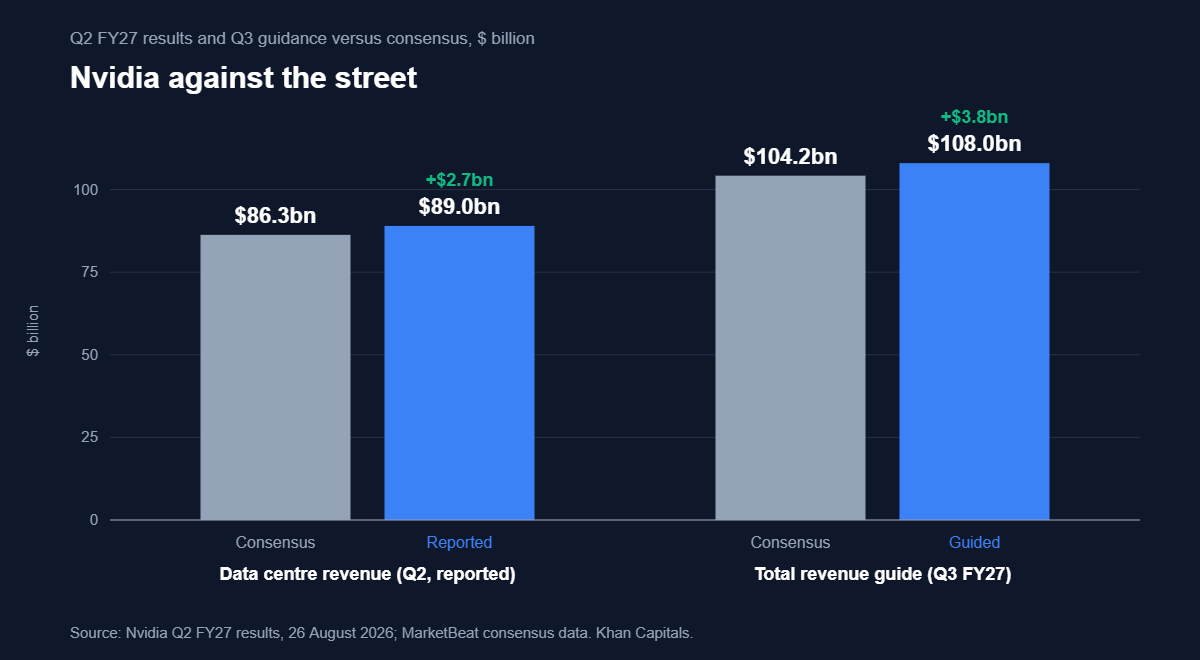
- A $96.2 billion quarter. Nvidia’s Q2 earnings, reported after Wednesday’s close, showed revenue up 106 per cent year on year, earnings of $2.22 per share (more than double a year ago) and data centre revenue of $89 billion against expectations near $86.3 billion.
- Guidance $4 billion above the street. The company guided the current quarter to $108 billion, plus or minus 2 per cent, against a consensus of roughly $104.2 billion, and management pointed to fiscal 2028 revenue growth of around 70 per cent, described as supply-constrained rather than demand-limited.
- Amazon tripled down. Alongside the results, AWS committed to a further 2 million Nvidia GPUs across Blackwell Ultra, Rubin and Rubin Ultra for 2027 and 2028, taking its committed total above 3 million, plus millions of Nvidia’s new Vera CPUs.
- The margin bill is the fine print. Gross margin held at 75 per cent this quarter but is guided to roughly 74 per cent next quarter and a trough of 71 to 72 per cent the quarter after, as memory component costs bite before announced price increases take effect in early fiscal 2028.
- The curse broke. Each of Nvidia’s previous four earnings reports had been followed by a fall in the shares. This one was bought: the stock rose almost 9 per cent in extended trading and the Nasdaq gained 1.6 per cent the following session.
Part of: The AI Infrastructure Supercycle — Khan Capital’s hub on the build-out reshaping markets.
Nvidia Q2 Earnings: The Print That Broke a Four-Quarter Pattern
The Nvidia Q2 earnings report had a pattern to break. For a year, the most reliable trade in the market had been to sell Nvidia’s good news. Each of the previous four earnings reports, every one of them a beat, was followed by a decline in the shares, as an options market priced for perfection collided with results that were merely excellent. The pattern extended beyond one company. As we wrote in our coverage of the August rotation, record results from Applied Materials and a $4 billion guidance raise from Cisco were both sold within hours earlier this month. The AI trade had acquired a grading curve that no realistic print could satisfy.
Nvidia’s Q2 earnings, covering the fiscal second quarter to July 2026 and reported after Wednesday’s close, ended the streak. Revenue reached $96.2 billion, up 106 per cent from a year earlier. Earnings per share of $2.22 more than doubled. Data centre revenue, the number the market actually trades on, came in at $89 billion against a consensus near $86.3 billion, growth of 117 per cent year on year. The shares rose almost 9 per cent in after-hours trading and held the gains into Thursday’s session, where the Nasdaq climbed 1.6 per cent to 26,541 and the S&P 500 added 0.7 per cent to 7,731.
The question worth asking is not why the quarter was strong. Nvidia’s quarters have been strong for three years. It is why the market chose this one to stop selling the news, and the answer sits in three places: a guidance number $4 billion above the street, an Amazon commitment that reframed the order book, and a gross margin disclosure that, unusually for this company, told investors something they did not want to hear and got bought anyway.
Inside the $89 Billion Data Centre Number
The composition of data centre revenue matters more than its size, because it answers the concentration question that has stalked the AI trade all year. Roughly $49 billion of the $89 billion came from the large hyperscale cloud builders, up 13 per cent sequentially. The remaining $40 billion, spanning cloud providers outside the big four, enterprises, sovereign programmes and industrial AI buyers, grew 25 per cent sequentially, nearly twice the pace.
That mix shift is the more important fact in the release. The bear case on Nvidia has never disputed current demand; it has argued that revenue depends on a handful of mega-cap budgets which must eventually mature, a concentration we examined in the week the market graded AI capex line by line. A quarter in which the non-hyperscale book grows twice as fast as the hyperscale book is direct evidence of the buyer base widening. It does not settle the argument: $49 billion from a handful of companies is still extraordinary concentration by any historical standard. But the direction of travel favours the bulls, and it compounds: a customer base of enterprises and states is stickier through a capex cycle than four procurement departments in Seattle and Silicon Valley.
| Metric | Reported / guided | Consensus | Year on year |
|---|---|---|---|
| Revenue (Q2 FY27) | $96.2bn | Beat | +106% |
| Earnings per share | $2.22 | Beat | More than doubled |
| Data centre revenue | $89.0bn | $86.3bn | +117% |
| Gross margin | 75% | In line | Held |
| Q3 revenue guide | $108bn (±2%) | $104.2bn | n/a |
The Amazon Order That Reframed the Backlog
Alongside the results came the announcement that turned a good print into a repricing event. Amazon Web Services will deploy an additional 2 million Nvidia GPUs across the Blackwell Ultra, Rubin and Rubin Ultra generations through 2027 and 2028, lifting its total committed purchases from more than 1 million chips to more than 3 million. AWS will also take what the companies described as millions of Nvidia’s Vera CPUs, the company’s first ground-up general-purpose processor, some integrated with Rubin systems and some standalone.
Two things make this order strategically interesting rather than just large. First, Amazon has been the hyperscaler most publicly committed to its own silicon: the Trainium line exists precisely to reduce dependence on Nvidia. A tripling of the AWS commitment is as clear a statement as the market will get that custom silicon is complementing Nvidia’s roadmap rather than displacing it, at least through 2028. Second, the Vera CPU component moves Nvidia into the server CPU market that Intel and AMD have divided between them for two decades. If millions of units ship to a single hyperscaler, the addressable market conversation changes for all three companies.
The order also gives partial cover to the debt-funded tier of the AI build-out. As we explored in our analysis of CoreWeave’s $104 billion backlog, the financing structures beneath AI infrastructure depend on multi-year demand visibility. A three-million-GPU commitment from the world’s largest cloud provider is the kind of anchor tenancy that keeps those structures fundable.
The 75 Per Cent Margin Meets the Memory Bill
The most consequential disclosure in the release was not a revenue number. Gross margin held at 75 per cent this quarter, on both GAAP and non-GAAP measures. The guidance is where the story turns: roughly 74 per cent next quarter, a trough of 71 to 72 per cent in the fiscal fourth quarter, and a recovery to 72 to 73 per cent across fiscal 2028 as announced price increases take effect from the first quarter.
The driver is the cost of memory. Every advanced accelerator ships with stacks of high-bandwidth memory, and the DRAM industry’s capacity is oversubscribed: the same AI demand that fills Nvidia’s order book has driven memory component costs sharply higher, and Nvidia, as the largest buyer, pays the bill first. A three-to-four point margin decline over two quarters is the cost of that inflation arriving faster than contract prices can be reset.

What matters for the investment case is the second half of the disclosure: Nvidia intends to pass the cost through. Guiding fiscal 2028 margins back to 72 to 73 per cent on the strength of price increases is a statement about pricing power. Companies facing genuine competitive pressure absorb input inflation; companies with pricing power reprice. The market’s willingness to buy a stock on the day it guided margins down nearly four points from the peak suggests investors read the trough as cyclical and the pass-through as credible. It is also a signal worth watching from the other side: for the hyperscalers, whose capex budgets we have tracked past the $200 billion mark, Nvidia’s price rises are a cost shock arriving in fiscal 2028.
| Period | Gross margin | Driver |
|---|---|---|
| Q2 FY27 (reported) | 75% | Blackwell Ultra at scale, costs contained |
| Q3 FY27 (guided) | ~74% (±50bp) | Memory cost inflation begins to land |
| Q4 FY27 (guided) | 71-72% (trough) | Full memory cost pass-through, Rubin ramp costs |
| FY28 (guided) | 72-73% | Announced price increases take effect from Q1 |
Guiding 70 Per Cent Growth on Constrained Supply
The current-quarter guide of $108 billion, plus or minus 2 per cent, sits roughly $4 billion above the consensus of $104.2 billion. On a base this large, a $4 billion beat-and-raise is arithmetically remarkable: the gap between guide and street on its own approaches Nvidia’s total quarterly revenue from six years ago.
The longer-dated commentary is more striking still. Management pointed to fiscal 2028 revenue growth of approximately 70 per cent, with the Vera Rubin platform expected to account for around 20 per cent of data centre revenue as soon as the current quarter. Most notable was the characterisation: 70 per cent is what supply allows, while demand, on management’s telling, is growing closer to 100 per cent. Whether that gap is marketing or measurement, the operational claim embedded in it is that the constraint on the AI build-out for the next 18 months is manufacturing capacity (wafers, advanced packaging and above all memory), not customer budgets.
That framing inverts the question that dominated the summer. Since July’s semiconductor drawdown, the market has asked whether AI demand would hold up. Nvidia’s answer is that demand is not the binding variable at all, and the numbers that would falsify it (order cancellations, backlog erosion, hyperscaler capex cuts) are currently moving the other way.
Why This Beat Was Bought When Others Were Sold
The honest answer is positioning. Four consecutive post-earnings declines had taught investors to fade Nvidia prints, and a summer of sold beats, from Applied Materials to Cisco, had drained speculative positioning from the AI complex. When the most heavily scrutinised company in the market delivers a $4 billion guidance beat into reduced positioning, the path of least resistance flips upward. The same print in February, with positioning stretched, might well have been sold.
There is also a substantive difference from the beats that were faded. Applied Materials and Cisco reported strong quarters with in-line-to-good guidance; the market treated them as peaks. Nvidia paired the beat with an acceleration signal (70 per cent growth on a run rate approaching $400 billion, a tripled AWS commitment, a new CPU franchise) and a margin disclosure that gave the bears their number and framed it as a trough with a dated recovery. Prints that pre-empt the bear case trade differently from prints that merely exceed the estimates, a distinction Palantir’s 93 per cent quarter demonstrated from the software side earlier this month.
Investor Implications
Equities. The print resets the AI trade’s evidence base: the widest beat-and-raise of the cycle, a broadening customer mix and a margin trough with a dated recovery path. The second-order exposures are worth as much attention as Nvidia itself: memory suppliers are the pricing bottleneck (and the margin story’s other side), Intel and AMD face a new CPU competitor with a hyperscaler anchor customer, and the equipment names sold off in July sit upstream of a customer now guiding 70 per cent growth on constrained supply. Concentration risk has narrowed, not disappeared: roughly $49 billion a quarter still comes from a handful of hyperscale buyers.
Fixed income. The margin guide is a clean read-through to the AI credit complex. Nvidia passing memory inflation through to customers raises the delivered cost per gigawatt of compute, which flows into the borrowing needs of debt-funded builders and the capex maths of investment-grade hyperscalers. For holders of the AI infrastructure credit stack, from CoreWeave’s bonds to data centre securitisations, a three-million-GPU AWS commitment is backlog collateral; dearer chips financed at 2026 yields are the offset.
Cross-asset. A $96 billion quarter growing 106 per cent is a productivity-boom data point in a macro tape otherwise debating sticky inflation and a possible resumption of rate rises. The AI capex impulse continues to do quiet fiscal-scale work in US growth data. If the Federal Reserve does tighten into it, the sector’s rate sensitivity, demonstrated repeatedly this summer, will be tested against the strongest fundamental backdrop the trade has yet produced.
What to Watch
- Through Q3 FY27 (August to October): the Vera Rubin ramp toward the guided 20 per cent of data centre revenue, and any update on the pace of the AWS deployments.
- November 2026: Nvidia’s Q3 FY27 report; delivery against the $108 billion guide and the first read on whether the 71 to 72 per cent Q4 margin trough still holds.
- Early fiscal 2028 (from February 2027): the announced price increases take effect; watch hyperscaler commentary on absorbing them and memory contract pricing as the cost side of the equation.
- Ongoing: hyperscaler capex guidance in the October earnings round, the demand signal that underwrites the 70 per cent fiscal 2028 growth claim.
Conclusion
Nvidia’s Q2 earnings delivered the largest revenue quarter in semiconductor history, a guidance beat measured in billions and the clearest broadening of the AI customer base yet reported, and paired it with an unusually candid margin disclosure. The market’s decision to buy this print after selling four straight is partly positioning and partly recognition that the release answered the bear case’s two best questions: demand concentration is easing at the margin, and input-cost inflation comes with a dated pass-through plan. What the quarter cannot answer is the question that has stalked the trade all year: whether the capital being spent on compute earns its keep. On that, the evidence arrives slowly, one hyperscaler earnings season at a time. For now, the constraint is supply, the order book runs through 2028, and the most important company in the market has stopped being sold on good news.
Frequently Asked Questions
What did Nvidia report in its Q2 2027 earnings?
Nvidia reported revenue of $96.2 billion for the fiscal second quarter of 2027, up 106 per cent year on year, with earnings of $2.22 per share, more than double a year earlier. Data centre revenue was $89 billion against consensus expectations of roughly $86.3 billion. Gross margin held at 75 per cent.
What guidance did Nvidia give for next quarter?
Nvidia guided current-quarter revenue to $108 billion, plus or minus 2 per cent, roughly $4 billion above the analyst consensus of $104.2 billion. Management also pointed to fiscal 2028 revenue growth of approximately 70 per cent, which it described as limited by supply rather than demand.
What is the new Amazon AWS deal with Nvidia?
Amazon Web Services committed to deploying an additional 2 million Nvidia GPUs across the Blackwell Ultra, Rubin and Rubin Ultra generations in 2027 and 2028, taking its committed total above 3 million chips. AWS will also purchase millions of Nvidia’s new Vera CPUs, some integrated with Rubin systems and some standalone.
Why is Nvidia’s gross margin falling?
The cost of memory components, particularly high-bandwidth memory, has risen sharply because AI demand has oversubscribed DRAM industry capacity. Nvidia guided gross margin from 75 per cent to a trough of 71 to 72 per cent in the fiscal fourth quarter, recovering to 72 to 73 per cent in fiscal 2028 as announced price increases take effect.
Sources: CNBC, Nvidia Q2 FY27 earnings live coverage; Nvidia Investor Relations, Q2 FY27 financial results; Kiplinger, Nvidia earnings live commentary; MarketBeat, NVDA Q2 FY27 earnings data; CNBC, stock market coverage, 27 August 2026; S&P Global Market Intelligence, Nvidia earnings preview.
Related Reading: For how the market has been grading the AI build-out, see the week Big Tech’s capex was graded line by line and the rotation week that sold record AI results. The financing layer beneath the GPU orders is covered in CoreWeave’s $104 billion backlog quarter, and the software side of the trade in Palantir’s 93 per cent quarter. For the fundamentals, start with high-bandwidth memory, explained and how company guidance moves markets. For the latest, see Broadcom AI revenue tripled to $16.7 billion.

Leave a Reply