
Khan Capitals | August 2026
Key Takeaways
- Aon has agreed to buy USI Insurance Services for $17 billion in cash: The agreement was announced on 31 August, values USI at roughly 14.5 times synergised trailing adjusted earnings, and is expected to close in the fourth quarter subject to regulatory approval.
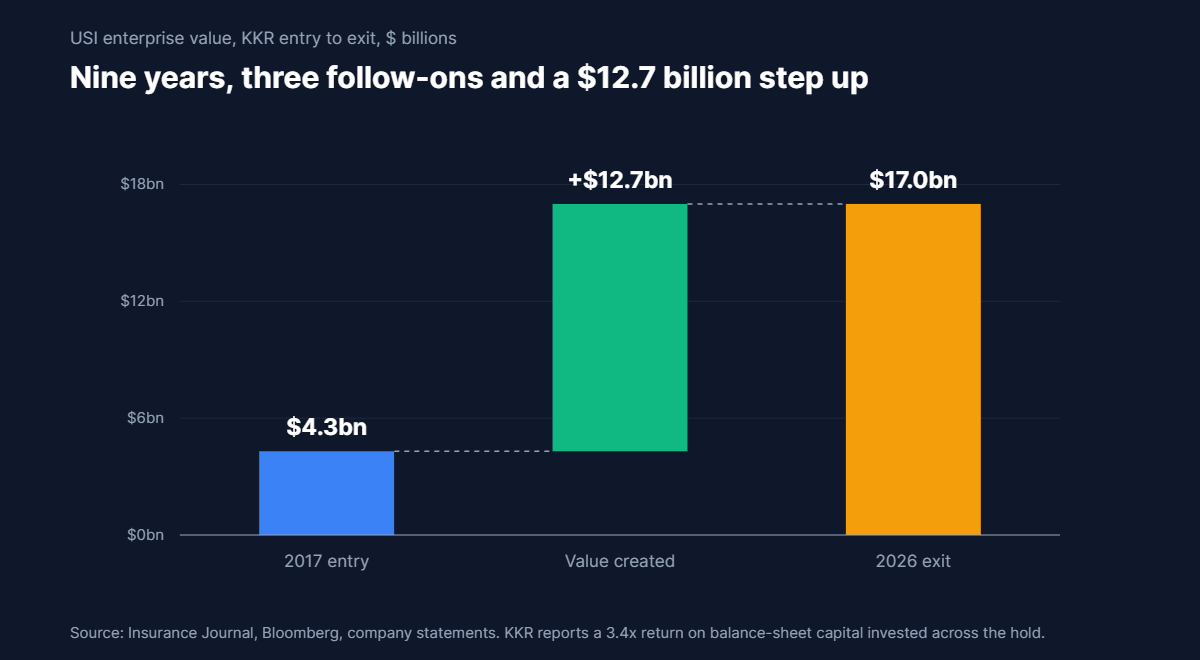
- KKR takes a $3.3 billion windfall and about $2 billion of adjusted net income: The sale is expected to generate a 3.4 times return on the balance-sheet capital KKR invested since first backing USI in 2017 at a valuation near $4.3 billion.
- The whole purchase price is being funded with new debt: Aon intends to preserve its Baa2 and A- ratings by suspending share buybacks while it pays the borrowing down, and expects the deal to add to adjusted earnings only from 2028.
- It is one of the largest private equity exits the sector has produced: Most brokerage transactions of the past two years have run the other way, with sponsors buying agencies rather than selling them to listed strategics.
- The exit came through the trade channel, not the listing channel: Four days after a $53 billion buyout of PayPal collapsed, a $17 billion sale to a listed acquirer completed the week’s more important lesson about where liquidity is actually available.
Part of: Private Credit & Private Markets – Khan Capital’s hub on private credit and private markets.
The Week’s Two Deals
Two transactions bracketed the last week of August, and the market spent almost all of its attention on the wrong one. On Thursday, Advent and Stripe walked away from a $53 billion pursuit of PayPal, and the collapse was read as evidence that the mega-buyout is once again out of reach. On Monday, Aon agreed to pay $17 billion in cash for USI Insurance Services, and KKR walked out of a position it had held for nine years with a $3.3 billion gain.
The second deal is the more informative one, because the private equity industry’s binding constraint in 2026 is not its ability to buy. It is its ability to sell. Committed capital has been abundant for years; realised capital has not. Limited partners have spent three years receiving distributions well below the pace they underwrote, and that shortfall is what has slowed fundraising, extended holding periods, and driven the growth of continuation vehicles and secondaries as substitutes for genuine exits. A $17 billion cash sale to a listed strategic buyer is the thing the industry has been short of.
It also happened alongside another: the same Monday, Apollo agreed a $4.1 billion cash-and-debt sale of the German cooling-equipment maker Kelvion, eight months after taking control of it. One large exit is a transaction. Two on the same day, in a month that also produced a record monetisation quarter at KKR, starts to look like a channel reopening.
The Aon USI Acquisition in Numbers
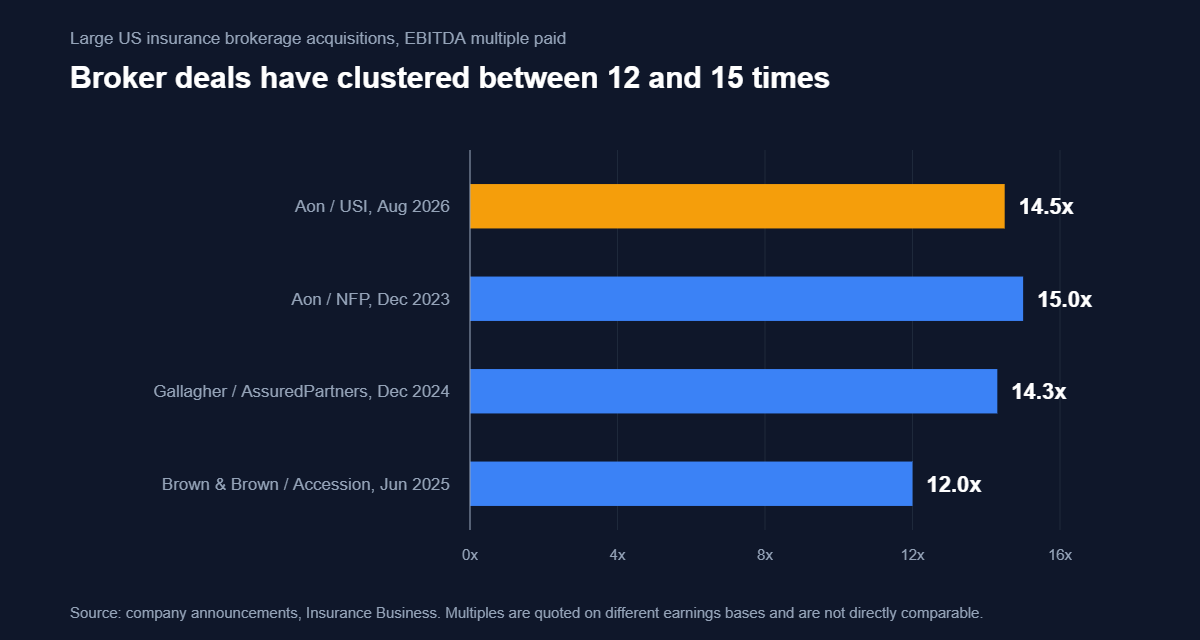
The Aon USI acquisition values the target at $17 billion gross, or approximately $16.7 billion once roughly $278 million of tax attributes are accounted for, which works out at about 14.5 times USI’s synergised trailing twelve-month adjusted earnings before interest, tax, depreciation and amortisation. Aon expects about $395 million a year of run-rate synergies once integration is complete, and expects the transaction to add to adjusted earnings per share from 2028.
USI is the tenth largest insurance broker in the United States, generating roughly $3 billion of annual revenue through more than 10,500 employees across close to 200 offices. It sells property and casualty cover, employee benefits, personal risk products and retirement plan advice, largely to businesses that are too substantial for a local agency and too small to interest the largest brokers directly. Its chairman and chief executive, Mike Sicard, will become president of Aon and global chief executive of its middle-market business, reporting to Aon’s chief executive Greg Case and joining the executive committee.
The strategic logic is straightforward and has been tested once already. Aon puts the US middle market at more than $40 billion in size, accounting for over a third of the country’s commercial property and casualty premium, and it bought its way into that market in December 2023 with the roughly $13.4 billion purchase of NFP. USI does the same thing at greater scale. The pitch, as Case has put it, is that Aon is exporting analytical capability it already possesses into a segment it has not fully reached, rather than buying capability it lacks.
| Transaction | Announced | Value | Earnings multiple |
|---|---|---|---|
| Aon and USI | August 2026 | $17.0bn gross, $16.7bn net | 14.5x synergised trailing adjusted EBITDA |
| Aon and NFP | December 2023 | approx. $13.4bn | approx. 15x seller-adjusted estimated EBITDA |
| Gallagher and AssuredPartners | December 2024 | $13.45bn gross, $12.45bn net | 14.3x gross, 11.3x net |
| Brown & Brown and Accession | June 2025 | $9.83bn | approx. 12x pro forma adjusted EBITDA |
| Marsh McLennan and McGriff | September 2024 | $7.75bn | not disclosed |
Why Brokers Fetch These Multiples
Fourteen and a half times earnings for a distribution business is a number that deserves explanation, particularly to anyone accustomed to the multiples that underwriters command. Insurance brokers are not insurers. They take no underwriting risk, hold no reserves against catastrophe, and require almost no capital to grow. What they own is a book of client relationships that renews annually, generates commission as a percentage of premium, and rarely churns, because changing broker is an administrative undertaking most finance directors avoid without cause.
That produces the financial profile the market pays for: recurring revenue, high incremental margins, minimal capital intensity and strong cash conversion. It also produces a structural bias towards consolidation, because a larger broker can place the same risk with more carriers, negotiate better terms, and spread the cost of analytics and compliance across a wider base. Every acquisition therefore arrives with a credible synergy story, which is how the sector has sustained multiples in the twelve to fifteen times range through an interest rate cycle that has compressed valuations almost everywhere else.
The caution is that these multiples are quoted on synergised earnings, meaning the denominator already includes savings that have not yet been achieved. On USI’s unadjusted earnings the effective multiple is higher, and the gap between the two is the execution risk expressed as a number. Aon’s own record offers a warning: after the NFP transaction, a group of specialty executives left the acquired platform for a competitor, the sort of departure that large consolidations routinely provoke and that matters disproportionately in a business where the relationships walk out of the building at the end of each day.
The Debt Question
Aon plans to fund the entire purchase with new borrowing. To protect its Baa2 rating at Moody’s and A- at Standard and Poor’s, it has said it will hold off on share repurchases while the debt is paid down. That is a meaningful commitment for a company with a market value of roughly $75 billion, and it converts what is nominally a growth transaction into a multi-year deleveraging exercise for equity holders.
The timing is worth pausing on. The debt is being raised into a market where the thirty-year Treasury yield sits near its highest level since before the financial crisis, a repricing we covered in the global bond selloff. Investment grade credit spreads remain historically tight, which cushions the all-in cost, but the underlying risk-free rate does not. A transaction of this size financed at these yields carries an interest bill materially higher than the equivalent deal would have carried three years ago, and that is the arithmetic behind the 2028 accretion date. Investors are being asked to wait roughly two years before the acquisition adds to earnings.
There is also a governance detail worth noting: Aon’s chief financial officer stepped down weeks before the announcement, remaining as an adviser to the chief executive into 2027. A finance leadership transition running concurrently with a debt-funded acquisition of this scale is not disqualifying, but it is the kind of detail that shareholders are entitled to press on, and it adds a small premium to the execution risk already embedded in the multiple.
A Balance Sheet Experiment Pays Its First Dividend
On the selling side, the interesting detail is where USI was held. KKR did not own it in a conventional buyout fund with a defined life. It sat in Strategic Holdings, the unit KKR created in 2023 to hold long-duration, dividend-paying businesses on its own balance sheet, an arrangement the firm has been open about describing in terms borrowed from Berkshire Hathaway.
That structure was, until this week, largely a promise. Strategic Holdings currently comprises eighteen investments and produced around $232 million of earnings last year, against an ambition of more than $1 billion by 2030. The USI sale is its first large realisation, and it delivers roughly $2 billion of adjusted net income in a single transaction, enough that analysts expect KKR’s 2026 adjusted net income to run well ahead of a $7 per share target the firm had not expected to hit this year.
The strategic reading is more interesting than the earnings bump. The permanent-capital and balance-sheet models that the listed alternative managers have been building were sold to shareholders as sources of durable, fee-independent earnings, a claim that came under severe pressure earlier this year, as we examined in the repricing of the alternative asset manager model. A single nine-year hold sold at a 3.4 times return on invested balance-sheet capital does not settle that argument. It does, however, demonstrate that the model can produce a realisation of consequence, which is more than the sceptical case allowed for.
It is worth being precise about the return. The 3.4 times figure is calculated across the whole life of KKR’s position, including three follow-on investments after the original 2017 purchase alongside the Canadian pension manager La Caisse at a valuation near $4.3 billion. Reports of a roughly six times return refer to the original equity rather than to total capital deployed. Both are true, and the difference between them is a useful reminder of how much work a single headline multiple can be asked to do.
What Has To Go Right
| Requirement | Why it matters | What failure would look like |
|---|---|---|
| Producer retention | Broker revenue follows individual relationship managers, not contracts | Team departures to competitors in the twelve months after closing, as happened after the NFP deal |
| $395m of run-rate synergies | The 14.5 times multiple is quoted on synergised earnings, so the savings are already in the price | Slipping timelines or one-off integration costs consuming the annualised benefit |
| Deleveraging on schedule | The buyback pause is the mechanism protecting the credit rating | A downgrade, or buybacks resuming before leverage normalises |
| Three-platform integration | USI must be combined with NFP and Aon’s existing middle-market business simultaneously | Client attrition or systems duplication surfacing in organic growth rates from 2027 |
What It Signals for the Rest of Private Equity
The most useful conclusion from this week has nothing to do with insurance. It concerns which exit routes are open and which remain closed.
Three doors lead out of a private equity position. The first is a public listing, which reopened materially in the first half of this year, as we set out when the IPO window reopened, but which remains selective and offers only partial liquidity at the point of sale. The second is a sale to another sponsor, which requires the buyer to underwrite a return from a price the seller has already bid up and which has been constrained by the cost of leveraged finance. The third is a sale to a listed strategic buyer, and that is the door that opened this week.
The distinction matters because the three doors do not open together and do not price alike. A strategic acquirer can pay for synergies that no financial buyer can access, which is precisely why 14.5 times was available for USI and why no sponsor was in a position to match it. It can also fund the purchase with corporate debt at investment grade spreads rather than with leveraged loans, an advantage that widens whenever credit conditions tighten. The collapse of the PayPal transaction and the completion of this one are therefore not contradictory signals. Both say that in the current financing environment the cost of capital, rather than the appetite for deals, is determining which transactions clear, a dynamic we traced in the biggest leveraged buyout never done.
The second-order effect runs into fundraising. Distributions are what fund the next commitment, and a drought in realisations has been the mechanism suppressing new fund closes across the industry for three years. KKR raised a record $23 billion for its latest Americas buyout fund this year while several listed peers fell short of their targets, and a visible realisation of this size is the kind of evidence that makes the next raise easier. Whether the trade channel stays open long enough to clear the backlog of ageing portfolio companies is a different question, and one that will be answered by acquirer balance sheets rather than by sponsor intent.
What to Watch
- Fourth quarter 2026: The expected completion date, subject to regulatory approval; any extension would signal antitrust friction in a sector that has consolidated heavily.
- Aon’s debt issuance: The size, tenor and spread of the financing, which will show what an investment grade acquirer actually pays in the current rate environment.
- Late October: Third-quarter results at the listed alternative managers, where the pace of realisations across the industry becomes visible rather than anecdotal.
- Through 2027: Producer and client retention disclosures at Aon’s middle-market segment, the cleanest test of whether the synergy number survives contact with the business.
- Remaining independent targets: With USI absorbed, the list of privately held brokers large enough to move a listed rival’s position is now very short, which may push the next wave of consolidation down the size scale.
Investor Implications
Equities. The transaction reshuffles a league table that has been static for years. On 2025 brokerage revenue, Aon stood second at roughly $17.0 billion against Marsh McLennan’s $26.7 billion; adding USI’s $2.9 billion narrows that gap by close to a third. For holders of the listed brokers, the relevant question is no longer whether consolidation continues but what remains to consolidate, since the pool of independent targets of consequence has now thinned considerably. Debt-funded acquirers typically trade softer on announcement while sellers are rewarded, and KKR’s shares were reported up around 1.7 per cent on the day.
Fixed income. A $17 billion all-debt financing from an investment grade issuer is a supply event in its own right, arriving into a market already absorbing heavy sovereign issuance. Credit investors may wish to consider that the sector’s acquisition spree has been financed largely at spreads set during an unusually benign period, and that the refinancing profile of these deals is now a genuine variable rather than a formality. The buyback suspension is the equity holder subsidising the bondholder, which is the correct order of priority but not a costless one.
Private markets. For allocators, the signal is about the composition of liquidity rather than its quantity. Realisations returning through the trade channel favour managers holding businesses that a strategic acquirer wants, which is a different portfolio from one built for a listing or a sponsor-to-sponsor sale. Investors reviewing manager selection may find the distribution record of the past twelve months more informative than the fundraising record, since the two have decoupled.
Conclusion
Aon is paying a full price, in cash, entirely with borrowed money, for a business it will spend two years integrating before it adds to earnings, in a rate environment that makes the borrowing expensive. It is doing so because the middle market is the largest addressable segment it does not yet lead, and because the number of assets capable of closing that gap has fallen to a handful.
KKR is selling a business it has held for nine years and improved through three follow-on investments, at a price no financial buyer could have justified, into the only channel currently offering liquidity at scale. Both sides are behaving rationally, and the transaction is a reasonable trade for each.
What makes it worth more than a paragraph in a deal round-up is what it says about the shape of the cycle. The private equity industry spent three years being told its problem was valuation. The evidence of this week suggests the problem was always the exit, and that the exit is being supplied not by a reopened listing market or by sponsors trading with each other, but by listed corporates with investment grade balance sheets and a strategic reason to pay more than a financial buyer can. That is a narrower door than the industry would like. It is, for now, the one that is open.
Sources: Aon announcement of the USI acquisition · Insurance Journal and Bloomberg on KKR’s windfall · Insurance Business on deal terms and sector comparables · CNBC interview with Aon’s chief executive · PitchBook on KKR’s Strategic Holdings unit · Claims Journal on the transaction · KKR investor relations
Related Reading: This exit is the counterpoint to the $53 billion PayPal buyout that died four days earlier, and it lands against the backdrop of the sector repricing examined in KKR, Apollo and the alternative asset manager model under pressure. For the other exit route and how far it has reopened, see the IPO window reopens; for private capital writing very long-dated cheques elsewhere, the $16 billion Kuwait pipeline deal; and for the official effort to measure this market, the Fed starts counting. For the fundamentals, start with leverage, explained. See also the differences between the main fund types. KKR’s other route out, a partial one, is analysed in the Apollo Atlantic Aviation deal.

Leave a Reply