

Khan Capitals | August 2026
Key Takeaways
- The Federal Reserve is building its first systematic window into private credit direct lending. The Dallas and New York Feds announced a pilot survey on 5 August of a US market they estimate at more than $1.3 trillion, comparable in size to the high-yield bond and broadly syndicated loan markets.
- It is a visibility exercise, not a supervisory one: participation is voluntary, findings will not be used for supervision, and the survey launches after the end of the third quarter with aggregate results due in the first quarter of 2027.
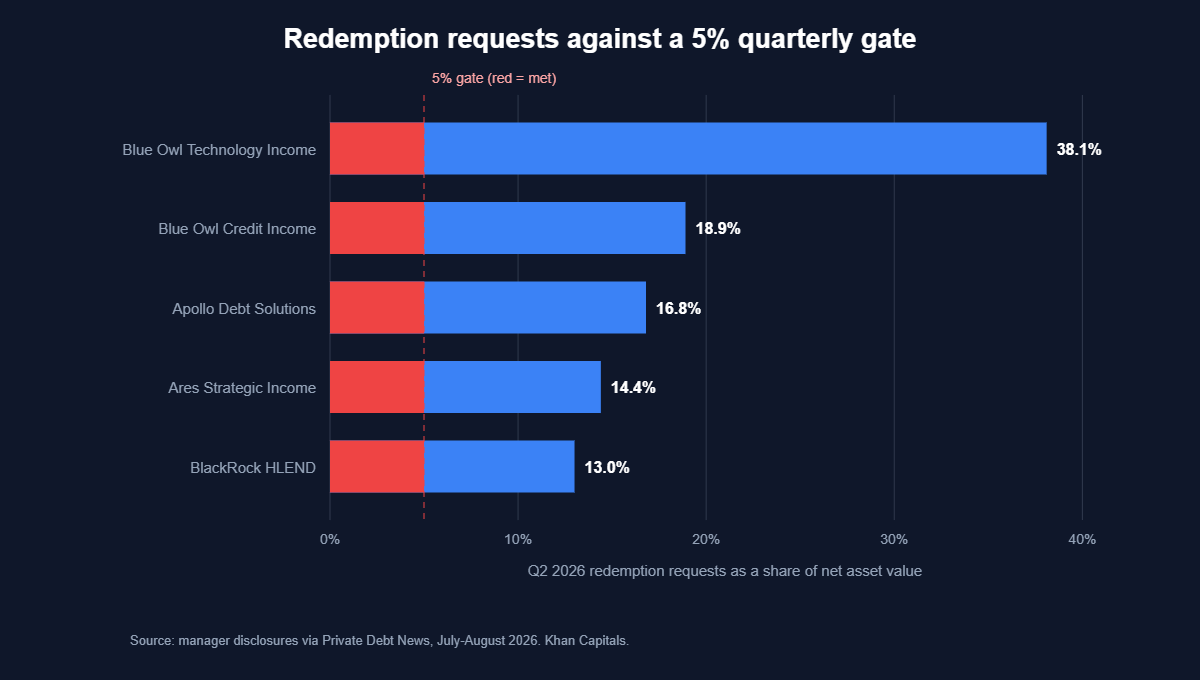
- The timing is pointed. Ares raised a record $36.4 billion in the second quarter, taking assets to $671 billion, in the same quarter its $10.8 billion retail credit fund gated at 5 per cent after redemption requests reached 14.4 per cent of shares.
- The redemptions have an address: more than half of Ares’s BDC requests came from Asia-Pacific family offices, and 95 per cent of its investors did not redeem at all. This looks like a specific distribution channel unwinding rather than a broad loss of faith.
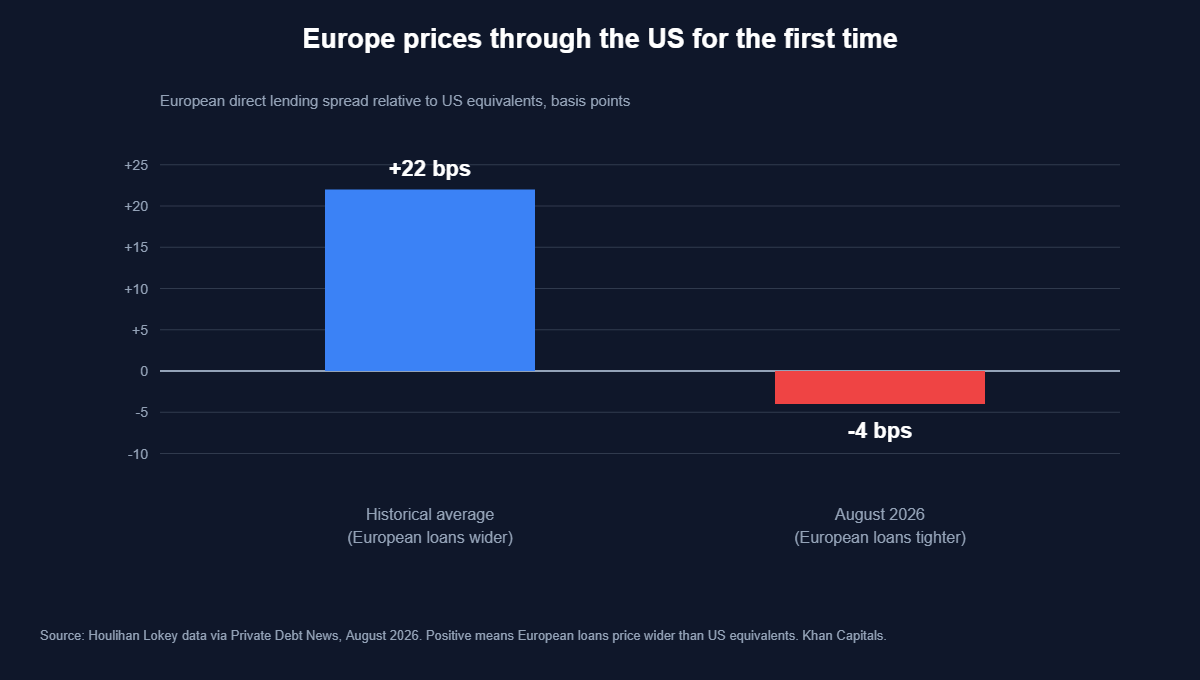
- Two numbers frame the stress: Apollo marked its Medallia loan down to roughly 40 cents from 60 the prior quarter, and European direct lending now prices about 4 basis points inside US paper, having historically priced 22 basis points wider.
Part of: Private Credit & Private Markets – Khan Capital’s hub on private credit and the alternatives industry.
A Market Too Large to Keep Guessing About
There is a particular kind of announcement that matters less for what it does than for what it admits. On 5 August the Federal Reserve Banks of Dallas and New York said they would launch a pilot survey of the US private credit direct lending market. No rules were proposed. No capital requirements were floated. The central bank simply said it intends to start collecting data on a market it estimates at more than $1.3 trillion, and explained why: unlike public credit markets, where conditions can be tracked through observable prices, visibility into new private credit lending activity is limited.
That sentence is the story. A market the size of the entire US high-yield bond market has grown up over a decade with no equivalent of a corporate bond tape, no consolidated view of new issuance, and no systematic measure of where lending standards are drifting. Policymakers assessing financial conditions, which is to say assessing how effectively their own policy rate transmits into the real economy, have been reading a map with a $1.3 trillion blank space on it.
The survey is deliberately modest in its ambitions. It is jointly run by the Dallas Fed’s research department and the New York Fed’s Open Market Trading Desk as part of ongoing market intelligence gathering. Participation is voluntary. The Fed states plainly that findings will not be used for supervisory purposes. It launches after the end of the third quarter of 2026, with aggregate-level results published in the first quarter of 2027. Nobody is being examined.
Modest beginnings are still beginnings. The senior loan officer opinion survey, now a fixture of every serious analysis of bank credit conditions, started as a similar exercise in measurement rather than control. Data collection tends to precede everything else, because it is difficult to regulate a market you cannot describe.
| Segment | Borrower size (EBITDA) | Why the Fed wants the data |
|---|---|---|
| Upper middle market | Above $100 million | Competes directly with the syndicated loan and high-yield markets; where the largest single financings and the AI infrastructure deals sit |
| Middle market | $30 million to $100 million | The traditional core of direct lending, and the segment where terms and covenant quality have loosened most through the boom |
| Lower middle market | Below $30 million | Closest to bank lending and to the real economy; the clearest read on whether policy is reaching smaller borrowers |
Record Fundraising and a Gate, in the Same Quarter
The Fed’s announcement landed in a fortnight of earnings that made the case for better data better than any policy argument could. Ares raised more than $36.4 billion in the second quarter, a firm record, pushing assets under management to $671 billion, up 17 per cent from a year earlier. Fee-related earnings rose 20 per cent to $491 million. Dry powder reached a record $170 billion.
In the same quarter, the firm’s $10.8 billion Ares Strategic Income Fund gated at 5 per cent after investors sought to redeem 14.4 per cent of shares. Chief executive Michael Arougheti’s explanation for the divergence was that institutional demand is accelerating precisely because those investors can see spreads widening and capital leaving. In other words, one investor’s redemption is another’s entry point.
Blue Owl told a version of the same story with different emphasis. Its shares rose 6 per cent after management stressed that direct lending is now 35 per cent of assets, down from nearly half two years ago, and that the wealth products absorbing most of the scrutiny represent 11 per cent of fee-paying assets. Fee-related earnings rose 9 per cent to $392.2 million. Underneath, the credit franchise was soft: quarterly credit fundraising fell to a three-year low of $1.8 billion, inflows from wealthy individuals dropped to $1.7 billion from $4.4 billion, and net deployment was $600 million against $2.5 billion a year earlier.
| Manager | Institutional signal | Retail signal |
|---|---|---|
| Ares | Record $36.4bn raised; AUM $671bn (+17%); dry powder $170bn | ASIF gated at 5% after 14.4% redemption requests |
| Blue Owl | $16.5bn equity raised in H1; AUM $319bn; FRE +9% | Credit fundraising at a three-year low of $1.8bn |
| Apollo | Continues to lead the largest private financings | ADS raised $87m in July, down 36% on June; gated after 16.8% requests |
| BlackRock / HPS | ~$151bn private credit; ~$27bn net new money over 12 months | HLEND gated a second straight quarter after 13% requests |
The Redemptions Have a Postcode
The most useful detail of the quarter was geographic. More than half of Ares’s BDC redemption requests came from family offices in Asia-Pacific, a region where demand has roughly halved. The same pattern appeared at Blue Owl, where much of the money that left arrived originally through a bank wealth platform serving Asian clients. Ares said 95 per cent of its investors did not redeem, US advisers held firm, and the firm is exploring separate share classes for international investors in the queue.
This reframes what has been reported for months as a retail revolt. A concentrated channel unwinding is a materially different problem from a broad loss of confidence, and a more containable one. It is also a design lesson. Semi-liquid vehicles were built on an assumption of diversified, uncorrelated investor behaviour; what they actually attracted, in part, was a specific pool of capital distributed through a specific set of platforms, which redeems in waves because it arrived in waves. We examined that structural tension when we looked at the liquidity illusion at the heart of the crackup, and this quarter is the clearest empirical support for it yet.
The opportunistic capital has noticed. Cox Capital launched a tender for Ares Strategic Income Fund shares at a 15 per cent discount to net asset value, which Ares urged shareholders to reject. That playbook follows a failed attempt at Blue Owl earlier this year that captured less than 1 per cent of shares. Discount tenders are a reliable marker of a market where the exit is congested and the underlying assets are not.
One Loan, Three Marks, Nine Months
If the redemption data describes the liability side, the Medallia mark describes the assets. Apollo’s monthly shareholder disclosure showed its term loan to the software company, whose creditors took control in June, carried at roughly 40 cents on the dollar, down from 60 the prior quarter. Blackstone and KKR had previously carried the same loan down from 80 to 60 over three months.
The same instrument, marked at three different levels by three different holders over nine months, is exactly the valuation opacity the Fed’s survey is aimed at, albeit from a different angle. Private credit’s defenders have long argued that its marks are less volatile than public credit because the assets are held to maturity and the borrowers are relationship-managed. Its critics reply that the marks are less volatile because nobody is forced to test them. A loan that travels from 80 to 40 in three steps, each disclosed by a different manager on a different schedule, gives the critics the better of the argument on this occasion.
The wider default picture is consistent with a market working through a genuine credit cycle rather than a crisis. KBRA’s default monitor reached a record $30 billion across 92 borrowers over twelve months. That is a serious number, and it is also one that a $1.3 trillion asset class with double-digit yields can absorb. What it cannot easily absorb is doing so inside vehicles that promise monthly or quarterly liquidity, which is the structural point the gates keep making.

Europe Prices Through America
The quarter’s most underappreciated data point had nothing to do with redemptions directly, and everything to do with their consequences. European direct lending loans now price roughly 4 basis points tighter than comparable US paper, according to Houlihan Lokey, after historically running about 22 basis points wider. For a decade American borrowers enjoyed cheaper private debt than their European counterparts, a reflection of the depth, competition and sheer capital availability of the US market. That relationship has inverted.
The mechanism is the redemption backlog. American managers sitting on roughly $14 billion of pending withdrawals are hoarding liquidity rather than deploying it, so they bid less aggressively and spreads drift wider. European lenders, operating largely without BDC structures or retail redemption mechanics, keep competing for scarce deals and spreads grind tighter. Recent pricing illustrates it: Germany’s GBA Group secured €425 million at around 475 basis points over Euribor from CVC, Goldman and Apollo, while a comparable US deal priced at 500 over SOFR in April.
The implication is uncomfortable for the American model. The retail capital that made US private credit the deepest market in the world has become, temporarily, the source of its competitive disadvantage, because capital that can be withdrawn cannot be fully deployed. Borrowers with a choice of jurisdiction are noticing, and Europe’s fundraising reflects it: Tikehau closed its sixth European direct lending vintage at €5.2 billion, 60 per cent above its predecessor.
What a Change of Ownership Looks Like
Put the pieces together and the picture is not an asset class in retreat. Private credit inflows are down roughly 25 per cent year to date against the same period in 2025, which is a meaningful slowdown but not a collapse, and it sits alongside a single manager raising $36 billion in three months. What is happening is a transfer: capital that arrived late through wealth platforms, and priced very little of the risk it was taking, is leaving; capital that understands cycles is arriving to buy the wider spreads that exit creates.
The product mix is changing with the ownership. Ares’s flows tilted toward alternative credit and real assets rather than vanilla direct lending. Secondaries are absorbing the mismatch, with Ares preparing to sell roughly €3 billion of bundled stakes in a European fund, one of the largest credit secondaries transactions attempted, following the record $3.2 billion continuation vehicle Crescent closed in January. A market that builds a functioning secondary market for its own illiquid positions is maturing, not failing, though it is worth remembering that the same could be said of several markets shortly before they were tested properly.
Which brings the argument back to measurement. Every claim in the preceding paragraphs rests on manager disclosure, industry surveys and press reporting, assembled by outsiders from fragments. None of it comes from a consistent, standardised source. That is precisely the gap the Dallas and New York Feds have set out to close, and it explains why an announcement with no immediate market consequence is the most important private credit development of the summer.
What to Watch
- After 30 September 2026: the pilot survey launches. The participation rate will be its own signal, since a voluntary survey that the largest managers decline to join tells policymakers something too.
- Q3 reporting season, October to November: whether redemption requests at the major semi-liquid vehicles fall from the second quarter’s levels. Blue Owl’s management has already argued that inflows troughed in May.
- Through the autumn: further marks on stressed software credits following the Medallia repricing, and whether managers still carrying similar paper in the 70s and 80s converge downward.
- Q1 2027: publication of the survey’s first aggregate findings, the first official read on private credit lending standards and credit availability.
- Ongoing: the US-Europe spread relationship. A return to the historical relationship, with European loans pricing wider, would signal the redemption backlog has cleared; persistent inversion would suggest something more structural about the American vehicle model.
Investor Implications
Equities. The listed alternative managers are being valued on a story that this quarter complicates. Ares and Blue Owl both demonstrated that fee-related earnings can grow while the credit franchise slows, because the growth is coming from elsewhere in the platform. For anyone analysing these businesses, the useful disclosure is no longer headline assets under management but the mix: how much is institutional and locked, how much is wealth-channel and redeemable, and which of the two is funding the fee growth. Our analysis of BlackRock’s record assets made a related point about how little of a headline number is genuinely new money.
Fixed income. Wider private credit spreads at a time when public investment grade spreads sit at 74 basis points, in the first percentile of twenty years, is an unusual relative-value configuration. It reflects a technical, the redemption backlog, rather than a fundamental deterioration relative to public credit. Technicals unwind; whether that happens through private spreads tightening or public spreads widening is the question worth thinking about.
Cross-asset. The systemic question the Fed is implicitly asking is whether private credit transmits policy differently from bank lending. If a third of corporate credit provision sits outside the banking system and outside the data, the relationship between the policy rate and real-economy credit conditions is less well understood than the models assume, which matters a great deal in a year when the committee is debating a hike. Better data will not change the transmission, but it will change how confidently anyone can claim to know what it is.
Conclusion
Private credit direct lending has spent a decade growing into one of the largest corporate credit markets in the world while remaining, from the outside, largely unmeasured. This summer produced the clearest evidence yet of what that opacity costs: a single loan marked at three different levels by three different holders, a redemption wave whose geographic concentration took months to identify, and a US-Europe pricing inversion that nobody predicted because nobody had the data to see it forming.
The Fed’s response, a voluntary survey with no supervisory teeth and results due in 2027, is modest almost to the point of understatement. It is still the most consequential thing to happen to the asset class this quarter, because everything that follows, from how investors price it to how regulators eventually treat it, depends on somebody first being able to describe it accurately.
Frequently Asked Questions
What is the Fed’s private credit survey?
It is a pilot survey announced on 5 August 2026 by the Federal Reserve Banks of Dallas and New York, exploring lending trends in the US private credit direct lending market. It will examine credit availability, credit provision and the evolution of lending standards, segmenting borrowers by size. Participation is voluntary and the findings will not be used for supervisory purposes.
How big is the private credit direct lending market?
The Federal Reserve estimates the US direct lending market at more than $1.3 trillion, comparable in size to both the high-yield bond market and the broadly syndicated loan market. Unlike those public markets, there is no consolidated source of pricing or issuance data, which is the gap the survey is intended to fill.
Why are private credit funds gating redemptions?
Semi-liquid vehicles such as non-traded BDCs offer periodic redemption, typically capped at around 5 per cent of shares per quarter, while holding illiquid loans. When requests exceed that cap the gate applies automatically. In the second quarter of 2026 requests reached 14.4 per cent at Ares Strategic Income Fund, 16.8 per cent at Apollo Debt Solutions and 13 per cent at BlackRock’s HLEND, with more than half of the Ares requests coming from Asia-Pacific family offices.
Is private credit shrinking?
Inflows are down roughly 25 per cent year to date against the same period in 2025, but the asset class is not contracting so much as changing hands. Ares raised a record $36.4 billion in the second quarter alone, with institutional investors buying the wider spreads that retail redemptions have created. The product mix is shifting away from vanilla direct lending toward alternative credit and real assets.
Sources: Federal Reserve Bank of Dallas, pilot survey of the private credit market; Federal Reserve Bank of New York, survey announcement; Private Debt News, quarterly results round-up; Bloomberg, private credit funds rebound from lows; New York Fed Teller Window, the basics of private credit; Crescent Capital, $3.2 billion continuation vehicle.
Related Reading: The structural tension between illiquid assets and redeemable vehicles is set out in the private credit crackup, and the largest test of open-market pricing for these loans in the $35 billion deal that started trading. For the manager-level view, see BlackRock’s $15.3 trillion quarter, and for the public-market comparison, credit spreads at record tights. For the fundamentals, start with what private credit actually is and how a BDC works. The other side of the coin, a record buyout that never happened, is covered in the PayPal takeover collapse. For the latest, see the $17 billion Aon USI acquisition and KKR’s exit.

Leave a Reply