

Khan Capitals | September 2026
Key Takeaways
- A headline beat the market saw through. Lululemon reported Q2 earnings per share of $2.92 against a consensus near $1.79, but $0.86 of that came from tariff refunds and interest benefits, net of tax, tied to $134.5 million of refunded duties, according to CNBC.
- Revenue fell short and fell outright. Net revenue of $2.42 billion missed the $2.46 billion consensus and declined 4.3 per cent year on year, with comparable sales down 9 per cent.
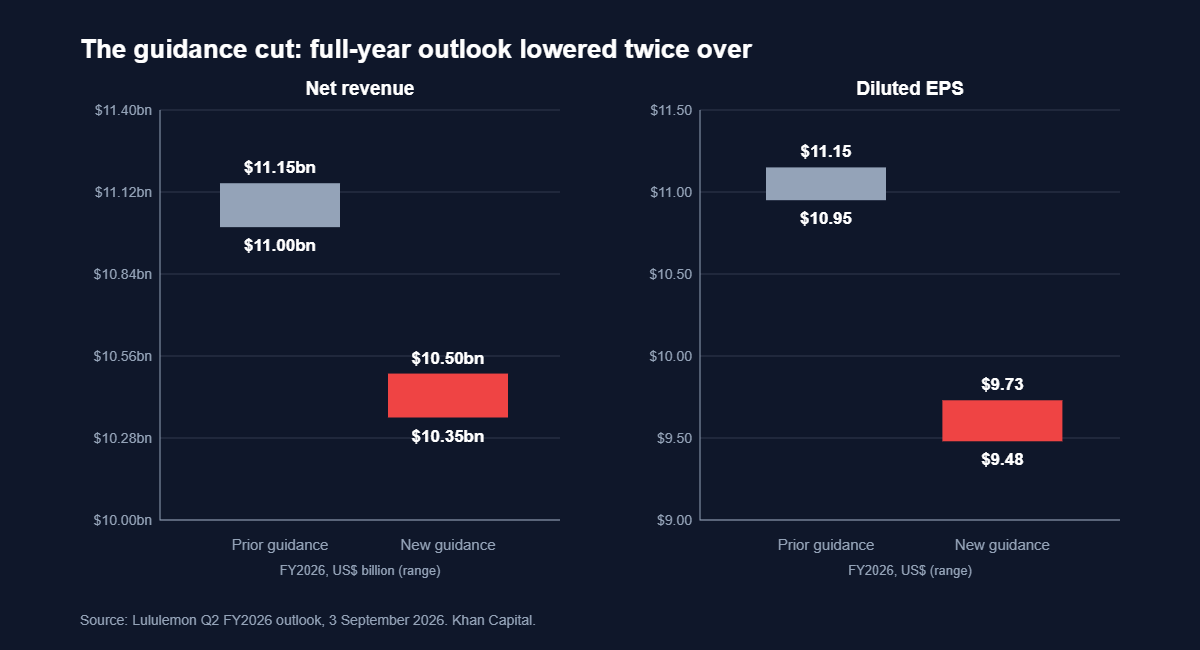
- The guidance cut was the real news. Full-year revenue guidance dropped from $11 billion to $11.15 billion to $10.35 billion to $10.5 billion, a 5 to 7 per cent annual decline, while EPS guidance fell from $10.95 to $11.15 to $9.48 to $9.73.
- The stock broke to multi-year lows. Shares dropped roughly 18 per cent in extended trading to under $100, below the prior 52-week low of $104.44, and closed the following session down around 15 per cent.
- Profitability is eroding beneath a flattered surface. Operating income fell 13 per cent to $453.7 million and operating margin contracted 190 basis points to 18.8 per cent, even as gross margin expanded 200 basis points to 60.5 per cent.
Part of: Tariffs & the Trade War — Khan Capital’s hub on trade policy and its market effects.
Lululemon Q2 Earnings: a 63 Per Cent Beat the Market Sold in Seconds
On paper, the Lululemon Q2 earnings release of 3 September was a blowout: $2.92 of earnings per share against a consensus around $1.79, a beat of more than 60 per cent. The market’s response was to sell the stock down roughly 18 per cent in extended trading, through its 52-week low and briefly below $100. That combination, a large reported beat and a violent sell-off, is rare enough that it deserves unpacking, because the explanation is a small case study in why reported earnings and economic earnings are not the same thing.
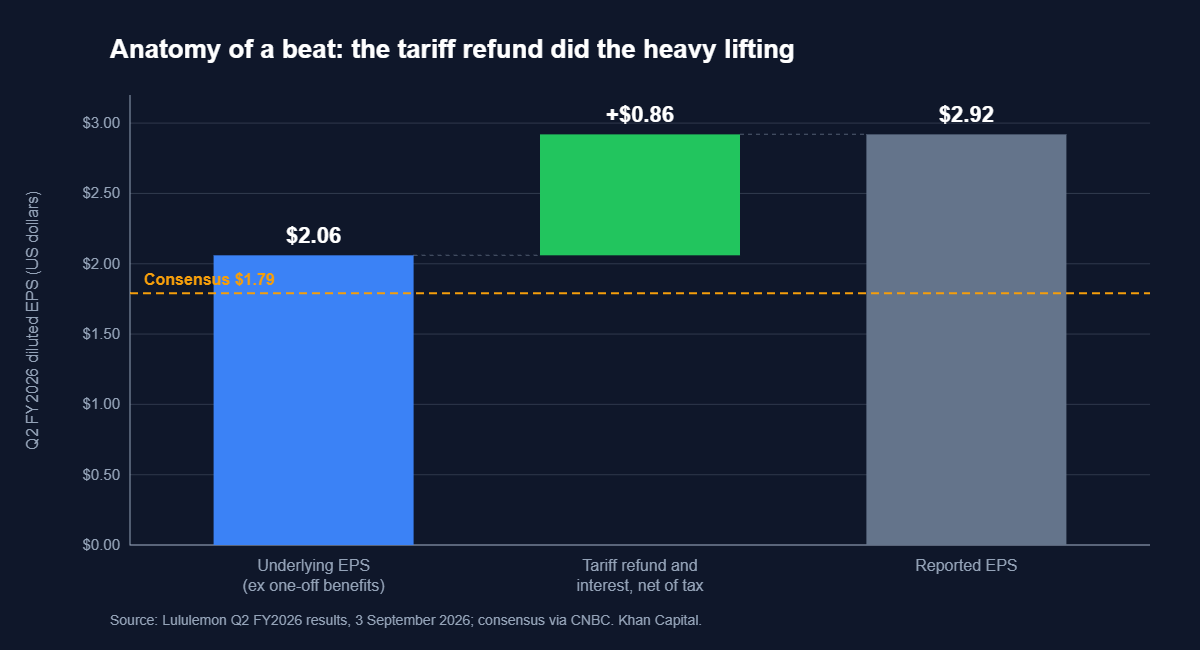
Strip out $0.86 per share of tariff refunds and associated interest, net of tax, and underlying EPS was about $2.06. That is still ahead of consensus, but the composition matters: the outperformance came from a one-off cheque, cost control and a lower share count, not from selling more product. Revenue of $2.42 billion missed expectations and declined 4.3 per cent from a year earlier. In a quarter where the rest of the retail sector had already flagged tariff refunds as an earnings-quality issue, investors had been primed to look through exactly this kind of beat.
Inside the $134.5 Million Asterisk
The refund itself traces back to the legal unravelling of the emergency-powers tariff regime, which has forced the US government to return duties collected under orders later found unlawful. For importers like Lululemon, which manufactures largely in Vietnam, Cambodia, Sri Lanka and Indonesia, those refunds arrive as a lump of pure margin: $134.5 million in this quarter. The money is real and shareholders keep it. What it is not is repeatable. A refund of past costs says nothing about future pricing power, and it mechanically flatters this year’s comparisons at the expense of next year’s.
The same distortion runs through the margin line. Gross margin expanded 200 basis points to 60.5 per cent, which would normally be read as evidence of brand strength. Set against a 9 per cent decline in comparable sales and rising markdown activity across the athleisure category, the more plausible reading is that refunds and mix did the work while the underlying trend is softer. Operating margin, which nets off the cost side, contracted 190 basis points to 18.8 per cent, and operating income fell 13 per cent to $453.7 million. When gross margin and operating margin move in opposite directions by roughly 400 basis points combined, the income statement is telling two different stories, and the operating line is usually the honest one.
Four Quarters of Erosion
The demand picture is now unambiguous. Comparable sales fell 9 per cent. Net income fell 11 per cent. Revenue declined across product categories and regions, a breadth of weakness that is hard to attribute to fashion cycles alone. The premium activewear consumer, long treated as immune to the pressures squeezing mass-market retail, is behaving like every other consumer: trading down, buying less and waiting for markdowns.
| Metric (Q2 FY2026) | Reported | Comparison |
|---|---|---|
| Net revenue | $2.42bn | Consensus $2.46bn; down 4.3% year on year |
| Diluted EPS | $2.92 | Consensus ~$1.79; includes $0.86 of one-off benefits |
| Comparable sales | -9% | Broad-based across categories and regions |
| Gross margin | 60.5% | Up 200bps year on year |
| Operating income | $453.7m | Down 13%; margin 18.8%, down 190bps |
| Net income | Down 11% | Despite the refund benefit |
The US backdrop does not offer much help. July retail sales fell 0.6 per cent, and while August’s strong jobs report showed restaurants hiring aggressively, discretionary goods spending has consistently lagged services all year. A $118 pair of leggings sits precisely in the category consumers defer when budgets tighten, and the brand no longer has the field to itself: lower-priced challengers have spent three years converting Lululemon’s aspirational customers into their core customers.
The Competition Closed the Gap
None of this is happening in a vacuum. The structural story behind four quarters of eroding comps is that the moat Lululemon spent two decades building, technical fabric, community-led marketing and a premium price point that signalled quality, has been systematically replicated. Newer athleisure brands compete directly on product at lower prices, established sportswear giants have rebuilt their women’s lines around the same silhouettes, and private-label programmes at the big-box retailers now offer credible imitations at a third of the price. When a category leader loses pricing power, the first symptom is exactly what this quarter showed: volume holding up better than revenue, margins defended through cost lines rather than price, and a widening reliance on outlet and markdown channels to clear product.
The second symptom is strategic, and it showed in the guidance. A brand with intact pricing power responds to a demand wobble by protecting price and accepting lower volume, keeping the franchise scarce. A brand that cuts its full-year outlook by double digits while comps fall 9 per cent is implicitly conceding that it must now compete for a consumer it used to own. That concession is reversible, product cycles have rescued apparel brands before, but reversing it requires investment in design and marketing precisely when the income statement argues for cost cuts. Managing that tension, spending into a downturn to defend the brand while Wall Street demands margin protection, is the central task facing the incoming leadership, and it is a harder task at ten times earnings than it was at thirty, because the market has stopped paying in advance for success.
A Guidance Cut That Rewrites the Year
Beats fade; guidance is what repriced the stock. Lululemon now expects full-year net revenue of $10.35 billion to $10.5 billion, down from $11 billion to $11.15 billion, which turns a flattish year into a 5 to 7 per cent decline. Full-year EPS guidance fell from $10.95 to $11.15 to $9.48 to $9.73, a cut of roughly 13 per cent at the midpoint, and one made after a quarter in which reported earnings were inflated by refunds. The implied second half is materially weaker than the first, which is the arithmetic of a company telling the market that the trends it can see in current trading are deteriorating, not stabilising.
A cut of this size also resets the credibility clock. Management teams generally try to cut guidance once, deeply, and rebuild from a beatable base. The risk case is that this is instead the second act of a longer sequence, as it proved to be for several premium consumer brands in past downcycles, where each quarter’s “rebased” outlook was overtaken by the next quarter’s trading. Which act this is will not be knowable until holiday trading data arrives.
What a Sub-$100 Print Means
The after-hours print under $100 took the stock through its 52-week low of $104.44 and back to levels last seen in the early 2020s. The de-rating is now the dominant feature of the investment case: a company still guiding to roughly $9.60 of earnings trades at around ten to eleven times that number, a multiple the market historically reserves for retailers in structural decline, not premium brands with 60 per cent gross margins. That is the debate in one line. If Lululemon is a healthy brand having a cyclical demand problem, the multiple is discounting far too much damage. If the brand itself has peaked, with competition permanently resetting its pricing power, then the earnings base is still too high and the multiple is fair warning rather than opportunity.
History offers both templates. Under Armour never recovered the premium positioning it lost in the late 2010s; Nike, which this week traded at levels first reached more than twenty years ago, is a live reminder that scale does not protect a sportswear brand from a lost decade. Against that, Abercrombie and American Eagle showed in the mid-2020s that written-off apparel brands can re-rate violently when product cycles turn. The distinguishing variable in those recoveries was inventory discipline and a genuine product refresh, not price cuts, which is why the next two quarters of gross-margin-ex-refunds and markdown behaviour matter more than any single revenue print.
Investor Implications
Equities. Within consumer discretionary, the read-across is narrow but sharp: earnings quality screens matter again. Any consumer name reporting this autumn with tariff refunds in the bridge should expect its beat to be discounted to the underlying number, and companies guiding on the assumption of a resilient premium consumer face a higher bar of proof. For the athleisure complex specifically, Lululemon’s markdown behaviour into the holiday season will set the promotional temperature for the whole category.
Fixed income and cross-asset. There is no credit story here; Lululemon carries minimal debt and generates cash even in decline. The macro signal is the more useful one: a premium consumer brand cutting guidance by double digits in the same week that payrolls surprised to the upside illustrates the split economy the Federal Reserve has to set policy for, where services employment is strong while discretionary goods demand contracts. It is a reminder that a September rate hike would land on parts of the consumer economy that are already in recession.
What to Watch
- October and November: channel checks and promotional intensity in athleisure into the holiday quarter; heavier-than-planned markdowns would signal the new guidance is already stale.
- Early December: the Q3 report, the first quarter fully inside the rebased outlook, where the clean test is gross margin excluding any further refund benefits.
- Ongoing: the tariff litigation and refund pipeline across the sector, which will keep distorting apparel earnings comparisons into 2027 and complicates every year-on-year margin claim in the category.
Conclusion
The Lululemon quarter is best understood as two releases stapled together: a one-off refund that made the headline EPS line look excellent, and an underlying business update, falling revenue, negative comps, contracting operating margins and a double-digit guidance cut, that was uniformly poor. The market graded the second release, which is the correct one to grade. What happens next depends on a question the numbers cannot yet answer: whether this is a cyclical trough in a premium brand’s demand or the repricing of a franchise whose best competitive position is behind it. The honest position is that the stock is now cheap enough to be interesting and the trend is still bad enough to justify the price, which is why the holiday quarter, reported clean of refunds, will be the most informative print this company has delivered in years.
Sources: CNBC, Lululemon Q2 2026 earnings; Lululemon Athletica, second quarter fiscal 2026 results; Investing.com, Lululemon Q2 2026 presentation; Yahoo Finance, Lululemon’s guidance cut raises fresh questions; 24/7 Wall St, Lululemon Q2 earnings live coverage.
Related Reading: The sector context for this quarter was set in retail earnings week, where tariff refunds first muddied the numbers, and the demand backdrop in July’s falling retail sales. For the macro cross-current, see the August jobs report published this week. For the fundamentals, start with how company guidance works and the IEEPA tariffs behind the refunds. The other side of the K is priced in the Apollo Atlantic Aviation deal. Shein’s Hong Kong listing put a public market price on the same tariff pressures; see Shein’s $26.5 billion IPO. For the next front in the tariff story, see the US-Canada escalation.

Leave a Reply