Khan Capitals | August 2026
Key Takeaways
- The pursuit is over. Advent International and Stripe have abandoned their pursuit of PayPal, walking away from what would have been, at more than $50 billion, one of the largest leveraged buyouts ever attempted.
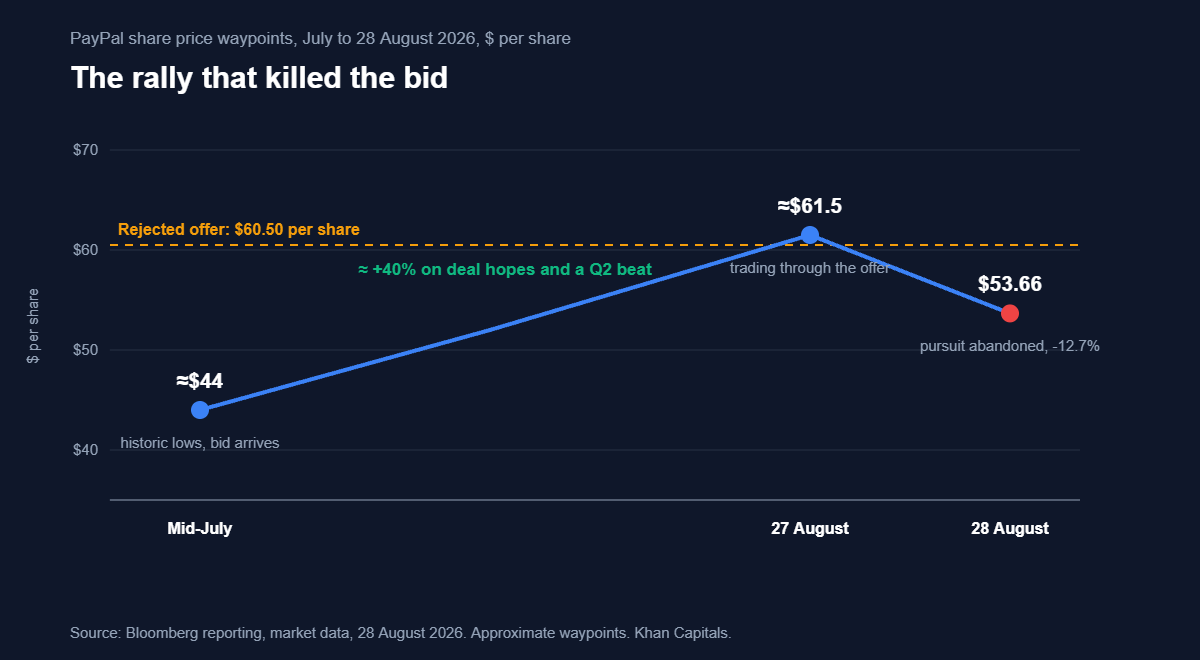
- The stock gave back the premium. PayPal shares fell 12.7 per cent on Friday to $53.66, on volume of 35.9 million shares, roughly 124 per cent above the three-month average, unwinding a rally built substantially on takeover hopes.
- The rally killed the deal. The consortium’s roughly $53 billion approach, at $60.50 per share, was made in July when PayPal traded near historic lows around a $40 billion valuation. The board rejected it, the shares then climbed about 40 per cent on deal hopes and a second-quarter beat, and the buyout arithmetic stopped working.
- PayPal’s own results contributed. The second quarter beat most estimates, with adjusted earnings of $1.38 per share against a $1.28 consensus on revenue of $8.68 billion, strengthening the board’s case that the offer undervalued the franchise.
- The door is not closed. The consortium could return with a future bid, and PayPal must now justify a standalone valuation that the market spent Friday repricing.
Part of: Private Credit & Private Markets — Khan Capital’s hub on the rise of private capital.
The PayPal Takeover Collapse, in One Sentence
The PayPal takeover collapse is a story about a deal that destroyed itself: a consortium bid for a company because it was cheap, the bid leaked, the leak made the company expensive, and the expense made the bid impossible. On Friday, Bloomberg reported that the group led by Advent International and Stripe is no longer pursuing PayPal, ending a saga that began in July with an approach worth roughly $53 billion, at $60.50 per share, when the payments company was trading near historic lows and valued at about $40 billion. PayPal’s board rejected that offer. The group was reported to be preparing a higher one. Instead, it walked.
The market’s response was immediate. PayPal shares fell 12.7 per cent to $53.66, their sharpest one-day fall since the takeover interest emerged, on volume 124 per cent above the three-month average, as an investor base that had spent six weeks accumulating on deal hopes reversed course in a session. What remains is a case study in the mechanics, and the current limits, of the leveraged buyout at the largest scale, and a test of what PayPal is worth on its own.
Six Weeks From Approach to Abandonment
The sequence matters because each step caused the next. In July, with PayPal’s shares at levels last seen in its early years as a public company, the Advent-Stripe group approached with an offer at $60.50 per share, a premium of roughly a third to the prevailing price. The board rejected it as too low. News of the interest then did what deal news always does: it repriced the target. PayPal shares climbed for weeks, helped along in early August by a second quarter that beat most estimates, with adjusted earnings of $1.38 per share against a $1.28 consensus and revenue of $8.68 billion. By late August the stock had gained roughly 40 per cent from its lows and was trading through the rejected offer price.
| Date / period | Event | Key number |
|---|---|---|
| July 2026 | PayPal trades near historic lows; Advent-Stripe group approaches | ~$40bn valuation; $60.50/share offer (~$53bn) |
| July 2026 | Board rejects the offer as too low | ~33% premium refused |
| Early August | Q2 results beat most estimates | Adj. EPS $1.38 vs $1.28; revenue $8.68bn |
| July to late August | Shares rally on deal hopes plus the beat | ~+40% from the lows |
| 28 August | Consortium abandons pursuit; shares reprice | -12.7% to $53.66; volume +124% vs average |
For a leveraged buyer, that rally is fatal in a way it would not be for a strategic acquirer paying with its own richly valued stock. A buyout’s returns are manufactured from the gap between the entry price and the value the sponsor believes it can build or reveal; the debt that funds the purchase must be serviced from the target’s own cash flows regardless of what was paid. A $53 billion cheque against a $40 billion market value was already at the outer edge of what the financing market has ever delivered. The same cheque against a company now trading above the offer price, with a board emboldened by a clean beat, would have required a bid so much higher that the equity returns no longer cleared any sensible hurdle. The consortium did the arithmetic and stopped.
The Biggest LBO Never Done
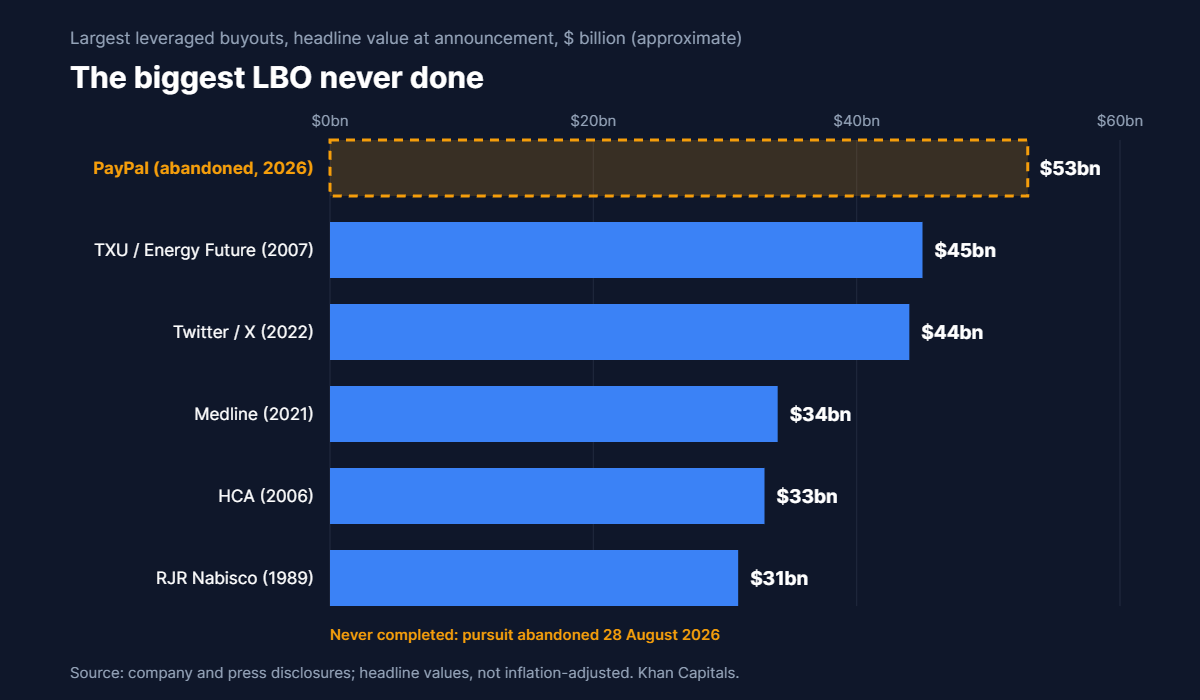
Scale is what made this pursuit worth watching. At more than $50 billion, the deal would have exceeded the inflation-unadjusted record for a leveraged buyout, the roughly $45 billion purchase of the Texas utility TXU in 2007, a transaction completed at the very top of the last credit cycle and remembered mostly for the bankruptcy that followed seven years later. The comparison is instructive in both directions: the appetite to attempt something larger than TXU says the financing capacity exists; the decision to walk rather than stretch says the discipline lessons of that era still hold.
The financing backdrop makes the attempt more remarkable, not less. This is not 2007’s bank-led debt machine; a buyout of this size in 2026 would lean heavily on private credit, the $1.3 trillion direct lending market whose concentration and opacity the Federal Reserve has just begun formally measuring. Direct lenders have written ever-larger unitranche cheques all cycle, and a consortium believed the market could absorb the largest buyout debt package ever assembled, at yields far above those of the last megadeal era. That confidence, expressed in the same summer that investment grade spreads sit in their first percentile of twenty years, tells you how much capital is straining for deployment across the credit spectrum.
The consortium’s structure was itself a signal. Stripe is not a financial sponsor; it is PayPal’s most direct private competitor, valued in its last funding rounds at a level comparable to its target. A strategic-plus-sponsor pairing at this scale, echoing the pattern of private capital’s mid-conflict $16 billion Kuwait pipeline deal in its willingness to underwrite complexity, was an attempt to make the equity maths work by adding synergy value that a pure sponsor could not claim. Even that was not enough once the target repriced.
Reflexivity: When the Bid Moves the Price That Kills the Bid
The deeper lesson of the PayPal takeover collapse is about information. Take-private candidates are, by definition, companies the public market has marked down. The moment a credible buyer’s interest becomes public, the market re-marks the target, and the discount that motivated the approach shrinks or vanishes. The buyer is left bidding against its own thesis: the more convincing the case that the company is undervalued, the faster the undervaluation disappears once the case leaks.
PayPal is an unusually clean specimen. Roughly $13 billion of market value appeared between the July approach and Thursday’s close, without the company announcing anything more transformative than a solid quarter. Some of that is the quarter; most of it is the option value of the bid itself. Friday’s 12.7 per cent fall is that option expiring. Notably, the stock did not return to its July lows: it settled roughly a fifth above them, which is the market’s estimate of what the episode revealed, partly that the business is performing better than the price implied, and partly that credible buyers exist at the right price. For students of how prices absorb information, the whole episode ran on the logic our concepts library files under what is already priced in.
What PayPal Must Now Prove
The board’s position is coherent only if the standalone plan delivers. Rejecting $60.50 in July looked shrewd when the stock traded through it in August; it looks different at Friday’s $53.66. Management now owns the gap: it must produce growth and margin evidence that supports a value above the offer it refused, without the bid support that flattered the shares for six weeks. The second quarter was a start. Branded checkout share, transaction margin expansion and the pace of buybacks, funded by free cash flow that was the original attraction for the leveraged buyers, are the metrics the market will grade from here.
There is also a scenario in which this is an intermission rather than an ending. Bloomberg’s reporting left open that the group could return, and abandoned pursuits have a way of resuming once the target’s shares have finished deflating. A renewed approach at a lower entry, or from a different consortium, remains live precisely because Friday’s fall rebuilt part of the discount that attracted the first bid.
| Scenario | What it requires | What it implies for the shares |
|---|---|---|
| Standalone re-rating (base) | Delivery on branded checkout, margins and buybacks over successive quarters | Grind rather than gap; the board’s refused $60.50 becomes the bar to clear |
| Renewed approach (bull) | Shares drifting low enough to restore buyout arithmetic; financing markets staying open | Bid premium returns, but from a lower base and likely on harder terms |
| Drift (bear) | Standalone execution stalls with no buyer re-emerging | The July lows become the reference point again, minus the takeover option |
The Stripe Angle: A Rival That Nearly Bought the Incumbent
Lost in the price action is what the attempt revealed about Stripe. A private company seriously pursuing the acquisition of its largest public rival, with a financial sponsor alongside to carry the leverage, is not normal competitive behaviour; it is the behaviour of a firm that believes consolidation, not organic share gains, is the fastest route to owning online payments. Walking away does not retire that logic. It redirects it.
Three consequences follow. First, the competitive fight between the two firms resumes with both sides having seen the other’s hand: PayPal knows Stripe considered it worth roughly $53 billion, and Stripe knows PayPal’s board holds out for more. Second, the capital and credibility Stripe assembled for the bid do not disappear; they are available for smaller acquisitions, or for the long-awaited question of its own public listing, which a completed PayPal deal would have deferred for years. Third, for private markets investors, the episode is a data point on how the largest private fintechs think about the public market: as a shopping venue when prices are depressed, and as an exit only when they are not. Which way Stripe now jumps is one of the more consequential open questions in payments.
Investor Implications
Equities. PayPal itself is now an execution story with a documented floor-and-ceiling: July’s lows mark where the market valued it without a bid, and $60.50 marks what informed buyers would have paid. More broadly, Friday is a reminder of how much deal premium can sit silently inside beaten-down names: holders of other rumoured take-private candidates are carrying the same optionality, in both directions. Event-driven positioning in megacap fintech has just been repriced across the board.
Fixed income and private markets. The collapse is not evidence that jumbo LBO financing is unavailable; the debt was never the reported obstacle. It is evidence that price discipline, not capital scarcity, is the binding constraint in 2026’s buyout market. For private credit investors, that is mildly reassuring on underwriting standards and mildly deflating on deployment: the record-sized deals that would absorb the industry’s dry powder keep failing on equity maths before the loans are ever syndicated.
Cross-asset. A $50 billion-plus buyout attempt in a summer of hike-or-hold uncertainty says financial conditions remain loose where it counts. If the Federal Reserve’s next move raises financing costs further, the marginal megadeal gets harder, and the public-to-private arbitrage that has supported valuations at the bottom of the market quietly weakens.
What to Watch
- September 2026: stake disclosures and 13F updates showing which event-driven funds were positioned for a deal, and whether any strategic holder emerges on the weakness.
- 16 September 2026: the FOMC decision; the cost of buyout debt for any renewed approach moves with it.
- Late October 2026: PayPal’s Q3 results, the first standalone print with no bid support in the share price.
- Ongoing: whether Advent, Stripe or another consortium re-engages once the shares settle; abandoned pursuits at this scale rarely stay abandoned if the discount rebuilds.
Conclusion
The PayPal takeover collapse ends the most ambitious leveraged buyout attempt of the cycle without a single loan being drawn. The deal died of its own publicity: an approach premised on a depressed price could not survive the repricing its existence triggered. For private markets, the episode cuts both ways: the capacity and appetite to attempt a record-breaking buyout plainly exist, and so does the discipline to abandon one when the entry price runs away. For PayPal, the questions are narrower and harder. The board turned down $60.50 a share on the argument that the company is worth more. From Friday evening, at $53.66, it has to prove it.
Frequently Asked Questions
Why did PayPal’s stock fall on 28 August 2026?
PayPal shares fell 12.7 per cent to $53.66 after Bloomberg reported that the consortium of Advent International and Stripe had abandoned its takeover pursuit. The stock had rallied roughly 40 per cent from its July lows largely on deal hopes, and Friday’s fall unwound much of that takeover premium.
Why did Advent and Stripe walk away from PayPal?
Their roughly $53 billion offer at $60.50 per share was made in July when PayPal was valued near $40 billion. The board rejected it, and the subsequent 40 per cent share price rally, helped by a second-quarter earnings beat, pushed the price of any successful bid beyond what leveraged buyout returns could justify.
Would this have been the largest leveraged buyout ever?
At more than $50 billion, the deal would have exceeded the roughly $45 billion TXU buyout of 2007, the largest leveraged buyout on record in headline terms. It would also have been the largest transaction ever financed substantially by the private credit market.
Could the PayPal takeover come back?
Bloomberg’s reporting indicated the consortium could still make a future bid. If PayPal’s shares drift low enough to restore the buyout arithmetic, a renewed approach from the same group or another buyer remains possible, though likely at a lower entry price and on harder terms.
Sources: Bloomberg, Advent-Stripe consortium said to drop pursuit of PayPal; The Motley Fool, market coverage, 28 August 2026; Forbes, PayPal falls after abandoned $53 billion bid; PYMNTS, Advent and Stripe abandon $50 billion pursuit; Engadget, Stripe-led group abandoning PayPal acquisition; Yahoo Finance, PayPal shares fall after acquisition plan abandoned.
Related Reading: The lending market that would have financed this deal is mapped in the Fed’s first count of the $1.3 trillion direct lending market, and the risk appetite around it in credit spreads at record tights. For private capital’s willingness to underwrite complexity at scale, see the $16 billion Kuwait pipeline deal, and for the sector’s structural backdrop, the private credit crackup and the liquidity illusion. For the fundamentals, start with leverage, explained and what it means for news to be priced in. For the latest, see the $17 billion Aon USI acquisition and KKR’s exit. For the structure that IS getting financed, see the Apollo Atlantic Aviation recap. The same price discipline reached the IPO market in Shein’s Hong Kong debut. A fortnight later, permanent capital succeeded where the consortium failed, in the $7.7 billion Baldwin Group take-private. For the contrast with a buyer that needs no financing, see Buffett stepping down as Berkshire chairman.

Leave a Reply