

Khan Capitals | September 2026
Key Takeaways
- The Senate blocked the CLARITY Act on 15 September in a 49-50 procedural vote, far short of the 60 needed, stalling the crypto industry’s flagship market-structure bill after months of lobbying and a last-minute rewrite of its ethics provisions.
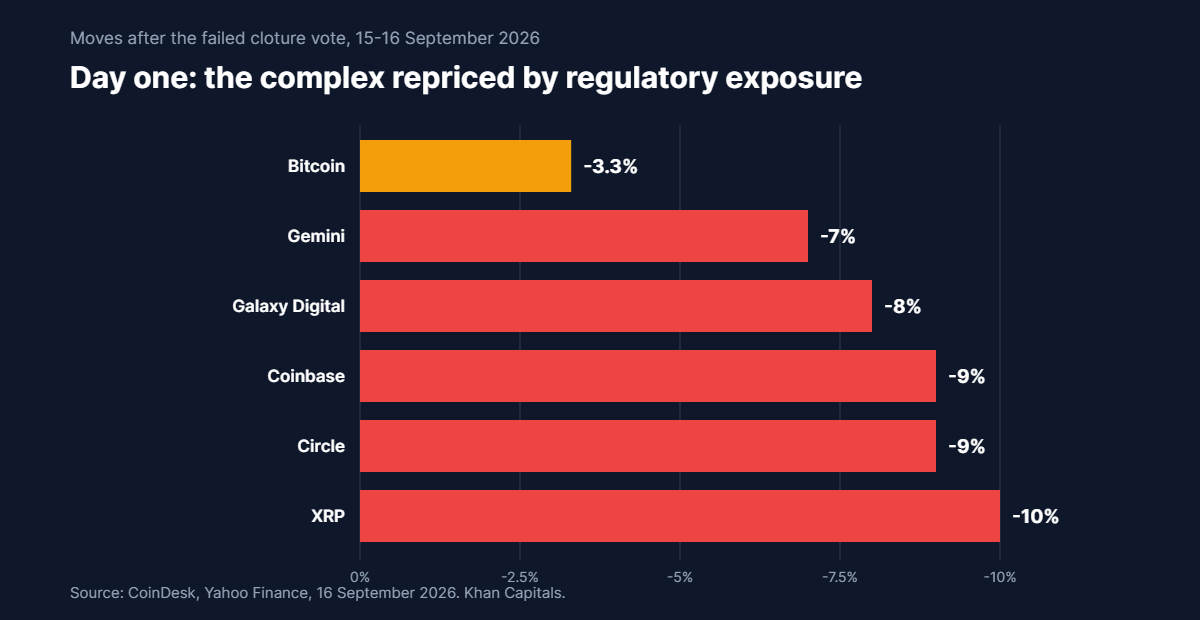
- The first reaction was a rout: bitcoin slid from nearly $80,000 toward $75,000, XRP fell roughly 10 per cent, and Coinbase and Circle each dropped around 9 per cent as the Fed’s rate hike landed a day later.
- Then the trade inverted: on Monday 21 September bitcoin broke above $84,000 for the first time in eight months, dragging Strategy, Coinbase, Circle and Robinhood higher with it.
- The bill failed on ethics, not on crypto: Senate Democrats objected to provisions around public officials profiting from digital assets, while a handful of Republicans defected after community bank lobbying over stablecoin reward rules.
- The six-session round trip is the tell: a market that crashes on a failed bill and then rallies through its pre-vote high is saying the bid never depended on Washington in the first place.
Part of: Crypto & Digital Assets — Khan Capital’s hub on bitcoin, stablecoins and the digital asset cycle.
A Bill Dies, a Rally Survives
The CLARITY Act bitcoin rally was not supposed to happen in this order. For most of the summer, the crypto market traded the Digital Asset Market CLARITY Act as its central catalyst: the bill that would finally split oversight between the SEC and CFTC, give exchanges a federal rulebook, and end a decade of regulation by enforcement. Passage odds on prediction markets roughly doubled into mid-September, bitcoin ran to nearly $80,000, and the White House hosted crypto chief executives as the president urged Congress to act. Then, on Tuesday 15 September, the Senate voted 49-50 against even opening debate. The catalyst was dead.
What followed looked, for three sessions, exactly as the textbook demanded: bitcoin fell about 4 per cent toward $75,000, XRP dropped 10 per cent, and the listed crypto complex, Coinbase, Circle, Galaxy Digital, Gemini, was marked down 7 to 9 per cent, with the Federal Reserve’s first rate hike since 2023 arriving the next day to complete the squeeze. And then the market changed its mind. By Monday 21 September, bitcoin had not only recovered the losses but broken above $84,000, its highest level in eight months, taking out the pre-vote high with the supposed catalyst lying dead on the Senate floor.
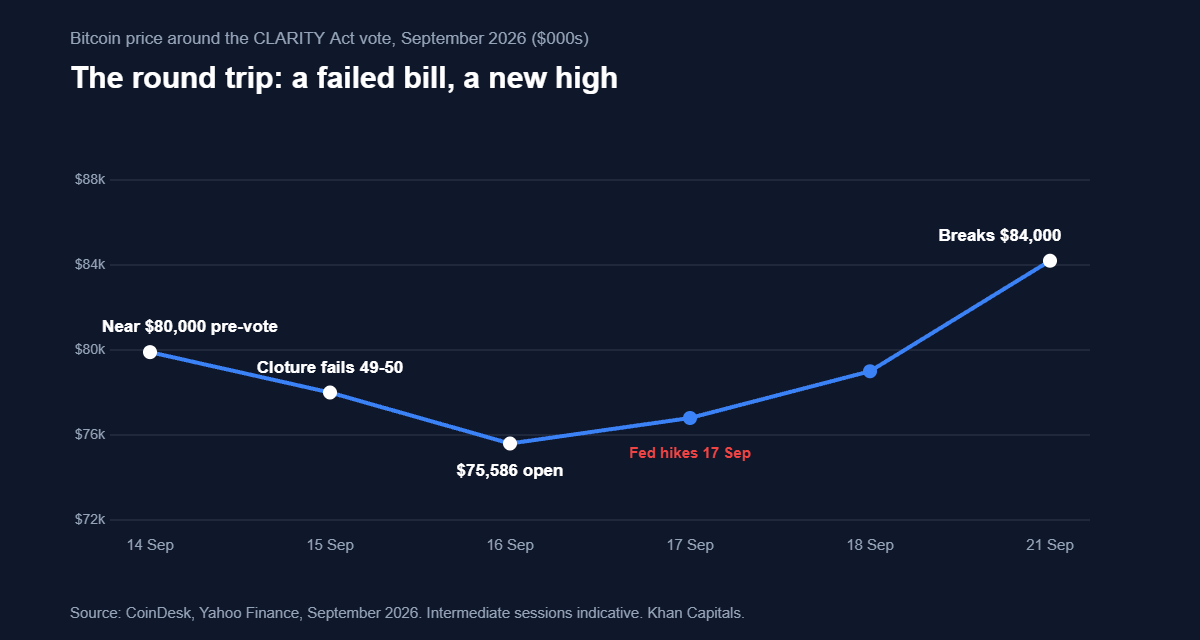
Round trips like this are information. When an asset crashes on bad news and then rallies through its old high within four sessions, the honest conclusion is that the news was not carrying the market, positioning and liquidity were. This piece unpacks why the bill failed, what the two-phase reaction reveals about what actually drives the 2026 crypto bid, and what a market that no longer needs Washington’s permission does next.
Inside the 49-50 Vote: Ethics, Not Crypto
The CLARITY Act did not fail because the Senate rejects digital assets. Its core architecture, classifying digital securities under SEC oversight while digital commodities and spot markets fall largely to the CFTC, had bipartisan support, and the Senate Banking Committee had passed its version 15-9 in May. It failed over who might profit. Senate Democrats’ objection centred on government ethics: provisions they judged too weak to prevent public officials, up to and including the president’s family with its extensive crypto ventures, from benefiting from the industry the bill would legitimise. A revised text released the Sunday before the vote added new ethics restrictions; they were not enough.
The Republican side of the ledger is less discussed and arguably more interesting for markets. A handful of Republicans defected after intense lobbying from community banks over stablecoin reward rules: smaller lenders fear that yield-bearing stablecoins become deposit substitutes, draining the funding base that community banking depends on. That objection does not disappear with redrafting, because it is structural: any framework that makes stablecoins safer and more useful makes them more competitive with bank deposits. The coalition against the bill, progressive ethics hawks plus deposit-protective bank allies, is the kind that survives elections.
For the industry, the practical consequence is that the enforcement-first status quo persists into 2027 at the earliest, with the midterm elections in November now the variable that decides whether the next Congress is friendlier or more hostile. That is the outcome the market spent August and early September treating as the bear case. Which makes what happened next the puzzle worth solving.
Phase One: The Textbook Selloff
The immediate reaction validated every analyst who called the bill priced in. Bitcoin, which had traded near $80,000 on vote-day optimism, opened Wednesday 16 September at $75,586, down 3.3 per cent, and probed lower. XRP, the token most levered to US regulatory outcomes after years of litigation, fell close to 10 per cent to $1.30. The equity complex was hit harder than the coins: Coinbase fell nearly 9 per cent to $174.42, Circle dropped more than 9 per cent to $88.26, Galaxy Digital lost 8 per cent and Gemini 7 per cent. The listed names carry the most direct earnings exposure to a US regulatory framework, so the market repriced them accordingly.
Timing amplified the damage. The Fed’s 25 basis point hike landed the following day, and a tightening Fed is mechanically hostile to non-yielding assets. Bloomberg called it a double whammy, and for 72 hours the crypto tape traded like a market that had lost both its policy catalyst and its liquidity backdrop in the same week. Short interest rebuilt quickly; the same leverage that had chased the rally up now chased it down.
| Asset | Reaction to the failed vote (16 Sep) | By Monday 21 Sep |
|---|---|---|
| Bitcoin | -3.3% open at $75,586, from near $80,000 pre-vote | Above $84,000, an eight-month high |
| XRP | -10% to $1.30 | Recovered with the complex |
| Coinbase (COIN) | -9% to $174.42 | Among Monday’s leaders |
| Circle (CRCL) | -9% to $88.26 | Among Monday’s leaders |
| Galaxy Digital / Gemini | -8% / -7% | Recovered with the complex |
Phase Two: The $84,000 Answer
The reversal began before the weekend and completed on Monday morning, when bitcoin broke above $84,000 for the first time in eight months and the same names that led the selloff, Strategy, Coinbase, Circle, Robinhood, led the bounce. Strategy’s Michael Saylor, never knowingly under-bullish, framed the defeat itself as the catalyst: “The rejection of CLARITY marks a positive inflexion point for Digital Assets,” he posted. Stripped of the salesmanship, there is a real argument underneath: the bill’s failure removes a binary event, ends the pretence that crypto’s fortunes hinge on one procedural vote, and leaves a market driven by flows rather than headlines.
The flow story is the more convincing explanation for the round trip. The August recovery that cracked crypto’s ten-month bear market was built on a short squeeze and ETF inflows, not on legislation, and those mechanics never stopped operating. Each leg down in the post-vote selloff liquidated leveraged shorts into a market where spot demand through the ETF complex had remained resilient; each liquidation became fuel for the next leg up. A market structured this way does not need good news to rally. It needs sellers to exhaust themselves, and a failed Senate vote obligingly provided the flush.
There is also a macro underlay that the legislative drama obscured. The same week the bill failed, the Bank of Japan hiked and the yen fell anyway, keeping the global carry machine intact, and the bond market’s troubles pushed more investors toward assets outside the sovereign-debt complex. Bitcoin near its 2026 highs alongside gold near records is not a coincidence; both are expressions of the same unease about deficits, inflation and the price of duration. Against that backdrop, a stalled market-structure bill is noise.
What the Round Trip Actually Prices
Put the two phases together and the market has delivered an unusually clean experiment. The hypothesis “crypto’s 2026 rally depends on the CLARITY Act” predicted a durable derating once the bill died. Instead the market produced a three-session flush and a new eight-month high. The hypothesis fails. What survives is a hierarchy of drivers that looks like this: first, flows and positioning (ETF demand, short interest, leverage); second, the macro regime (real rates, the dollar, deficit anxiety); and only third, the legislative calendar, which sets the medium-term ceiling for the listed intermediaries more than for the coins themselves.
That hierarchy explains the dispersion inside the complex. Bitcoin recovered fastest because its bid is flow-driven and global. The exchange and stablecoin equities, Coinbase and Circle in particular, remain the genuine losers from the bill’s failure: their compliance costs stay high, their product roadmaps stay hostage to enforcement risk, and the discount they carry against conventional financial-infrastructure peers persists. XRP’s outsized fall is the same logic concentrated: tokens whose investment case leans on US legal clarity lose the most when clarity is deferred. Regulation, it turns out, is priced token by token, not as a sector switch.
The prediction-market arc completes the picture: passage odds that doubled from around 14 per cent to near 30 per cent into the vote collapsed with it, and the market rallied anyway. The lesson for the next legislative cycle is that Washington optionality is a trade around positions, not the position itself.
| Scenario | Legislative path | Coins | Listed intermediaries |
|---|---|---|---|
| Lame-duck revival | Slimmed bill with renegotiated ethics provisions passes by year-end | Modest positive; already flow-driven | Largest beneficiaries; regulatory discount narrows |
| Dead until 2027 | Bill returns in the next Congress, shaped by midterm outcome | Neutral; macro and flows dominate | Discount persists; enforcement risk unchanged |
| Hostile Congress | Midterms strengthen crypto-sceptic bloc; tougher framework proposed | Headline volatility; offshore migration resumes | Derating; US-listed names lose share to offshore venues |
Investor Implications
Equities. The listed crypto complex now trades on two clocks: the flow clock, which is bullish while ETF demand and the bitcoin price hold, and the regulatory clock, which has stopped until at least the next Congress. That argues for discrimination rather than sector exposure: the exchanges and stablecoin issuers carry the unresolved regulatory discount, while the miners and treasury proxies track the coin. Crypto-adjacent earnings remain hostage to a volatile underlying; position sizes should assume the August and September two-way moves are the norm, not the exception.
Fixed income. The failed bill removes a potential source of Treasury demand that stablecoin legislation was expected to create, since regulated issuers would have been steered further into bills as reserves. It is a marginal effect, but in a market this sensitive to the bill supply-demand balance, marginal buyers matter; the deferral lands on the same side of the ledger as Japanese repatriation.
Cross-asset. Bitcoin making eight-month highs through a failed flagship bill, a Fed hike and an equity wobble is a statement about liquidity preference: capital is seeking assets outside the sovereign complex, and it is not waiting for regulatory permission. Whether that is prudent diversification or late-cycle exuberance, the correlation between bitcoin, gold and deficit anxiety is now a live input for portfolio construction, and it strengthens on every bond auction that goes badly.
What to Watch
- 3 November 2026: the US midterm elections, now the decisive variable for whether a market-structure bill returns in friendlier or more hostile form in the next Congress.
- Coming weeks: any lame-duck attempt to revive a slimmed-down bill; leadership signalled willingness to renegotiate ethics provisions, and the president has pushed for passage “before the end of the year”.
- Weekly ETF flow data: the rally’s foundation; sustained outflows would remove the mechanical bid that powered the round trip.
- Late October (expected): the Fed’s next meeting; a second hike would retest crypto’s newfound indifference to tightening.
Conclusion
The CLARITY Act’s failure was supposed to be the crypto bear case for 2026, and for three sessions it was. The 49-50 vote entrenched the enforcement-first status quo, punished the listed intermediaries and handed the sceptics their cleanest talking point of the year. But the market’s answer, a break above $84,000 within four sessions, reframed the whole episode: the 2026 crypto bid is a flows-and-macro phenomenon wearing a regulatory costume, and the costume just came off.
None of this makes the legislative question irrelevant; it makes it specific. The exchanges, the stablecoin issuers and the tokens that need American legal clarity still need it, and they will carry the discount until a bill passes. But bitcoin has demonstrated, in real time and against a hostile tape, that its marginal buyer lives somewhere other than Capitol Hill. Markets rarely run controlled experiments. This one did, and the result deserves to be taken seriously.
Frequently Asked Questions
What is the CLARITY Act and why did it fail?
The Digital Asset Market CLARITY Act is a market-structure bill that would classify digital securities under SEC oversight while placing digital commodities and spot markets largely under the CFTC. It failed a Senate cloture vote 49-50 on 15 September 2026, short of the 60 votes needed, after Democrats objected to its government ethics provisions and several Republicans defected over stablecoin reward rules following community bank lobbying.
Why did bitcoin rise after the CLARITY Act failed?
After an initial fall toward $75,000, bitcoin broke above $84,000 within four sessions, an eight-month high. The recovery reflected the drivers that were carrying the market before the vote: ETF inflows, short positioning that turned into squeeze fuel on each selloff, and macro demand for assets outside the sovereign-debt complex. The episode suggested the rally was never primarily about the legislation.
Which crypto assets were hurt most by the bill’s failure?
The listed intermediaries and US-clarity-dependent tokens. Coinbase and Circle each fell around 9 per cent on the news, Galaxy Digital and Gemini 7 to 8 per cent, and XRP dropped roughly 10 per cent. These names retain the regulatory discount because their business models and legal standing benefit most directly from a federal framework.
Will the CLARITY Act come back?
Possibly, but not quickly. A lame-duck revival would require renegotiating the ethics provisions that Democrats blocked, and the structural objection from community banks over stablecoin rules remains. The November midterm elections will shape whether the next Congress takes up a version of the bill in 2027 and on what terms.
Sources: CNBC, Senate cloture vote on Clarity Act fails; CoinDesk, XRP sinks 10% as the Clarity Act fails; Yahoo Finance, Crypto prices tank after CLARITY Act fails; Yahoo Finance, Bitcoin prices rip despite the Clarity Act failure; Bloomberg, Crypto market faces pressure as Clarity Act fails, Fed raises rates; Axios, Crypto’s Clarity Act fails to advance in Senate.
Related Reading: The flow mechanics behind this month’s round trip were first visible in August’s short squeeze that cracked the ten-month bear market. The macro backdrop tightened the same week the bill failed: the Fed delivered its first hike since 2023 and the Bank of Japan raised rates to a 31-year high while the yen fell anyway, keeping the global liquidity picture more complicated than any single vote. For the fundamentals, start with our bitcoin explainer and what a stablecoin is.

Leave a Reply