
Khan Capitals | September 2026
Key Takeaways
- The Bank of Japan raised its policy rate 25 basis points to 1.25 per cent on Friday, the highest level since 1995, citing the risk that underlying inflation overshoots its 2 per cent target as firms’ wage and price setting turns more aggressive.
- The vote was split 7-2, with board members Toichiro Asada and Ayano Sato dissenting in favour of holding, and Governor Kazuo Ueda offered no commitment on the timing of further moves.
- The yen fell instead of rising, weakening past 157 to the dollar, as traders read the split vote and Ueda’s caution as a signal that the tightening cycle is nearer its end than its middle.
- The 10-year Japanese government bond yield eased even as it held near 3 per cent, its highest territory since 1996, and the Nikkei 225 rose 1.5 per cent: a full reversal of the script a rate rise is supposed to follow.
- The yen carry trade is the transmission channel that matters: cross-border yen borrowing has grown roughly 67 per cent since late 2021 to around ¥360 trillion, and Morgan Stanley estimates some $500 billion of yen-funded positions remain outstanding despite August’s partial unwind.
Part of: Rates, Bonds & the Macro Picture — Khan Capital’s hub on the yield curve, central banks and the macro cycle.
A 31-Year High Delivered in a Whisper
The Bank of Japan rate hike of September 2026 was the most heavily signalled move of the year, and the market still managed to be surprised by it. On Friday 18 September the BoJ lifted its short-term policy rate by 25 basis points to 1.25 per cent, the highest setting in 31 years. Every economist surveyed ahead of the meeting expected precisely this outcome. What they did not expect was what came next: the yen, which textbook logic says should strengthen when its central bank raises the price of money, promptly weakened past 157 to the dollar. Japanese government bond yields, which should rise on a hike, slipped. And the Nikkei 225, which might reasonably wobble as borrowing costs climb, instead gained 1.5 per cent.
Markets flipping the expected script is rarely random. When a currency falls on a rate rise, the message is that the rise itself was fully priced and everything else in the package leaned the other way. That is exactly what happened in Tokyo. The 7-2 vote, the absence of any revised inflation projections, and Governor Kazuo Ueda’s refusal to commit to further moves together read as a central bank tightening reluctantly, at the pace of its most cautious members, into an inflation problem it would rather describe than confront.
For global investors the stakes are larger than one currency pair. Japan remains the world’s cheapest major funding market even at 1.25 per cent, and the yen carry trade that funds positions across emerging markets, US credit and global equities has grown into what is by some measures the largest such cycle in three decades. A BoJ that hikes without conviction keeps that trade alive. A BoJ that ever finds conviction would put it at risk. Friday’s meeting suggested the first outcome, and markets traded it accordingly.
The Decision: What the BoJ Actually Said
The formal justification was straightforward. In its statement, the BoJ pointed to the risk that underlying inflation deviates above its 2 per cent target, with firms’ wage and price setting behaviour becoming more aggressive and medium to long-term inflation expectations rising. That language matters because it describes a central bank worried about persistence rather than a spike: not one bad print, but a change in how Japanese companies think about pricing after three decades of treating price rises as taboo.
Notably, the Bank did not update its quarterly Outlook for Economic Activity and Prices at this meeting; the next full set of projections arrives at the October meeting. Raising rates between forecast rounds, rather than waiting a few weeks to justify the move with fresh numbers, suggests the board felt the case was strong enough not to need them, or that waiting carried its own risks. Ueda’s press conference added a further wrinkle: he described the move as largely driven by global upward pressures on yields. That is an unusual framing for a domestic policy decision, and an honest one. With long yields rising across the US, Europe and the UK, a BoJ that stood still would be importing ever-easier relative policy whether it wanted to or not.
The hike lands in a global context that has changed dramatically in a month. The Federal Reserve raised rates on Wednesday for the first time since 2023, and the European Central Bank delivered its second hike of the year the week before. For the first time since the early 1990s, the world’s three major developed-market central banks are tightening simultaneously into an energy-led inflation shock. Japan, the last holdout of the easy-money era, is no longer holding out. It is simply moving more slowly, and with less agreement, than anyone else.
Seven to Two: Reading the Dissents
The vote split is where the story gets political. Board members Toichiro Asada and Ayano Sato voted against the hike, with Sato arguing that economic and price developments had not substantially accelerated compared with earlier in the year, making a rate rise inappropriate at this time. Both dissenters are widely viewed as sympathetic to Prime Minister Takaichi’s preference for a gentler tightening path, which makes the arithmetic on the nine-member board worth watching: a government that appoints cautious members as terms expire can slow the cycle without ever publicly leaning on the Bank.
Central bank dissents are information. A unanimous hike with hawkish guidance says the committee sees more work ahead. A split hike with no guidance says the committee is divided about whether this move was even necessary. Currency markets are efficient translators of that distinction, which is why the yen’s fall on Friday was less a paradox than a verdict. If two members opposed this hike and the Governor will not promise another, the odds of the BoJ reaching 1.5 per cent or beyond on any near horizon just lengthened, whatever the inflation data says.
There is a useful parallel in recent Japanese history. The BoJ’s exit from negative rates and its subsequent hikes were each followed by long pauses justified by the need to confirm the durability of wage growth. Each pause let inflation pressure build, which forced the next move to arrive against a worse backdrop. The September 2026 hike fits the pattern: policy that is always responding to the last inflation surprise rather than positioning for the next one. Economists call this falling behind the curve. The dissenters, in effect, argued the Bank is ahead of it. The gap between those two readings is where the next several meetings will be fought.
Why the Yen Fell on a Rate Rise
The mechanics of Friday’s currency move are worth unpacking, because they explain much of what happens next. Going into the meeting, the hike was fully priced: forward markets had assigned it near-certainty for weeks. A fully priced hike delivers no new information when it lands. What was not priced was the composition of the vote and the tone of the guidance, and both surprised on the dovish side. The rational response was to sell the fact, and the yen weakened through 157 within hours of Ueda’s press conference.
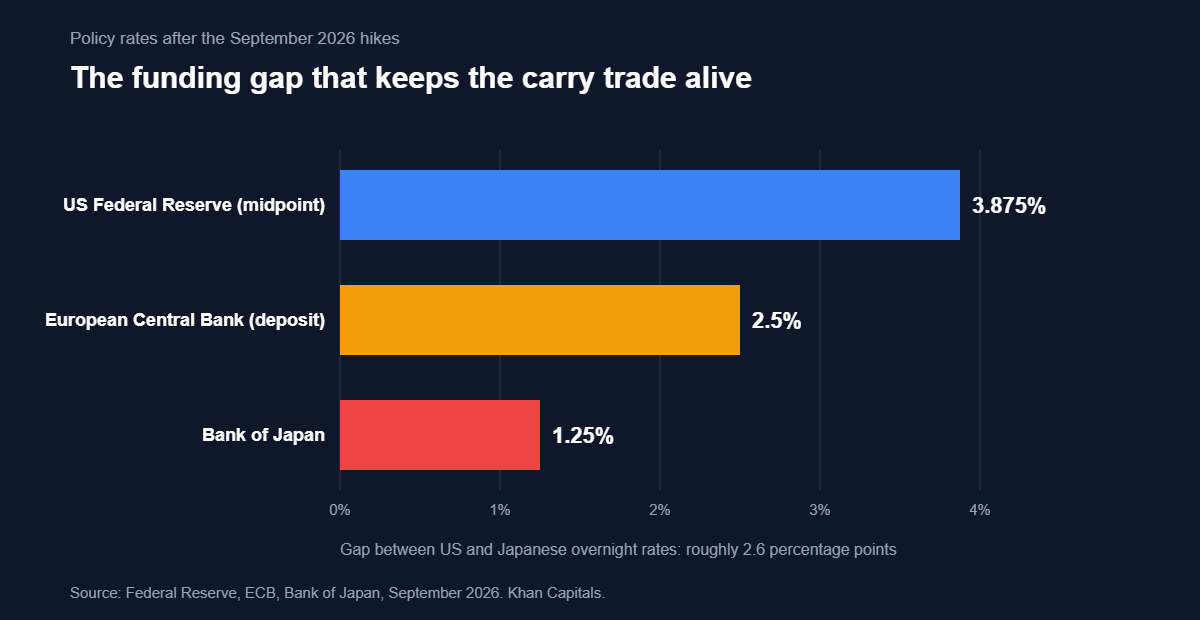
Positioning amplified the move. Traders had trimmed short-yen exposure ahead of the meeting as insurance against a hawkish surprise. When the surprise came dovish instead, those positions were rebuilt at speed, with long dollar-yen positions re-established above 157 in the sessions that followed. The rate differential arithmetic still favours the trade decisively: even after Wednesday’s Federal Reserve hike took the funds rate to 3.75 to 4 per cent and Friday’s BoJ move took Japan to 1.25 per cent, the gap between US and Japanese overnight rates remains roughly 2.6 percentage points. Carry does not care about direction of travel; it cares about the level of the spread, and the spread remains wide.
The equity and bond reactions complete the picture. The Nikkei’s 1.5 per cent gain reflects the same logic in reverse: a central bank in no hurry is good news for domestic risk assets, and a weaker yen flatters the exporters that dominate the index. The slight easing in the 10-year JGB yield, even as it held near 3 per cent, its highest area since 1996, says bond investors concluded the terminal rate in this cycle is closer than they had feared. One meeting produced three market moves that all decode to the same sentence: this was a dovish hike.
| Measure | Outcome, 18 September 2026 | Signal |
|---|---|---|
| Policy rate | +25bp to 1.25% (highest since 1995) | Fully priced beforehand |
| Board vote | 7-2 (Asada and Sato dissenting) | Dovish: committee divided |
| Outlook Report | Not updated; next due October | No fresh hawkish anchor |
| Yen | Weakened past 157 per dollar | Sell-the-fact on soft guidance |
| 10-year JGB yield | Eased, holding near 3% (highest area since 1996) | Terminal rate seen closer |
| Nikkei 225 | +1.5% | Relief at gradualism |
The ¥360 Trillion Question: Carry Survives Tightening
The reason a BoJ meeting matters far beyond Japan is a number that has grown quietly enormous. Cross-border yen borrowing, the broadest proxy for the yen carry trade, rose roughly 67 per cent between December 2021 and March 2026 to about ¥360 trillion, around $2.3 trillion, the largest carry cycle in three decades. Investors borrow cheaply in yen and deploy the proceeds into anything yielding more: US Treasuries, emerging market debt, equities, credit. The trade works so long as the funding rate stays low and the yen stays weak or stable. It fails, sometimes violently, when either condition breaks.

August offered a reminder of the failure mode. A sharp bout of yen strength forced a partial unwind of carry positions, rippling through global equities before conditions stabilised. Yet the striking fact is how much of the structure survived: Morgan Stanley estimates roughly $500 billion in yen-funded carry positions remain outstanding. Friday’s decision, by weakening the yen and flattening the expected path of Japanese rates, effectively re-armed the trade. Every basis point of spread between dollar and yen funding that survives a BoJ meeting is an invitation to releverage.
This is the sense in which the BoJ, almost uniquely among central banks, sets financial conditions for everyone else. When Japanese institutions and global funds borrow trillions of yen to buy foreign assets, Japanese monetary policy becomes a component of the global term premium, of emerging market currency stability, and of the marginal bid for US Treasuries at auction. A Japan that tightens slowly keeps that liquidity flowing. The week’s global bond market stress makes the linkage unusually live: JGB yields near 30-year highs pull Japanese capital home at the margin, precisely when the US long end can least afford to lose a buyer.
JGBs at 1996 Levels: The Domestic Squeeze
Inside Japan, the bond market is undergoing its own regime change. The 10-year JGB yield has risen close to 90 basis points this year to near 3 per cent, territory last seen in 1996. For Japanese banks, insurers and pension funds that spent a generation starved of domestic yield, 3 per cent government paper changes the calculus of every foreign bond they hold on a currency-hedged basis. Hedging costs already made US Treasuries unattractive for much of the past two years; a domestic alternative at 3 per cent makes repatriation the default rather than the exception.
The fiscal dimension sharpens the squeeze. Japan carries the developed world’s largest public debt load relative to its economy, and every step higher in yields feeds through to a debt service bill that was designed around free money. This is one reason the political system leans dovish: a government whose interest costs compound at 3 per cent has a direct budgetary interest in the BoJ moving slowly. The dissenting votes on Friday are best read in that light. The question for investors is whether fiscal dominance, the polite term for central banks constrained by their treasuries, is becoming a Japanese story just as markets have begun asking the same question of Washington.
None of this remains contained within Japan. Japanese investors are among the largest foreign holders of US Treasuries and a structural presence in European and Australian bond markets. The more attractive their home market becomes, the higher the yield the rest of the world must pay to keep their capital. The US Treasury’s own struggles with its long end this month are not independent of what is happening in Tokyo; they are partly a consequence of it.
| Scenario | BoJ path | Yen and carry trade | Global spillover |
|---|---|---|---|
| Base: gradualism holds | Next hike pushed to 2027; October Outlook stays cautious | Yen drifts in the mid-to-high 150s; carry positions rebuilt | Cheap yen funding cushions risk assets; JGB repatriation pressure builds slowly |
| Hawkish: inflation forces the pace | 1.5% signalled by October, further hikes in 2027 | Yen rallies sharply; carry unwinds in stages | Global bonds lose a marginal buyer faster; risk assets face August-style deleveraging |
| Disorderly: currency forces the issue | Yen slide toward intervention levels forces defence of the currency | Intervention plus faster hikes; abrupt carry unwind | Volatility shock across FX, bonds and equities; tightest global conditions of the cycle |
Three Hikes in Eight Days: The Global Read
Step back and the week’s real story comes into focus. Between 10 and 18 September, the ECB, the Federal Reserve and the Bank of Japan all raised rates. The proximate causes differ: Europe is fighting an energy shock, the US a petrol-led inflation reacceleration, Japan a slow-burn shift in wage and price behaviour. But the synchronisation is the point. The global cost of capital is rising on every major axis simultaneously, and the era in which at least one major central bank could be relied upon to supply cheap liquidity has, for now, closed.
For markets, synchronised tightening removes the diversification that cushioned previous cycles. When the Fed tightened alone in 2022-23, yen funding and euro funding remained cheap, and global liquidity found workarounds. In late 2026 there is no workaround: dollar, euro and yen funding costs are all rising at once, into bond markets already unsettled by supply. That is the environment in which small policy surprises produce outsized market moves, because the buffers are gone.
The irony is that Japan, the most reluctant tightener of the three, may matter most. The Fed and ECB are operating on economies that have lived with positive real rates before. Japan is attempting its first genuine tightening cycle since the asset bubble burst in the early 1990s, with a carry trade of historic size levered against its success being gradual. The BoJ’s caution on Friday bought the carry trade time. Whether that proves stabilising or simply stores up a larger adjustment is the question that will define the next yen crisis, whenever it arrives.
Investor Implications
Equities. The Nikkei’s positive reaction reflects a market that fears BoJ conviction more than BoJ tightening, and Friday delivered the absence of conviction. A weaker yen supports exporter earnings, while financials benefit from the steeper domestic curve. The vulnerability is a scenario in which inflation forces the Bank to accelerate: Japanese equities are effectively long the BoJ remaining gradual. Globally, continued cheap yen funding is a marginal support for risk assets, though one that reverses abruptly when carry unwinds, as August demonstrated.
Fixed income. JGB yields near 3 per cent change global bond arithmetic. Repatriation pressure from Japanese institutions removes a structural bid from Treasuries, gilts and European sovereigns precisely as supply expands, an underappreciated component of the term premium repricing under way across developed markets. Investors holding duration outside Japan are, whether they know it or not, short the pace of Japanese normalisation.
Cross-asset. The carry trade is the system’s pressure point. A stable or weakening yen with a wide rate differential keeps roughly half a trillion dollars of leveraged positions comfortable. The triggers to monitor are a rapid yen appreciation through recent ranges, any BoJ communication that hardens the path to 1.5 per cent, or intervention by Japanese authorities to defend the currency, each of which would tighten global financial conditions through forced deleveraging rather than policy. Volatility markets price this as a tail; August suggested it is fatter than it looks.
What to Watch
- Late October: the BoJ’s next policy meeting, accompanied by the quarterly Outlook Report the Bank declined to update in September. Revised inflation projections are the natural vehicle for signalling, or burying, the next hike.
- Coming weeks: the yen’s path around 157 to the dollar. A sustained slide toward the levels that provoked July’s coordinated intervention would test Tokyo’s tolerance and reopen the currency-defence question.
- Monthly wage and services price data: the Bank has anchored its case on wage and price setting behaviour; the shunto-linked wage prints and services CPI are the series that would force its hand.
- 27-28 October (expected): the Federal Reserve’s next meeting. The dollar-yen rate differential is set on both sides; a Fed that signals further hikes widens the carry incentive regardless of what Tokyo does.
Conclusion
The September 2026 Bank of Japan rate hike will be remembered less for the 25 basis points than for the market’s verdict on it. A 31-year high in the policy rate produced a weaker yen, firmer equities and softer bond yields: the full anti-textbook set, and a rational one given the split vote and absent guidance. Japan is tightening, but at a pace set by its most reluctant policymakers, under a government that prefers it that way, with a carry trade of historic size betting on that reluctance persisting.
For global investors the meeting resolves nothing and clarifies much. The world’s three major central banks are now tightening together for the first time in a generation, but Japan’s contribution comes with a visible governor on its speed. That keeps yen funding cheap, global carry alive and the world’s bond markets exposed to the day Tokyo’s gradualism ends, by choice or by force. The yen falling on a rate rise is not a paradox. It is the market pricing the distance between what the BoJ did and what it conspicuously declined to promise.
Frequently Asked Questions
Why did the yen fall after the Bank of Japan raised rates?
The 25 basis point hike was fully anticipated and already priced into the currency. What moved markets was the dovish packaging: a 7-2 split vote, no updated inflation projections and no commitment from Governor Ueda to further increases. Traders concluded the tightening cycle may end sooner than previously assumed and rebuilt short-yen positions, pushing the currency past 157 to the dollar.
How high are Japanese interest rates now compared with history?
At 1.25 per cent, the policy rate is the highest since 1995. It remains far below US and European levels: the Federal Reserve’s target range is 3.75 to 4 per cent after its September hike. That gap of roughly 2.6 percentage points is what keeps the yen carry trade profitable despite Japan’s tightening.
What is the yen carry trade and why does this decision matter for it?
The carry trade involves borrowing cheaply in yen and investing the proceeds in higher-yielding assets abroad. Cross-border yen borrowing has grown to roughly ¥360 trillion, about $2.3 trillion, making it the largest carry cycle in three decades. A dovish BoJ keeps yen funding cheap and the currency soft, which sustains the trade; a hawkish shift or sharp yen rally would force positions to unwind, tightening global financial conditions.
When will the Bank of Japan raise rates again?
The Bank gave no timetable. The next natural decision point is the late-October meeting, when the quarterly Outlook Report is refreshed with new inflation projections. With two board members already dissenting and the government favouring caution, most observers expect the Bank to wait for further evidence from wage and services price data before moving again.
Sources: Bank of Japan, Statement on Monetary Policy, 18 September 2026; CNBC, Bank of Japan raises interest rates to 31-year high; CNBC, Why Japan’s markets flipped the usual script; The Japan Times, BoJ raises rates and offers mixed signals; MUFG Research, USD/JPY volatility post BoJ meeting; CNBC, US-Japan yen intervention and the carry trade.
Related Reading: The BoJ’s move landed a day after the Fed’s first hike since 2023 and a week after the ECB tightened into its own oil shock, completing an unusual trio. The domestic bond pressure behind Tokyo’s move is part of the global bond selloff that put four sovereign markets at multidecade yield highs, while our analysis of July’s joint yen intervention covers the last time authorities pushed back against the currency’s slide. For the fundamentals, start with our explainer on the yen carry trade. Risk assets’ verdict on the week came from crypto: bitcoin broke $84,000 even as the CLARITY Act failed.

Leave a Reply