
Khan Capitals | September 2026
Key Takeaways
- Warren Buffett, 96, stepped down as chairman of Berkshire Hathaway on Friday and was named chairman emeritus, ending a run of more than six decades in which he built a failing textile mill into one of the world’s most valuable companies. “Father Time always wins,” he wrote to shareholders.
- His son Howard Buffett, 71, a Berkshire director since 1993, becomes non-executive chairman with no management role and a single stated responsibility: preserving Berkshire’s culture. Warren Buffett remains on the board.
- The move completes a two-step handover: Greg Abel took over as chief executive at the start of 2026, and Buffett wrote on Friday that his expectations for Abel “were sky high from the start, and he has exceeded them”.
- Abel is already running a different Berkshire: the cash pile has come down from a record $397.4 billion to $365.5 billion, buybacks accelerated from $235 million to $4.5 billion in a quarter, and the company turned net buyer of equities after 14 consecutive quarters of selling.
- The market’s verdict on the era’s end was silence: the shares were little changed on the news, though Berkshire’s 1.3 per cent gain this year trails the S&P 500’s 11.6 per cent by more than ten points.
The Last Title Buffett Held
Warren Buffett steps down as Berkshire Hathaway chairman at 96, and the most remarkable thing about the announcement was how little the market moved on it. On Friday 18 September, Berkshire said its board had elected Howard Buffett as non-executive chairman, named his father chairman emeritus, and thanked him for six decades of service. Class B shares, which had closed at $509.20 the day before, were little changed in early trading. For an event that ends the longest and most successful chairmanship in American corporate history, the calm is itself the story: the succession machine Buffett spent two decades building worked exactly as designed.
The chairmanship was the last executive title Buffett held. He handed the chief executive role to Greg Abel at the start of 2026, having announced the plan the previous May, and Friday’s move came nearly nine months into Abel’s tenure. In his letter, Buffett was characteristically direct about the reason: age. “Father Time always wins,” he wrote, adding that Abel had exceeded expectations that “were sky high from the start”. He remains a director and, through his A shares, Berkshire’s most influential shareholder, but the operating and governance reins now formally belong to others.
For investors the question is not sentimental but structural. Berkshire without Buffett in the chair is a $1 trillion-class conglomerate with a fortress balance sheet, a new capital allocator at the helm, and an unresolved debate about whether the whole is worth more than its parts without the man who assembled them. This article looks at what actually changed on Friday, what changed months earlier without the market fully noticing, and what the first Abel-era data says about where Berkshire goes from here.
What Changed on Friday, and What Did Not
The formal changes are narrow. Howard Buffett, 71, a Berkshire director for 33 years, becomes non-executive chairman. He will not manage anything; his father has long described his role as guardian of the culture, the person who would step in if a future chief executive ever needed replacing for the wrong reasons. Warren Buffett becomes chairman emeritus, an honorific with no defined powers. Greg Abel’s authority as chief executive is unchanged, as is Ajit Jain’s oversight of insurance. The board, in effect, converted an informal arrangement that has existed on paper for years into the live structure.
| Role | Before 18 September | After 18 September |
|---|---|---|
| Chairman | Warren Buffett (since 1970) | Howard Buffett (non-executive) |
| Chief executive | Greg Abel (since January 2026) | Greg Abel (unchanged) |
| Warren Buffett’s position | Chairman, director | Chairman emeritus, director |
| Insurance operations | Ajit Jain | Ajit Jain (unchanged) |
| Stated mandate of new chairman | n/a | Preserve Berkshire’s culture; no management role |
What did not change is just as deliberate. Buffett keeps his board seat and his shareholding, which concentrates supervoting A shares that still anchor control. The pledge to give away his fortune continues, which means Berkshire’s share count and voting structure will keep evolving for years as A shares are converted and distributed. And the culture role assigned to Howard Buffett is explicitly conservative: Berkshire’s decentralised model, its aversion to dividends, its refusal to provide earnings guidance, and its preference for keeping subsidiaries forever are all meant to outlive the founder. Whether they can is the multi-decade question; Friday was constructed to make the answer yes.
Nine Months of Abel: The Numbers Tell a Different Story
While the chairmanship changed hands ceremonially, the capital allocation changed hands months ago, and the data shows a genuine shift in behaviour. Under Buffett’s final years, Berkshire was a seller: 14 consecutive quarters of net equity sales, a cash pile that compounded to a record $397.4 billion by the end of March 2026, and buybacks that had slowed to a trickle as Buffett judged even his own shares insufficiently cheap. Under Abel, each of those dials has turned.
In the second quarter of 2026, Berkshire became a net buyer of equities for the first time in three and a half years, with nearly $20 billion of net purchases and gross equity buying of $39.4 billion. Share repurchases jumped to roughly $4.5 billion, from just $235 million in the first quarter. The cash pile retreated to $365.5 billion. Deals resumed too: the roughly $9.4 billion OxyChem acquisition completed in January, and an $8.5 billion purchase of homebuilder Taylor Morrison closed in July. In two quarters, Abel deployed more capital into equities, buybacks and whole businesses than Berkshire had in the previous two years.
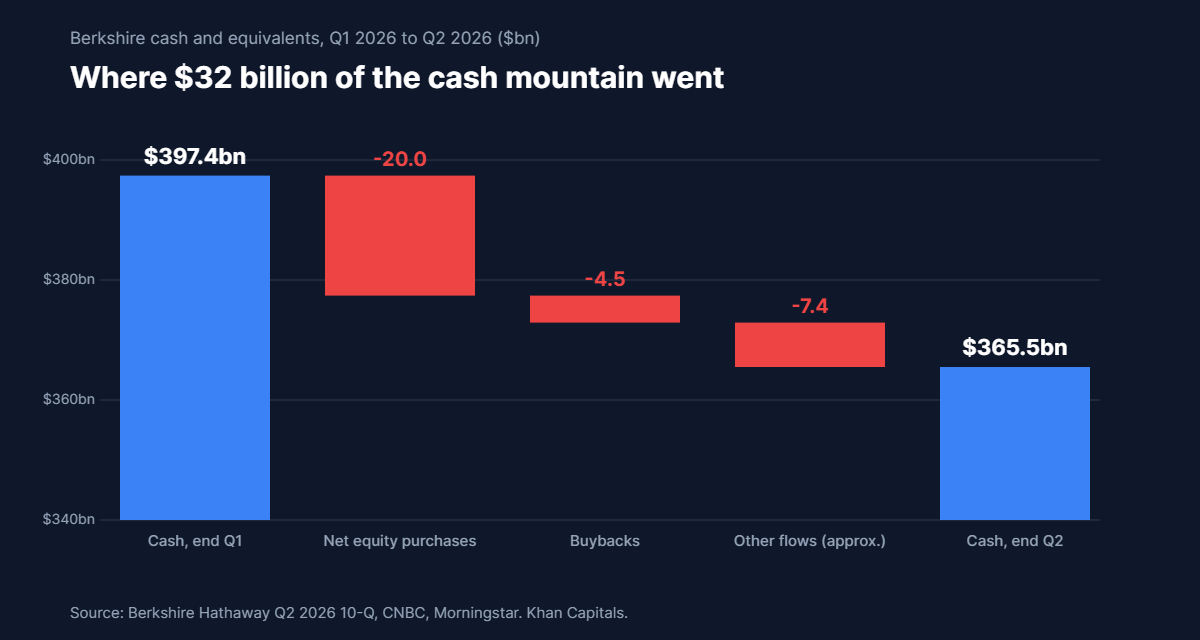
The pattern matters because the bear case on Berkshire was never about succession of judgement alone; it was about paralysis of scale. A conglomerate holding nearly $400 billion of Treasury bills is, functionally, a bond fund with an equity multiple. Abel’s first year suggests he views the cash mountain as an instrument rather than a monument. That reads well against a market where buyout capital has struggled to close large deals and family offices and permanent capital have become the marginal buyers of whole companies: Berkshire is one of very few acquirers on earth that can write a $50 billion cheque without financing.
The Underperformance Question
The polite silence around Friday’s announcement conceals a less polite fact: Berkshire has had a poor year relative to the index. The shares have gained about 1.3 per cent in 2026 against 11.6 per cent for the S&P 500, a gap of more than ten percentage points. Part of that is mechanical: Berkshire carries no exposure to the AI infrastructure names that have driven index returns, and its largest listed holdings skew toward consumer and financial franchises in a year that has rewarded semiconductors and hyperscalers. Part of it is the so-called Buffett premium unwinding in slow motion as the founder’s roles wound down.
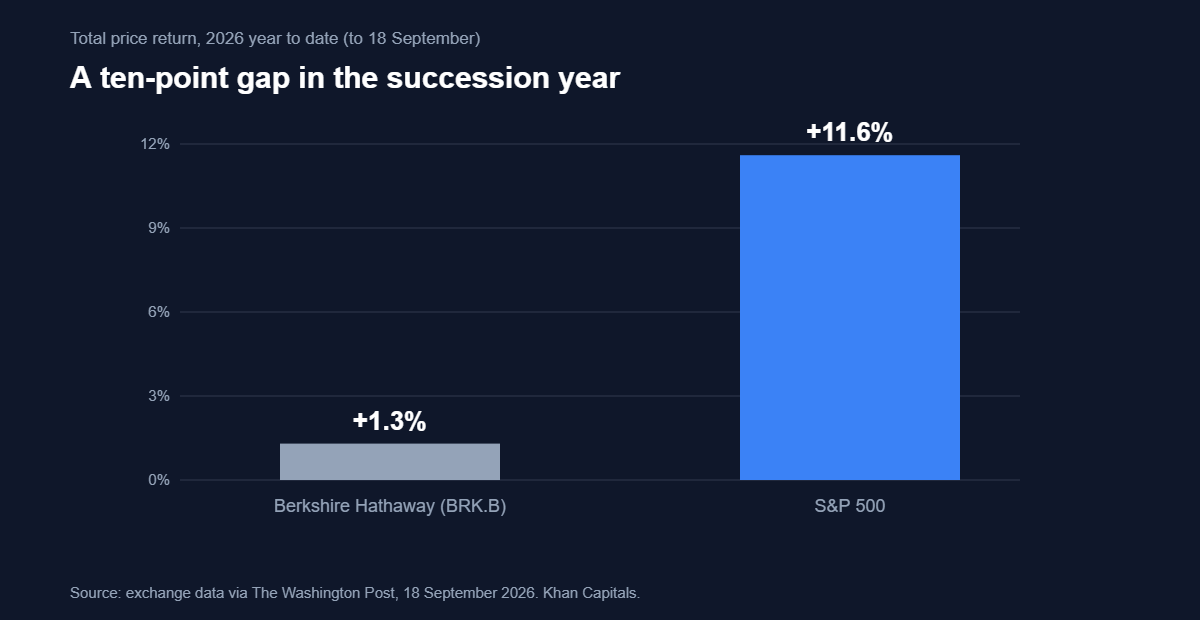
The historical record cuts both ways. Berkshire habitually lags in momentum-led bull markets and outperforms brutally in drawdowns; it trailed badly in 1999 and 2020-21 and was vindicated in 2000-02 and 2022. With the S&P 500 led by an AI trade that showed its own fragility this week, and with rates rising, a portfolio throwing off insurance float and holding $365 billion of T-bills yielding around 4 per cent is not obviously the losing side of the trade. The relative-performance gap is real, but it is precisely the setup in which Berkshire’s defensive economics have historically earned their keep.
There is also the discount debate. Analysts have argued for years about whether Berkshire trades below the sum of its parts: an insurance empire, a railroad, a utility complex, an industrial portfolio and a $300 billion-plus equity book. Bulls contend a post-Buffett board will eventually face pressure to close any discount with structural moves Buffett resisted: a dividend, larger systematic buybacks, even separations. Bears reply that the conglomerate’s cheap insurance float only works as one machine, and that dismantling it would destroy the very engine that compounded at roughly 20 per cent a year for six decades. Friday’s governance change hands that debate to a new generation without resolving it.
Succession as a Capital Allocation Regime Change
Most chief executive successions change management style. Berkshire’s changes the destination of one of the largest discretionary capital pools in the world. Buffett’s later-years framework was famously restrictive: hold cash unless an elephant-sized acquisition appears at a fair price, buy back stock only below a conservative estimate of intrinsic value, never pay a dividend. The framework’s discipline built the cash mountain; its strictness meant years in which almost nothing cleared the bar.
Abel’s opening two quarters suggest a wider funnel: the same value language, applied with more willingness to transact. OxyChem deepened a chemicals franchise; Taylor Morrison added a homebuilder at the bottom of a frozen housing cycle; the equity book turned net buyer into a market most managers consider expensive. None of this is reckless, and $365.5 billion of remaining cash means optionality is intact. But the direction is unmistakable, and it gives investors something Berkshire has not offered in years: a reason to model deployment rather than accumulation.
| Capital lever | Late Buffett era | Abel era so far (2026) | What to infer |
|---|---|---|---|
| Listed equities | Net seller, 14 straight quarters | Net buyer in Q2 (~$20bn net, $39.4bn gross) | Higher risk appetite at the margin |
| Buybacks | Minimal ($235m in Q1) | $4.5bn in Q2 | Intrinsic-value bar recalibrated |
| Whole-company M&A | Rare; last elephants years ago | OxyChem (~$9.4bn), Taylor Morrison ($8.5bn) | Deal funnel reopened |
| Cash | Record $397.4bn (end Q1) | $365.5bn (end Q2) | Deployment, with a fortress intact |
| Dividend | Never | Unchanged | The one lever still untouched |
The Governance Design: Why a Buffett Still Chairs the Board
Handing the chair to the founder’s son invites an obvious critique: is this governance or dynasty? The design answers it in an unusual way. Howard Buffett takes no salary-driven executive role, runs nothing, and holds the chair precisely because he is not a manager. His father has explained the logic for years: the chairman’s real job at Berkshire is to fire a chief executive who fails the culture, a task requiring independence from management and immunity to Wall Street fashion, not operating brilliance. A Buffett with a 33-year board tenure and a farm in Illinois is, on this theory, harder for bankers to lobby than any professional director.
The structure still concentrates unusual trust in one family, and institutional investors have historically grumbled about Berkshire’s board being closer to a partnership than a modern governance model. But the company’s returns bought it the right to be eccentric, and the two-step succession, chief executive first, chairman second, with the founder observing the new chief executive for nine months before releasing the last title, is more careful than most transitions at companies a tenth its size. The contrast with the corporate norm of simultaneous, abrupt handovers is the point.
Investor Implications
Equities. For Berkshire holders, the event risk of succession is now substantially behind the stock: both titles have moved, and the market has absorbed each without dislocation. The shares offer a defensive profile at a moment when index leadership is narrow and rate-sensitive; the discount-to-parts debate is unresolved upside optionality rather than a near-term catalyst. The year’s underperformance is a momentum statement, not a solvency one. For the broader market, Berkshire’s turn to net buying is a quietly constructive signal from the world’s most patient allocator, though its purchases skew away from the AI complex that drives the index.
Fixed income. Berkshire’s $365 billion bill portfolio makes it one of the largest private holders of short-dated Treasuries; a Berkshire that deploys cash is, at the margin, a seller of bills into a market already digesting heavy supply. The effect is small against $6 trillion-plus of bills outstanding, but the direction of the world’s most-watched cash pile is a sentiment input for the front end.
Cross-asset. The transition is a live case study in key-person risk, the theme running through several of 2026’s market stories. Portfolios that price a franchise on a founder’s judgement should note how Berkshire defused the risk: sequenced handovers, a culture guardian without operating power, and a successor given room to demonstrate a record before the final title moved. The alternative approach is visible elsewhere in the market, and it usually costs shareholders a re-rating.
What to Watch
- Early November: Berkshire’s third-quarter report, the first fully under the new governance structure. Buyback pace and the equity book’s direction are the tells on how far Abel’s wider funnel opens.
- Mid-November: the quarterly 13F filing showing what Berkshire bought in its ~$39 billion gross purchase programme; the names will define how different Abel’s equity taste is from his predecessor’s.
- May 2027: the first Omaha annual meeting with Abel as chief executive and Howard Buffett in the chair; whether Warren Buffett takes the stage, and in what role, will set the tone for the emeritus era.
- Ongoing: any move on the untouched levers: a first-ever dividend, a step-change in buybacks, or an elephant-scale acquisition funded from the $365 billion war chest.
Conclusion
When Buffett steps down as chairman, the news is simultaneously enormous and already priced. Enormous, because no investor in history has compounded capital at that scale for that long, and because the chairmanship was the final thread connecting Berkshire’s daily governance to the man who defined it. Already priced, because this handover was telegraphed, sequenced and rehearsed with a care that is itself Buffett’s last lesson in management: succession done so slowly that the market never has a day to panic.
The investing question now belongs to Abel’s Berkshire: a company that is buying stocks again, repurchasing its own shares again, doing deals again, and still sitting on $365 billion of optionality in a market that punishes patience until, abruptly, it rewards it. The era that ended on Friday returned roughly 20 per cent a year for six decades. The one that began will be judged on a simpler test: whether the machine works without the mechanic.
Frequently Asked Questions
Who is the chairman of Berkshire Hathaway now?
Howard Buffett, Warren Buffett’s eldest son and a Berkshire director since 1993, became non-executive chairman on 18 September 2026. He has no management role; his stated responsibility is to preserve Berkshire’s culture. Greg Abel remains chief executive, having taken that role at the start of 2026.
Is Warren Buffett still involved with Berkshire Hathaway?
Yes, in a reduced capacity. He was named chairman emeritus, an honorary title, and remains a member of the board of directors as well as the company’s most influential shareholder through his supervoting A shares. He no longer holds any executive or governance leadership role.
How has Berkshire Hathaway changed under Greg Abel?
The capital allocation has become more active. In the second quarter of 2026 Berkshire turned net buyer of equities after 14 consecutive quarters of net selling, accelerated buybacks from $235 million to $4.5 billion quarter on quarter, and completed the OxyChem and Taylor Morrison acquisitions. The cash pile fell from a record $397.4 billion to $365.5 billion.
Why did Berkshire Hathaway stock barely move on the announcement?
The transition was heavily telegraphed. Abel had been the designated successor since 2021 and became chief executive nine months earlier, so the chairmanship change carried little new information. The shares were little changed on the day, closing near the previous session’s $509.20 for the Class B stock.
Sources: CNBC, Buffett stepping down as Berkshire chairman; The Washington Post, Warren Buffett steps down as chairman; NBC News, Warren Buffett steps down as chairman of Berkshire Hathaway; CNBC, Berkshire Hathaway earnings Q2 2026; Morningstar, Berkshire cash balances retreat on increased investments; Berkshire Hathaway, Form 10-Q, Q2 2026.
Related Reading: Berkshire’s turn toward deployment lands in a market where the buyers of whole companies are changing: family office capital took Baldwin Group private at an 88 per cent premium and Aon’s $17 billion USI purchase showed which exit doors remain open, while the collapsed PayPal buyout marked the limits of leveraged deals in a higher-rate world. The macro backdrop that rewards a $365 billion bill portfolio is covered in our analysis of the Fed’s September hike. For the fundamentals, start with our explainer on mean reversion versus momentum.

Leave a Reply