

Khan Capitals | September 2026
Key Takeaways
- Shein finally went public, and the market marked it down twice. The fast-fashion group priced its Hong Kong offering at HK$48.56 per share, raising about HK$13.6 billion ($1.74 billion) at a valuation near $26.5 billion, then fell 9 per cent on its first day of trading.
- The listing price is roughly 73 per cent below the $100 billion valuation Shein commanded in its 2022 private funding round, one of the largest peak-to-listing markdowns ever absorbed by a company of this size.
- Growth has collapsed from 41.1 per cent in 2023 to 1.1 per cent in the first quarter of 2026, and the company swung to a $99 million quarterly net loss after Washington scrapped the de minimis duty exemption that underpinned its US model.
- Hong Kong was the third venue Shein tried, not the first. A confidential US filing in 2023 went nowhere and a London listing was blocked when Beijing withheld approval over supply-chain risk disclosures, leaving the exchange closest to its Chinese production base as the route that worked.
- A cornerstone book of roughly $383 million, including Boyu Capital, Tiger Global, General Atlantic, Tencent and UBS Asset Management, was enough to get the deal priced near the midpoint of its range, but not enough to hold the price on day one.
Part of: Tariffs & the Trade War — Khan Capital’s hub on trade policy and its market consequences.
A $100 Billion Story Closes at $26.5 Billion
The Shein Hong Kong IPO was, on paper, the listing event Asia’s equity capital markets had waited years for: the largest fast-fashion platform in the world, 280 million Class B shares on offer, and a book that priced near the midpoint of its marketed range. What the first session delivered instead was a reminder of how brutally the market now reprices growth stories that stop growing. Shares in the company, trading under the code 00625, opened weak, fell as much as 10 per cent during the day and closed down about 9 per cent.
The debut valuation near $26.5 billion is not a small number for a company founded in Nanjing in 2008 that spent a decade as an anonymous cross-border retailer. But it has to be read against the $100 billion price tag investors accepted in Shein’s April 2022 funding round, when the company briefly ranked among the most valuable startups on earth. Measured from that peak, the listing represents a markdown of roughly 73 per cent, absorbed not in a crash but in four slow years of repricing, regulatory friction and, latterly, tariff policy aimed directly at its business model.
For Hong Kong, the deal still counts as a win. The exchange has spent 2026 rebuilding its claim to be the venue for large China-adjacent listings, and an offer that raises $1.74 billion is a statement of capacity. For everyone else, the more useful information is in why the price was where it was, and why the first public holders of the stock decided even that was too high.
Four Years, Three Exchanges
Shein’s route to a ticker symbol is a case study in how geopolitics now sets the terms of equity issuance. The company filed confidentially for a New York listing in 2023, at a moment when Washington’s scrutiny of Chinese-founded consumer platforms was intensifying and lawmakers were publicly questioning whether Shein’s cotton supply chain complied with US forced-labour legislation. The US listing never surfaced. The company pivoted to London in 2024, a coup for an exchange starved of large primary listings, only to discover that the approval it could not obtain was Beijing’s: Chinese regulators, whose consent is required for offshore listings by companies with Chinese operational roots, withheld sign-off over the risk disclosures London required about its China supply chain.
Hong Kong resolved the impasse in both directions. The exchange’s disclosure regime was acceptable to Beijing, which approved the offering on 10 July, and its investor base is one for which Shein’s China-centred production network is a familiar feature rather than a red flag. The company that moved its headquarters to Singapore in 2022, partly to soften its Chinese identity for Western regulators, ended up listing on the exchange where that identity matters least. There is an irony in that, but also a lesson: for businesses with Chinese supply chains and Western customers, the set of viable listing venues has narrowed to something close to one.
The Growth Engine Was Slowing Before the Tariffs Hit
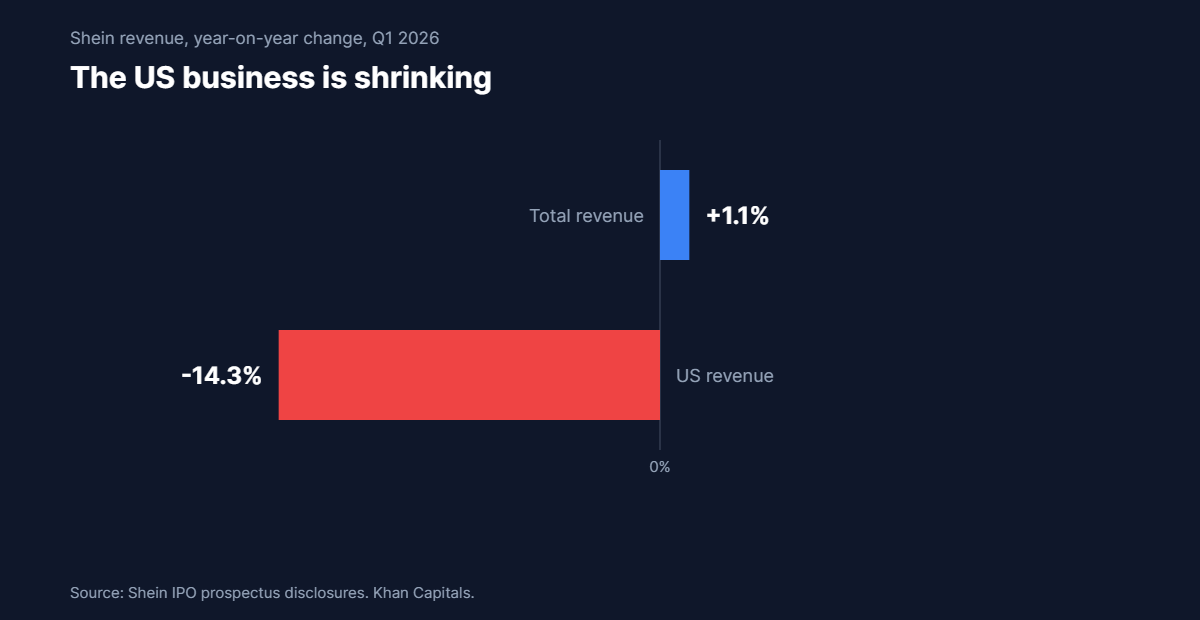
The prospectus numbers explain the markdown more efficiently than any narrative. Shein grew revenue 41.1 per cent in 2023 and 20.7 per cent in 2024. In 2025 growth fell to 8 per cent, taking revenue to $41.8 billion. In the first quarter of 2026 it grew 1.1 per cent. A business that was compounding at 40 per cent three years ago is now, on the most recent evidence, broadly flat, and the profit line has followed: a $395 million net profit in the first quarter of 2025 became a $99 million net loss in the same quarter of 2026.

| Period | Revenue growth | Detail |
|---|---|---|
| 2023 | +41.1% | Peak de minimis era; US parcels duty-free |
| 2024 | +20.7% | Growth halves as competition from Temu intensifies |
| 2025 | +8.0% | Revenue reaches $41.8bn; US revenue falls over 3% |
| Q1 2026 | +1.1% | US revenue down 14.3%; $99m net loss |
Two forces sit behind the deceleration, and it matters which one you weight. The first is competitive: Temu, backed by PDD’s balance sheet, spent 2024 and 2025 contesting Shein’s core proposition of extreme price and infinite assortment, and forced marketing costs up across the category. The second is structural: the regulatory arbitrage that made ultra-cheap cross-border parcels viable has been legislated away. The first problem is the ordinary friction of retail. The second changed the economics of the model itself.
What Killing De Minimis Did to the US Business
For most of its life, Shein’s US operation ran on the de minimis exemption, the customs rule that allowed parcels under $800 to enter the United States duty-free and with minimal inspection. Shipping millions of individually addressed packages direct from Chinese factories meant Shein’s goods crossed the border essentially untaxed while conventional retailers paid duty on containerised freight. When Washington eliminated the exemption for Chinese-origin parcels, the subsidy embedded in Shein’s cost base disappeared overnight.
The damage is now quantified in the listing documents. US revenue fell more than 3 per cent across 2025 and then dropped 14.3 per cent year on year in the first quarter of 2026, the quarter in which the company recorded its $99 million loss. The US, once the growth engine, is now the fastest-shrinking large market Shein has. The company’s response, building out local fulfilment and onshoring parts of production, is rational but expensive, and it erodes precisely the cost advantage that made the model work.
The prospectus contains a warning that deserves more attention than it received on debut day: Shein told investors the tariff pressure on its US business could extend to Europe, which supplied 35 per cent of 2025 revenue. The EU has its own de minimis reform in train, and if Brussels follows Washington’s template, the two regions that together account for the majority of Shein’s sales would both be repricing its core cost advantage at once. That is the scenario the IPO price has to be tested against, and it echoes the pattern we traced in retail earnings week, where tariff mechanics rather than consumer demand determined who reported what.
How the Shein Hong Kong IPO Was Priced
The offer itself was competently executed. Shein priced at HK$48.56, near the midpoint of its range and below the HK$49.50 maximum, selling roughly 280 million Class B shares for proceeds of about HK$13.6 billion. A cornerstone syndicate committed approximately $383 million, with Boyu Capital and UBS Asset Management alongside Tiger Global, General Atlantic, Tencent, Greenwoods and Taikang Life. The presence of Tiger Global and General Atlantic is notable for a different reason: both were investors in earlier private rounds, which means part of the cornerstone book was existing holders defending a mark rather than new money expressing conviction.
Midpoint pricing plus a nine per cent first-day fall implies the deal was priced roughly where the marginal buyer lived, and no higher. That is actually the system working. The era of IPOs priced for a guaranteed pop ended when the 2021 cohort spent two years underwater; issuers and banks now push the price to where demand thins. The cost of that discipline is that there is no cushion when early sellers appear, and on day one in Hong Kong, they appeared.
What a Nine Per Cent Fall Actually Says
A weak debut is information, but it is worth being precise about what it is information about. It does not say Shein is worthless; a $26.5 billion market capitalisation still prices a durable global franchise. It says the marginal public investor demanded compensation for three stacked uncertainties: whether 1.1 per cent growth is a floor or a waypoint on the way to contraction, whether the European regulatory regime converges with the American one, and whether a Chinese-rooted, Singapore-domiciled, Hong Kong-listed retailer selling into Western markets can navigate a trade environment that is deteriorating on every axis at once. On the same logic that killed the PayPal buyout in August, price discipline has become the defining feature of 2026’s capital markets: buyers no longer pay for the story, only for the numbers.
There is also a benchmark question. Hong Kong’s IPO market has revived this year on the back of technology and AI-linked listings that have mostly traded well. Shein breaking issue on day one, despite a conservative price and a stacked cornerstone book, suggests the market is discriminating between China-linked growth stories rather than buying the category. That is a healthier market than 2021’s, and a harder one for the next consumer-facing candidate in the pipeline.
The Scenarios From Here
| Scenario | Key assumptions | What it implies |
|---|---|---|
| Bull | Growth stabilises above 5% as local fulfilment scales; EU keeps a workable de minimis threshold; margins recover on lower marketing spend | Stock re-rates towards global value-retail multiples; cornerstone marks vindicated |
| Base | Low single-digit growth; US keeps shrinking but Europe holds; profitability hovers near breakeven through 2027 | Rangebound stock; valuation debate unresolved until two clean quarters print |
| Bear | EU adopts US-style parcel duties; revenue turns negative; loss-making quarters persist into 2027 | Further de-rating; pressure at the March 2027 lock-up expiry becomes the dominant flow story |
Investor Implications
Equities. The read-across is wider than fast fashion. Shein’s debut prices, in public form, what tariff policy does to a business model built on duty-free cross-border volume, and it lands in the same reporting season in which Lululemon’s tariff refund flattered a shrinking core business. Investors holding retailers with large direct-import exposure now have a public market comp for the cost of the new customs regime. For the Hong Kong listing pipeline, the signal is that valuation discipline is intact: strong AI-linked debuts and a weak consumer one is differentiation, not euphoria.
Fixed income. There is no direct credit event here, but the deal is a data point on how much equity cushion exists beneath consumer-facing, trade-exposed business models. Lenders to the sector, including the private credit funds that financed e-commerce logistics through the boom, are marking against a world in which the highest-profile name in the category is worth 73 per cent less than its 2022 private mark. That gap between private marks and public clearing prices remains one of the quietest risks in credit portfolios.
Cross-asset. The venue story matters as much as the stock. Every large listing that lands in Hong Kong rather than New York or London shifts fee pools, index composition and, over time, where price discovery for China-adjacent assets happens. Sterling watchers should note what London lost; the LSE’s largest prospective listing of the decade ultimately priced 9,600 kilometres away because of a disclosure dispute between two other governments.
What to Watch
- Autumn 2026: Shein’s first results as a listed company, the first test of whether 1.1 per cent growth was a floor or a waypoint.
- Fourth quarter 2026: the EU’s de minimis reform debate; any move towards US-style parcel duties would put 35 per cent of revenue under the same pressure as the US business.
- 29 September 2026: the next round of US-Canada trade measures takes effect, a reminder that the tariff regime Shein listed into is still escalating across multiple borders.
- Around March 2027: expiry of the standard six-month lock-up on cornerstone and pre-IPO holders, the first structural supply event for the stock.
Conclusion
The Shein Hong Kong IPO closed a four-year listing odyssey and opened a harder conversation. At $100 billion, Shein was a story about software-speed fashion conquering global retail. At $26.5 billion, minus 9 per cent, it is a business being asked to prove it can grow at all in a world that has legislated away its founding advantage. The deal got done, the exchange got its trophy, and the early investors got liquidity at a price. What nobody got, yet, is evidence that the model works under the new rules. That evidence, in either direction, arrives one quarterly report at a time, starting this autumn.
Frequently Asked Questions
Why did Shein list in Hong Kong instead of New York or London?
Shein filed confidentially for a US listing in 2023, which never progressed amid scrutiny of its supply chain, and then pursued London, where Chinese regulators withheld the approval required for the offshore listing over supply-chain risk disclosures. Hong Kong’s regime was acceptable to both Shein and Beijing, which approved the offering on 10 July 2026.
How much did Shein raise in its Hong Kong IPO?
Shein sold roughly 280 million Class B shares at HK$48.56 each, raising about HK$13.6 billion, or roughly $1.74 billion, at a valuation near $26.5 billion. The price was close to the midpoint of the marketed range and below the HK$49.50 maximum.
Why is Shein worth so much less than in 2022?
The $100 billion valuation of April 2022 assumed hypergrowth would continue. Since then revenue growth has slowed from 41.1 per cent in 2023 to 1.1 per cent in the first quarter of 2026, the company has swung to a quarterly net loss, and the US removal of the de minimis duty exemption has directly raised the cost of its core cross-border model.
What is the de minimis exemption and why does it matter to Shein?
De minimis rules allowed low-value parcels, under $800 in the US, to enter duty-free with minimal inspection. Shein’s model of shipping individual packages direct from Chinese factories relied on that exemption; its removal for Chinese-origin parcels raised Shein’s effective costs and contributed to US revenue falling 14.3 per cent year on year in the first quarter of 2026.
Sources: CNBC, Quartz, Asharq Al-Awsat, South China Morning Post, Bloomberg, Yahoo Finance.
Related Reading: The tariff mechanics reshaping retail profit statements ran through Lululemon’s refund-flattered second quarter and the wider retail earnings week of tariff refunds. For the demand backdrop in Shein’s home supply base, see China’s July stall, and for the same price discipline at work in private markets, the PayPal takeover collapse. For the fundamentals, start with how IPO lock-ups work and the tariff toolkit explained. The trade regime Shein listed into escalated within the week; see the US-Canada trade war going kinetic.

Leave a Reply