

Khan Capitals | August 2026
Key Takeaways
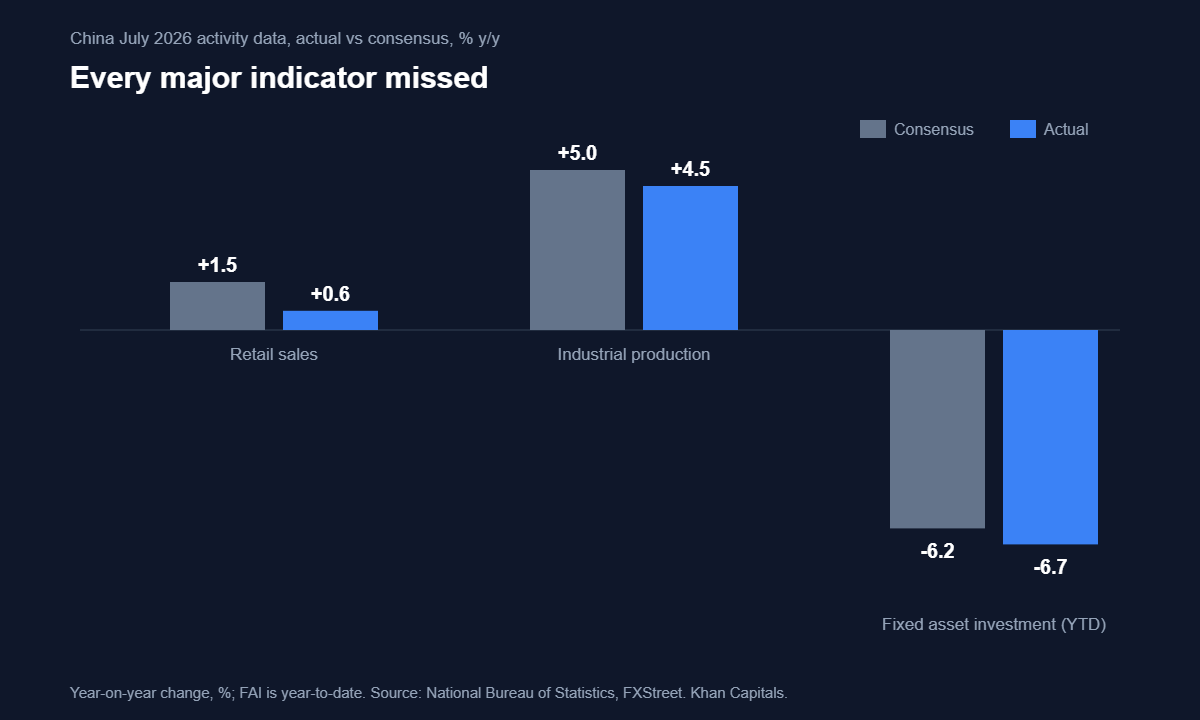
- China’s July data confirmed the economic slowdown is deepening: retail sales grew just 0.6 per cent year on year against expectations of 1.5 per cent, industrial production slowed to 4.5 per cent, and fixed asset investment contracted 6.7 per cent year to date, all missing forecasts, per the National Bureau of Statistics.
- The property crisis remains the gravitational centre: development investment fell 18 per cent year on year in the first half, new home prices dropped 0.5 per cent in July, and Morgan Stanley estimates roughly 41 trillion yuan of housing value has been destroyed since December 2024.
- The labour market is absorbing the strain: youth unemployment rose to an eleven-month high in July as a record 12.7 million graduates enter the workforce, and unemployment insurance outlays are running at pandemic-era levels.
- Beijing is rationing its response: the July cabinet meeting promised to maximise “the efficient use of fiscal funds” and defend the 4.5 to 5 per cent growth target, but analysts expect acceleration of existing measures rather than fresh stimulus unless conditions deteriorate further.
- The global read-through is disinflationary: a consumer this weak in the world’s second-largest economy restrains commodity demand and export prices at exactly the moment US demand has begun to soften too.
A Data Batch Beijing Rescheduled
China’s statisticians moved the timing of Monday’s data release and briefing at short notice over the weekend, and the numbers, when they arrived, explained the sensitivity. Every major July indicator missed. Retail sales, the economy’s most watched demand gauge, grew 0.6 per cent from a year earlier, less than half the 1.5 per cent economists expected and down from June’s already anaemic 1.0 per cent. Industrial production rose 4.5 per cent against a 5.0 per cent forecast. Fixed asset investment, the engine of every previous Chinese cycle, contracted 6.7 per cent year to date, worse than the expected 6.2 per cent decline. The China economic slowdown is no longer a forecast; it is the print.
Context sharpens the numbers. A 0.6 per cent nominal increase in retail spending, in an economy with even modest inflation, is flat-to-falling real consumption. Investment contracting at an accelerating pace despite state direction of credit means private developers and manufacturers are shrinking faster than state projects can compensate. And these are the official series, published after a rescheduling that itself invited questions about how the figures would land.
The growth target turns these misses into a deadline. Officials reaffirmed 4.5 to 5 per cent for the year at July’s cabinet meeting, and every month of sub-trend consumption and contracting investment raises the acceleration the second half must deliver to reach it. That arithmetic is the real message of the batch: either activity improves materially from here, or policy has to do more than maximise the efficiency of existing funds, or the target quietly becomes a range with a soft floor. Each of the three outcomes is tradeable, and they point in different directions.
July’s Scorecard Against Expectations
| Indicator | July print | Consensus | Prior |
|---|---|---|---|
| Retail sales (y/y) | +0.6% | +1.5% | +1.0% |
| Industrial production (y/y) | +4.5% | +5.0% | +5.3% |
| Fixed asset investment (YTD y/y) | -6.7% | -6.2% | -6.7% (H1, deteriorating) |
| New home prices (m/m) | -0.5% | n/a | Falling, fifth year of slump |
Forty-One Trillion Reasons the Consumer Will Not Spend
The retail number is best understood as a balance-sheet symptom rather than a sentiment problem. More than 70 per cent of Chinese household wealth is held in property, and that asset class is now in the fifth year of decline. Morgan Stanley’s arithmetic frames the hole: roughly 41 trillion yuan of housing market value destroyed since December 2024, against approximately 24 trillion yuan of gains in A-shares over the same period. Even after a year in which Chinese equities rallied hard, the average household’s largest asset has destroyed more wealth than its financial assets have created, and the wealth that equities did create sits disproportionately with households that already spend what they wish.

A household sector watching its main asset depreciate behaves exactly as July’s data describes: it saves, it delays, it trades down. This is why five years of consumption-support measures, vouchers, trade-in schemes, rate cuts, have moved the needle only briefly. The policy problem is not the price of money or the availability of discounts; it is that the collateral underneath household confidence keeps shrinking. Property development investment falling 18 per cent in the first half guarantees the drag continues, because construction is both employer and wealth engine for the interior economy.
The Labour Market Pressure Valve
The strain has found its way to employment, and particularly to the young. Youth unemployment climbed to an eleven-month high in July, just as an unprecedented 12.7 million students, nearly 4 per cent more than last year, enter the workforce. An ANZ economist has warned the rate could approach 20 per cent as the labour oversupply worsens. The fiscal system is already leaning against it: outlays from the unemployment insurance fund reached 88.1 billion yuan between January and May, on par with expenditures during the 2020 pandemic. A jobs market this soft feeds directly back into the consumption data, because the marginal spender in any economy is the newly employed graduate, and China is producing fewer of them than at any point in the modern era relative to supply.
The early-summer improvement, when the youth jobless rate eased to 14.9 per cent in June, now reads as the seasonal lull before the graduate wave rather than a turn. July is when the new cohort lands, and the deterioration on cue suggests the labour market absorbed the supply exactly as badly as the pessimists expected.
Beijing’s Calculated Patience
The policy response so far is notable for its restraint. At the cabinet’s July meeting, officials pledged that “the efficient use of fiscal funds should be maximised” and reaffirmed the annual growth target of 4.5 to 5 per cent. The phrasing rewards parsing: maximising the efficiency of existing funds is what a finance ministry says when it does not intend to add new ones. Most analysts expect Beijing to accelerate measures already in the pipeline and reserve genuine stimulus for further deterioration. The calculation is recognisable from previous episodes: policymakers fear reflating the property bubble more than they fear a slow grind, and they retain administrative levers, from directed lending to local government bond quotas, that can be pulled without announcing a package.
The external environment complicates the choice. The US forced labour tariffs that took effect in July put a 10 to 12.5 per cent duty on nearly all imports, China included, pressuring the export engine that has been offsetting domestic weakness. Technology restrictions continue to bind, even as H200 export licences created a controlled opening. And the region’s currency dynamics, reshaped by the joint yen intervention, limit how far a weaker yuan can be allowed to carry the adjustment without inviting accusations of competitive devaluation into a US election-adjacent trade agenda.
The Deflation China Exports
The gap between China’s production and its consumption has to go somewhere, and where it goes is prices. Industrial output growing at 4.5 per cent into domestic demand growing at 0.6 per cent nominally is a machine for surplus, and the surplus clears through exports priced to move. The pattern is most visible in the sectors Beijing designated as growth engines: electric vehicles, solar equipment and batteries have all seen brutal domestic price wars as capacity built for a growth story meets a consumer who is not buying it, and the discounting spills into every market Chinese producers ship to. For Western economies this arrives as goods disinflation, welcome to central banks in the abstract, less welcome to the industries competing with it, and politically combustible in a year when tariff walls are already rising.
The tariffs complicate the arithmetic without resolving it. Duties raise the landed price of Chinese goods in America, but they do not absorb the underlying surplus, which reroutes through third markets and through re-export hubs instead. The likely result is a bifurcation: tariff-protected markets import less disinflation and more friction, while everyone else imports more of both. Europe, caught between its own industrial base and its dependence on Chinese inputs, faces the sharpest version of the dilemma.
What Would Change the Story
Three developments would force a rewrite. A genuine household transfer programme, cash or vouchers at scale rather than trade-in schemes, would attack the consumption problem directly; Beijing has resisted it for years on ideological and fiscal grounds, and its arrival would signal that patience has run out. A decisive property intervention, a state balance sheet absorbing unsold inventory at scale, would address the wealth destruction at its source. And a stabilisation in home prices, however achieved, would do more for the consumer than any stimulus, because it would stop the monthly erosion of the asset seven in ten households depend on. None of the three appeared in July’s policy signals. Until one does, the base case remains an economy managed for stability rather than revival, and data batches that look like this one.
Policy Paths from Here
| Path | Trigger | Market expression |
|---|---|---|
| Accelerate the pipeline (base) | Data weak but stable; target still reachable | Modest support for A-shares and industrial commodities; yuan drifts |
| Broad demand stimulus | Retail sales near zero, youth unemployment toward 20% | Sharp commodity and China-equity rally; global reflation impulse |
| Forbearance and drift | Leadership prioritises deleveraging over the target | Deepening disinflation exported through goods prices; pressure on EM Asia FX |
The Tape
Investor Implications
Equities. The Chinese equity rally and the Chinese economy have decoupled, and July’s data widens the gap. That is sustainable while the rally is driven by state-directed flows, buybacks and the scarcity of alternatives for domestic savings fleeing property, but it leaves the market exposed to any wobble in policy support. For global portfolios, the sharper question is second-order exposure: European luxury, industrial exporters, mining and any earnings stream priced on a Chinese consumer recovery now face a consumer growing at less than 1 per cent nominally.
Fixed income. China’s weakness is a disinflationary export. Goods prices from a manufacturer running 4.5 per cent production growth into 0.6 per cent domestic demand growth have one direction to travel, and that flow lands in Western import prices just as US consumer momentum stalls. For developed-market bonds, the world’s two largest consumers slowing simultaneously is an argument for duration that did not exist a quarter ago; against it stands the tariff wedge, which taxes exactly the goods disinflation China is trying to ship.
Cross-asset. Commodities carry the most direct China exposure, and the divergence within the complex is instructive: energy is trading Gulf geopolitics while metals trade Chinese construction, which is why the two have parted company this summer. A pipeline-acceleration response from Beijing keeps that split intact; a genuine stimulus package would close it violently. The yuan, youth employment prints and local government bond issuance are the three tells worth watching between now and the fourth quarter.
What to Watch
- 31 August: official August PMIs, the first broad read on whether July’s deceleration extended into late summer.
- Early September: August trade data, which will show how much of the surplus is still finding buyers through the tariff walls.
- Mid-September: the next monthly activity batch; a second consecutive broad miss would test Beijing’s pipeline-only approach.
- Ongoing: yuan fixings, home price prints and any signal of a household transfer or property inventory programme, the two interventions that would change the story.
Conclusion
China’s July data describes an economy in which production still grows, demand barely does, and the asset underpinning household confidence keeps deflating. None of this is new in kind; all of it is worse in degree, and the simultaneous softening of the American consumer removes the external cushion that made domestic weakness tolerable. Beijing’s bet is that efficiency, patience and administrative acceleration can hold the growth target without reflating the bubble it spent five years deflating. The global economy now has both of its consumer engines running below trend at once, and markets, priced for records in the West and recovery in the East, have not yet reconciled themselves to that arithmetic.
Frequently Asked Questions
How weak is China’s economy in 2026?
July 2026 data showed retail sales growing 0.6 per cent year on year, industrial production 4.5 per cent, and fixed asset investment contracting 6.7 per cent year to date, with all three missing consensus forecasts. Property investment fell 18 per cent in the first half and new home prices continue to decline in the fifth year of the housing slump. Beijing’s official growth target remains 4.5 to 5 per cent.
Why are Chinese consumers not spending?
More than 70 per cent of Chinese household wealth is held in property, and Morgan Stanley estimates roughly 41 trillion yuan of housing value has been destroyed since December 2024. Households watching their main asset depreciate save more and spend less, while a soft labour market, with youth unemployment at an eleven-month high, weakens income growth. Stimulus measures have not addressed the underlying balance-sheet problem.
What does China’s slowdown mean for global markets?
A weak Chinese consumer restrains demand for commodities, luxury goods and industrial exports, and excess Chinese production capacity pushes goods prices lower worldwide. With US retail sales also falling in July, both of the world’s largest consumer engines are slowing together, which supports the case for bonds while pressuring earnings expectations tied to either consumer.
Sources: National Bureau of Statistics of China, FXStreet, Business Today, Construction Briefing, Yahoo Finance, Trading Economics.
Related Reading: The tariff regime squeezing the export offset is covered in US forced labour tariffs, and the technology dimension in Nvidia’s H200 exports to China. The region’s currency backdrop is set out in the joint yen intervention, and the American half of the twin consumer slowdown in July’s US retail sales decline. For the fundamentals, start with the two levers of monetary and fiscal policy. See also duration, explained. The supply-shock side of the inflation problem is covered in the Black Sea grain crisis. For the flotation that priced China’s cross-border export model under the new tariff regime, see Shein’s Hong Kong IPO.

Leave a Reply