
Khan Capitals | July 2026
Key Takeaways
- Tesla reported record Q2 2026 revenue of $28.2 billion, up 26 per cent year on year and comfortably ahead of the roughly $26.3 billion consensus, on record deliveries of 480,126 vehicles and 13.5 GWh of energy storage.
- The profit line went the other way. Adjusted earnings of $0.33 per share missed the $0.50 consensus by a third, adjusted EBITDA of $3.27 billion fell short of the $4.0 billion expected, and net income slipped 5 per cent to $1.11 billion.
- Gross margin of 16.8 per cent, against a 19.4 per cent forecast, is the number that matters: operating profit fell 57 per cent year on year as regulatory credit revenue collapsed and spending on AI, Robotaxi and new manufacturing lines ran ahead of returns.
- The strategic pivot is now explicit. Elon Musk spent the call on Robotaxi expansion across seven US metropolitan areas, Cybercab production, Optimus manufacturing at Fremont and an ordered “development fab” for chips, while hinting at growing overlap with SpaceX.
- The investment case has quietly inverted: a record car and energy business is now the funding vehicle for a portfolio of pre-revenue bets, and the quarter showed the cost of that arrangement arriving before the payoff.
A Record Quarter That Cost a Third of the Profit
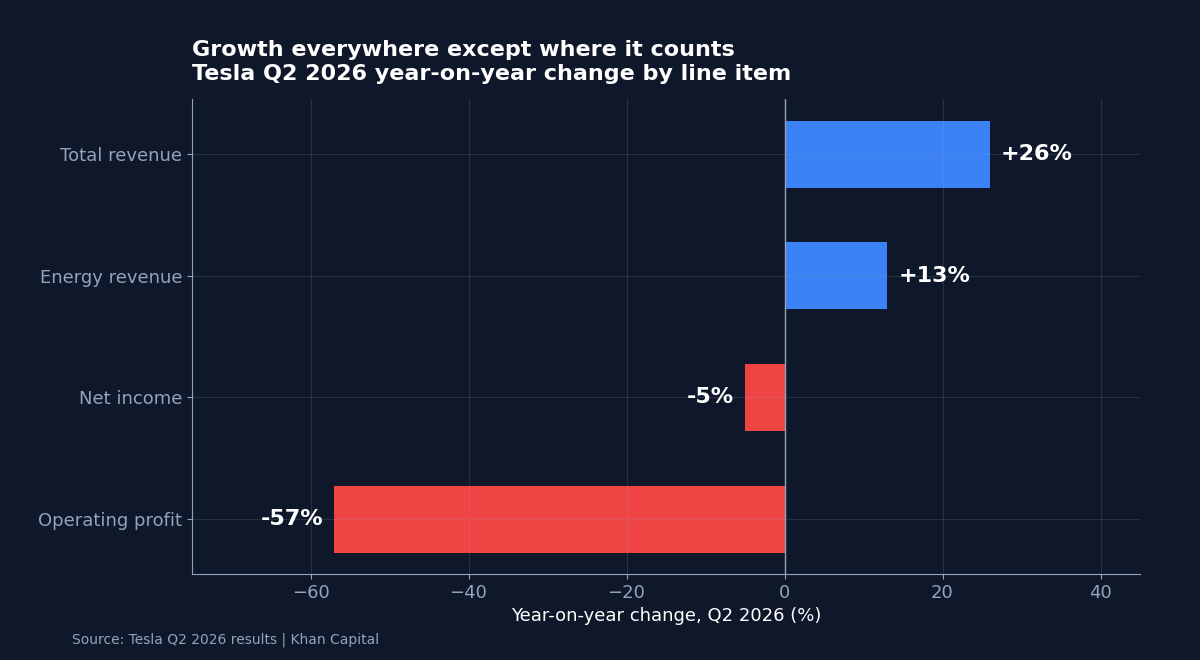
The Tesla Q2 2026 earnings landed on the same evening as Alphabet’s, and told a structurally similar story with a weaker balance sheet of proof behind it. Revenue of $28.24 billion was a record and rose 26 per cent from $22.5 billion a year earlier, beating consensus by around 7 per cent. Deliveries of 480,126 vehicles set a company record, energy storage deployments reached 13.5 GWh, and energy revenue grew 13 per cent to $3.14 billion. On the measures Tesla’s bulls once cared most about, volume and top line, this was among the best quarters the company has produced.
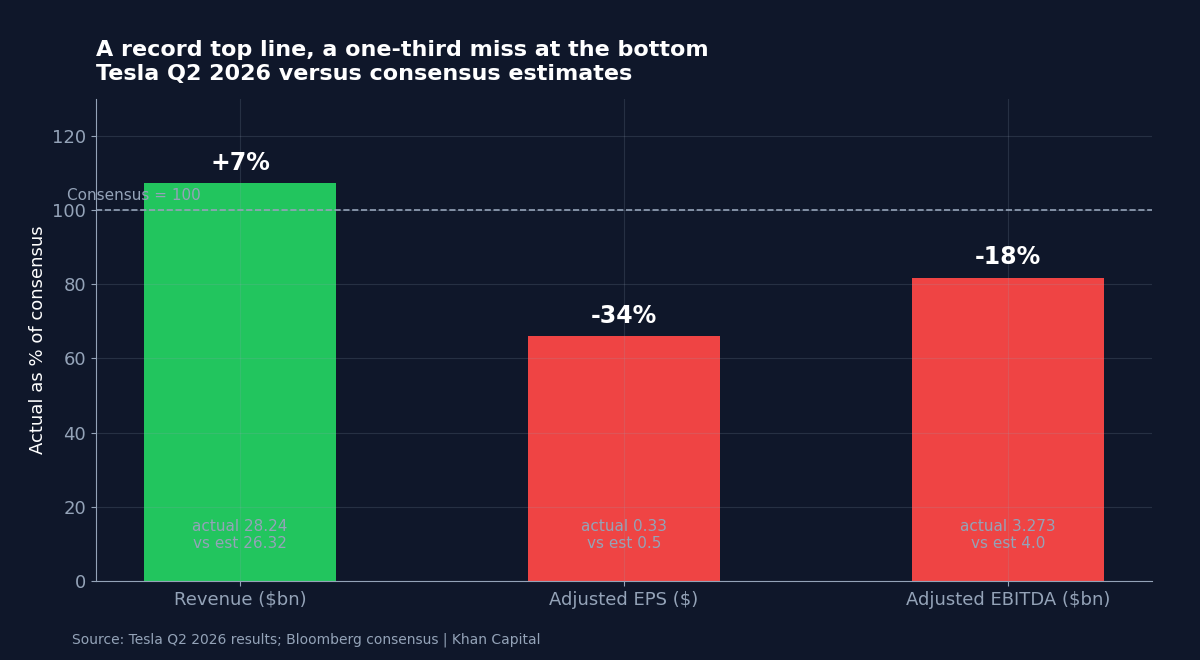
The bottom of the income statement rejected the story. Adjusted earnings per share of $0.33 missed the $0.50 consensus by 34 per cent. Adjusted EBITDA of $3.27 billion came in 18 per cent light. Net income fell 5 per cent year on year to $1.11 billion, and operating profit dropped 57 per cent, a decline of a scale normally associated with cyclical industrials in a downturn, not with a company printing record revenue. The one genuine consolation was cash: free cash flow beat expectations as the cash burn attached to the AI and manufacturing programmes came in narrower than feared, with capital expenditure guided at $25 billion for the year.
Where the Margin Went
Gross margin of 16.8 per cent, against the 19.4 per cent analysts had pencilled in, is the cleanest measure of the quarter’s problem. Three forces compressed it at once. First, price: record deliveries were bought with a model mix and pricing posture that continued to trade margin for volume in a competitive global EV market. Second, regulatory credits: the high-margin revenue Tesla has long booked from selling emissions credits to other carmakers collapsed in the quarter, removing a profit stream that historically flowed almost entirely to the bottom line. Third, spending: the company is simultaneously funding Robotaxi operations, Cybercab industrialisation, the conversion of Fremont lines for Optimus robot production, and now chip manufacturing equipment for a “development fab”.
Each of those is defensible in isolation. Together they explain how 26 per cent revenue growth coexisted with a 57 per cent operating profit decline, and why the earnings miss should be read less as an execution failure than as a statement of priorities. Management is deliberately running the profitable business hot and thin to pay for the speculative one.
| Metric (Q2 2026) | Reported | Consensus / prior year |
|---|---|---|
| Revenue | $28.24bn | Est. $26.32bn; $22.5bn a year ago |
| Adjusted EPS | $0.33 | Est. $0.50 |
| Adjusted EBITDA | $3.27bn | Est. $4.0bn |
| Gross margin | 16.8% | Est. 19.4% |
| Net income | $1.11bn | -5% y/y |
| Operating profit | -57% y/y | Regulatory credits collapsed |
| Vehicle deliveries | 480,126 | Company record |
| Energy storage | 13.5 GWh | Record; energy revenue +13% to $3.14bn |
| 2026 capex | ~$25bn | Company guidance |
The Robotaxi Ledger: Seven Cities and Three Missed Targets
The business Musk wants investors to value is the one that barely registers in the accounts. The Robotaxi service now operates in seven major US metropolitan areas, and Musk told the call it would continue to scale with “more than 10% growth in miles driven per week”, while conceding that safety considerations will cap how quickly the network expands. That candour matters, because the guidance record on autonomy is now unambiguous: Tesla has missed its own short-term Robotaxi targets on three consecutive earnings reports, from the promise of 50 per cent US coverage by end-2025 down to the current, more modest cadence of city-by-city expansion.
A weekly compounding rate above 10 per cent is, if sustained, an extraordinary growth curve; it is also a claim about the future made by a management team with a record of overshooting on exactly this subject. The distinction between what the service earns and what it promises is the entire Tesla valuation debate compressed into one line item, and this quarter the promise was repriced downward alongside the margin. Few large companies illustrate more purely how a management team’s forecasts can move a share price further than its reported results do.
Optimus, a Development Fab, and the SpaceX Question
Beyond autonomy, the call sketched a company redefining itself as an AI and robotics manufacturer that happens to sell cars. Fremont lines are being converted to build Optimus humanoid robots. Equipment has been ordered for a chip “development fab”, with more detail promised on what Musk called “high-risk, high-payoff bets”. And in the evening’s most speculative moment, Musk pointed to “more and more overlap” between Tesla and SpaceX while declining to discuss a merger, a comment that was widely read as him raising the subject precisely by refusing to.
For shareholders, the corporate structure question is not idle. SpaceX remains private, its valuation set in a listing process that already redefined the scale of private markets, and any combination would raise governance questions about related-party transactions at a scale public markets have not previously priced. The more immediate point is simpler: every one of these ventures consumes capital and management attention today against revenue that is, at best, years away, and the funding source for all of them is a car business whose margin just printed 16.8 per cent.
| Venture | Status, Q2 2026 | Revenue today | Key test |
|---|---|---|---|
| Robotaxi | Seven US metro areas; >10% weekly miles growth targeted | Minimal | Expansion cadence after three missed targets |
| Cybercab | Production ramping | None material | Unit economics at volume |
| Optimus | Fremont lines being converted | None | Production timeline and first customers |
| Chip “development fab” | Equipment ordered; details promised | None | Capital commitment and purpose |
| Energy storage | Record 13.5 GWh deployed | $3.14bn/quarter, +13% | Margin and interconnection constraints |
The Quiet Compounder in the Accounts
Amid the venture theatre, the energy division delivered the least discussed and arguably most durable result of the quarter: a record 13.5 GWh of storage deployments and revenue of $3.14 billion, up 13 per cent. The demand behind it is structural rather than speculative. Utility-scale batteries are being pulled into grids strained by the very AI data centre build-out that Alphabet quantified the same evening, and by renewable penetration that makes storage economics improve with every volatile power price print. Unlike Robotaxi or Optimus, the storage business sells a product that exists, at a margin that is real, into demand that is contracted by utilities years ahead.
The 13 per cent growth rate is slower than the segment’s recent past, which deserves watching; deployment schedules are lumpy and grid interconnection queues remain the binding constraint across the industry. But if one asks which part of Tesla would command the highest quality multiple as a standalone business today, the answer is probably not the car company and certainly not the robot programme. It is the division that gets five minutes on the call. Markets have a long record of undervaluing the boring segment inside a story stock, and Tesla’s storage business is becoming a textbook candidate.
The Inverted Investment Case
Tesla’s equity story has inverted over two years without ever quite announcing it. The old case ran: the car business is the value, autonomy is the free option. The current case, as presented on this call, runs the other way: autonomy, Optimus and AI are the value, and the car business is the financing mechanism. That inversion changes what each line of the accounts means. Record deliveries at compressed margins are no longer disappointing execution; they are the cost of capital. Regulatory credit collapse is no longer a footnote; it removes the cushion that used to hide that cost. And a 34 per cent earnings miss is no longer a scandal; it is the visible price of bets the company believes will define it.
The difficulty is that this structure is exactly what the market has spent July repricing across the AI complex. Alphabet fell 5 per cent the same evening for raising capex against demonstrable, contracted cloud demand of $514 billion; Tesla asks for patience against demand that is still mostly a projection. In a market that has just put the semiconductor complex through a 20 per cent drawdown over monetisation doubts, the tolerance for spending without visible return is the scarcest commodity in equities, and Tesla consumes more of it than any large company on the board.
Live Chart: Tesla (TSLA)
Investor Implications
Equities. The quarter sharpens the distinction between Tesla as an operating business and Tesla as a portfolio of options. On the operating numbers, a company growing revenue 26 per cent with a 57 per cent operating profit decline and a 16.8 per cent gross margin would struggle to justify a premium industrial multiple, let alone a technology one. The valuation therefore rests almost entirely on the options: Robotaxi economics at scale, Optimus, energy storage growth and the chip programme. Investors may wish to track the small number of disclosures that convert options into operations: Robotaxi miles and revenue per mile if ever disclosed, energy storage margin, and whether regulatory credits stabilise. The energy business, growing 13 per cent with utility-scale demand behind it, remains the most underwritten real asset in the story.
Fixed income. Tesla carries little debt relative to its scale and free cash flow surprised positively, so the credit story is quiet for now. The forward question is whether the AI ventures eventually reach for external financing, as the rest of the AI complex has done through private credit at record scale; a chip fab is the kind of asset that historically ends up debt-financed. Any move that direction would give credit markets their first direct pricing of Tesla’s speculative portfolio.
Cross-asset. Tesla remains one of the highest-beta expressions of the AI theme in large-cap equities, and its result, paired with Alphabet’s, frames the season: markets are now grading the AI trade on delivered cash economics rather than narrative. A widening gap between record operational metrics and falling profitability at bellwether names is the pattern that has historically preceded multiple compression in concentrated indices, which matters for anyone holding the market through capitalisation-weighted vehicles.
What to Watch
- Late July: Microsoft, Meta and Amazon results complete the Big Tech capex picture that Alphabet and Tesla opened, setting the sector’s tone into August.
- Through H2 2026: the pace of Robotaxi expansion beyond seven metropolitan areas, against Musk’s stated cadence of more than 10 per cent weekly growth in miles driven; a fourth consecutive missed autonomy target would be increasingly hard for the multiple to absorb.
- Coming months: promised detail on the chip development fab and Optimus production timelines at Fremont, the first hard capital commitments behind the robotics story.
- Early October: Q3 delivery numbers, the first test of whether record volumes can hold without further margin surrender.
Conclusion
Tesla’s second quarter was simultaneously the best volume quarter in its history and one of its weakest profit quarters of the decade, and both facts are downstream of the same decision: to run the car and energy business as the treasury for an AI and robotics venture portfolio. That is a coherent strategy, and it may yet be a historic one. But it converts every quarterly report into a referendum on faith, because the businesses being funded do not yet report numbers of their own. This quarter, with credits collapsing and margins at 16.8 per cent, the cost side of the bargain was fully visible and the return side remained a projection. In a market that has stopped paying in advance for AI narratives, that asymmetry, more than any single miss, is Tesla’s problem to solve.
Frequently Asked Questions
Did Tesla beat or miss expectations in Q2 2026?
Both. Revenue of $28.24 billion beat the roughly $26.32 billion consensus by about 7 per cent, on record deliveries of 480,126 vehicles. Profitability missed badly: adjusted earnings per share of $0.33 came in a third below the $0.50 consensus, adjusted EBITDA of $3.27 billion missed the $4.0 billion expected, and gross margin of 16.8 per cent fell short of the 19.4 per cent forecast.
Why did Tesla’s operating profit fall 57 per cent?
Three pressures combined: competitive pricing that traded margin for record volume, a collapse in high-margin regulatory credit revenue, and heavy spending on AI, Robotaxi, Cybercab production and the conversion of factory lines for Optimus robots. Revenue grew 26 per cent, but the cost of the strategic programmes grew faster.
Where does Tesla’s Robotaxi service operate now?
The Robotaxi service operates in seven major US metropolitan areas as of Q2 2026. Elon Musk said miles driven should keep growing at more than 10 per cent per week, while noting that safety considerations will limit how fast the network expands. Tesla has missed its own short-term Robotaxi expansion targets on three consecutive earnings reports.
Is Tesla merging with SpaceX?
No merger has been announced. On the Q2 2026 earnings call Musk said he could not talk about a merger while pointing to “more and more overlap” between the two companies. Any combination would raise substantial governance and valuation questions, and for now the comment is best read as signalling rather than a transaction.
Sources: CNBC, Tesla Q2 2026 earnings report; Electrek, Tesla Q2 2026 financial results; Teslarati, Q2 2026 earnings results; Forbes, Musk on the SpaceX overlap; Yahoo Finance, capex guidance; TradingView, TSLA.
Related Reading: The same evening’s other AI spending verdict is dissected in Alphabet’s $205 billion capex quarter, and the market mood both companies reported into is charted in the semiconductor bear market. The scale of the private company Musk keeps gesturing towards is covered in SpaceX’s $1.75 trillion IPO filing, and the season’s wider pattern of record results being sold in Samsung’s record quarter the market sold. For the fundamentals, start with why guidance moves a stock more than results, and revenue vs profit vs cash flow.

Leave a Reply