Khan Capitals | July 2026
Key Takeaways
- A record that satisfied nobody. Samsung Electronics guided to preliminary second-quarter operating profit of 89.4 trillion won (roughly $58 billion), up more than 1,800 per cent year on year and above analyst estimates, according to CNBC. The shares fell as much as 10 per cent before closing 6.9 per cent lower in Seoul.
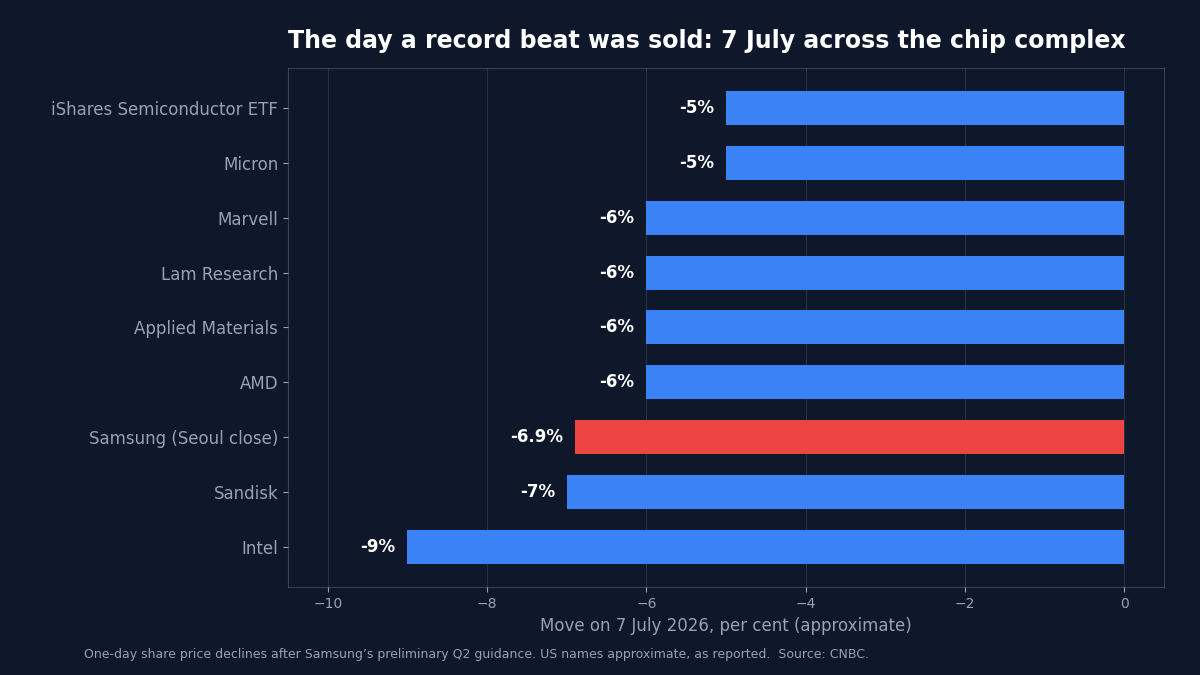
- The rout travelled. The selling spread through the global chip complex on Tuesday: Intel lost around 9 per cent, Sandisk about 7 per cent, AMD, Marvell, Lam Research and Applied Materials around 6 per cent each, and the iShares Semiconductor ETF roughly 5 per cent.
- Scale is no longer the question. Samsung’s quarterly operating profit exceeded what Nvidia and Apple each earned in their most recent quarters. The market’s concern is not whether the AI build-out is generating profits today, but whether memory pricing this steep can coexist with the spending plans that drive it.
- The bar has migrated from logic to memory. The pattern that defined Nvidia’s recent earnings, where beating estimates is treated as the minimum acceptable outcome, has now reached the memory makers at the very moment their pricing power peaks.
- Positioning, not demand, is the near-term risk. Nobody in the sellside commentary argued that AI demand has cracked. The dispute is about how much of the memory supercycle is already in the price, with a $1 trillion valuation test arriving within days as SK hynix lists in New York.
Part of: The AI Infrastructure Supercycle — Khan Capital’s hub on the AI infrastructure build-out.
What the Samsung Q2 Earnings Actually Showed
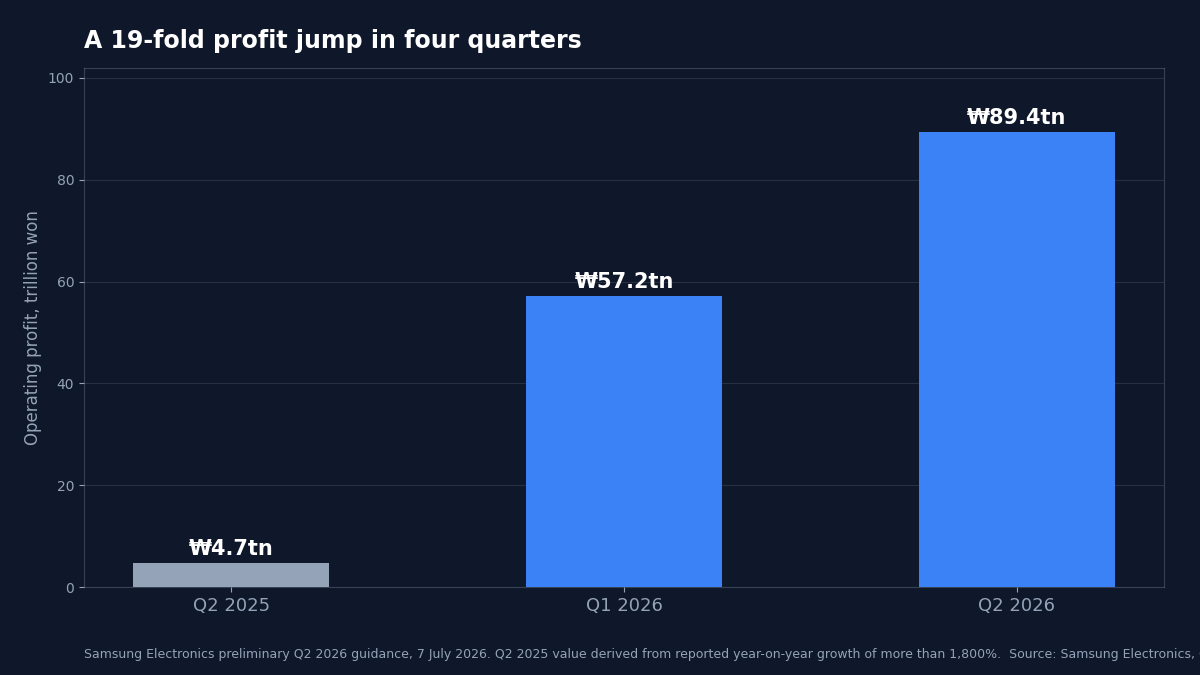
The Samsung Q2 earnings guidance released on Tuesday morning in Seoul was, on its face, one of the great quarterly results in the history of the semiconductor industry. Preliminary operating profit of 89.4 trillion won, approximately $58 billion at current exchange rates, represents a jump of more than 1,800 per cent from the same quarter a year earlier and a 56 per cent increase on the 57.2 trillion won reported just three months ago. Revenue of 171 trillion won was up from 133.9 trillion won in the first quarter. The Korea Herald noted that the figure exceeded the quarterly operating profit of both Nvidia and Apple, an almost surreal milestone for a company whose memory division was posting losses as recently as 2023.
The response was a 10 per cent intraday decline, moderating to 6.9 per cent by the close. That reaction cannot be explained by the numbers themselves, which beat consensus. It has to be explained by what the numbers imply. Samsung is a preliminary reporter: the company publishes headline revenue and operating profit without divisional detail, leaving analysts to infer the mix. The inference drawn on Tuesday was that virtually all of the upside came from memory pricing, with analysts estimating the chip division generated the overwhelming majority of group profit on the back of steep increases in DRAM and NAND contract prices.
That is precisely what unsettled the market. Memory pricing of this steepness is a windfall for the sellers and a cost explosion for the buyers, and the buyers happen to be the hyperscalers whose capital spending underwrites the entire AI infrastructure trade. A quarter this good is, from a different angle, evidence of an input-cost problem for everyone downstream, a dynamic we examined when Apple and Microsoft began passing memory costs on to consumers earlier this month.
A Rout That Started Before the Print
Tuesday’s selling did not arrive out of a clear sky. The semiconductor complex had already cracked once this month: in the first days of July, a two-day slide that began on Wall Street spread to Seoul, where Samsung and SK hynix fell as much as 9 per cent in a single session. The catalyst then was a re-rating of the AI supply chain triggered by Meta’s cloud ambitions and OpenAI’s inference price cuts, a story we covered in depth in Meta’s AI Cloud Pivot: The Week the Supply Premise Cracked.
Monday had offered a brief reprieve. The Dow closed at a record 53,055.91, the S&P 500 rose 0.7 per cent and the Nasdaq gained 1.1 per cent, led by the familiar AI heavyweights. Then Samsung’s guidance landed, and the tape inverted. By Tuesday’s US close, the damage ran through every layer of the stack: equipment makers, logic designers, memory names and the diversified ETF wrappers that hold them all. CNBC’s tally had Intel down around 9 per cent, Sandisk around 7 per cent, Marvell, Lam Research and Applied Materials over 6 per cent each, AMD around 6 per cent and Micron about 5 per cent, with the iShares Semiconductor ETF losing roughly 5 per cent.
| Samsung preliminary Q2 2026 | Reported | Comparison |
|---|---|---|
| Operating profit | ₩89.4tn (~$58bn) | ₩57.2tn in Q1 2026 |
| Revenue | ₩171tn | ₩133.9tn in Q1 2026 |
| Operating profit, year on year | Up more than 1,800% | Above analyst estimates |
| Share price reaction (7 July) | -6.9% at the close | Down as much as 10% intraday |
When Beating Is the Minimum
There is a recognisable grammar to this reaction, because the equity market has been speaking it for over a year. When Nvidia reported an $81.6 billion revenue quarter in May and fell anyway, we described the dynamic as the bar becoming the beat: once a stock’s valuation embeds perfection, results that merely confirm perfection carry no new information, and any detail short of it becomes a reason to sell. What is new this week is the migration of that grammar from logic chips to memory.
Memory was supposed to be the value corner of the AI trade. When Micron reported its record quarter in late June, the framing across most commentary was that the memory makers were early in a repricing cycle, with years of undersupply ahead. Samsung’s print does not contradict that thesis; if anything it confirms it emphatically. What it does is force the question of duration. An industry earning 89 trillion won in a quarter invites new capacity, and memory has historically been the most cyclical business in all of technology precisely because windfall pricing summons its own correction. The market on Tuesday was not doubting the numbers. It was applying a cyclical discount to a sector that had, for six months, been priced as if the cycle had been abolished.
The Buyers’ Problem: Memory as an Input Cost
The second anxiety visible in Tuesday’s trading is arithmetic rather than cyclical. The hyperscalers are committed to capital spending programmes measured in hundreds of billions of dollars, and an increasing share of every data centre dollar is being absorbed by memory. Analysts quoted in the wake of the print worried openly that AI spending budgets cannot expand as fast as memory prices are rising, which would force one of two outcomes: either the hyperscalers accept lower returns on their AI investments, or they slow the build-out and the demand curve that justifies today’s memory pricing flattens.
Neither outcome is priced kindly by a sector trading at record levels. This is the sense in which a blowout quarter can genuinely be bearish information: it quantifies the squeeze on the industry’s own customers. The clearest precedent is the oil market, where price spikes enrich producers for exactly as long as it takes demand destruction to arrive. Nobody on Tuesday was arguing that data centre demand is about to be destroyed. But the mechanism, input costs rising faster than the budgets that pay them, is the same one that has ended every previous memory boom, and investors have seen this film before.
What the Preliminary Print Cannot Tell Us
Some humility about the data is warranted. Samsung’s preliminary guidance contains two numbers and no divisional breakdown; the full result, due later in July, will show how much of the profit came from memory pricing versus foundry, displays and devices, and crucially what the company says about capacity additions. The gap between the preliminary and full reports is where narratives harden, and the narrative being built this week rests on analyst estimation rather than disclosed segment data.
It is also worth separating the two Korean memory stories. Samsung is the lagging HBM supplier racing to qualify its most advanced high-bandwidth memory with Nvidia, while SK hynix leads that market and has locked in its position through the supply partnership signed with Nvidia in June. A windfall driven by conventional DRAM and NAND pricing says less about the durability of the AI-specific memory franchise than the headline suggests. Investors discriminating between commodity memory pricing and contracted HBM revenue will read the same 89.4 trillion won very differently.
Scenarios for the Memory Cycle
The range of credible paths from here is wide, which is itself the message of Tuesday’s volatility. The table below sketches the three broad scenarios the market is weighing.
| Scenario | What it looks like | Signposts |
|---|---|---|
| Extended supercycle | HBM capacity stays committed to AI accelerators, conventional DRAM remains tight, pricing holds through 2027 | Hyperscaler capex guidance raised again; contract prices firm in Q3 |
| Plateau | Prices stabilise at high levels; profits stay elevated but the growth rate collapses; multiples compress | Flattening contract price surveys; capex budgets reallocated toward power and networking |
| Classic correction | New capacity arrives into slowing order growth in 2027; contract prices roll over as they have in every prior cycle | Capacity announcements from all three DRAM makers; inventory builds at OEMs |
Investor Implications
Equities. The episode reinforces a discipline that has served all year: distinguish between companies with contracted, multi-year AI revenue and companies enjoying spot-price windfalls. The first group can carry premium multiples through a pricing plateau; the second cannot. It also highlights concentration risk in the sector wrappers, where a single preliminary print in Seoul moved US-listed ETFs by 5 per cent in a session. Position sizing in semiconductor exposure should assume this volatility is structural, not episodic.
Fixed income. Memory pricing is quietly becoming a macro variable. If hardware costs keep rising, they feed corporate capex deflators and, at the margin, goods inflation, at a time when the Federal Reserve is already debating whether its next move is a hike. Credit investors in the technology supply chain should note that windfall profits are strengthening balance sheets across the memory complex, while the leverage is accumulating downstream among the buyers of compute.
Cross-asset. The won, Korean equity indices and the US semiconductor complex are now tightly coupled through a single earnings cycle. Tuesday demonstrated that the transmission runs in both directions and in hours, not days. Investors using semiconductor strength as a proxy for the broader AI trade should be aware that the proxy now embeds Korean memory pricing risk to a degree it did not a year ago.
What to Watch
- 10 July: SK hynix’s American depositary receipts are expected to begin trading on the Nasdaq, in a listing reported to target roughly $29 billion. The reception will be the cleanest read on whether Tuesday’s selling was a repricing of memory or a rejection of it.
- 8 July: Minutes of the June FOMC meeting, which frame the rate backdrop against which all long-duration technology valuations are being marked.
- Mid-July: TSMC’s second-quarter results, the first full disclosure from the logic side of the supply chain this earnings season.
- Late July: Samsung’s full second-quarter report with divisional detail and any commentary on capacity additions, the variable on which the cycle scenarios above turn.
- Late July into August: Hyperscaler earnings and capital expenditure guidance, the demand side of the memory equation.
Conclusion
Samsung delivered the largest quarterly operating profit in its history, out-earned Nvidia and Apple, beat expectations, and lost 7 per cent of its market value in a day. That sentence would be incomprehensible in any previous market regime; in this one it is almost routine. The AI trade has reached the stage where results no longer move prices, expectations about the durability of results do. For the memory makers, the question the market asked on Tuesday is the oldest one in their industry: not how good is this quarter, but how long can it last. The preliminary print, by its nature, cannot answer that. The full report, the SK hynix listing and the hyperscalers’ capex guidance over the next four weeks will go some way to answering it, and the violence of Tuesday’s reaction tells you how much is riding on the answer.
Frequently Asked Questions
Why did Samsung shares fall after record Q2 2026 earnings?
Samsung’s preliminary guidance beat estimates, but the profit was driven almost entirely by steep memory price increases. Investors worried that pricing this aggressive squeezes the AI spending budgets of Samsung’s own customers and invites new capacity, the classic end-of-cycle mechanism in memory. With the shares priced for an uninterrupted supercycle, confirmation of the windfall was read as a warning about its durability.
What did Samsung report for the second quarter of 2026?
Preliminary operating profit of 89.4 trillion won, roughly $58 billion, on revenue of 171 trillion won. Operating profit rose more than 1,800 per cent from a year earlier and 56 per cent from the first quarter. The full report with divisional detail is due later in July.
What does the chip selloff mean for AI and memory stocks?
The selloff signals that the market now treats record results as the minimum acceptable outcome across the AI supply chain, memory included. It does not indicate that AI demand has weakened. The key variables from here are hyperscaler capital spending guidance, memory contract prices in the third quarter, and capacity announcements from the three DRAM makers.
Sources: CNBC, Samsung posts 1,800% jump in profit; CNBC, Chip stocks sell off after Samsung earnings; Samsung Newsroom, Q2 2026 earnings guidance; The Korea Herald, Samsung tops Nvidia with record Q2 operating profit; Bloomberg, Tech weakness resumes after Samsung misses lofty AI expectations; CNBC, Samsung and SK Hynix shares tumble as chip rout spreads; Seeking Alpha, AI memory stocks fall despite Samsung’s profit surge.
Related Reading: This piece extends our coverage of the AI trade’s evolving relationship with good news, which began with Nvidia’s $91 billion quarter in May and sharpened in the $1 trillion semiconductor selloff of early June. On the memory cycle specifically, see Micron’s record quarter and the AI memory supercycle and the AI memory price shock reaching consumers, while Meta’s AI cloud pivot explains the early-July crack in the supply premise that framed this week’s selling. For the fundamentals, start with our explainer on high-bandwidth memory and what “priced in” actually means. The mirror image arrived a week later when IBM lost a quarter of its value on a 3.7 per cent revenue miss. For the contrast with a foundry that controls its own bottleneck, see TSMC’s Q2 2026 earnings. The memory story took another turn with SK Hynix’s $26.5bn Nasdaq listing. The pattern of record results being sold reached the EV market in Tesla’s Q2 2026 earnings. The sector’s latest print is analysed in Intel’s Q2 2026 earnings, the fastest growth in 15 years.

Leave a Reply