

Khan Capitals | July 2026
Key Takeaways
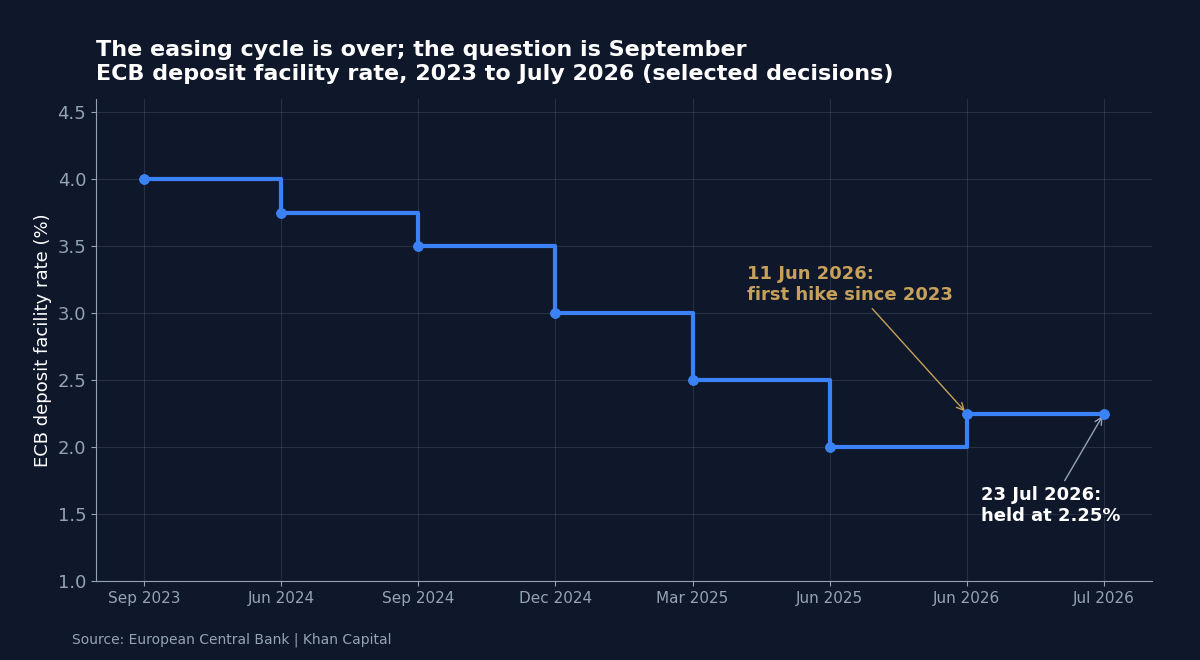
- The ECB held its deposit rate at 2.25 per cent on 23 July, pausing after June’s 25 basis point move, the bank’s first hike since 2023. Markets had assigned a probability above 95 per cent to no change.
- This was a hold designed to keep a hike alive. The Governing Council said the full inflationary impact of the energy shock “has yet to play out”, pledged to monitor its “indirect and second-round effects”, and stressed it is “not pre-committing to a particular rate path”, keeping the September option firmly on the table.
- The dilemma is stark: eurozone inflation has cooled to 2.8 per cent but sits 80 basis points above target, while GDP growth is projected at just 0.8 per cent. The ECB is weighing further tightening against an economy with almost no cyclical cushion.
- Oil is the swing variable. The June hike was justified by energy-driven inflation from the Iran conflict, and with Brent trading near $92 and Hormuz transits halved, the September decision is being set in the Strait of Hormuz as much as in Frankfurt.
- A September hike is close to fully priced. The risk for markets is therefore asymmetric: confirmation would largely validate current pricing, while any dovish softening would move the euro and the front end far more than the hike itself.
A Pause With Its Finger on the Trigger
The ECB July 2026 hold was the least surprising decision of the European summer, and among the most consequential for what it declined to rule out. The Governing Council left the deposit facility rate at 2.25 per cent, the main refinancing rate at 2.40 per cent and the marginal lending rate at 2.65 per cent, six weeks after delivering the first rate rise in the euro area since 2023. Money markets had priced the hold at better than 95 per cent; the meeting’s information content was always going to be in the language around it.
The statement did what analysts had expected of a “hawkish-leaning hold”. July is a non-projection meeting: the ECB publishes fresh staff macroeconomic forecasts only in March, June, September and December, and without new numbers to anchor a move, the bar for hiking in July was always high. The written decision instead did the work of keeping September alive: energy prices, it noted, stand “well above the levels recorded prior to the conflict in the Middle East”, the full inflationary impact of the shock “has yet to play out”, and the Council is “not pre-committing to a particular rate path”. For a committee that spent the spring debating whether the June hike was a one-off correction or the start of something, the message was deliberate ambiguity with a hawkish tilt.
How the ECB Got Here: From Cutting Cycle to Oil Shock
The path to 2.25 per cent tells the story of a central bank overtaken by geopolitics. From the 4 per cent peak of the last inflation fight, the ECB cut steadily through 2024 and the first half of 2025, reaching 2 per cent as euro area inflation converged on target and growth stagnated. That was supposed to be the destination: a neutral-ish rate for a low-growth, low-inflation bloc.
The Iran conflict rewrote the script. Energy prices surged as the war disrupted Gulf supply, and by June the Governing Council judged the pass-through into headline and expected inflation serious enough to warrant the first hike in three years, moving all three key rates up 25 basis points. It was an unusual hike: not a response to domestic overheating, but insurance against an imported supply shock un-anchoring expectations in an economy too weak to generate much inflation of its own. That distinction, between imported price pressure and domestic demand, now defines every argument inside the committee.
Two Numbers That Do Not Fit Together
The case for and against September fits into two figures. Inflation at 2.8 per cent is moving in the right direction, having cooled from higher levels earlier in the year, but it remains 80 basis points above the 2 per cent target with energy risks pointing the wrong way. Growth of 0.8 per cent, meanwhile, is the kind of number that historically argues for easing, not tightening. Very few hiking cycles anywhere have begun with the economy expanding at less than 1 per cent.
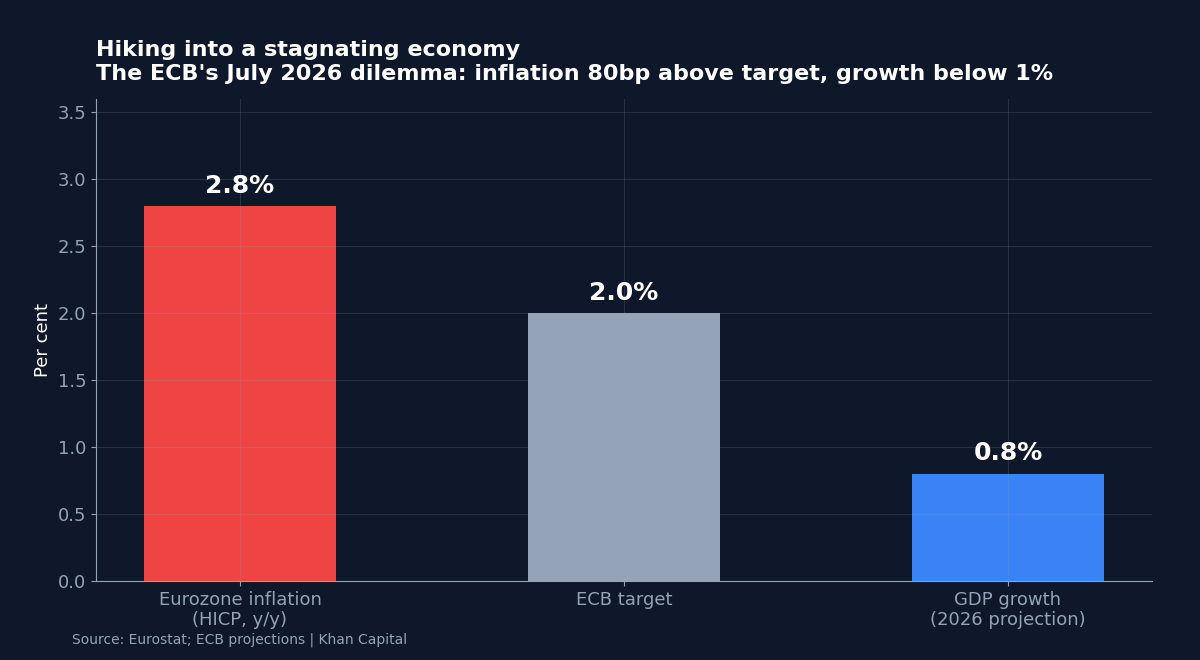
This is a mild but real stagflationary configuration, and it explains why the committee’s hawks and doves are both able to argue from the same data. The hawks’ case: with inflation above target and an oil shock live, credibility requires acting before second-round effects appear in wages, and waiting for proof means being late. The doves’ case: a supply shock taxes the economy on its own, monetary tightening doubles the tax, and with growth at 0.8 per cent the euro area cannot afford a policy error in the restrictive direction. The same debate is playing out at the Federal Reserve in more acute form, where a September hike returned to the pricing after the Fed’s own June split, and the answer both central banks land on will define the global rate environment into 2027.
| Indicator | Level | Read for policy |
|---|---|---|
| Deposit facility rate | 2.25% | Held 23 July; hiked from 2.00% on 11 June |
| Main refinancing rate | 2.40% | Held |
| Marginal lending rate | 2.65% | Held |
| Eurozone inflation (HICP) | 2.8% | Cooling, but 80bp above target |
| GDP growth (2026 proj.) | 0.8% | Little cyclical cushion for tightening |
| Brent crude | ~$92 | Up ~30% since 1 July; key upside inflation risk |
| September hike pricing | Nearly full | Next projection meeting: 10 September |
The Decision Is Being Made in the Strait of Hormuz
The honest answer to “will the ECB hike in September?” is that Frankfurt does not know, because the determining variable is not European. The June hike was explicitly an energy story, and the energy story has worsened since: Brent has risen roughly 30 per cent from its early-July lows as the US-Iran conflict re-escalated, tanker transits through Hormuz have halved, and war-risk insurance costs have repriced by multiples. Europe imports its energy shock wholesale; it has no domestic production buffer worth the name and a currency that weakens when global risk appetite sours, importing still more inflation through the exchange rate.
If crude stabilises or the conflict de-escalates into the autumn, the September projections will likely show imported inflation fading through 2027, and the committee can plausibly stop at one hike. If Brent is trading with a 100-handle by early September, as some scenarios now contemplate, a second hike becomes close to unavoidable on the ECB’s own logic. The bank has, in effect, delegated its September decision to a naval conflict it cannot influence, and the statement’s refusal to pre-commit was an acknowledgement of exactly that.
| September scenario | Trigger conditions | Likely ECB response | Market read |
|---|---|---|---|
| Hike to 2.50% | Brent holds above ~$90; August HICP sticky or higher | Second insurance hike, hawkish projections | Largely priced; euro modestly supported, curve flattens further |
| Hawkish hold | Oil retreats toward $80; inflation resumes cooling | Pause with tightening bias retained | Front-end rallies, euro softens; the larger surprise |
| Cycle over | Ceasefire or supply normalisation; growth deteriorates | Neutral language, projections show target by 2027 | Sharp front-end repricing; equity relief in rate-sensitive sectors |
How an Oil Shock Becomes a Rate Decision
The transmission channel deserves spelling out, because it is the mechanism on which September turns. A sustained rise in crude reaches euro area inflation through three routes of different speeds. The fast route is the pump: petrol and diesel reprice within weeks, and retail fuel prices across Europe have already begun climbing as July’s disruption fed through product markets. The medium route is industry: transport, chemicals, fertilisers and any energy-intensive process pass higher input costs into producer prices over one to two quarters. The slow route, and the one central banks actually fear, is expectations: if households and wage negotiators come to treat higher energy prices as permanent, wage settlements begin to compensate for them, and a one-off supply shock hardens into a wage-price process that only demand destruction can break.
The first two routes are already in motion and are, on their own, survivable; they raise the price level rather than the inflation rate, and their arithmetic drops out of the annual comparison within a year. The entire September argument is about the third route. The ECB hiked in June precisely to signal that it would not allow expectations to drift, judging a small insurance premium today cheaper than a large credibility repair later. Whether one hike buys enough insurance depends on how long the energy tax persists, which returns the question, as everything this summer does, to the strait.
What the Euro and the Curve Are Saying
Currency and rates markets came into the meeting with the hawkish outcome substantially pre-loaded. A September hike has been close to fully priced for weeks, which inverts the usual reaction function: confirmation of the hawkish path mostly ratifies existing pricing, while any hint of softening carries the larger market move. The euro’s support this month has rested on exactly this rate story; strategists had flagged ahead of the meeting that a Lagarde who emphasised upside inflation risks and restrictive-for-longer policy would support the currency, while any wobble would hit it disproportionately.
The front end of the curve carries the same asymmetry. With the hike priced, euro area two-year yields are more exposed to dovish surprise than hawkish confirmation, while the long end trades the growth consequence: a central bank tightening into 0.8 per cent growth is a flattening story, since every basis point of front-end tightening subtracts from an already thin expansion. The transatlantic parallel is imperfect but instructive; the gilt market has spent the summer demonstrating what happens when fiscal credibility joins the argument, a complication the euro area has so far been spared.
Live Chart: EUR/USD
Investor Implications
Equities. European equities face a narrower path than the index level suggests. A hiking ECB compresses the multiple on domestic cyclicals and rate-sensitive sectors while banks, the usual beneficiaries of higher rates, only benefit if the economy avoids stalling; at 0.8 per cent growth the margin between “net interest income tailwind” and “provisioning cycle” is thin. Exporters carry the additional variable of a rate-supported euro. Investors may wish to note that the sectors most insulated from this configuration, energy and defence, are the same ones the Iran conflict has already been rewarding, a concentration worth monitoring in European portfolios.
Fixed income. The asymmetry at the front end favours convexity over conviction: with September nearly fully priced, the payoff to positioning for confirmation is limited while the payoff to dovish surprise is not. Further out, tightening into sub-1 per cent growth historically flattens curves, and the sovereign spread complex bears watching; higher policy rates raise debt service across the periphery just as growth undershoots, the combination that has periodically reopened fragmentation questions. The ECB’s tools for that scenario exist, but their use would itself be an event.
Cross-asset. The euro is now primarily a rate-differential trade on the September question, with the dollar side of the pair carrying its own hike debate. The deeper cross-asset point is the correlation regime: an oil-driven tightening cycle on both sides of the Atlantic means bonds and equities can fall together on the same headline, as they did repeatedly in July’s escalation windows. Portfolios relying on the bond leg to hedge the equity leg are exposed to precisely the configuration now on the table.
What to Watch
- 30-31 July: the Bank of Japan meets, the next major central bank decision in a summer where policy divergence is repricing currencies weekly.
- Early August: euro area flash inflation for July, the first of two HICP prints before the September meeting and the cleanest read on energy pass-through.
- Through August: Brent crude and the Hormuz shipping data; the ECB’s September decision tracks the oil market’s summer more closely than any domestic indicator.
- 10 September: the ECB’s next meeting, with fresh staff projections; on current pricing this is the live hike decision, and the projections’ 2027 inflation path will carry the verdict.
Conclusion
The July hold changed nothing and settled nothing, which was its purpose. The ECB has moved from a completed easing cycle to a contingent tightening one, with a single hike delivered as insurance and a second suspended on an oil price it does not control. What deserves more attention than the September probability is the configuration: a central bank tightening into sub-1 per cent growth because a war 3,000 miles away is taxing its economy through the energy channel. That is not a policy cycle Europe has run since the 1970s analogues everyone is careful not to overquote, and it makes the euro area the developed market most exposed to the difference between de-escalation and a hundred-dollar barrel. Frankfurt will publish its answer on 10 September; the strait will write it first.
Frequently Asked Questions
What did the ECB decide at its July 2026 meeting?
The Governing Council held all three key rates unchanged on 23 July 2026: the deposit facility rate at 2.25 per cent, the main refinancing rate at 2.40 per cent and the marginal lending rate at 2.65 per cent. The pause follows the 25 basis point increase of 11 June, which was the ECB’s first rate rise since 2023.
Why did the ECB hike rates in June 2026?
The June hike responded to inflation pressures the bank tied to higher energy prices from the Middle East conflict. It was insurance against an imported oil shock feeding into inflation expectations, rather than a response to domestic overheating, which is why the subsequent path depends so heavily on the oil market.
Will the ECB raise rates in September 2026?
Markets have priced a September hike as close to fully expected, but the ECB has not pre-committed. The 10 September meeting comes with fresh staff projections, and the decision will hinge largely on energy prices: sustained crude strength through August would support a second hike, while de-escalation and softer oil would let the bank stay on hold.
What does the ECB hold mean for the euro?
The euro’s recent support has come from the expectation of further tightening, so the risks are asymmetric. Hawkish confirmation largely validates existing pricing, while any dovish softening in the ECB’s language would likely weaken the euro more than a confirmed hike would strengthen it, particularly against a dollar backed by its own hike debate.
Sources: European Central Bank, monetary policy decisions, 23 July 2026; Euronews, the June 2026 hike; FXStreet, July hold preview and pricing; FX Leaders, decision-day guide; ING, Lagarde keeps the door open; Foreign Policy, the oil market’s war maths.
Related Reading: The parallel American debate is traced in the hike that came back, and the oil shock driving both central banks in the invisible blockade repricing Hormuz. The inflation print that complicated the story is examined in the June CPI report, and what tightening does to an indebted long end in UK gilts above 5 per cent. For the fundamentals, start with what a rate rise actually changes, and the neutral rate that anchors every hiking debate. The trade-policy shock that followed is covered in the US forced labour tariffs. The property-market consequences are examined in UK property investment under PM Burnham.

Leave a Reply