Khan Capitals | July 2026
Key Takeaways
- Alphabet raised its 2026 capital expenditure guidance to $195-205 billion, up from $180-190 billion a quarter ago, and told analysts that spending will rise again in 2027. The shares fell around 5 per cent in after-hours trading despite a clear revenue beat.
- The quarter itself was strong almost everywhere: revenue of $119.8 billion rose 24 per cent year on year, ahead of the roughly $116.9 billion consensus, and Google Cloud grew 82 per cent to $24.8 billion, its fastest rate in at least three years.
- Free cash flow turned negative, at roughly -$5.9 billion, as quarterly capex reached $44.9 billion, about double the level of a year earlier. For the first time in the AI era, one of the great cash machines of corporate history consumed more cash than it generated in a quarter.
- Demand is not the problem. Google Cloud’s backlog of contracted future revenue reached $514 billion, up more than $50 billion in a single quarter, and finance chief Anat Ashkenazi repeated that the company remains “in a supply-constrained environment”.
- The market’s reaction marks a regime change in how AI spending is priced. Through 2024 and 2025, capex increases were read as confidence. In July 2026, three weeks into a semiconductor bear market, they are read as cost. That shift matters more than the quarter.
Part of: The AI Infrastructure Supercycle – Khan Capital’s hub on the AI infrastructure build-out.
The Beat the Market Refused to Buy
Alphabet’s $205 billion capex guidance was, in the end, the only number that mattered on Wednesday evening. The company opened Big Tech’s earnings week after the close on 22 July with a set of results that would once have produced an untroubled rally: revenue up 24 per cent to $119.8 billion against expectations near $116.9 billion, Google Cloud growing at 82 per cent, and a backlog of contracted cloud demand that now exceeds half a trillion dollars. The shares fell about 5 per cent in extended trading anyway.
The reason sat in one line of the earnings call. Finance chief Anat Ashkenazi told analysts that Alphabet now expects to spend between $195 billion and $205 billion on capital expenditure this year, up from the $180-190 billion range guided just one quarter earlier, and cautioned that spending will increase again, significantly, in 2027. Quarterly capex alone came to $44.9 billion, roughly twice the figure of a year before. The bottom line showed the strain in adjusted form too: adjusted earnings per share of $2.85 landed slightly below the $2.89 consensus, even as a headline net income figure was flattered by unrealised gains on investments that say nothing about the operating business.
| Metric (Q2 2026) | Reported | Context |
|---|---|---|
| Revenue | $119.8bn | +24% y/y; consensus ~$116.9bn |
| Google Cloud revenue | $24.8bn | +82% y/y, fastest in at least three years |
| Adjusted EPS | $2.85 | Consensus $2.89 |
| Capital expenditure | $44.9bn | Roughly double a year earlier |
| 2026 capex guidance | $195-205bn | Prior guidance $180-190bn |
| Free cash flow | -$5.9bn | First negative quarter of the AI era |
| Cloud backlog (RPO) | $514bn | Up more than $50bn sequentially |
| Share reaction | About -5% | After-hours, 22 July |
From Margin Machine to Cash Consumer
The most consequential number in the release was negative. Free cash flow, the figure that made Alphabet one of the most reliable compounding machines in equity market history, came in at roughly minus $5.9 billion for the quarter. The business still generates enormous operating cash flow; the build-out simply absorbed all of it and then some. A company that returned tens of billions to shareholders through the last decade spent the quarter, in cash terms, paying for concrete, power and silicon.
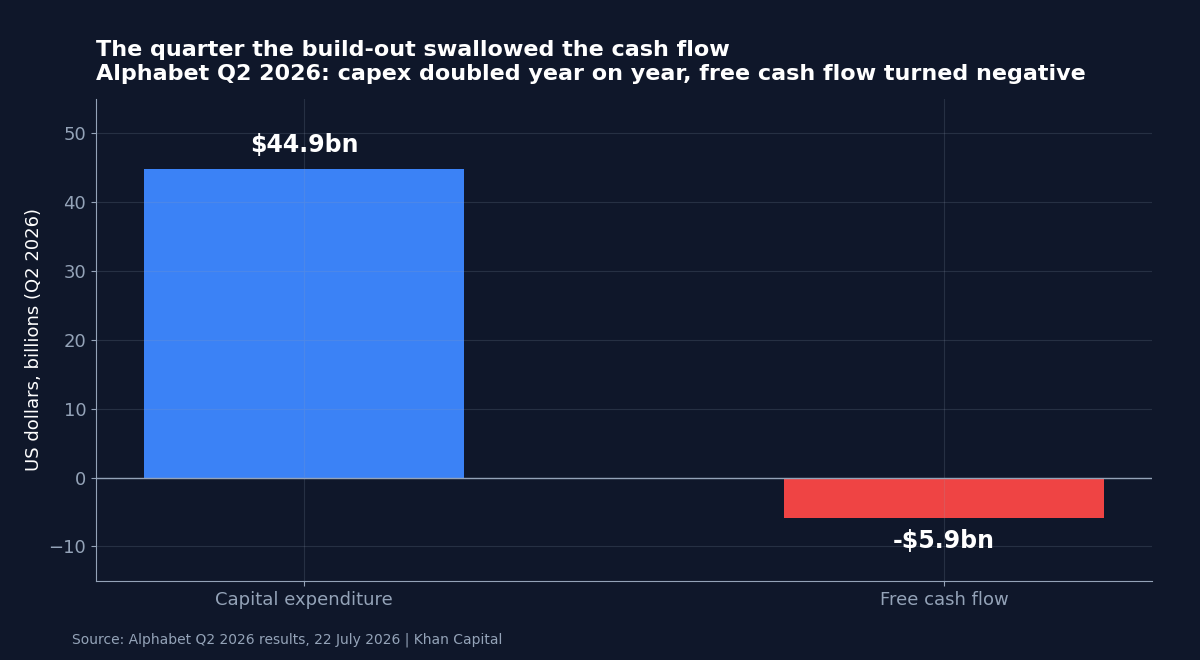
It is worth being precise about what this does and does not mean. Negative free cash flow at Alphabet is not distress; the balance sheet holds a cash pile that dwarfs a single quarter’s deficit, and the spending is discretionary in a way that a steel maker’s maintenance capex is not. What it does mean is that the AI build-out has crossed a psychological line. Investors tolerated the capex supercycle for two years partly because it was funded out of surplus: the cash machine kept running and the data centres were built with what was left over. In the second quarter of 2026 there was nothing left over. From here, every incremental dollar of capex is a dollar that would otherwise have been a buyback, a dividend, or balance sheet accumulation, and the market has begun to price it that way.
There is also a slower-moving cost inside the income statement. Capital expenditure does not hit profits when the cash leaves; it arrives later, as depreciation spread over the useful life of the asset. Roughly $200 billion of annual spending on servers and data centres builds a wall of future depreciation that will press on operating margins for years, whatever the demand environment looks like when it lands. The accounting mechanics that flattered the early years of the build-out now work in reverse, a dynamic we unpacked when TSMC presented the supply-side bill for the same boom last week.
Eighty-Two Per Cent: The Number Behind the Spending
If the capex line explains the share price reaction, the cloud line explains the capex. Google Cloud grew 82 per cent year on year to $24.8 billion of quarterly revenue, an acceleration that is extraordinary for a business of this scale and the fastest rate the division has reported in at least three years. Nothing in the enterprise software universe of comparable size is growing at anything like that pace.
More striking still is the order book. Remaining performance obligations, the backlog of contracted cloud revenue not yet delivered, reached $514 billion, up more than $50 billion in a single quarter. Set against an annualised cloud revenue run rate of roughly $99 billion, the backlog now represents more than five years of the current delivery rate. Customers are signing commitments faster than Alphabet can physically build the capacity to serve them.
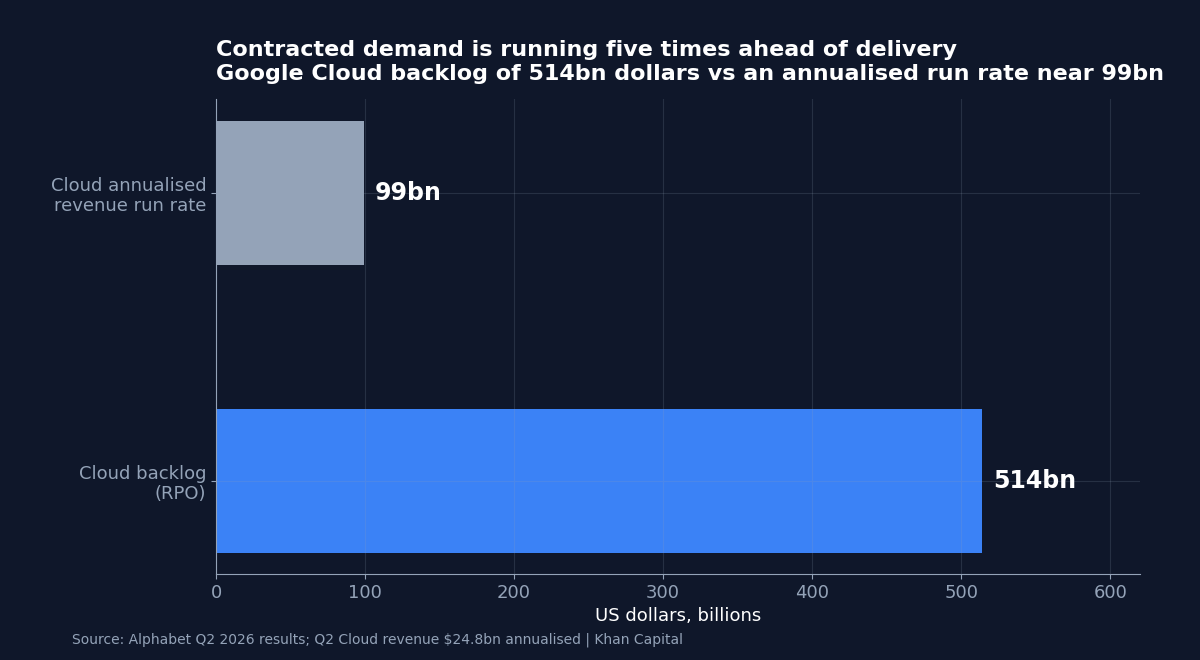
This is the context for Ashkenazi’s two most quoted lines of the call: “We have increased our capacity quite significantly over the past three years. The demand still outpaces that investment,” and, “We’re still in a supply-constrained environment.” On the company’s own telling, the $205 billion is not speculative overbuilding; it is an attempt to catch up with contracts already signed. The backlog also functions as a partial answer to the bear case that AI demand is a mirage of circular vendor financing: these are enforceable customer commitments, recognised under accounting rules, from external cloud customers as well as Alphabet’s own products.
What $205 Billion Actually Buys
Two disclosures on the call gave shape to where the money goes. First, Sundar Pichai confirmed that Alphabet has begun recognising revenue from direct external sales of its TPU accelerator chips, with the majority of revenue from those agreements arriving next year. That is a quiet but significant strategic turn: the hyperscaler that built custom silicon for its own use is now selling it into a market that has been, in effect, a single-supplier market. It puts Alphabet into more direct competition with Nvidia at the moment when export policy has already begun reshaping the demand map for accelerators.
Second, Pichai said the company continues to test Gemini 3.5 Pro while it has started training Gemini 4, “applying a lot of our compute and effort in that direction”. Frontier model training is the least monetisable, most capital-hungry use of compute that exists, and it is a treadmill: each generation costs multiples of the last. Some meaningful share of the capex line is therefore not capacity for the $514 billion backlog at all, but table stakes in the frontier model race, spending whose return arrives only if the resulting model wins share. The distinction between revenue-backed capacity and competitive necessity is one the market is starting to draw with a sharper pencil.
The Market’s New Arithmetic on Capex
A year ago, a capex raise of this size from Alphabet would most likely have lifted the whole AI complex: chip makers, power utilities, networking suppliers, the lot. The after-hours reaction on Wednesday inverted that reflex, and the inversion has a context. The Philadelphia Semiconductor Index entered a bear market this month after a three-week, 20 per cent drawdown that unwound a 105 per cent rally, a repricing driven not by absent demand but by leverage, positioning and doubts about the durability of AI monetisation. Into that mood, “we will spend up to $205 billion and more next year” lands very differently from how it would have landed in the scarcity panic of 2025.
The equity market is now applying something closer to a utility framework to hyperscaler spending: capex is a cost to be recovered, with a return on invested capital to be demonstrated, rather than an option on the future to be celebrated. Under that framework the questions become mechanical. What is the revenue yield on a dollar of AI infrastructure? How fast does a GPU depreciate relative to the contract it serves? What happens to returns if inference prices keep falling, as they have done all year? None of these questions has a settled answer, which is precisely why the stock now trades on the guidance line rather than the revenue line.
| Scenario | Capex path | Cloud trajectory | Equity read |
|---|---|---|---|
| Bull: backlog converts | Peaks 2027, then plateaus | Growth stays above 50% as capacity lands | FCF recovers sharply; capex re-rated as prepaid revenue |
| Base: long grind | High plateau through 2028 | Growth moderates to 35-50%; backlog converts on schedule | Margins absorb rising depreciation; stock range-bound on ROIC proof |
| Bear: utilisation gap | Cut mid-2027 | Inference price deflation outruns volume growth | Capex cuts read as demand cracking; multiple compresses across the complex |
The Financing Question Nobody Asked in 2024
A company running negative free cash flow while spending $200 billion a year eventually meets the capital markets, whatever the size of its cash pile. The industry has already started building that plumbing. This month the $35 billion Apollo-Blackstone financing for AI chip infrastructure began trading, the first time the market has priced AI infrastructure credit risk in the open, and data centre developers across the sector are leaning on private credit at a scale that did not exist two years ago. Alphabet is the least constrained borrower imaginable, but the direction of travel is clear: the AI build-out is migrating from a story about income statements to a story about balance sheets, and eventually about credit. When the marginal data centre is debt-financed rather than cash-financed, the cycle acquires a new set of participants with a much lower tolerance for utilisation disappointments.
Live Chart: Alphabet (GOOGL)
Investor Implications
Equities. The read-through hierarchy matters more than the single name. Alphabet’s spending is unambiguous good news for the supply chain it pays: foundries, memory makers, power and cooling suppliers, and now, in a twist, for Alphabet’s own TPU business as a merchant vendor. For the hyperscaler peer group, the bar has moved: Microsoft, Meta and Amazon all report within days, and each will face the same question about the gap between AI capex and demonstrable AI revenue. Investors may wish to watch backlog and RPO disclosures as closely as capex guidance; the companies that can show contracted demand five times ahead of delivery have a defensible answer, and those that cannot may find their spending priced as pure cost. Positioning in the AI complex increasingly needs to distinguish businesses paid in cash today from businesses paid in expectations.
Fixed income. Alphabet’s negative free cash flow quarter is a data point for credit markets precisely because the company does not need to borrow: it marks the moment the sector’s aggregate internal funding capacity was exhausted by the build-out. Incremental AI infrastructure from here is increasingly a bond and private credit story, from hyperscaler issuance to the securitised data centre financings now reaching the market. Spreads on that paper, not equity multiples, may become the cleanest real-time gauge of whether the market believes the utilisation case.
Cross-asset. A capex number of this size is macro-relevant. Hyperscaler investment at a $200 billion annual run rate for a single company, with peers behind it, is functioning as a private-sector fiscal programme: it supports industrial activity, electricity demand and construction employment while tightening the market for power and grid equipment. It is one reason US growth has stayed firmer than the rate environment would suggest, and one reason any synchronised capex retrenchment would carry macro consequences well beyond the Nasdaq.
What to Watch
- 23 July: Intel reports after the US close, the first direct read on whether the semiconductor complex can stabilise against the capex news flow.
- Late July: Microsoft, Meta and Amazon report second-quarter results. Their capex guidance, and any RPO or backlog disclosures, will determine whether Alphabet’s evening was idiosyncratic or the template for the season.
- Through H2 2026: the ramp of external TPU sales agreements, with the majority of revenue guided to arrive next year; any named customers would be a material datapoint for the accelerator market’s structure.
- Next quarterly report: whether 2027 capex guidance is quantified, and whether free cash flow returns to positive territory; a second consecutive negative quarter would harden the utility framing.
Conclusion
Alphabet delivered one of the strongest operating quarters in its history and was sold for it, which tells you the market has changed the question it is asking. Through the first two years of the AI boom the question was “how big is the opportunity?”, and capex was the measure of conviction. In July 2026 the question is “what is the return on the money?”, and capex is the measure of risk. The company’s answer, a $514 billion backlog and an admission that it still cannot build fast enough, is the best answer any hyperscaler currently has. Whether it satisfies a market that has just watched the semiconductor complex reprice is the live question of the next fortnight, and Alphabet has now handed the burden of proof to the three companies reporting behind it.
Frequently Asked Questions
Why did Alphabet’s share price fall after strong Q2 2026 results?
The market’s concern was spending rather than sales. Alphabet raised its 2026 capital expenditure guidance to $195-205 billion, said 2027 spending would rise further, and reported negative free cash flow of roughly $5.9 billion for the quarter. In the current environment investors treated the higher capex as a cost pressure rather than a signal of confidence, and the shares fell around 5 per cent after hours.
What is Alphabet’s capex guidance for 2026?
Alphabet guided to capital expenditure of $195-205 billion for 2026, up from the $180-190 billion range given a quarter earlier. Second-quarter capex alone was $44.9 billion, roughly double the level of a year before, and management cautioned that spending will increase significantly again in 2027.
Why is Alphabet’s free cash flow negative?
Operating cash generation remained strong, but capital expenditure of $44.9 billion in the quarter exceeded it, producing free cash flow of about minus $5.9 billion. The company is building AI and cloud capacity faster than its operations generate cash, which management attributes to demand that still outpaces its investment in capacity.
What does Google Cloud’s $514 billion backlog mean?
The backlog, formally remaining performance obligations, is revenue customers have contracted to pay but Alphabet has not yet delivered or recognised. At $514 billion it equals more than five years of Google Cloud’s current annualised revenue run rate, which suggests the capacity Alphabet is building is substantially pre-sold rather than speculative.
Sources: CNBC, Alphabet Q2 earnings live coverage; Yahoo Finance, GOOGL after-hours reaction and capex guidance; Seeking Alpha, Alphabet Q2 summary; Yahoo Finance, cloud-driven beat and capex forecast; Alphabet investor relations; TradingView, GOOGL.
Related Reading: The supply-side bill for the same build-out arrived a week earlier in TSMC’s record quarter, while the mood into which Alphabet reported was set by the semiconductor bear market that unwound a 105 per cent rally in three weeks. The financing layer beneath the capex is examined in the $35 billion private credit test, and the demand-side crack that started the repricing in Meta’s AI cloud pivot. The other side of the capex verdict is in Amazon’s $3 trillion market cap. For the fundamentals, start with capex vs opex and the accounting behind the AI build-out, and why revenue, profit and cash flow tell different stories. The sector’s latest print is analysed in Intel’s Q2 2026 earnings, the fastest growth in 15 years. For the week the rest of big tech faced the same test, see Big Tech Earnings: The Week the Market Graded AI Capex Line by Line. For the debt-funded version of the same trade, see CoreWeave’s $104 billion backlog and $640 million interest bill.

Leave a Reply