

Khan Capitals | August 2026
Key Takeaways
- The quiet shock of the summer. Wheat futures are up roughly 10 per cent this week, more than 20 per cent in the past month and 51 per cent in 2026, at their highest levels in two years, after Black Sea grain exports ground to a virtual halt.
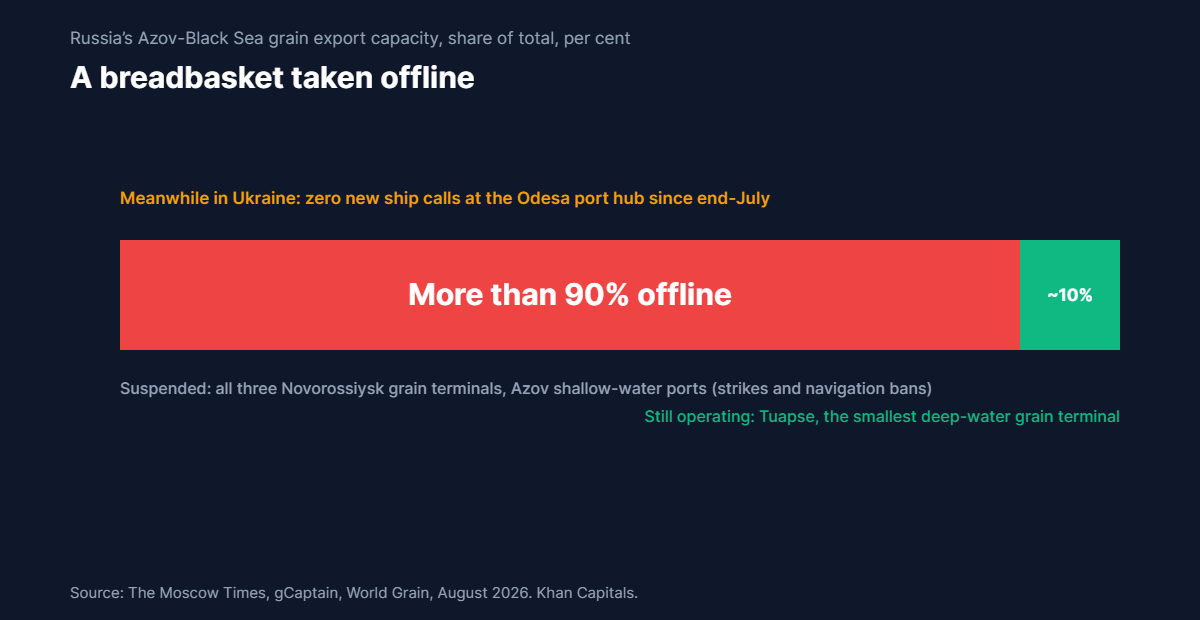
- Both breadbaskets are dark. More than 90 per cent of Russia’s grain export capacity in the Azov-Black Sea basin is offline after Ukrainian strikes and navigation restrictions, with all three grain terminals at Novorossiysk suspended; Ukraine’s Odesa port hub has recorded no new ship calls since the end of July.
- The whole complex is moving. Corn is up about 6 per cent this week and 22 per cent this year; soybeans about 3 per cent and 22 per cent. This is a repricing of the food supply chain, not a single-commodity squeeze.
- The timing is the multiplier. The disruption has hit the August-to-December window when Russian exports normally peak; expected August shipments of 2.5 million tonnes may come in at 1.5 million at best, and winter storms and freezing make lost cargoes hard to recover later.
- It feeds the inflation story. A food-price shock of this size arrives precisely as central banks battle sticky core inflation, adding a supply-side complication no policy rate can fix.
The Black Sea Grain Crisis Nobody Is Trading Yet
While the market spent August debating the Federal Reserve and grading AI earnings, the Black Sea grain crisis built quietly into the largest agricultural supply shock since 2022. The facts are stark. Attacks by both Russia and Ukraine on each other’s port infrastructure, coupled with navigation restrictions, have halted almost all grain shipments through the Black Sea and the Sea of Azov, routes that until recently carried around 70 per cent of Russia’s grain exports and the bulk of Ukraine’s. Wheat has responded the way a market does when it believes the disruption is real: up roughly 10 per cent this week, more than 20 per cent over the month, and 51 per cent for the year, to two-year highs.
Mainstream financial coverage has treated the move as a commodities footnote. That underplays it on three counts: the share of world grain trade that flows through these waters, the seasonal timing of the stoppage, and the macro moment into which a food-price shock is now arriving. Each deserves attention.
Two Breadbaskets, One Sea, Zero Ships
What distinguishes this episode from earlier phases of the war is symmetry. In 2022 the story was Russia blockading Ukrainian exports; grain diplomacy, insurance workarounds and the corridor deal eventually restored flow. In 2026 both sides’ export machines are impaired at once. On the Russian side, Ukrainian strikes and navigation restrictions have taken more than 90 per cent of Azov-Black Sea grain export capacity offline: all three grain terminals at Novorossiysk, the country’s main deep-water outlet, have suspended operations, leaving Tuapse, the smallest of the deep-water grain ports, as the only facility in the region still working. On the Ukrainian side, the Odesa port hub effectively ceased operations at the end of July, with no new ship calls recorded through mid-August.
| Commodity | This week | August | 2026 to date |
|---|---|---|---|
| Wheat | +10% | +20%+ | +51% |
| Corn | +6% | +16% | +22% |
| Soybeans | +3% | +7% | +22% |
The price action follows the concentration. Wheat is the commodity most dependent on Black Sea supply, so it leads. Corn, where Ukraine is a major exporter but the Americas provide alternatives, moves less. Soybeans, a largely American and Brazilian trade, move least and mostly in sympathy. The market is, in other words, pricing the geography correctly; what it may be underpricing is the duration.

Why the Calendar Makes It Worse
Grain export capacity is not fungible across the year. The August-to-December window is when Russian shipments normally run at their annual peak, moving the new harvest to buyers across the Middle East, North Africa and Asia. Industry estimates suggest Russia was expected to export around 2.5 million tonnes of grain in August; with Novorossiysk blocked, the realistic figure is 1.5 million tonnes at best. The comforting assumption, that missed cargoes are simply shipped later, runs into the Black Sea winter: storms and seasonal freezing progressively close the window from late autumn. Capacity lost now is not deferred, much of it is gone.
There is a second-order effect inside Russia. With the export route severed, domestic grain prices have collapsed below production costs, a margin squeeze on the farm sector of a commodity superpower. That matters for supply next year: producers squeezed this hard plant less. A disruption that began as a logistics story can become an acreage story, which is how one-season shocks become multi-season ones.
| Supply-side fact | Scale | Why it matters |
|---|---|---|
| Russian Azov-Black Sea export capacity offline | >90% | Novorossiysk suspended; only Tuapse still operating |
| Share of Russian grain exports via these routes | ~70% | No comparable substitute routes exist at scale |
| Expected vs likely Russian August exports | 2.5Mt vs ≤1.5Mt | Shortfall lands in the peak shipping season |
| Odesa hub ship calls since end-July | Zero | Ukraine’s export machine idled simultaneously |
| Russian domestic grain prices | Below production cost | Squeezed margins risk lower planting next season |
The Insurance Channel, Again
Readers of our energy coverage will recognise the mechanism. In the Gulf, as we wrote in our analysis of the Hormuz blockade, the binding constraint on shipping is rarely the physical attack; it is the war-risk insurance market that decides which voyages are economically possible. The Black Sea is now running the same experiment with grain. Underwriters have no appetite for hulls transiting waters where both combatants are striking port infrastructure, and no corridor agreement currently exists to price against. Until insurers can underwrite the route, the capacity stays offline whether or not another missile flies.
The parallel with energy runs one step further. Oil markets absorbed this year’s Iran sanctions escalation with surprising calm because spare capacity existed elsewhere: OPEC could, in principle, pump more. Grain has no OPEC. Exportable wheat surpluses are concentrated in a handful of countries, and the two largest happen to be shooting at each other’s ports. The buyers most exposed, import-dependent states across North Africa, the Middle East and South Asia, are the same populations for whom bread prices are politics, which is why food shocks have historically outrun their commodity-market origins.
Food Prices Meet a Fed Fighting Sticky Inflation
The macro timing is unhelpful in the extreme. Central banks spent August confronting inflation that has stopped falling: US core inflation is parked well above target, and the market has spent the month repricing the odds of renewed tightening. Food commodities feed through to consumer prices with a lag of several months, first through raw ingredients, then processing, then menus and shelves. A 51 per cent annual rise in wheat will not appear in next month’s CPI, but it is now in the pipeline for winter, precisely when policymakers hoped the disinflation story would resume.
For emerging markets the arithmetic is harsher. Food carries far larger weights in EM inflation baskets, often 30 to 50 per cent against under 15 in advanced economies, so the same commodity move produces a multiple of the headline impact. Central banks across the importing world may find themselves tightening into a supply shock they cannot influence, the least rewarding form of monetary policy. And unlike 2022, this shock arrives with China’s economy soft, as July’s across-the-board misses showed, so the demand offset that once eased commodity pressure is absent on the food side, where demand is inelastic regardless.
Investor Implications
Equities. The listed exposure runs through fertiliser and seed producers, agricultural machinery, grain handlers and food processors, with the handlers, the firms that own storage and alternative logistics, historically the cleanest beneficiaries of dislocated grain flows. On the cost side, packaged food and quick-service margins absorb the shock with a lag, a squeeze that tends to surface two to three quarters later in guidance. Consumer staples’ defensive reputation gets tested when the defence itself is the input inflating.
Fixed income. Food inflation is the variety monetary policy handles worst, and bond markets know it: it lifts headline prints and inflation expectations while doing nothing for growth. For EM sovereign debt, the food import bill is a fiscal event; the 2010-2012 period demonstrated how quickly grain prices translate into subsidy costs and political risk premia across importing states.
Cross-asset. Agricultural commodities have quietly become 2026’s best-performing major asset class outside precious metals, and almost nobody’s portfolio reflects it. Whether that continues turns on the war’s targeting choices, insurance capacity and the southern-hemisphere harvest, none of which respond to the variables most portfolios are built around. That low correlation is precisely the argument for paying attention; it is also, framed plainly, a description of risk rather than a recommendation.
What to Watch
- September 2026: whether Novorossiysk’s terminals restart, and any movement toward a new shipping corridor or insurance framework; each headline is worth multiple per cent on wheat.
- September to October 2026: monthly export data from Russia and Ukraine against the 2.5 million tonne baseline, the cleanest measure of how much capacity is genuinely lost.
- October to November 2026: northern-hemisphere planting decisions and any Russian export tax or quota response to collapsed domestic prices.
- Into winter: the first food-price pass-through into CPI prints across major importers, and the political response in exposed EM states.
Conclusion
The Black Sea grain crisis is what a structural supply shock looks like in its early innings: prices up 51 per cent, the cause plainly visible, and the broader market still treating it as somebody else’s chart. The disruption is concentrated in the season that matters most, in the commodity least substitutable, through a chokepoint both combatants are now targeting, with an insurance market unwilling to bridge the gap. It may resolve quickly; corridor deals have been conjured before. But the asymmetry is uncomfortable: a resolution returns wheat to trend, while persistence pushes a food-price impulse into a global inflation picture that has no room for one. Quiet charts in August have a way of becoming loud ones by winter.
Sources: gCaptain, Black Sea grain exports grind to a virtual halt; The Moscow Times, Ukrainian strikes halt most Russian grain exports; World Grain, escalating war stalling Black Sea exports; UkrAgroConsult, Russian grain prices fall below production costs; IFPRI, Black Sea tensions and rising wheat prices; Stock Rover, weekly market brief, 28 August 2026.
Related Reading: The insurance mechanism throttling the route is the same one we mapped in the indefinite Hormuz blockade, and the sanctions side of the supply war in Washington’s economic D-Day. For the inflation backdrop this shock lands on, see the Fed’s eight-day reversal, and for the demand side, China’s July stall. For the fundamentals, start with war-risk insurance, explained and inflation, explained.

Leave a Reply