

Khan Capitals | July 2026
Key Takeaways
- Washington bought yen. The US Treasury intervened on 31 July, with the New York Fed selling euros to buy yen on its behalf through Goldman Sachs and Morgan Stanley: the first American yen-buying intervention alongside Tokyo in more than a decade.
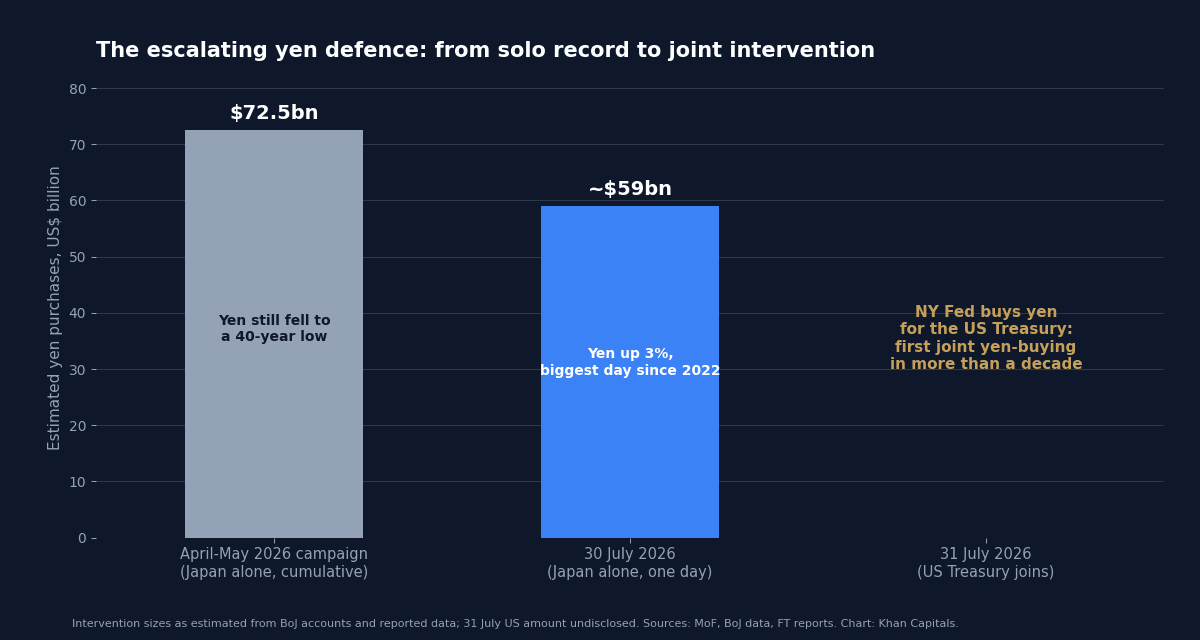
- Japan struck first, and hard. On 30 July, with the dollar near 163 yen, Tokyo bought an estimated $59 billion of yen in a single session, driving USD/JPY down almost six yen to 157.96, the currency’s biggest one-day gain since 2022.
- The trigger was a 40-year low. Days earlier the yen had touched 164 to the dollar, its weakest since 1986, despite a record solo intervention campaign in the spring and the highest Bank of Japan policy rate since 1995.
- The BoJ supplied the other pincer. Hours after the intervention, the Bank of Japan held at 1.0 per cent by 8-1, upgraded its economic outlook, warned inflation could overshoot, and signalled September is live; only Hajime Takata pushed for an immediate hike.
- The carry trade now faces a two-sided official market. With speculative yen shorts near multi-year peaks, the largest funding trade in global markets has, for the first time in this cycle, both governments positioned against it.
Four Days That Redrew the Yen’s Front Line
The joint yen intervention of 30 and 31 July is the kind of event currency markets go years without seeing. When this publication examined the yen’s slide to a 40-year low a month ago, the conclusion was uncomfortable for Tokyo: record intervention had failed because Japan was fighting the Federal Reserve’s rate structure with its own reserves, alone. This week the word alone stopped applying. In the space of four days the yen touched 164, absorbed the largest single-day defence of this cycle, and then acquired a second official buyer: the United States Treasury.
The sequence matters as much as the sums, so it is worth laying out precisely.
| Date | Event |
|---|---|
| 28 July | USD/JPY trades to 164, the yen’s weakest level since 1986 |
| 30 July | Japan intervenes: an estimated $59bn of yen bought in one session; USD/JPY falls from near 163 to 157.96, the biggest one-day yen gain since 2022 |
| 31 July, morning | US Treasury informs banks it may intervene and tells them to “stand ready for future action” |
| 31 July | New York Fed sells euros to buy yen on the Treasury’s behalf via Goldman Sachs and Morgan Stanley; first joint US-Japan yen purchase in over a decade |
| 31 July | Bank of Japan holds at 1.0% (8-1, Takata dissenting for a hike), upgrades outlook, flags September |
Why Solo Intervention Kept Failing
Japan’s problem all year has been arithmetic, not resolve. Between late April and late May the Ministry of Finance deployed roughly $72.5 billion defending the currency, a record campaign, and the yen still made new lows within weeks. The reason is the gap the intervention could not touch: with the federal funds rate at 3.50 to 3.75 per cent and the Bank of Japan at 1.0 per cent, holding dollars pays roughly two and a half percentage points more than holding yen, every year, before anything happens. Selling reserves into that current buys time, not direction. Speculators learned the pattern, waited out each operation, and re-shorted the bounce; by late July, bets against the yen had climbed back to multi-year peaks.
The 30 July operation was different in scale but not in kind: one government, financing the defence from its own reserves, against a market that knows those reserves are finite. What happened the next morning changed the kind.
What the Joint Yen Intervention Changes
Mechanically, the American operation was modest and deliberately visible. The Treasury first told a number of banks it might act, an announcement that is itself a weapon, then had the Federal Reserve Bank of New York sell euros and buy yen on its behalf through two dealers. No amount was disclosed. The signal, not the size, is the instrument: for the first time in this cycle, both sides of the world’s most heavily shorted currency pair have an official actor on the bid.
That transforms the game theory that made shorting the yen so comfortable. A trader positioned against the Ministry of Finance faces an opponent with large but countable reserves and a known reluctance to waste them. A trader positioned against a coordinated US-Japan front faces an opponent whose combined signalling power includes the currency’s issuer on both sides of the pair, and whose future actions are, by design, unknowable. The Treasury’s “stand ready for future action” line to banks was not operational housekeeping; it was aimed directly at the re-shorting reflex that defeated every previous defence. Coordinated intervention has a strong historical record precisely because it converts a one-sided trade into a two-sided risk: the joint dollar-support operations of 1998 and the G7 yen operation after the 2011 earthquake both marked durable turning points.
Washington’s motives are its own. A yen this weak is a dollar this strong, and a dollar this strong is a standing complaint in American trade politics as tariff policy tightens. There is also a systemic dimension: US officials watched the August 2024 carry unwind ripple through American equities, and a disorderly yen break past 165 or 170 risked a larger version of the same. Stabilising the yen is, from one angle, macroprudential policy for the S&P 500.
The BoJ’s Hawkish Whisper
The third actor moved within hours. The Bank of Japan held its policy rate at 1.0 per cent, the highest since 1995, by an 8-1 vote, with Hajime Takata alone in seeking a back-to-back increase after June’s hike. But the hold came wrapped in language that read like a promise: an upgraded assessment of the economy, an explicit warning that inflation could overshoot the 2 per cent target, and a clear signal that September is a live meeting. A central bank that has spent three years being dovish by default chose, on intervention day, to be hawkish on purpose.
The choreography is the point. Intervention weakens shorts’ positions; a hawkish central bank raises the cost of rebuilding them; a second government’s participation makes the timing of the next strike unknowable. None of the three tools works alone, as the spring proved. Together they constitute the first coherent yen defence of the cycle, and the market’s behaviour into the weekend, with the yen holding near 159.55 rather than round-tripping as it did after every previous operation, suggests the message landed.
The Carry Trade Meets Its Counterparty
The global significance of all this runs through a single trade. Borrowing cheap yen to fund positions in Treasuries, US technology shares, Mexican bonds and everything else with a higher yield remains the largest funding trade in world markets, and it is profitable precisely to the extent the yen keeps falling or stays still. A yen that rises 3 per cent in an afternoon converts leveraged carry profits into margin calls, and forced unwinds sell the assets the borrowed yen bought. August 2024 demonstrated the transmission at small scale; positioning today is larger. As we noted in our analysis of the Fed’s July meeting, the yen was already one of the two assets most levered to the September rate decision. It is now also the asset most levered to two finance ministries.
The table below sets out what has actually changed for a yen short between the spring campaign and this week, because the difference is structural rather than rhetorical.
| Factor | Spring 2026 defence | After 31 July |
|---|---|---|
| Participants | Japan alone | Japan + US Treasury (via NY Fed) |
| Signal to shorts | Finite reserves, predictable triggers | Two-sided official risk, unknowable timing |
| BoJ stance | Reluctant hiker | Hawkish hold, September signalled, overshoot warning |
| Rate gap vs Fed | ~2.75 points, static | ~2.6 points, narrowing from both ends if hawks win |
| Result | New lows within weeks | Yen holding near 159.5 into the weekend |
US dollar / Japanese yen. Chart: TradingView.
Investor Implications
Equities. The transmission channel to watch is funding, not Japan. Assets that have been quiet beneficiaries of yen borrowing, led by US mega-cap technology and other crowded longs, are the sale candidates in any accelerated carry unwind, exactly as in August 2024. Japanese exporters face the direct effect: every step of yen strength trims repatriated earnings, while banks and domestic demand names benefit from the normalisation story the BoJ is now openly telling. A stronger yen alongside a hawkish BoJ is, historically, the rotation signal within Tokyo’s market rather than a verdict on it.
Fixed income. Japanese investors are the largest foreign holders of US Treasuries, and the calculus that kept that money in dollars, a wide rate gap and a falling hedging cost, erodes from both ends if the BoJ hikes into a stabilising yen. Repatriation flows are slow but enormous, and a credible yen floor is their precondition. At the margin this is one more source of upward pressure on the US long end, arriving in the same week the 30-year Treasury touched a 19-year high.
Cross-asset. Coordinated intervention episodes are historically inflection points for the dollar broadly, not just against the yen. A softer dollar would ease the pressure that has kept gold in its quiet bear market and emerging market currencies pinned. The speed of any turn depends on the Fed: a September hike re-widens the gap and hands the shorts their argument back, which is why the yen is now, in effect, a position on two central banks and two treasuries simultaneously. Nothing here is a recommendation; the observation is that the risk has become two-sided for the first time in years.
What to Watch
- 7 August: the US employment report; soft data narrows the rate gap from the American side and does the interveners’ work for them.
- Mid-August: US CPI, the other half of the September Fed equation that ultimately anchors USD/JPY.
- Late August: Japan’s Ministry of Finance monthly intervention disclosure, the first official confirmation of the July operations’ true size.
- Mid-September: the Bank of Japan’s next decision, now openly signalled as live; a hike would be the first act of the defence that costs speculators carry rather than reserves.
Conclusion
For three months the yen’s decline was a one-way market with a predictable, exhaustible opponent. In four days that structure broke: a record single-day defence, the United States buying yen for the first time in over a decade, and a central bank converting its hold into a threat. None of it repeals the rate gap that created the carry trade, and if September delivers neither a Fed pause nor a BoJ hike, the shorts will be back to test the new front line. But the line itself has moved. The world’s largest funding trade now has an official counterparty on both sides of the pair, and markets that spent the spring fading Tokyo’s telegraphs must now price an opponent that no longer telegraphs at all.
Frequently Asked Questions
What is currency intervention?
Currency intervention is when a government or central bank buys or sells its own currency in the open market to influence its exchange rate. Japan’s Ministry of Finance instructs the Bank of Japan to buy yen using foreign reserves when it judges the currency’s fall excessive. Intervention is most powerful when coordinated between countries, because it removes the assumption that only one side of the trade carries official risk.
Why is the yen so weak in 2026?
Primarily the interest rate gap: US rates at 3.50 to 3.75 per cent against Japan’s 1.0 per cent make holding dollars structurally more rewarding than holding yen, encouraging investors to borrow yen and invest abroad. Elevated energy import costs and fiscal concerns have added to the pressure, pushing the yen to 164 per dollar in late July, its weakest since 1986.
Why does the yen carry trade matter to global markets?
Because borrowed yen funds positions far beyond Japan: US shares, Treasuries and emerging market bonds among them. When the yen strengthens quickly, those loans become more expensive to repay, forcing investors to sell the assets they bought with them. That is how a currency move in Tokyo becomes a selloff in New York, as happened in August 2024.
Sources: FT via Yahoo Finance; CNBC; Reuters via Yahoo Finance; Bloomberg on the BoJ; Bloomberg on the intervention; EBC analysis.
Related Reading: For why the solo defence kept failing, see The Yen at a 40-Year Low: Why Record Intervention Keeps Failing. On the American half of the rate gap, read The Fed’s Triple Dissent: A 9-3 Hold and the Most Hawkish Vote in a Decade and The Hike That Came Back. For the dollar’s other casualty, see Gold’s Quiet Bear Market. For the fundamentals, start with the yen carry trade and why exchange rates move. The other consumer engine’s stall is covered in China’s July stall. The JGB side of the story returns in the global bond selloff of August 2026. The metal’s answer to all of it is charted in the gold price rally. The intervention’s aftermath came into focus in September, when the BoJ hiked to a 31-year high and the yen weakened regardless.

Leave a Reply