
Khan Capitals | July 2026
Key Takeaways
- New US forced labour tariffs took effect on 24 July 2026: duties of 10 to 12.5 per cent on goods from 60 trading partners, including the EU, China, Japan, India, the UK, Canada and Mexico, covering roughly 99 per cent of US imports, according to NBC News.
- The legal basis is novel: the action was taken under Section 301 of the Trade Act of 1974, with the administration charging that partners have failed to impose and enforce bans on goods made with forced labour; partners that have adopted import prohibitions face 10 per cent, those that have not face 12.5 per cent.
- The timing compounds an oil shock: the tariffs arrived with Brent crude having touched $100 a barrel and Treasury yields at year-to-date highs, layering a goods-price impulse onto an energy-price impulse in the same week.
- Partners are protesting, not yet retaliating: governments from Canberra to Brasília rejected the forced-labour rationale but most signalled they would keep negotiating rather than counter-tariff, leaving escalation risk contained for now.
- Market reaction was muted but the margin question is not: bond yields edged higher on the inflation risk while equities focused on the Middle East; the cost burden lands on importer margins and consumer prices into the 28-29 July FOMC meeting.
The new US forced labour tariffs that took effect on Friday 24 July are, by coverage, among the broadest single trade actions in modern American history: a two-tier duty of 10 or 12.5 per cent applied to the country’s 60 largest trading partners at once. Yet they arrived to a market reaction so muted it barely registered against the week’s oil-driven bond selloff. That gap, between the scale of the policy and the shrug of the tape, is worth examining carefully, because it rests on assumptions about absorption, negotiation and inflation pass-through that the next two quarters will test.
What the US Forced Labour Tariffs Cover
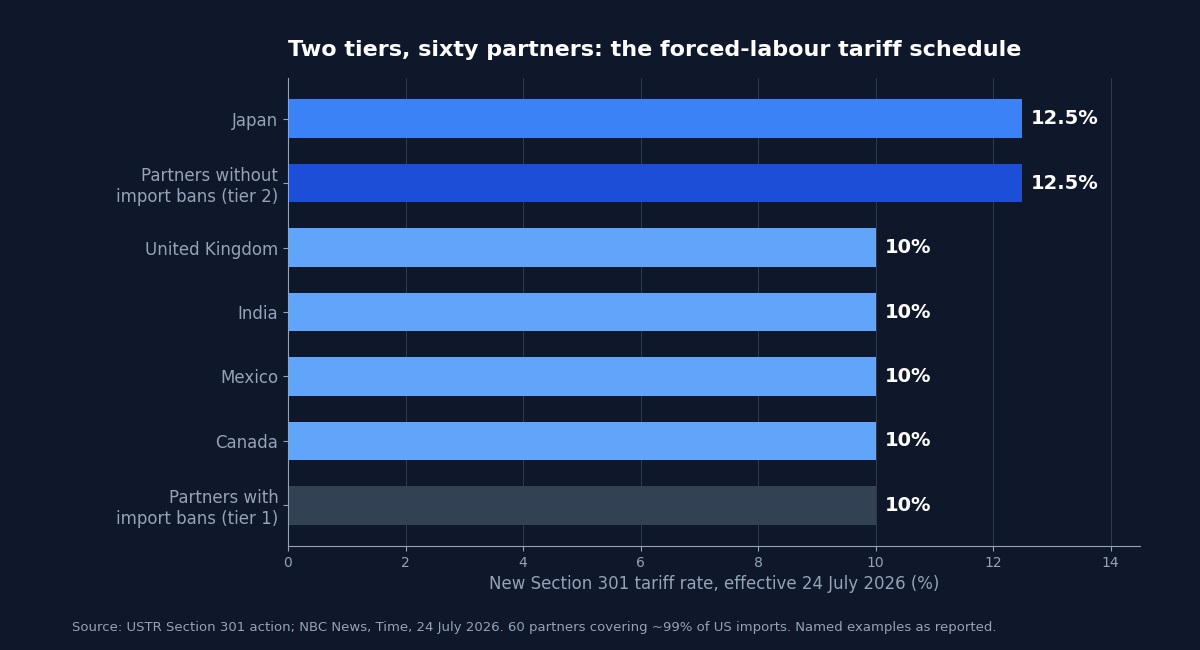
The Office of the US Trade Representative imposed the duties under Section 301 of the Trade Act of 1974, the statute that authorises action against trading partners deemed to engage in unfair practices. The charge, as CNBC reported, is that the 60 targeted economies have failed to adequately impose and enforce prohibitions on goods produced with forced labour. The remedy is structured as an incentive: partners that have adopted or committed to import bans on forced labour goods face the lower 10 per cent rate, while those that have not face 12.5 per cent.
Among named examples, Canada, Mexico, India and the United Kingdom fall in the 10 per cent tier, while Japan drew the 12.5 per cent rate, effective from one minute past midnight US Eastern time on 24 July. The EU and China are also covered. Sixty economies accounting for roughly 99 per cent of US imports puts this action closer in spirit to a universal baseline tariff than to a targeted trade remedy, whatever the legal vehicle.
A Statute Stretched to a New Shape
The forced labour framing does real legal work. Section 307 of the Tariff Act of 1930 has long prohibited imports produced wholly or in part by forced labour, and enforcement of that ban, historically directed at specific goods and regions, is uncontroversial internationally. What is new is using an alleged enforcement gap in other countries’ import regimes as the predicate for across-the-board duties under Section 301. Trade lawyers quoted through June, when the action was first proposed, noted that the case is far from simple: most of the 60 targets have no forced labour import ban because, until recently, almost no country other than the United States had one at all.
The choice of vehicle matters for investors because it affects durability. Earlier rounds of tariffs under the International Emergency Economic Powers Act spent 2025 under legal challenge, a saga we covered as it moved through the courts. A Section 301 action follows a formal investigation process with deeper statutory roots and is correspondingly harder to strike down quickly. Notably, the new duties took effect as an earlier tranche of 10 per cent IEEPA-based tariffs expired, which means the administration has, in effect, refounded its baseline tariff on firmer legal ground while raising the top rate for a subset of partners.
The Macro Arithmetic: A Second Price Impulse
Considered alone, a 10 to 12.5 per cent duty on virtually all imports is a material cost shock. US goods imports run at roughly $3 trillion annually; a blended duty near 11 per cent implies a gross levy in the region of $300 billion a year, some fraction of which reaches consumer prices depending on how it is split between foreign exporters’ prices, importer margins and retail pass-through. The June CPI print, which fell more than any month since April 2020 and briefly revived the disinflation narrative, was the high-water mark of the Fed’s comfort. As we argued in our June CPI analysis, the committee was already unwilling to bank that progress. The tariffs give it a second reason not to.
The sequencing is what makes this week distinctive. Brent crude topped $100 a barrel before easing on Friday, up nearly 38 per cent for the month on the Gulf escalation, and global bonds sold off to year-to-date yield highs as the inflation threat repriced. Fed funds futures moved from pricing a roughly 10 per cent chance of a July hike a week earlier to about a third by Wednesday. Onto that energy impulse, policy has now layered a goods impulse. Energy shocks fade if crude retraces; tariff levels persist until renegotiated. For a central bank already debating a hike, the second is arguably the more consequential input, precisely because it is the more durable one.
| Feature | This action (Jul 2026) | 2025 IEEPA baseline | 2018-19 Section 301 (China) |
|---|---|---|---|
| Legal basis | Section 301, forced labour enforcement | IEEPA emergency powers | Section 301, IP and tech transfer |
| Coverage | 60 partners, ~99% of imports | Near-universal 10% baseline | China only, phased lists |
| Rate | 10% or 12.5% by tier | 10% (higher reciprocal rates paused) | 7.5-25% |
| Off-ramp | Adopt and enforce forced labour import bans | Bilateral deals | Phase One purchase commitments |
Why Markets Shrugged
Three reasons explain Friday’s muted reaction, and each carries its own fragility. First, attention: with a live conflict repricing oil and war-risk insurance in the Strait of Hormuz, a trade action telegraphed since early June was not the marginal story. Second, the expiry offset: for many partners the new 10 per cent tier replaces the expiring 10 per cent IEEPA baseline, so the net change in landed costs is smaller than the headline suggests; the genuine increment falls on the 12.5 per cent tier. Third, learned behaviour: after eighteen months of tariff announcements followed by negotiations, carve-outs and pauses, markets have concluded that opening rates are bids, not final prices.
Each assumption is testable. The attention deficit ends if the Gulf de-escalates. The netting argument fails for goods where the increment compounds with existing sectoral duties. And the negotiation discount rests on partners choosing talks over retaliation, which held on day one, with governments from Canberra to Brasília rejecting the rationale while declining to counter, but which is a diplomatic choice, not a market fact. The eurozone dimension deserves particular attention: the ECB held rates in July partly on trade uncertainty, as we covered in the ECB’s hawkish hold, and a 10 per cent duty on EU exports to the US lands directly on the bloc’s already-flat industrial economy.
Sector Exposure: Where the Increment Bites
Because the action is near-universal, relative exposure matters more than absolute. Retailers and consumer goods importers with thin margins and Asian supply chains face the most direct cost pressure, and unlike the 2018-19 round, there is no low-tariff country to reroute through: the schedule covers effectively everyone. Autos are a special case, with Japan’s 12.5 per cent tier layering onto an industry already navigating sectoral duties; Japanese carmakers’ US transplant production shields volume but not imported components. Semiconductors sit in an uneasy position, given the sector’s concentrated Asian supply base and its existing entanglement in export controls, a dynamic we mapped in Nvidia’s H200 China exports. Agricultural importers and food retailers face pass-through that is politically visible in grocery prices, historically the least tolerated form of tariff inflation.
The offsetting flows are fiscal and reshoring-related. Tariff revenue at this breadth is a meaningful receipts line, and domestic manufacturers competing with imports gain a price umbrella. But the experience of 2018-19, documented extensively in Federal Reserve research at the time, was that input-cost effects on downstream producers outweighed protection effects for protected sectors. There is little reason to expect the arithmetic to invert at four times the coverage.
Live Chart: S&P 500 (SPX)
Investor Implications
Equities. The first-order screen is import intensity against pricing power: businesses that can pass an 11 per cent blended input increment through to customers keep margins; those that cannot absorb it in a quarter where consensus already expects 23 per cent S&P 500 earnings growth face a high bar for disappointment. The second-order question is guidance language: July and August earnings calls will be the first to quantify the levy, and the 2018-19 precedent suggests dispersion between companies that pre-positioned inventory and those that did not. Domestically-oriented small caps, relative beneficiaries in past tariff episodes, face the complication that this round’s inflation impulse also pressures the rate path they are most sensitive to.
Fixed income. The tariffs reinforce the week’s repricing rather than redirect it. A durable goods-price impulse arriving alongside a 38 per cent monthly oil move gives the FOMC’s hawks a second exhibit at the 28-29 July meeting, and the front end has already moved: from a 10 per cent implied probability of a July hike to roughly a third in a week. Breakeven inflation rates are the cleaner expression of the tariff effect than nominal yields, which are carrying the oil shock simultaneously. The stagflationary mix, positive for price level, negative for trade volumes and margins, is the configuration that the September hike debate was already converging on.
Cross-asset. The dollar’s reaction function to tariffs remains double-edged: duties compress the trade deficit mechanically while retaliation risk and growth drag cut the other way; in 2018-19 the net effect was dollar-positive against targeted currencies. Gold, already unwound from its peak as real yields climbed, gains a tail-risk bid if partners move from protest to retaliation. The scenario that would force a genuine cross-asset reassessment is the EU or China converting rhetorical rejection into counter-measures, which day-one diplomacy suggests neither wants while the Gulf conflict is unresolved.
What to Watch
- 28-29 July 2026: the FOMC decision and statement language on tariffs; a hike with futures only two-thirds convinced would be the sharpest monetary surprise of the year.
- August 2026: formal responses from the EU, China and Japan, and whether any partner files at the WTO or announces counter-duties rather than continuing talks.
- July-August earnings calls: quantified tariff-cost guidance from importers and retailers; the first hard data on absorption versus pass-through.
- September-October 2026: the August and September CPI prints, the first to carry a full month of the new duties in goods prices.
Conclusion
The forced labour tariffs are simultaneously less than they appear, a partial replacement for an expiring baseline, discounted by a market trained to expect negotiation, and more than the tape implies: a durable, legally hardened floor under US import costs applied at near-universal breadth in the same month an oil shock reached three digits. The market’s calm rests on the assumption that talks will grind rates down and that absorption will mute pass-through. Both may hold. But the configuration this week leaves behind, a goods-price impulse layered on an energy-price impulse days before a live FOMC meeting, is precisely the mix that turns a single hike debate into a cycle debate. The tariff schedule is now a standing feature of the inflation outlook, and unlike crude, it does not retrace on a ceasefire.
Frequently Asked Questions
What are the new US forced labour tariffs?
They are duties of 10 to 12.5 per cent on goods from 60 US trading partners, effective 24 July 2026, imposed under Section 301 of the Trade Act of 1974. The administration charges that the targeted economies have failed to impose and enforce bans on goods made with forced labour. Partners that have adopted import prohibitions face 10 per cent; those that have not face 12.5 per cent.
Which countries are affected by the July 2026 tariffs?
The 60 covered economies account for roughly 99 per cent of US imports and include the EU, China, Japan, India, the UK, Canada and Mexico. Among named examples, Canada, Mexico, India and the UK fall in the 10 per cent tier, while Japan faces the 12.5 per cent rate.
Will the tariffs raise US inflation?
Some pass-through to consumer prices is likely, though the size depends on how costs split between foreign exporters, importer margins and retail prices. Because part of the new schedule replaces an expiring 10 per cent baseline, the net increment is smaller than the headline rates suggest. The August and September CPI prints will provide the first full-month evidence.
How did markets react to the new tariffs?
The immediate reaction was muted. Bond yields edged higher on the added inflation risk, while equities remained focused on the Middle East conflict and the surge in oil prices. Trading partners protested the forced labour rationale but most signalled they would negotiate rather than retaliate, which kept escalation risk contained on the first day.
Sources: NBC News, US sets new tariffs on 60 trade partners; CNBC, trading partners rebuke forced-labor justification; Time, the new tariffs explained; Euronews, tariffs over forced labour claims; Bloomberg, global bonds reel as oil renews inflation threat; Office of the US Trade Representative.
Related Reading: The monetary backdrop these duties land on is set out in the return of the rate hike debate and the June CPI report the Fed would not bank. The energy shock running alongside is covered in the war-risk repricing of the Strait of Hormuz, and the European exposure in the ECB’s hawkish hold. For the fundamentals, start with how emergency-powers tariffs work and inflation, explained.

Leave a Reply