Khan Capitals | August 2026
Key Takeaways
- Kevin Warsh delivers his first keynote as Fed Chair on Friday. The Kansas City Fed’s symposium runs from 27 to 29 August at Jackson Lake Lodge, with the Chair’s address expected around 10:00 Eastern on the 28th.
- Neutral is the priced-in outcome, not the safe one. Roughly 69 per cent of fund managers surveyed by Bank of America expect a neutral tone. When a consensus is that crowded, a neutral speech moves very little and the entire risk sits in the tails.
- The dual mandate is pointing in opposite directions. July payrolls fell 23,000 against a consensus of a gain of 85,000, while July CPI ran at 3.4 per cent. September hike odds moved from about 60 per cent to roughly one in three on that combination.
- Warsh has deliberately removed the market’s usual guidance. Post-meeting statements now run about 130 words, and he is the first Chair to withhold his own projection from the dot plot since it began in 2012. Markets are still building a dictionary for his phrasing.
- A Treasury intervention has complicated the podium. Scott Bessent’s decision to at least double long-end buybacks briefly pushed the 30-year to 5.19 per cent before it returned toward 5.27, raising a question about who is setting long rates that Warsh will either address or conspicuously avoid.
Part of: The Fed’s Regime Change, Khan Capital’s hub on the Warsh Fed, the end of forward guidance and the 2026 policy debate.
A Chair the Market Cannot Yet Translate
Ahead of Jackson Hole 2026, it is worth beginning with what the market does not yet have. Every Federal Reserve Chair eventually acquires a vocabulary. Investors learn that “measured” means something specific, that “patient” carries a defined shelf life, that “substantial further progress” is a threshold rather than a mood. That shared dictionary takes years to compile, and it is what allows a central bank to move markets with a paragraph instead of a decision.
Kevin Warsh does not have one yet. He was confirmed on 22 May by a Senate vote of 54 to 45, the narrowest margin the position has ever received, and he has spent the three months since actively shrinking the surface area available for interpretation. Post-meeting statements now run to roughly 130 words, about half their previous length. He has declined to submit his own rate projection to the dot plot, making him the first Chair to withhold that data point since the projections began in 2012. He has commissioned five external task forces covering communications, the balance sheet, economic data, productivity and jobs, and the inflation framework, with findings due by the end of the year.
The result is a policymaker who has removed the instruments markets normally use to read him, at precisely the moment they most need to. Narayana Kocherlakota, formerly of the Minneapolis Fed and now at the University of Rochester, has argued that this approach is “going to lead to market volatility” and makes businesses “more reluctant to invest”. That criticism is the backdrop against which Friday’s speech will be judged, and Warsh knows it.
His own description of the address, offered at the July press conference, was that it was “like a blank sheet of paper”. He also supplied the formulation that has been passed around trading desks since: “This is a period of watchful thinking, not watchful waiting.” It is characteristic of him, a phrase engineered to be parsed rather than understood.
Jackson Hole 2026 and a Theme That Is Not the Story
The Kansas City Fed has convened this symposium at Jackson Lake Lodge in Grand Teton National Park since 1981, a location chosen in part because Paul Volcker wanted the fly fishing. It now draws around 120 central bankers, academics and officials from more than 70 countries, by invitation only, with the agenda released the evening before proceedings open.
This year’s academic theme is “Financial Innovation: Implications for Payments and Policy”, the first time the symposium has organised itself around digital payments. The timing is not arbitrary. The stablecoin market has grown beyond $230 billion of outstanding tokens, large banks are preparing to issue dollar-pegged instruments, and the GENIUS Act, signed in July 2025, takes effect in January 2027 as the first federal framework for payment stablecoin issuance. There are genuine monetary questions here about whether instant settlement and programmable redemption alter the transmission of interest rate policy at the margin.
Investors should nonetheless be careful not to over-read the theme. The historical record is unambiguous: chairs use this platform for whatever the moment requires, not for whatever the programme says. Ben Bernanke signalled a fresh round of quantitative easing in 2010. Jerome Powell delivered his framework shift in 2020 under a review-themed agenda, spoke for eight minutes in 2022 about the “pain” required to restore price stability, and opened the door to cuts in 2024. The theme constrains the papers. It has never constrained the Chair.
One wrinkle does make the digital asset content worth monitoring in its own right. Warsh disclosed holdings across more than a dozen blockchain protocols and decentralised finance ventures in his April ethics filing, all of which he undertook to divest on confirmation, and he has appointed Marc Andreessen to co-lead his AI and productivity task force alongside Stanford’s Charles I. Jones and Microsoft’s Asha Sharma. Any language about digital asset regulatory direction would therefore carry policy content, not merely rate-expectation mechanics.
The Data That Split the Mandate
Warsh arrives at the lectern with the two halves of the Federal Reserve’s mandate arguing with each other, which is the least comfortable position a central banker can occupy.
On 29 July the Federal Open Market Committee voted 9 to 3 to hold the federal funds rate at 3.50 to 3.75 per cent, a fifth consecutive meeting without a move. The three dissenters, Beth Hammack of Cleveland, Neel Kashkari of Minneapolis and Lorie Logan of Dallas, each voted for an immediate increase, citing more than five consecutive years of above-target inflation. That was the most hawkish dissent the committee had produced since September 2016, and the 30-year Treasury yield rose roughly 11 basis points on the day to its highest level since 2007.
Then the data turned. July nonfarm payrolls fell by 23,000 against a consensus expecting a gain of 85,000, one of the weakest readings since the pandemic, and September hike odds fell from around 60 per cent to roughly one in three. Retail sales fell 0.6 per cent in the same period, as we covered when the US consumer joined the slowdown. Against that, July CPI printed at 3.4 per cent, in line with forecasts but comfortably above target, and July producer prices concealed a 0.4 per cent acceleration in the core measure behind a flat headline, driven by a 6.5 per cent jump in portfolio management fees that feeds directly into the August PCE calculation.
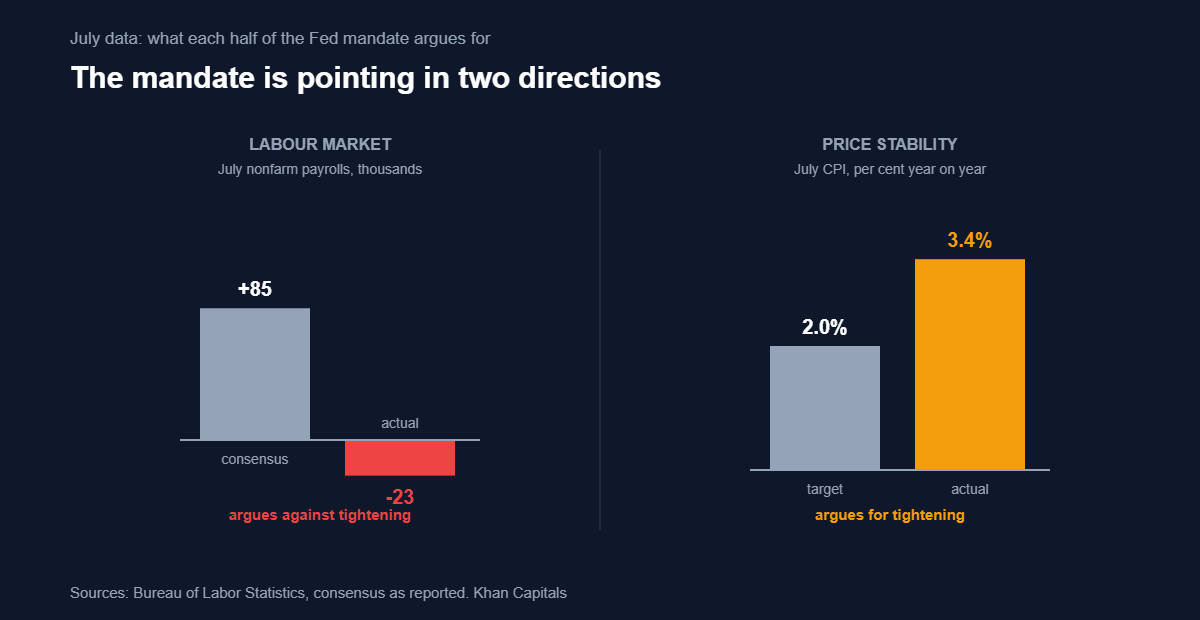
| Indicator | Latest reading | Reference point | Which mandate it argues for |
|---|---|---|---|
| July nonfarm payrolls | -23,000 | Consensus +85,000 | Employment: argues against tightening |
| July CPI, year on year | 3.4 per cent | 2 per cent target | Price stability: argues for tightening |
| July core PPI | +0.4 per cent | Flat headline | Price stability: feeds August PCE |
| July retail sales | -0.6 per cent | Largest fall in over a year | Employment and demand: argues against |
| 30-year Treasury yield | Around 5.27 per cent | Near highest since 2007 | Market scepticism on the inflation fight |
| September hike odds | Roughly one in three | About 60 per cent pre-payrolls | The variable the speech can move |
There is a further complication that sits outside the standard dashboard. Energy costs have risen sharply through the conflict in the Gulf, with US pump prices reaching $4.09 a gallon from $2.98 in late February, a dynamic we examined this week alongside the latest sanctions package. J.P. Morgan’s wealth management strategists cited exactly that energy pressure, together with a Chair who had declined to signal his intentions, when they moved in mid-August to pencil in a September quarter-point increase as their base case.
Why Neutral Is the Crowded Trade
Roughly 69 per cent of fund managers surveyed by Bank of America expect Warsh to strike a neutral tone: a broad, philosophical address that reaffirms the 2 per cent objective without committing to September either way. That is what he has effectively promised, and it is the most reasonable single forecast.
It is also the reason the speech is worth taking seriously. A consensus held by roughly seven in ten participants is, by construction, already in the price. If Warsh delivers precisely what is expected, the market impact should be close to nothing. The distribution of outcomes on Friday is therefore not centred on the modal case at all; almost all of the potential movement lives in the two tails.

A speech read as hawkish, one that restates the “no soft inflation target” formulation with emphasis or validates the three dissenters, would reprice September odds upward and pressure both long duration and rate-sensitive equities. A speech read as dovish, acknowledging the payrolls contraction as materially shifting the committee’s weighting, would likely produce a weaker dollar and a bond rally, with the awkward side effect of demonstrating that the Treasury’s own intervention was unnecessary. Neither of those is the base case. Both are considerably more consequential than the base case.
The Treasury Problem He Cannot Ignore
The week before the symposium introduced a complication that did not exist when Warsh began drafting.
On 19 August, without advance notice, Treasury Secretary Scott Bessent announced that the Treasury would at least double the size of its long-end buyback operations, raising the maximum per operation from $2 billion to $4 billion across the 10 to 20 year and 20 to 30 year segments. The announcement landed on the same day the national debt formally crossed $40 trillion. The 30-year yield fell 9 basis points to 5.19 per cent, then erased the entire move within two sessions and returned toward 5.27, obliging Bessent to state publicly that the operations could grow further. We set out the mechanics of that episode in the global bond selloff.
The commentary was unusually pointed. Evercore ISI’s Krishna Guha characterised the intervention as “a weak form of Operation Twist”. RSM’s Joe Brusuelas argued that suppressing long-end yields artificially could make the Fed’s task harder, because those yields are supposed to reflect monetary conditions rather than debt management preferences. J.P. Morgan’s Maia Crook said the intervention “belies the underlying structural challenges and does nothing to address them”.
Underneath the technical argument is a question about where the boundary between the two institutions now sits. If the long end of the curve is being managed by the fiscal authority, then the signal the Fed relies upon is partly an administered price, and the transmission of monetary policy is correspondingly weaker. Whether Warsh addresses this directly, addresses it obliquely, or pointedly says nothing will be read as a statement about the Fed’s independence from Treasury’s financing agenda. There is no neutral option on that particular question, which is what makes it the most interesting thing he could choose to discuss.
The Argument That Divides His Own Committee
The most substantive intellectual position Warsh has staked out is that artificial intelligence will prove disinflationary. He wrote in a November 2025 opinion piece that AI “will be a significant disinflationary force, increasing productivity and bolstering American competitiveness”. If that view is correct, the Fed can tolerate inflation running above target for longer without tightening, because the supply side is about to do the work.
It is a genuinely contested proposition rather than a consensus one. Three of his own colleagues voted to raise rates in July regardless. A University of Chicago and Financial Times survey found that roughly 60 per cent of leading economists expect AI’s effect on inflation over the next two years to be approximately zero. BCA Research has made the sharper theoretical objection: within a standard Solow growth framework, faster productivity growth implies a higher equilibrium real interest rate, not a lower one, so a genuine AI productivity boom would argue for tighter policy rather than looser.
Whether Warsh develops this thesis at a symposium whose formal theme is financial innovation would carry signal well beyond the rates market. A Chair publicly building an intellectual case for tolerating above-target inflation on supply-side grounds is a materially different proposition for equity duration, and particularly for the AI infrastructure complex, than one who leaves the argument in an opinion column.
| Reading of the speech | What would signal it | Rates and bonds | Equities and dollar |
|---|---|---|---|
| Hawkish | Emphatic restatement of the 2 per cent objective; sympathy for the three dissenters | September odds rise; long end under renewed pressure | Rate-sensitive and long-duration equities pressured; dollar firmer |
| Neutral (consensus) | Philosophical address; mandate reaffirmed; September left genuinely open | Limited movement; attention shifts to August payrolls and CPI | Limited movement; already in the price |
| Dovish | Payrolls contraction framed as materially changing the balance of risks | Yields fall; September hike largely removed | Dollar weaker; small caps and duration-sensitive equities favoured |
Investor Implications
Fixed income. The long end carries the greatest sensitivity to Friday, because it is where the inflation-credibility question and the debt-management question intersect. A 30-year near 5.27 per cent after a failed intervention indicates a market that is not convinced by either institution at present. The point worth holding is that the buyback episode demonstrated the limits of a fiscal fix for a monetary problem: yields returned to where they started within two sessions. What that market appears to require is a credible account of the inflation path, which only the Fed can supply.
Equities. The asymmetry described above applies with particular force to anything long-duration. Positioning built on the assumption of a neutral speech is positioning that earns very little if it is right and loses meaningfully if it is wrong in either direction. The week also stacks its own risks: Nvidia’s quarterly results and the July PCE reading both land before the Chair speaks, so the market will arrive at the keynote already at elevated sensitivity rather than in a state of calm anticipation.
Cross-asset. Two features distinguish this symposium from its predecessors. The first is that a Chair who has withdrawn forward guidance is speaking at length for the first time, so the informational content per sentence is unusually high. The second is that the theme creates a genuine second channel: remarks on stablecoins, tokenised deposits or central bank digital currency would carry direct consequences for digital asset valuations independently of anything said about rates. Very few Jackson Hole speeches have had two distinct transmission channels.
What to Watch
- Wednesday 26 August. Nvidia’s quarterly results after the close, with the July PCE reading also due this week. Both land before the keynote and will colour how it is received.
- Wednesday evening. The Kansas City Fed releases the full agenda, confirming the keynote time and the paper line-up.
- Friday 28 August, around 10:00 Eastern. The keynote itself, delivered as prepared remarks and published simultaneously. Watch the treatment of the 2 per cent objective, the reaction function, the AI thesis and the Treasury relationship.
- The August employment report and August CPI. Both arrive between the symposium and the September decision, which gives Warsh a legitimate data-dependence argument for committing to nothing on Friday.
- 16 September, the FOMC decision. The point at which the ambiguity has to resolve into a vote, and where the three dissenters will be counted again.
Conclusion
Jackson Hole matters in most years because the Chair chooses to make it matter. This year it matters because of what has been withheld. A Chair who has cut his statements in half, declined to publish his own rate projection and offered markets phrases rather than guidance is about to speak at length for the first time, into a mandate that is pulling in two directions and a long bond that has just rejected an intervention from the Treasury.
The temptation is to treat a neutral speech as the benign outcome. It is more accurate to treat it as the outcome that has already happened, in the sense that it is fully reflected in current pricing. What is not reflected is a Chair who decides that his first appearance on this platform is the appropriate moment to say something definite, about inflation, about artificial intelligence, or about who should be setting the long end of the curve. Warsh described the speech as a blank sheet of paper. On Friday morning the market finds out what he wrote on it.
Frequently Asked Questions
When is the Jackson Hole 2026 symposium and Warsh’s speech?
The Kansas City Fed’s Economic Policy Symposium runs from 27 to 29 August 2026 at Jackson Lake Lodge in Grand Teton National Park. Chair Kevin Warsh’s keynote is expected at approximately 10:00 Eastern on Friday 28 August, with the exact time confirmed when the agenda is published the evening before. The remarks are released in prepared form and streamed publicly.
Why is a neutral speech considered risky rather than safe?
Because roughly 69 per cent of fund managers surveyed expect exactly that. When a single outcome is anticipated by around seven in ten participants, it is already reflected in prices, so delivering it produces very little movement. The potential for a meaningful market reaction therefore sits almost entirely in the hawkish and dovish tails rather than in the expected case.
What is the 2026 Jackson Hole theme?
“Financial Innovation: Implications for Payments and Policy”, the first time the symposium has organised around digital payments. It arrives with the stablecoin market above $230 billion in outstanding tokens and the GENIUS Act taking effect in January 2027. Historically, however, the theme constrains the academic papers rather than the Chair’s keynote.
Why does Warsh give markets less guidance than previous chairs?
It is a deliberate change of approach. Since taking office in May he has shortened post-meeting statements to around 130 words, roughly half their previous length, and has declined to submit his own projection to the dot plot, the first Chair to do so since 2012. The stated rationale is greater data dependence; the practical effect is that markets have less material with which to anticipate decisions.
What would move September rate expectations on Friday?
Any clarification of how Warsh weighs the two halves of the mandate against each other. Odds currently sit at roughly one in three after July payrolls fell 23,000 while CPI ran at 3.4 per cent. Language emphasising the 2 per cent objective would lift those odds; framing the labour market deterioration as decisive would lower them further. Both the August employment report and August CPI still arrive before the 16 September decision.
Sources: Federal Reserve Bank of Kansas City, Federal Reserve July FOMC statement, Bureau of Labor Statistics employment situation, CNBC on the Treasury buyback, Tech Times symposium preview, US Treasury buyback announcement.
Related Reading: The committee Warsh leads produced the most hawkish vote in a decade in July, before the September repricing reversed much of it. The long end that will judge Friday’s speech is examined in the global bond selloff, the energy pressure underneath the inflation debate in the latest Iran sanctions package, and the demand picture in July’s retail sales fall. For the fundamentals, start with how market-implied rate odds work and why Fed speeches move markets. The sequel, in which hot PCE and Warsh’s Jackson Hole warning put the hike back on the table, is in the day the tightening question reopened. For the data that vindicated the hawks, see the August jobs report. The intervention Warsh spoke into has since tripled; see the $6 billion Treasury buybacks.

Leave a Reply