Khan Capitals | July 2026
Key Takeaways
- The Fed held, but only just. The FOMC voted 9-3 on 29 July to keep the federal funds rate at 3.50 to 3.75 per cent, the fifth consecutive hold at a level unchanged since November 2022.
- Three dissents, one direction. Beth Hammack, Neel Kashkari and Lorie Logan all voted for a quarter-point hike: the first time three policymakers have dissented with a unified view since September 2016, and the most hawkish committee vote in nearly a decade.
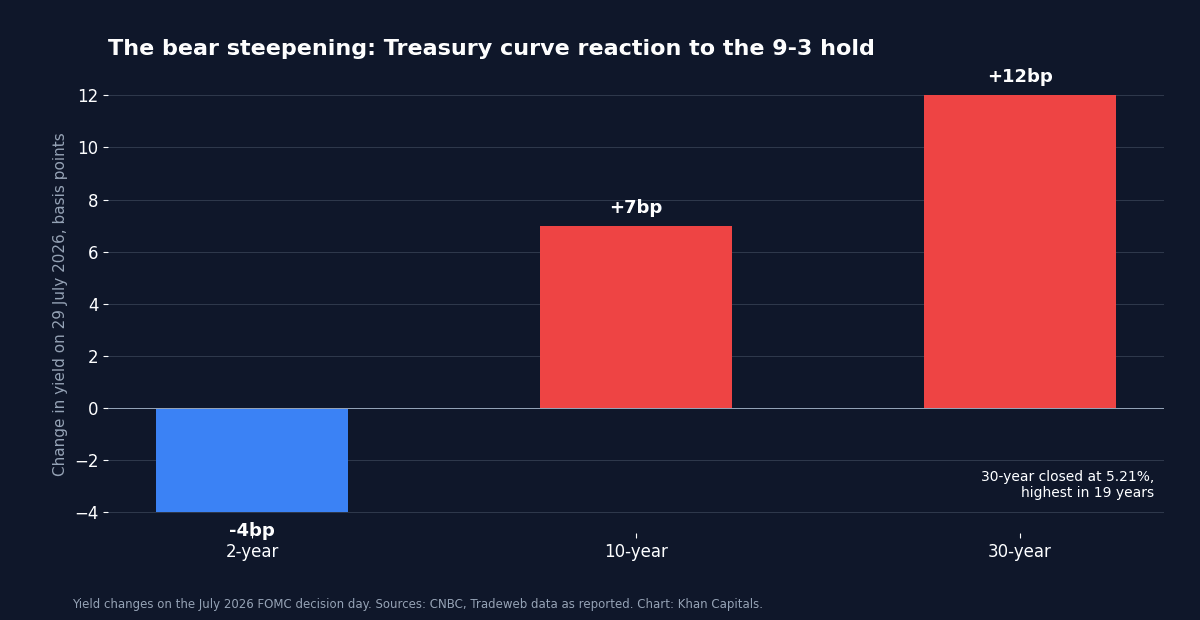
- The long end delivered the verdict. The 10-year Treasury yield rose seven basis points to 4.67 per cent and the 30-year surged twelve to 5.21 per cent, its highest in 19 years, while the two-year fell four: a textbook bear steepening that says the market doubts the Fed’s resolve.
- Warsh refused to guide. The chair repeated that his Fed is “not in the forecasting business”, pledged the committee “will not hesitate to act”, and offered no signal on September, leaving officials’ year-end projections spanning 3.6 to 4.1 per cent.
- Equities noticed. The Dow fell more than 840 points on the day as the S&P 500 lost 0.6 per cent, with the selloff concentrated in rate-sensitive sectors as the long end repriced.
Part of: The Fed’s Regime Change – Khan Capital’s hub on the Fed’s 2026 regime change.
Nine Votes That Held, Three That Mattered
The Fed triple dissent of 29 July will be remembered longer than the decision it accompanied. The Federal Open Market Committee kept the federal funds rate at 3.50 to 3.75 per cent, where it has sat since November 2022, and on the surface delivered exactly what futures markets expected. Beneath the surface, the committee fractured. Beth Hammack of Cleveland, Neel Kashkari of Minneapolis and Lorie Logan of Dallas each voted for an immediate quarter-point increase, citing inflation that has now run above the 2 per cent target for more than five years. Not since September 2016 have three FOMC voters dissented in the same direction at the same meeting; not in nearly a decade has the committee produced a more hawkish vote.
Dissents at the Fed are usually noise: a lone regional president marking an intellectual position. Three dissents with a unified view are signal. They tell you where the committee’s centre of gravity is drifting, and they follow weeks of public statements in which each of the three had flagged hawkish urgency. The September hike debate that this publication has been tracking since the minutes revived it at 64 per cent odds is no longer a market speculation about the Fed. It is now visible inside the building.
The context makes the split sharper. This is the fifth consecutive meeting at 3.50 to 3.75 per cent, a range the committee reached in November 2022 and has defended through an oil shock, a semiconductor bear market and a change of chairman. Five holds is not itself unusual; five holds with inflation above target for more than five years is. The committee has, in effect, been running an experiment in whether an economy with strong productivity growth and heavy capital investment can carry moderately above-target inflation back to 2 per cent without further tightening. The three dissenters have concluded the experiment is failing. The nine-member majority believes it needs more time. That is the entire policy debate of late 2026, compressed into one vote.
| Item | Detail |
|---|---|
| Decision | Hold at 3.50-3.75%, fifth consecutive meeting |
| Vote | 9-3 |
| Dissenters | Hammack (Cleveland), Kashkari (Minneapolis), Logan (Dallas), all for +25bp |
| Last triple same-direction dissent | September 2016 |
| Officials’ year-end rate view | 3.6% to 4.1% |
| Stated concern | Inflation above 2% target for more than five years |
A Chairman Who Will Not Forecast
Kevin Warsh came to the chairmanship promising a smaller, humbler Fed: shorter statements, fewer projections, no forward guidance. The July meeting was the sternest test yet of that doctrine. Asked repeatedly about September, Warsh told the press conference that “decisions by this committee matter a great deal, and where necessary and appropriate, we will not hesitate to act”, while declining to characterise the path of rates at all. He described the dissents as healthy deliberation; earlier in the cycle he had said he wanted a “good family fight”, and on 29 July he got one.
The difficulty is that a central bank that refuses to guide leaves markets to price its reaction function from the raw data, and the raw data are ambiguous. As we wrote after the June CPI report, headline inflation has been falling on the ceasefire dividend in energy even as the underlying trend sits stubbornly above target. Meanwhile payroll growth has slowed markedly, the economy grew at just 1.5 per cent annualised in the second quarter, and the statement itself acknowledged elevated uncertainty owing in part to the conflict in the Middle East. Hawks read five years of misses; doves read a slowing economy. Without guidance, the tie-break is left to the bond market.
The Long End Files a Protest
The bond market’s response was unambiguous, and it was not flattering. The two-year yield, which tracks the expected policy path, actually fell four basis points: traders trimmed the odds of an imminent hike once the hold was confirmed. But the 10-year rose seven basis points to 4.67 per cent, and the 30-year jumped twelve to 5.21 per cent, its highest level in 19 years. That combination, short yields down and long yields sharply up, is a bear steepening, and it carries a specific message: the market increasingly doubts that this Fed will act against inflation soon enough, and is charging more to hold long-duration claims on a currency whose central bank prizes patience.
Equities translated the same message into prices within hours. The Dow fell more than 840 points, 1.6 per cent, with the S&P 500 down 0.6 per cent and the Nasdaq off 0.5 per cent. For a market that had spent July absorbing a semiconductor bear market and record-tight credit spreads, the reminder that the long end can still reprice was unwelcome. The moves are set out below, and the pattern matters more than the magnitudes: this was not a growth scare, where the whole curve rallies, but an inflation-credibility repricing concentrated at the far end of the curve.
Five Years Above Target
The dissenters’ arithmetic deserves to be taken seriously, because it is unusual in the Fed’s modern history. Inflation has now run above the 2 per cent objective for more than five consecutive years, the longest sustained overshoot since the inflation targeting era began. Each of the three dissenting presidents made versions of the same argument in the weeks before the meeting: that every additional quarter of overshoot embeds expectations a little deeper, that policy at 3.50 to 3.75 per cent is not obviously restrictive when the economy is growing and capital investment is strong, and that waiting for perfect clarity is itself a policy choice with costs. Their case is not that inflation is accelerating; it is that tolerance is compounding.
The majority’s counter-argument is embedded in the statement’s language: growth is solid but slowing, job gains have merely kept pace with the workforce, and the Middle East conflict injects an oil-price distortion that could either lift headline inflation or crush demand, depending on how it resolves. Raising rates into a 1.5 per cent growth quarter, with payrolls decelerating and a war premium in crude, risks converting a slowdown into something worse. Both positions are coherent. What the committee no longer has is a chairman willing to arbitrate between them in public.
The precedent is worth studying. The last time three voters dissented together, in September 2016, Esther George, Loretta Mester and Eric Rosengren wanted a hike the committee would not deliver; the Fed raised rates three months later, in December. Clustered dissents have historically been a leading indicator of committee action rather than a curiosity: they mark the moment an argument has gathered enough internal support that the leadership can delay it but rarely defeat it. The 2016 hawks lost the meeting and won the quarter. Whether the 2026 hawks repeat the pattern depends on data neither side controls, but the historical base rate is not on the side of indefinite patience.
What September Now Requires
The September meeting is now live in a way no meeting has been since the spring. The scenarios below sketch how the next six weeks of data map to outcomes. The hawks need an inflation print that confirms stickiness or an oil passthrough; the doves need the labour market to keep softening. The wildcard is Warsh himself, who has demonstrated that he will not spend credibility steering expectations in advance, which raises the odds that the decision, whichever way it falls, surprises someone.
| Scenario | What it requires | Likely market response |
|---|---|---|
| September hike (+25bp) | Firm July/August inflation prints; labour market stabilises; oil passthrough visible | Curve flattens from the front; long end rallies on credibility; dollar firms |
| Hawkish hold | Mixed data; more dissents; statement language hardens | Continued bear steepening; term premium builds; equity multiples pressured |
| Dovish hold | Payrolls deteriorate further; inflation resumes falling; oil retreats | Front end rallies; steepener unwinds partially; risk assets relieved |
US 10-year Treasury yield. Chart: TradingView.
Investor Implications
Equities. A Fed that tolerates inflation is short-term supportive of earnings and long-term corrosive to multiples, and 29 July showed the market beginning to price the second effect. Long-duration equities, the unprofitable growth cohort and rate-sensitive sectors such as housebuilders and utilities are most exposed to a rising 30-year yield; banks with asset-sensitive books benefit at the margin from a steeper curve. The 840-point Dow fall was concentrated, not indiscriminate, and that discrimination is the pattern to watch into September.
Fixed income. The bear steepener is the cleanest expression of the credibility question, and at 5.21 per cent the 30-year now offers its highest nominal yield since 2007 for investors willing to take the other side. The front end looks anchored whichever way September falls: a single hike is largely priced across the curve’s belly. The tension sits in the term premium, which has been rebuilding all year; as we noted when credit spreads reached record tights, compensation for risk has migrated from credit to duration, and this meeting extended that migration.
Cross-asset. A patient Fed with above-target inflation is, historically, a weak-dollar and strong-real-assets regime, but the immediate session delivered the opposite as yields backed up. The resolution of that tension depends on whether September validates the hawks. Gold, which has spent the summer in a quiet bear market, and the yen, pinned near 40-year lows by the rate gap, are the two assets most directly levered to the answer.
What to Watch
- 7 August: July employment report; a third consecutive soft payroll print would strengthen the majority’s case for patience.
- Mid-August: July CPI; the first read on whether June’s energy-led relief extended, and the single most important input into September pricing.
- Late August: the Jackson Hole symposium, Warsh’s most natural venue to reframe the committee’s reaction function if he chooses to use it.
- Mid-September: the FOMC decision itself, now carrying three public dissents and no guidance into the meeting.
Conclusion
The July hold was priced; the July split was not. Three regional presidents voting together for a hike is the strongest internal challenge a Fed chair has faced in nearly a decade, and it arrived at a meeting where the chair’s own doctrine forbids him from telling markets how he intends to respond. The result is a policy debate that has moved into the open, a bond market charging 19-year highs to lend long, and a September meeting that will now be read as a referendum on whether patience is a strategy or a drift. The committee’s next family fight has a date.
Sources: Federal Reserve FOMC statement; Chairman Warsh’s press conference transcript; CNBC; CNBC analysis; CNN Business; Fortune.
Related Reading: For how the September hike came back into pricing, see The Hike That Came Back: Pricing a September Rate Hike After the Minutes. On the inflation backdrop, read The June CPI Report: A Ceasefire Dividend the Fed Will Not Bank and The June Jobs Report: 57,000 and the Hike That Faded. For the European parallel, see The ECB’s Hawkish Hold: Rates Stay at 2.25 Per Cent With September Live. The equity market’s very different reading of the same policy backdrop is in Amazon’s $3 trillion market cap. For the fundamentals, start with how an FOMC meeting works and the Fed dot plot. For the London mirror of this meeting a day later, see the Bank of England’s dovish hold. For the intervention that followed two days later, see the joint US-Japan yen intervention. Within a fortnight the market had reversed that reading entirely, as September rate hike odds collapsed. The consumer’s turn arrived with July’s 0.6 per cent retail sales fall. The story reached the long end in August: see the global bond selloff and the Treasury’s $4 billion answer. The sanctions package that followed, and the oil market’s refusal to react to it, is covered in the economic D-Day announcement. The stage all of this sets is examined in our preview of Warsh’s first Jackson Hole keynote. The sequel, in which hot PCE and Warsh’s Jackson Hole warning put the hike back on the table, is in the day the tightening question reopened.

Leave a Reply