Khan Capitals | August 2026
Key Takeaways
- Revenue more than doubled to $2.58 billion from $1.21 billion a year earlier, ahead of the $2.56 billion consensus, according to the company’s second-quarter results. Adjusted operating income of $128 million came in at roughly double what analysts expected.
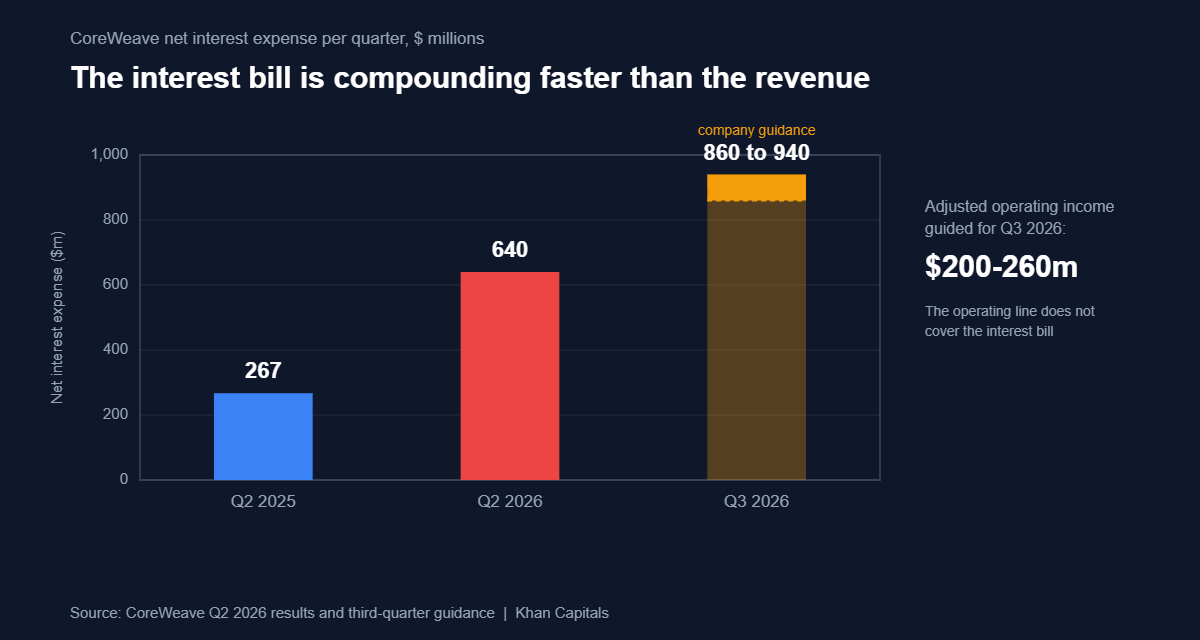
- Net interest expense of $640 million is the number that decides the story. The operating business ran at roughly breakeven, at a $49 million loss. Interest turned that into a $626 million net loss, and management guided third-quarter interest to $860 million to $940 million.
- Revenue backlog reached $104.2 billion, up 246 per cent, with more than half of it attached to contracts where delivery has already begun. A further $25 billion of commitments was signed in the opening weeks of the third quarter and sits outside that figure.
- Total debt stands at $35.1 billion against $5.0 billion of equity, with $6.2 billion of principal falling due in 2027. Facility rates run from 9 to 15 per cent, though the weighted average cost has fallen around 300 basis points over the past year.
- The shares rose 19.3 per cent on 12 August, taking them roughly 50 per cent higher for the year, two weeks after touching a 52-week low of $60.55 during a credit market wobble in late July.
Part of: The AI Infrastructure Supercycle, Khan Capital’s hub on the AI build-out.
A Quarter in Which Everything Doubled
Revenue doubled. Net losses doubled. Interest expense rather more than doubled. CoreWeave’s second quarter is the clearest statement yet of what the AI build-out looks like when a company does it with borrowed money rather than with the cash flows of a two-trillion-dollar advertising business, and the market’s reaction on Wednesday, a 19.3 per cent gain, suggests investors have decided they like the trade.
That verdict deserves scrutiny, because the same set of accounts supports two entirely coherent readings. One is that a company with $104 billion of contracted future revenue and a near-breakeven operating business is being handed the demand of a generation and is sensibly borrowing to meet it. The other is that a company losing $626 million a quarter, burning close to $5.7 billion of free cash flow and carrying $35 billion of debt at rates between 9 and 15 per cent is running a leveraged bet on a technology cycle staying hot for longer than any technology cycle usually does.
Both readings are supported by the filings. Which one turns out to be right depends almost entirely on questions the second quarter did not answer.
What CoreWeave Q2 2026 Earnings Actually Showed
Revenue of $2,575 million against $1,212 million a year earlier is 112 per cent growth, and it beat the $2.56 billion consensus. Adjusted EBITDA of $1,510 million carried a 59 per cent margin, down from 62 per cent. Adjusted operating income of $128 million was roughly double the $66 million analysts had modelled, though it fell from $200 million a year ago as the margin compressed from 16 per cent to 5 per cent.
Below that, the picture changes. Depreciation and amortisation of $1,393 million and cost of revenue rising from 26 to 34 per cent of sales pushed the reported operating line to a $49 million loss. Net interest expense of $640 million, against $267 million a year earlier, did the rest. The company lost $626 million on a GAAP basis, or $1.14 a share, which was actually better than the $1.41 consensus. On the adjusted basis most of the coverage used, the loss was $1.03 against $1.20 expected.
| $ millions | Q2 2026 | Q2 2025 |
|---|---|---|
| Revenue | 2,575 | 1,212 |
| Cost of revenue | 879 | 316 |
| Depreciation and amortisation | 1,393 | n/d |
| Operating income (loss) | (49) | 19 |
| Interest expense, net | (640) | (267) |
| Net loss | (626) | (290) |
| Adjusted EBITDA | 1,510 | 753 |
| Adjusted operating income | 128 | 200 |
| Cash purchases of property and equipment | 6,422 | n/d |
| Total debt | 35,068 | n/d |
| Total equity | 5,024 | n/d |
One line in the cash flow statement is worth more attention than the entire income statement. Cash spent on property and equipment was $6,422 million in the quarter, against operating cash flow of $679 million. That is roughly $5.7 billion of free cash outflow in three months, funded by $13.5 billion of gross debt proceeds. The chief financial officer put total capital expenditure, on an accrual basis, at $9.4 billion, slightly above the top of the guided range, with construction in progress rising from $9.6 billion to $11.9 billion.
The $640 Million Line That Decides Everything
Strip the quarter down to its arithmetic and the shape becomes obvious. The operating business, after every cost of running it including a $1.4 billion depreciation charge, came within $49 million of breaking even on more than $2.5 billion of revenue. Everything that made this a large loss happened below the operating line, and almost all of it was interest.

This is not a criticism disguised as an observation. It is the actual business model. CoreWeave buys graphics processors and data centre capacity with debt, contracts that capacity out for multi-year terms, and earns the spread between the contracted revenue and the cost of the asset plus the cost of the money. The interest bill is not an unfortunate side effect. It is the principal input cost, and the company’s profitability is therefore a function of the credit market at least as much as of the AI market.
That makes the guidance the most important disclosure of the quarter. Third-quarter interest expense is guided to $860 million to $940 million, up from $640 million. Adjusted operating income is guided to $200 million to $260 million. On those numbers the operating business does not cover its interest bill in the third quarter either, and management is explicitly telling investors so.
Set against that, the company has been chipping away at the cost. The finance chief said the weighted average cost of debt has fallen by almost 300 basis points over the past year, worth roughly $1.1 billion of annualised interest saving at the current debt load. That is a genuinely large number, and it is the clearest evidence that the credit market has become more comfortable with this borrower rather than less.
A Backlog of $104 Billion, and What It Is Not
Revenue backlog of $104.2 billion, against $30.1 billion a year earlier, is the headline that moved the shares. It is worth being precise about what the figure contains, because backlog definitions vary and this one is broader than a pure remaining performance obligation.
CoreWeave defines it as remaining performance obligations plus amounts it estimates will be recognised in future periods under committed customer contracts, subject to delivery and availability conditions being satisfied. In other words, part of it is contractually locked and part of it depends on CoreWeave building what it has promised to build. That is not a criticism, but it does mean the number is a statement about intent as much as obligation, and the same caveat we applied to Alphabet’s cloud backlog applies here.
The quality disclosure is more useful than the headline. Management said more than half the backlog is attached to contracts where customer delivery has already commenced, and expects that to exceed two thirds by year end. Revenue actually delivered against contracts is a far better predictor than revenue promised under them, and the trajectory of that ratio is the single metric worth tracking across the next few quarters.
There is also a footnote most coverage skipped: the $104.2 billion excludes more than $25 billion of net new customer commitments signed in the opening weeks of the third quarter. Adding the two together produces a larger number that appeared in several headlines, but the company did not disclose a combined figure, and the two were measured on different dates.
The Cost of Being the Borrower in an Equity Story
Total debt of $35.1 billion sits against $5.0 billion of equity and $6.9 billion of cash and securities. The maturity schedule is manageable in the near term and demanding thereafter: $4.4 billion for the remainder of this year, $6.2 billion in 2027, $4.4 billion in 2028, then $14.9 billion beyond 2030.
The rates tell you how the market prices this. The oldest delayed-draw facility carries an effective rate of 15 per cent, the senior notes around 10 per cent, and the convertibles around 2 per cent. A $2.6 billion facility arranged in August priced at term SOFR plus 550 basis points and matures in 2031. Moody’s rates the company Ba3 with a stable outlook and S&P has it at B+, which is to say firmly in high-yield territory.
Late July supplied a reminder of what that means in practice. The shares touched a 52-week low of $60.55 on 29 July during a broad repricing of AI-linked credit, and the finance chief acknowledged on the call that the August facility priced during one of the most dislocated weeks for credit this year, adding that the company chose to complete the transaction at full size and that its spreads have retraced since. For a business whose principal input cost is money, a fortnight of credit market stress is a direct hit to future earnings in a way it simply is not for a self-funding hyperscaler. It is the same dynamic we traced when the largest private credit deal on record began trading.
The Depreciation Question, and the Answer Given
Depreciation and amortisation of $1,393 million plus net interest of $640 million together exceed adjusted EBITDA of $1,510 million. That single comparison is the whole of the bear case on earnings quality, and it explains why the argument about how long a graphics processor lasts has become a market-moving debate rather than an accounting footnote.
CoreWeave depreciates technology equipment over six years, having extended the assumption from five years with effect from January 2023. A longer life spreads the cost of each chip over more quarters and therefore flatters reported earnings; a shorter one does the reverse. Sceptics argue that hardware running continuously under heavy load degrades faster than six years, and that a new generation of accelerators makes the old ones commercially obsolete well before they physically fail.
The chief executive offered the most concrete rebuttal available, which is a contract rather than an argument. Michael Intrator said the company had contracted a 2020-vintage architecture out to 2029 at full price, attributing the durability to the hardware itself, to the CUDA software layer that makes capacity fungible across generations, and to delivery through CoreWeave’s own cloud. If six-year-old silicon is still being booked at full rates into a fourth and fifth year of service, the six-year schedule looks defensible.
Management also made a structural point worth recording: the deployments are designed so that asset-level debt is fully repaid over the initial customer term, meaning a cluster carries no debt by the time its first contract expires. If that holds, the economics do not depend on recontracting at attractive rates, only on not having to write the asset off. It is a claim that will be tested from 2028 onwards rather than verified now.
Concentration, Improving But Still Extreme
The quarterly filing discloses three customers above the reporting threshold: one at 36 per cent of revenue, one at 26 per cent and one at 10 per cent. A year ago the largest was 71 per cent. The direction is unambiguously good, but 62 per cent of revenue in two accounts is still a concentration that would be considered extreme in almost any other listed business, and receivables show the same pattern at 32 per cent each.
The filing does not name the customers in the concentration table, though its risk factors state that significant customers include Microsoft and OpenAI. The named contracts are large: Meta committed up to approximately $21.0 billion in March 2026 running to December 2032, on top of a $14.2 billion agreement signed in September 2025, and OpenAI committed up to roughly $6.5 billion through May 2031 under an order form agreed in September 2025. A multi-year agreement with Anthropic was announced in April 2026 without disclosed financial terms.
What genuinely improved this quarter is the mix of growth: 93 per cent of the revenue increase came from expansion within the existing customer base, and new logos included Bentley Systems, Caterpillar, Grammarly and Isomorphic Labs. A customer list broadening from AI laboratories toward industrial and enterprise buyers is exactly what has to happen for the contracted revenue to look less like a bet on a handful of model developers, which is what the summer’s capex scrutiny was ultimately about.
Investor Implications
For equity investors the central question is not whether demand exists. Contracted power of 4.2 gigawatts, a backlog above $100 billion and a raised capital expenditure plan of $35 billion to $39 billion settle that. The question is what the equity is actually a claim on. With $35 billion of debt ahead of $5 billion of book equity, the shares are a residual interest in a heavily levered asset pool, which is why they can rise 19 per cent on a results day and touch a 52-week low a fortnight earlier. Short interest at roughly 17.6 per cent of the float reflects a market that has not settled the argument.
For credit investors the picture is more legible than the equity. A Ba3 and B+ borrower funding long-lived assets against multi-year contracts from investment grade counterparties is a recognisable structure, and the roughly 300 basis point improvement in the weighted average cost of debt says the market has been repricing it favourably. The vulnerability is timing rather than solvency: $6.2 billion falls due in 2027, and refinancing that in a stressed credit window would be considerably more expensive than refinancing it in a calm one.
Across assets, the read-through is that this company is a cleaner expression of the AI trade’s financing leg than any hyperscaler can be. Microsoft and Alphabet fund their build-outs from operating cash flow, so their capex debate is about return on investment. CoreWeave funds its build-out from the credit market, so its capex debate is about the price of money. That makes it a useful barometer: when AI credit spreads widen, this is where it shows up first, and the interaction with a policy path that just saw September rate hike odds collapse is more direct here than almost anywhere else in the complex.
| Scenario | What has to be true | Where it shows up first |
|---|---|---|
| Bull | Backlog converts on schedule, delivery-commenced share passes two thirds, cost of debt keeps falling, adjusted operating margin reaches low teens in Q4 | Adjusted operating income beating the $200m to $260m Q3 guide; interest guidance revised down |
| Base | Revenue lands in the $12.4bn to $13.2bn range, interest rises broadly as guided, losses persist while the operating line improves | Delivery-commenced backlog ratio and the gap between adjusted operating income and interest expense |
| Bear | Credit conditions tighten into the 2027 maturities, or a large customer slows deployment, forcing capex to be cut into contracted obligations | Widening spreads on the traded notes; construction in progress flattening; capex guidance trimmed |
What to Watch
- Third-quarter results, expected November: whether interest expense lands inside the $860 million to $940 million guide, and whether adjusted operating income of $200 million to $260 million is delivered.
- Year-end 2026: the raised targets of more than 1.85 gigawatts of active power and an annualised revenue run rate of $18.5 billion to $19.5 billion, plus the promised move to a low-teens adjusted operating margin in the fourth quarter.
- Each quarterly filing: the share of backlog where customer delivery has commenced, which management expects to exceed two thirds by year end.
- Through 2027: the refinancing of $6.2 billion of principal, the largest single-year maturity before 2030 and the clearest test of the funding model.
- From 2028: the first meaningful cohort of clusters reaching the end of their initial contract term, which is when the claim that asset-level debt is repaid within that term becomes verifiable.
Conclusion
The second quarter was a good one by almost any operating measure. Revenue beat, adjusted operating income came in at roughly double what was expected, the backlog grew by three quarters of a trillion dollars’ worth of headline in percentage terms, customer concentration improved sharply and the cost of debt fell. None of that is in dispute.
What the quarter did not do is resolve the question the business exists to answer. An operating line at breakeven and a $640 million interest bill describes a company whose profitability belongs to its lenders for the time being, by design, and whose path to keeping more of it runs through falling funding costs and rising utilisation rather than through anything it can do to demand. Management has been reducing that funding cost, and the 19 per cent move on Wednesday was the market marking that progress rather than declaring the argument over.
The useful frame is that CoreWeave has turned the AI build-out into a credit instrument with an equity option attached. That is a legitimate structure, priced by ratings agencies at Ba3 and B+, and it behaves accordingly: it rallies hard when the financing environment is friendly and it falls to 52-week lows when the credit market has a difficult fortnight, as it did a mere two weeks ago. Investors reading the backlog should read the maturity schedule alongside it.
Frequently Asked Questions
Why did CoreWeave lose money if revenue doubled?
The operating business came close to breaking even, at a $49 million loss on $2,575 million of revenue after a $1,393 million depreciation charge. The $626 million net loss was created below the operating line, principally by $640 million of net interest expense on roughly $35 billion of debt. CoreWeave funds its data centre and chip purchases with borrowing, so interest is a core input cost rather than an incidental one.
What is CoreWeave’s revenue backlog and how reliable is it?
Backlog was $104.2 billion at 30 June 2026, up 246 per cent year on year. The company defines it as remaining performance obligations plus amounts it estimates will be recognised under committed contracts, subject to delivery and availability conditions. Management said more than half is attached to contracts where delivery has already commenced and expects that share to pass two thirds by year end, which is the more meaningful quality measure.
How much debt does CoreWeave have and when is it due?
Total debt stood at $35.1 billion at the end of June, against $5.0 billion of equity and $6.9 billion of cash and securities. Contractual principal repayments are $4.4 billion for the remainder of 2026, $6.2 billion in 2027, $4.4 billion in 2028, $2.4 billion in 2029, $3.2 billion in 2030 and $14.9 billion thereafter. Facility rates range from around 2 per cent on convertibles to 15 per cent on the oldest term loan.
Why does GPU depreciation matter so much to CoreWeave?
Because depreciation of $1,393 million and net interest of $640 million together exceed adjusted EBITDA of $1,510 million, so the assumed useful life of the hardware largely determines reported profitability. CoreWeave depreciates technology equipment over six years, extended from five with effect from January 2023. Management points to having contracted 2020-vintage hardware out to 2029 at full price as evidence the assumption is conservative enough.
Sources: CoreWeave, second quarter 2026 results; CoreWeave Q2 2026 earnings release, SEC filing; CoreWeave Form 10-Q, quarter ended 30 June 2026; CNBC, CoreWeave Q2 earnings report; Investing.com, CoreWeave Q2 2026 results slides; Quartz, revenue and losses both doubled; CoreWeave and Meta, expanded infrastructure agreement; CNBC interview with Michael Intrator, 12 August 2026.
Related Reading: the market’s line-by-line scrutiny of AI spending is set out in the week the market graded AI capex, and the moment the build-out turned cash flow negative in Alphabet’s $205 billion capex quarter. On the financing leg specifically, see the $35 billion test as the largest private credit deal began trading and credit spreads at record tights. For the policy backdrop, September rate hike odds collapsed this week. For the fundamentals, start with what remaining performance obligations actually measure and the accounting behind the AI build-out. The same reflex, a whole category repriced on one qualitative headline, drove the mRNA cancer vaccine breakthrough. Nvidia’s own verdict arrived in the $96 billion quarter the market finally bought. For the latest, see Broadcom AI revenue tripled to $16.7 billion. The pacing questions that later hit the debt-funded model are covered in the AI safety selloff.

Leave a Reply