Khan Capitals | August 2026
Key Takeaways
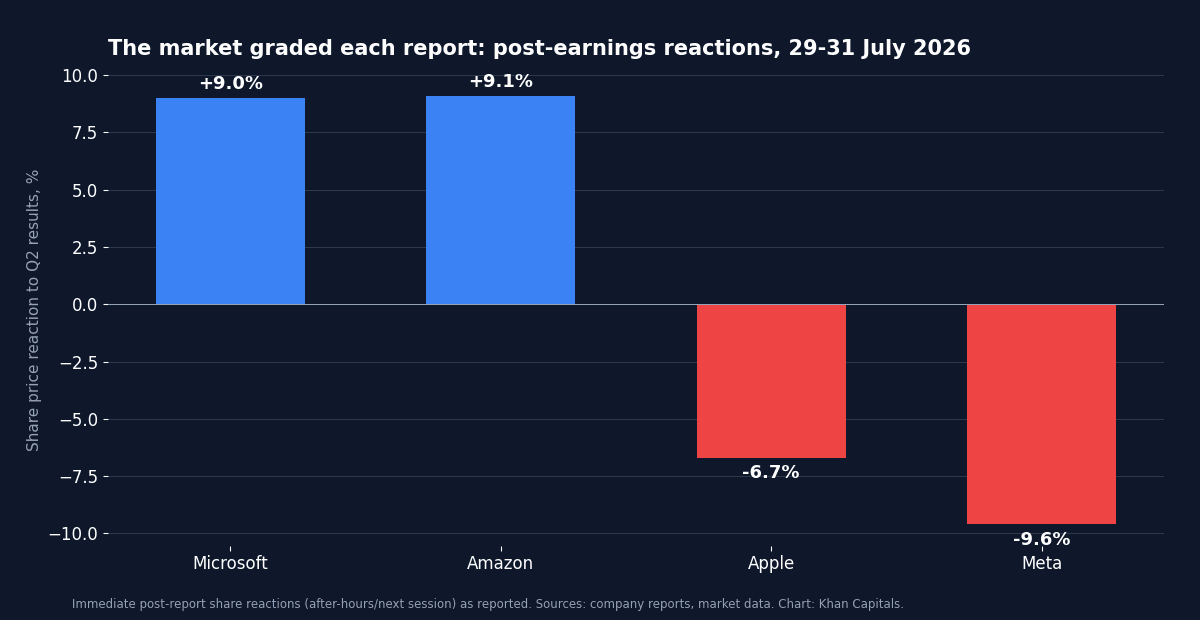
- Four giants reported, and the market split them ruthlessly. Microsoft rose 9 per cent and Amazon 9 per cent on their results, while Meta fell almost 10 per cent and Apple dropped hard on soft guidance, in the most consequential earnings week of the year.
- The judgment was about capex, not revenue. Every company grew revenue by double digits; the reactions tracked whether AI spending came attached to visible returns. Azure grew 32 per cent and AWS accelerated to 36.7 per cent, its fastest in 18 quarters; Meta raised its capex floor with free cash flow of just $784 million to show for it.
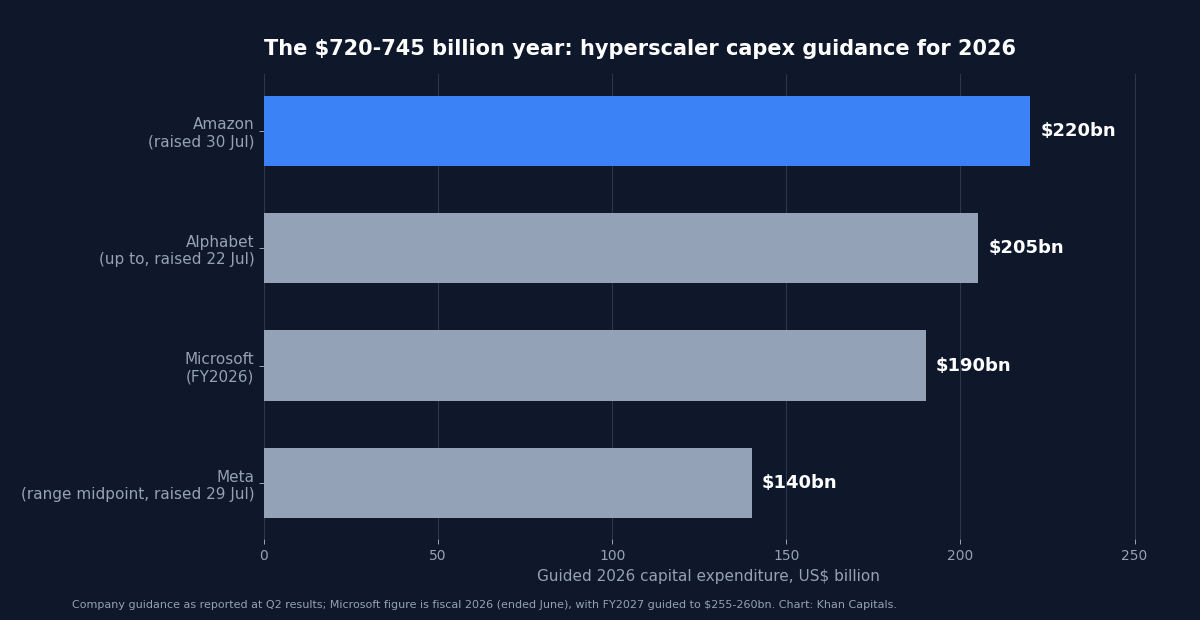
- The bill for 2026 is now $720 to $745 billion. With Amazon raising to roughly $220 billion and Meta to $135-145 billion, the four largest cloud builders’ combined 2026 capital spending guidance reached three quarters of a trillion dollars, and Microsoft guided fiscal 2027 to $255-260 billion, 35 per cent above this year.
- Winners added $1.5 trillion while the index fell. Alphabet, Amazon and Microsoft added nearly $1.5 trillion of combined market value on the week, yet the S&P 500 still closed out its first losing July since 2014.
- The AI trade has a new rule. The market no longer buys the build-out as a theme; it grades each builder’s spending against same-quarter revenue, and prices the difference within hours.
Part of: The AI Infrastructure Supercycle – Khan Capital’s hub on the AI infrastructure build-out.
Four Reports, One Question
The big tech earnings week of 29 to 31 July arrived with the market in an unusually unforgiving mood. July had already delivered a semiconductor bear market, a capex-driven repricing of Alphabet, and a Federal Reserve meeting that pushed long-term yields to 19-year highs. Into that mood walked Microsoft, Meta, Apple and Amazon, carrying between them the answer to the only question that now matters to equity indices: is the largest capital spending programme in corporate history producing returns, or consuming them?
The answer the market extracted was: it depends which building you are standing in. By Friday’s close, Alphabet, Amazon and Microsoft had added nearly $1.5 trillion in combined value, Meta had surrendered a tenth of its market capitalisation, Apple had been marked down for a cautious forecast, and the S&P 500 had still completed its first losing July in twelve years. This was not a verdict on the AI build-out. It was four separate verdicts, and the differences between them are the story.
The Big Tech Earnings Scorecard
| Company | The beat | The sore point | Reaction |
|---|---|---|---|
| Microsoft | Revenue $90.0bn (+18%); Intelligent Cloud +32% | FY27 capex guided to $255-260bn | +9% |
| Meta | Revenue $60.8bn (+28%) | EPS $6.18 vs $7.14 expected; FCF $784m; capex floor raised to $135bn | -10% |
| Apple | Revenue $109.4bn; EPS $2.02 vs $1.89; iPhone +22% | Next-quarter growth guided to 9-11% vs 12% hoped; supply constraints | -7% |
| Amazon | Revenue $200.6bn; AWS +36.7%, fastest in 18 quarters | 2026 capex raised to ~$220bn; trailing FCF negative $7.6bn | +9% |
Nasdaq 100, the index where all four reporters live. Chart: TradingView.
The Winners Bought Credibility
Microsoft’s quarter was constructed to answer the sceptics. Revenue of $90.0 billion grew 18 per cent, the Intelligent Cloud segment grew 32 per cent to $39.3 billion, and headline earnings of $4.74 per share crushed the $4.24 consensus, though investors did well to notice that around 27 cents of that came from unusual items, chiefly a $3.2 billion unrealised gain on the company’s stake in Anthropic as the AI developer’s valuation jumped from $350 billion to $900 billion. The number that could have wrecked the print, fiscal 2027 capital spending guided to $255-260 billion, some 35 per cent above this year, instead passed almost unremarked. When cloud growth accelerates, the market treats capex as investment; the same figure against decelerating growth would have been treated as confession.
Amazon’s report made the same point more loudly. AWS revenue grew 36.7 per cent to $42.2 billion, the fifth consecutive quarter of acceleration and the fastest pace since 2021, and total revenue crossed $200 billion for the first time. Even a raised 2026 capex budget of roughly $220 billion, the largest of any company on earth, and trailing free cash flow that has swung to negative $7.6 billion could not dent the reception: the shares jumped 9 per cent toward records. The market’s logic is consistent, if unsentimental: Amazon and Microsoft are spending fortunes and showing the revenue those fortunes buy, in the same quarter, on the same page of the release.
The Losers Paid Cash
Meta grew revenue 28 per cent to $60.8 billion, ahead of expectations, and still suffered the week’s harshest treatment, because everything below the revenue line went wrong at once. Earnings of $6.18 per share missed the $7.14 consensus badly on legal and severance charges; quarterly capex reached $31.1 billion; the full-year budget’s floor was raised by $10 billion to a $135-145 billion range; and free cash flow, the metric that measures what is left after the data centres are paid for, collapsed to $784 million. A company generating three quarters of a billion dollars of quarterly free cash flow on sixty billion of revenue is, for that quarter, spending essentially everything it makes. Mark Zuckerberg’s hint at building a cloud business to sell excess compute, a pivot we flagged when the supply premise first cracked in June, reads increasingly like the plan for making the spending pay. The market wants the revenue first and repriced the shares 10 per cent lower while it waits.
Apple’s fall belongs in a different category, and the difference is instructive. The quarter itself was excellent: record June-quarter revenue of $109.4 billion, earnings ahead of estimates, and iPhone revenue up 22 per cent to $54.3 billion. The shares fell anyway, as much as 7 per cent after hours, on guidance for growth to slow to 9-11 per cent against hopes of 12, with management citing supply constraints, and on softness in China and Services. Apple is the one member of the four that is not spending a fortune on AI infrastructure, and it discovered that abstention buys no safety: without a capex story to grade, the market simply graded the growth, and the growth guide missed. In a week that punished spending without revenue, Apple was punished for revenue without a frontier.
The $745 Billion Ledger
Add the week’s guidance together and the scale of the programme comes into focus. Amazon at roughly $220 billion, Alphabet at as much as $205 billion following the raise that turned its free cash flow negative, Microsoft at around $190 billion for the fiscal year just ended, and Meta at $135-145 billion: the four largest cloud builders now expect to spend a combined $720 to $745 billion on capital projects in 2026, a figure that rivals the annual defence budget of the United States and dwarfs any private investment programme in history. Microsoft’s fiscal 2027 guidance suggests the number is still rising.
The accounting mechanics of that ledger are where the next phase of the story will be decided. Capital spending does not hit profits when the cheque is written; it arrives later, as depreciation, spread over the useful life of the asset. A build-out of this size is therefore a delayed-action commitment: the hundreds of billions being poured into data centres in 2026 will surface as hundreds of billions of cumulative depreciation charges through 2027-2030, and the revenue to absorb those charges has to arrive on schedule. That is why the market now reacts so violently to the pairing of capex and growth in each individual report. It is not judging this quarter; it is judging whether the depreciation wave already ordered will land on an income statement that can carry it.
| Company | 2026 capex guidance | The cash-flow consequence |
|---|---|---|
| Amazon | ~$220bn (raised from ~$200bn) | Trailing 12-month FCF negative at -$7.6bn |
| Alphabet | Up to $205bn | First negative FCF quarter of the AI era (Q2) |
| Microsoft | ~$190bn (FY26); FY27 guided $255-260bn | Capex growing ~35% into FY27 |
| Meta | $135-145bn (floor raised $10bn) | Quarterly FCF down to $784m |
What the Divergence Means for the AI Trade
Step back from the individual prints and the week resolves a question that has hung over markets since the semiconductor complex entered a bear market at the start of July: has the market lost faith in the AI build-out? The answer is no, and also that faith is no longer the operative word. The market believes in the build-out precisely as far as each builder can document returns, company by company, quarter by quarter. That is a regime change from 2024-2025, when a raised capex number anywhere in the complex lifted everything from utilities to uranium. The theme trade has become a stock-picker’s market, and the dispersion inside the week, nineteen percentage points between Amazon’s reaction and Meta’s, is the widest the AI era has produced for a single earnings cycle.
The reinforcement for the earnings winners was that the demand signal now runs through everyone’s numbers at once: the four buyers’ combined budgets underwrite the order books of TSMC, the memory makers and the power chain, and increasingly they are financed in ways that pull in credit markets too, as the $35 billion Apollo-Blackstone AI financing demonstrated earlier this summer. Three quarters of a trillion dollars of annual spending is no longer a technology story; it is a macroeconomic flow, large enough to move GDP arithmetic, credit issuance and, as this week showed, the composition of index returns even in a falling month.
Investor Implications
Equities. The clean lesson is dispersion: owning “AI” as an undifferentiated basket now carries the risk of holding the quarter’s Meta alongside the quarter’s Amazon. The market is rewarding demonstrated utilisation (cloud growth rates, backlog conversion) and penalising promised utilisation, which favours the hyperscalers with visible cloud engines over the builders still constructing their monetisation story. The concentration question sharpens too: three companies added $1.5 trillion in a week when the index fell, meaning index investors are increasingly holding a two-layer market, a handful of graded winners over a broad tape that no longer follows them.
Fixed income. A $720-745 billion capex programme is financed somewhere, and progressively less of it from internal cash flow as FCF compresses across the group. Expect continued heavy investment-grade issuance from the hyperscalers, more structured and private credit financings of the Apollo-Blackstone type, and a growing transmission channel between AI capex and credit markets that barely existed two years ago. Credit investors are, in effect, being offered the build-out’s bill just as spreads sit near generational tights.
Cross-asset. The build-out is now big enough to matter for macro variables: it is a material support to US capital investment in GDP, a driver of power demand and commodity consumption, and one reason the Fed’s hawks can argue the economy is absorbing 3.50 to 3.75 per cent rates without strain. The paradox of the week is that the stronger the capex cycle looks, the stronger the case for the higher-for-longer rates that pressure the long-duration equity multiples funding it. That loop, capex strength feeding rate risk feeding multiple risk, is the AI trade’s chief vulnerability into the autumn.
What to Watch
- Late August: Nvidia’s results, the supply-side mirror of this week’s demand signal and the next single print capable of regrading the whole complex.
- Mid-September: the Fed decision; the higher-for-longer path is the discount rate on every one of these capex programmes.
- October: the Q3 reporting round, where Meta’s monetisation narrative and Amazon’s AWS momentum face their first re-examination under the new grading regime.
- Ongoing: hyperscaler bond and private credit issuance, the clearest running indicator of how much of the $745 billion is being financed rather than earned.
Conclusion
The week of 29 July will be remembered as the moment the AI trade stopped being a belief and became an audit. Four companies presented the same strategy, spend historic sums to build the computing base of the next decade, and received four different grades, separated by nineteen percentage points, on a single criterion: show the revenue now. Microsoft and Amazon could; Meta asked for time; Apple, outside the race, was judged by the old rules and found merely mortal. With three quarters of a trillion dollars committed for this year alone and the depreciation wave beginning to build beneath the income statements, the grading will only get stricter. The build-out’s believers and sceptics finally agree on the test; they differ only on who passes the next one.
Frequently Asked Questions
Why did Meta’s stock fall despite record revenue?
Meta grew revenue 28 per cent to $60.8 billion, but earnings of $6.18 per share missed the $7.14 consensus on legal and severance charges, free cash flow collapsed to $784 million as quarterly capital spending hit $31.1 billion, and the company raised the floor of its 2026 capex budget to $135 billion. The market punished the combination of rising spending and shrinking cash generation, not the revenue.
How much are the big tech companies spending on AI in 2026?
The four largest cloud providers, Amazon, Alphabet, Microsoft and Meta, now guide to a combined $720 to $745 billion of capital spending in 2026, most of it directed at data centres and AI infrastructure. Amazon leads at roughly $220 billion, and Microsoft has guided its fiscal 2027 spending to $255-260 billion, around 35 per cent above its fiscal 2026 level.
Why did Apple fall if it beat expectations?
Apple’s June quarter beat on revenue and earnings, with iPhone sales up 22 per cent. The shares fell because guidance for the current quarter implied growth slowing to 9-11 per cent against hopes of about 12 per cent, with management citing supply constraints, alongside softer China and Services trends. Markets price the forecast, not the quarter just ended.
Sources: SiliconANGLE on Microsoft; CNBC on Meta; Fortune on Meta; CNBC on Amazon; CNBC on Apple; CNBC on the week’s moves; Fortune preview.
Related Reading: For the print that set this week’s template, see Alphabet’s $205 Billion Capex: The Quarter the AI Build-Out Turned Cash Flow Negative. On the supply side of the same trade, read The Semiconductor Bear Market and TSMC Q2 2026 Earnings. For how the build-out is being financed, see The $35 Billion Test. The software side of the verdict arrived days later in Palantir’s 93 per cent quarter that split the AI trade. The market cap milestone that followed, and the melt-up around it, is covered in Amazon’s $3 trillion market cap. For the fundamentals, start with capex vs opex and the accounting behind the AI build-out and why guidance moves stocks more than results. The financing leg of the same build-out was priced in August by CoreWeave’s second quarter. The week the rotation set records while strong AI results were sold is covered in the small-cap rotation week. The same reflex, a whole category repriced on one qualitative headline, drove the mRNA cancer vaccine breakthrough. Nvidia’s own verdict arrived in the $96 billion quarter the market finally bought. For the latest, see Broadcom AI revenue tripled to $16.7 billion.

Leave a Reply