Khan Capitals | July 2026
Key Takeaways
- Intel Q2 2026 earnings beat on every line: revenue of $16.1 billion against consensus of $14.42 billion and adjusted earnings of 42 cents per share against 21 cents expected, according to figures reported by CNBC, with 25 per cent year-on-year growth marking the company’s fastest expansion since 2011.
- Data Centre and AI was the engine: segment revenue rose 59 per cent to $6.3 billion, and chief executive Lip-Bu Tan told investors that demand for Intel’s AI server processors now exceeds the company’s production capacity.
- The foundry story advanced but remains lossmaking: Intel Foundry revenue rose 31 per cent to $5.8 billion, most of it internal, while the unit lost $2.1 billion in the quarter; external foundry revenue was just $293 million.
- The print landed in a sector bear market: Intel shares had fallen 21 per cent in the seven trading sessions before results as the Philadelphia Semiconductor Index entered a 20 per cent drawdown, a collision between collapsing sentiment and accelerating fundamentals.
- Spending is going up, not down: Intel raised 2026 capital expenditure above $20 billion and guided 2027 significantly higher, keeping it inside the AI infrastructure build-out that the equity market spent July questioning.
Part of: The AI Infrastructure Supercycle – Khan Capital’s hub on the AI build-out.
Intel Q2 2026 earnings arrived on 23 July with the sector around them in retreat. The company reported its fastest revenue growth in roughly fifteen years, a $1.7 billion beat against consensus, and gross margin nearly three percentage points above its own guidance, in the same month that semiconductor stocks entered their first bear market since 2022. That collision, between a sector-wide drawdown driven by fears about artificial intelligence returns and a set of results that suggest those returns are arriving at Intel of all places, is the most instructive earnings event of the season so far.
Intel Q2 2026 Earnings: The Numbers That Broke the Script
The headline figures deserve restating because of how far they sit from where consensus stood. Revenue of $16.1 billion beat the $14.42 billion analysts expected by nearly 12 per cent, a margin of surprise that large companies rarely deliver. Adjusted earnings per share of 42 cents doubled the 21 cent estimate. Non-GAAP gross margin reached 41.8 per cent, 280 basis points above guidance. Growth of 25 per cent year on year was, as Data Center Dynamics noted, the fastest Intel has recorded since 2011, when the company was riding the last great PC and server refresh cycle.
Guidance held the gains rather than extending them dramatically: the current quarter is framed around adjusted earnings of 38 cents per share on revenue of $15.8 billion to $16.8 billion. On the call, management attributed the beat to demand across data centre and client segments running ahead of supply, an inversion of the position Intel occupied for most of the past decade, when the question was whether anyone still needed what it made.
Where the Growth Came From
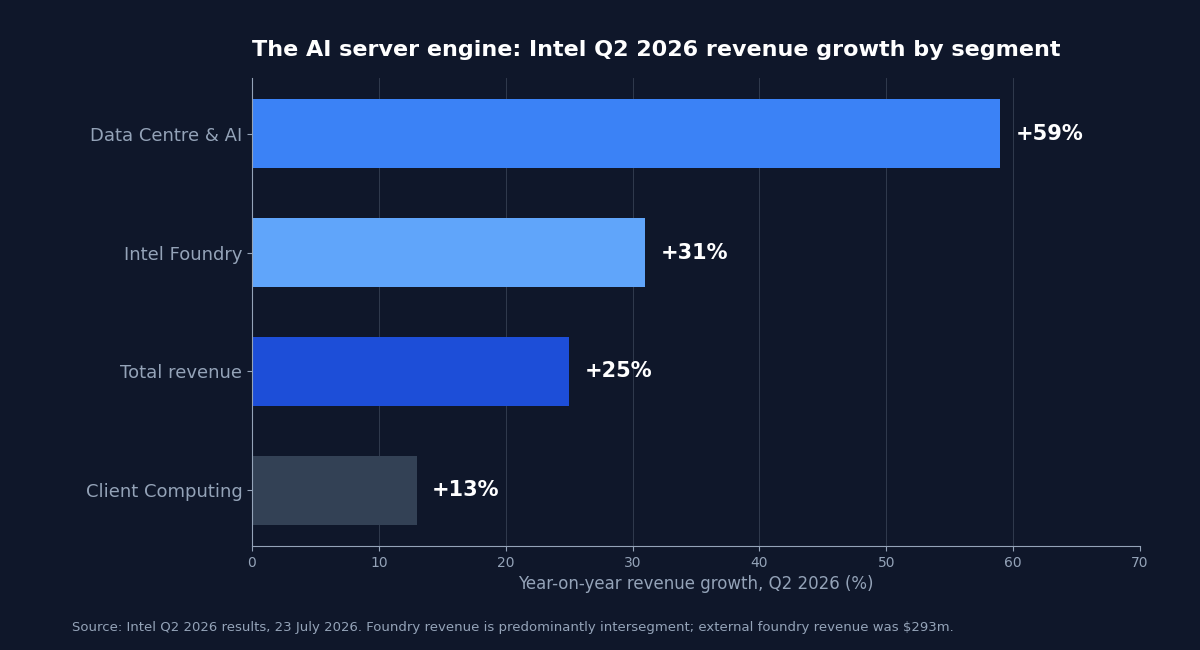
The segment split tells the story more precisely. Data Centre and AI revenue rose 59 per cent to $6.3 billion, the fastest-growing part of the company and the source of the beat. Client Computing, the PC business that remains Intel’s largest segment at $8.9 billion, grew a steadier 13 per cent. Intel Foundry recorded $5.8 billion of revenue, up 31 per cent, though the overwhelming majority of that is internal: Intel’s own products paying the foundry for wafers. External foundry revenue, the money paid by outside customers that the entire turnaround thesis ultimately rests on, was $293 million.
The 59 per cent data centre figure deserves scrutiny because of what sits behind it. Intel is not winning the AI accelerator market; Nvidia’s position there remains commanding, as we examined when H200 exports to China resumed. What Intel is selling is the CPU that sits beside the accelerator in every AI server, the head node that orchestrates the GPUs, plus a growing volume of inference workloads that run on processors rather than accelerators. As AI clusters multiply, the attach rate does too. Management’s claim that server CPU demand now exceeds production capacity is the sort of statement that would have seemed fanciful eighteen months ago.
| Metric | Q2 2026 reported | Consensus / guidance | Surprise |
|---|---|---|---|
| Revenue | $16.1bn | $14.42bn | +11.7% |
| Adjusted EPS | $0.42 | $0.21 | +100% |
| Non-GAAP gross margin | 41.8% | 39.0% guided | +280bps |
| Data Centre & AI revenue | $6.3bn (+59%) | n/a | n/a |
| Q3 revenue guide | $15.8-16.8bn | n/a | n/a |
A 21 Per Cent Drawdown Meets a Record Quarter
The timing is what makes this print unusual. Intel entered its results having lost 21 per cent in seven trading sessions, part of the sector-wide unwind we documented in the semiconductor bear market: the Philadelphia Semiconductor Index down more than 20 per cent from its late-June record, Moonshot AI’s Kimi K3 release reviving fears of commoditised models, and a market newly hostile to any company spending heavily on AI infrastructure. Intel, still up roughly 163 per cent for the year even after the slide and among 2026’s best-performing large caps, had further to fall than most and fell faster: an early-July report of 18A yield problems compounded the pressure.
The results contradicted the most specific of those fears directly. Panther Lake processors are in high-volume manufacturing on 18A, the follow-on 18A-P node has entered risk production, and management said 18A yields are tracking ahead of internal expectations, with the company now committed to bringing its next node, 14A, into high-volume production in 2028. Shares rose around 5 per cent in the immediate aftermath. One quarter does not settle a bear market argument, but it does relocate the burden of proof.

The Foundry Question, Honestly Framed
The equity story that carried Intel up more than 300 per cent over the past year is not really about selling more server CPUs. It is about whether Intel Foundry becomes the credible Western alternative to TSMC, and that story is still mostly promise. The unit lost $2.1 billion this quarter. External revenue of $293 million represents under 2 per cent of company sales. Reports through July of design commitments from Apple and Microsoft, the two largest Western buyers of custom silicon, are the reason the market pays up for the option; HSBC analysts have argued both relationships could produce early revenue in the second half of 2026. Until external wafers ship at scale, the foundry remains an option on execution rather than an earnings stream, and options reprice violently in both directions.
What changed this quarter is the cost of doubting the execution. A company that guides its capital expenditure above $20 billion for 2026 and signals a significant increase for 2027, while its yields improve and its largest prospective customers deepen their commitments, is behaving like a business that believes its own roadmap. The March 2025 appointment of Lip-Bu Tan, whose career at Cadence was built on disciplined turnaround execution, was widely treated as the moment the turnaround became investable. Six quarters on, the numbers are beginning to agree.
What the Sector Selloff Was Actually Pricing
Step back from Intel specifically and the tension becomes a sector-level question. July’s semiconductor drawdown was driven by an argument about demand: that AI capital expenditure would disappoint, that Chinese open-weight models would compress the economics of the entire stack, that the hyperscalers’ spending was about to be cut. Intel’s quarter is evidence on the other side of that argument, and it is not alone. TSMC’s record June quarter, which we covered in TSMC’s Q2 results, and Samsung’s ₩89 trillion quarter pointed the same direction. Across the industry’s reporting season, the demand data keeps beating while the stocks keep de-rating.
Two readings are available. The bearish one is that the market is correctly looking through current-quarter strength to a 2027 in which AI infrastructure spending finally digests, in which case record results now are exactly what a cycle peak looks like; the moment supply catches demand is the moment the shortage premium in prices and margins evaporates. The bullish one is that the selloff was a sentiment event, catalysed by a Chinese model release and amplified by positioning, and that the fundamental data never confirmed it. The bearish reading has history on its side; semiconductors are a cyclical industry that has punished extrapolation at every peak. The bullish reading has the current numbers. The distinction that matters for Intel is that its growth is coming off a depressed base with a company-specific catalyst attached, which is a different exposure from paying peak multiples on peak margins elsewhere in the sector.
| Scenario | Key assumptions | What it implies for the shares |
|---|---|---|
| Bull: foundry converts | Apple and Microsoft 18A volumes ramp in 2027; external revenue scales toward a break-even foundry; server CPU shortage persists | The 2026 re-rating resumes; Intel trades as a strategic asset rather than a cyclical |
| Base: execution, slowly | 18A ships on schedule; external foundry grows but losses persist into 2027; data centre growth moderates from 59% | Earnings compound but the multiple stalls; shares track EPS revisions |
| Bear: cycle rolls over | AI capex digests in 2027; server CPU demand normalises; foundry customers delay volume commitments | A high-capex company meets falling demand; the July drawdown resumes with fundamentals now confirming it |
Live Chart: Intel (NASDAQ: INTC)
Investor Implications
Equities. The quarter reframes the July semiconductor selloff as a stock-picking environment rather than a uniform de-rating. Companies reporting acceleration into depressed sentiment, Intel this week, TSMC the week before, are being repriced upward on results days even as the sector index languishes, which suggests the market is differentiating between AI spending narratives and AI revenue evidence. Investors weighing the sector may wish to distinguish between businesses priced for the cycle continuing and those, like Intel, still priced with substantial scepticism embedded. The foundry option remains the swing factor: external revenue of $293 million against a $2.1 billion segment loss means the turnaround case still rests on 2027 delivery, not current earnings.
Fixed income. A capital programme above $20 billion for 2026, rising further in 2027, keeps Intel among the largest issuers of investment-grade paper in the technology sector. Improving operating cash flow eases the funding arithmetic, but with credit spreads at record tights, bondholders are being paid little for the execution risk that equity holders are pricing so visibly. Cross-asset, the wider question from this earnings season is whether the AI build-out’s cash demands keep landing in credit markets at spreads that assume nothing can go wrong.
Cross-asset. Semiconductor equipment names, memory suppliers and the industrial complex around fab construction all key off the capex signals in this report. Intel raising spending into a sector drawdown, alongside TSMC’s elevated budget, argues that the physical build-out is not slowing even as its equity valuation does. That divergence, real economy acceleration against financial market doubt, echoes the pattern we described in Samsung’s sold-off record quarter and tends to resolve with a lag, in one direction or the other.
What to Watch
- 28-29 July 2026: the FOMC decision, with futures pricing a meaningful chance of a hike; the discount rate applied to long-duration semiconductor earnings moves with it.
- Late July 2026: Microsoft, Meta and Amazon report; their capital expenditure guidance is the single most direct test of the AI demand thesis Intel’s quarter supports.
- Second half 2026: any announcement converting the reported Apple and Microsoft 18A design work into disclosed volume agreements or recognised external foundry revenue.
- October 2026: Intel’s Q3 report against the $15.8-16.8 billion revenue guide; a second consecutive beat-and-raise would force consensus 2027 models materially higher.
Conclusion
Intel delivered its strongest quarter in fifteen years into the least receptive tape imaginable, and the shares still rose. That is information. The July bear market in semiconductors was built on the proposition that AI infrastructure demand was about to disappoint; Intel’s 59 per cent data centre growth, capacity-constrained server shipments and rising capex are direct evidence against it, at least for now. The unresolved question is the one the bulls least want asked: whether this is what the top of a cycle looks like, record numbers and record spending announced just before the digestion phase begins. The foundry losses guarantee that Intel’s re-rating remains an argument about 2027 rather than a settled fact. But after 23 July, the burden of proof in that argument has shifted, and it no longer rests with the company.
Frequently Asked Questions
What did Intel report in its Q2 2026 earnings?
Intel reported revenue of $16.1 billion, up 25 per cent year on year and its fastest growth since 2011, with adjusted earnings of 42 cents per share against expectations of 21 cents. Non-GAAP gross margin of 41.8 per cent came in 280 basis points above guidance, and the company guided the current quarter to revenue of $15.8 billion to $16.8 billion.
Why did Intel’s data centre revenue grow 59 per cent?
AI server build-outs require host CPUs alongside accelerators, and a growing share of inference workloads runs on processors rather than GPUs. Intel’s chief executive said demand for its AI server CPUs now exceeds production capacity, so the segment grew to $6.3 billion as cloud and enterprise customers expanded AI clusters.
Is Intel’s foundry business profitable?
No. Intel Foundry lost $2.1 billion in Q2 2026 despite segment revenue of $5.8 billion, most of which came from Intel’s own products. External customers contributed $293 million. The investment case rests on reported design commitments from Apple and Microsoft converting into volume production on the 18A process, which analysts suggest could begin generating revenue in the second half of 2026.
Why did Intel shares fall before the results?
Intel lost 21 per cent in the seven trading sessions before results as the whole semiconductor sector entered a bear market, driven by fears that AI capital spending would disappoint and by a Chinese open-weight model release that revived competition concerns. An early-July report of yield problems on Intel’s 18A process added company-specific pressure that the results subsequently contradicted.
Sources: CNBC, Intel Q2 2026 earnings report; Data Center Dynamics, Intel Q2 2026 results coverage; Intel investor relations; TechTimes, AI server demand outstrips supply; TradingKey, Intel 18A foundry and customer coverage.
Related Reading: This result lands directly against the backdrop of the semiconductor bear market that unwound a 105 per cent rally, and alongside the season’s other capacity-constrained prints in TSMC’s Q2 2026 earnings and Samsung’s record quarter the market sold. The policy backdrop for Intel’s China exposure is covered in Nvidia’s H200 China exports, and the funding side of the AI build-out in Alphabet’s $205 billion capex. For the fundamentals, start with how earnings season works and why guidance moves stocks more than results.

Leave a Reply