
Khan Capitals | July 2026
Key Takeaways
- Every headline metric printed above the top of its own guidance. Revenue of $40.20 billion against a $39.0 to $40.2 billion range, a gross margin of 67.7 per cent against 65.5 to 67.5 per cent, and an operating margin of 60.3 per cent against 56.5 to 58.5 per cent, per TSMC’s own results disclosure.
- Profit set a fifth consecutive record. Net income reached NT$706.56 billion, up 77.4 per cent on the year and roughly 13 per cent above the consensus estimate compiled by Bloomberg.
- The full-year growth forecast went up, not down. Management now expects 2026 revenue to grow by more than 40 per cent in US dollar terms, raised from a previous forecast of more than 30 per cent.
- Capital spending was raised by around $8 billion at the midpoint, to a range of $60 to $64 billion from $52 to $56 billion, with a further $100 billion earmarked for capacity in Arizona.
- Margins were guided lower in the same breath. Third-quarter gross margin is guided to 65.0 to 67.0 per cent against the 67.7 per cent just delivered, which is the clearest signal in the release of what the next leg of this build-out costs.
Part of: The AI Infrastructure Supercycle – Khan Capital’s hub on the AI infrastructure build-out.
A Quarter That Beat Its Own Ceiling
There is a particular kind of quarterly result that tells you less about the company reporting it than about the industry standing behind it. The TSMC Q2 2026 earnings released on 16 July are that kind of result. Taiwan Semiconductor Manufacturing Company does not sell to consumers, does not design the chips that carry its name into data centres, and does not participate in the narrative cycles that move the companies it supplies. It converts capital into capacity and capacity into wafers. When it speaks, it is describing the physical constraint that everything else in the artificial intelligence trade has to pass through.
What it described was a quarter in which every headline number landed above the top of the range management had set three months earlier. Revenue came in at $40.20 billion, precisely at the ceiling of a $39.0 to $40.2 billion guide and 33.7 per cent higher than the same quarter a year ago. In local terms the figure was NT$1.27 trillion, up 36 per cent. Gross margin printed at 67.7 per cent when the guide had topped out at 67.5 per cent. Operating margin reached 60.3 per cent against a ceiling of 58.5 per cent. Net income of NT$706.56 billion was up 77.4 per cent on the year, a fifth straight quarter of record profit, and came in roughly 13 per cent above the NT$623.73 billion the sell side had pencilled in.
Beating a revenue guide by landing on its upper bound is, in TSMC’s case, close to a formality: the company publishes monthly revenue, so by the time the quarter is reported the top line is arithmetic rather than news. June sales alone hit a record NT$442.68 billion, up almost 68 per cent on the year, which is why the revenue line had been effectively known since 13 July. The margins were the news. Those are not pre-announced, and both cleared their ceilings at a moment when the market had spent six weeks arguing that the economics of this cycle were about to deteriorate.
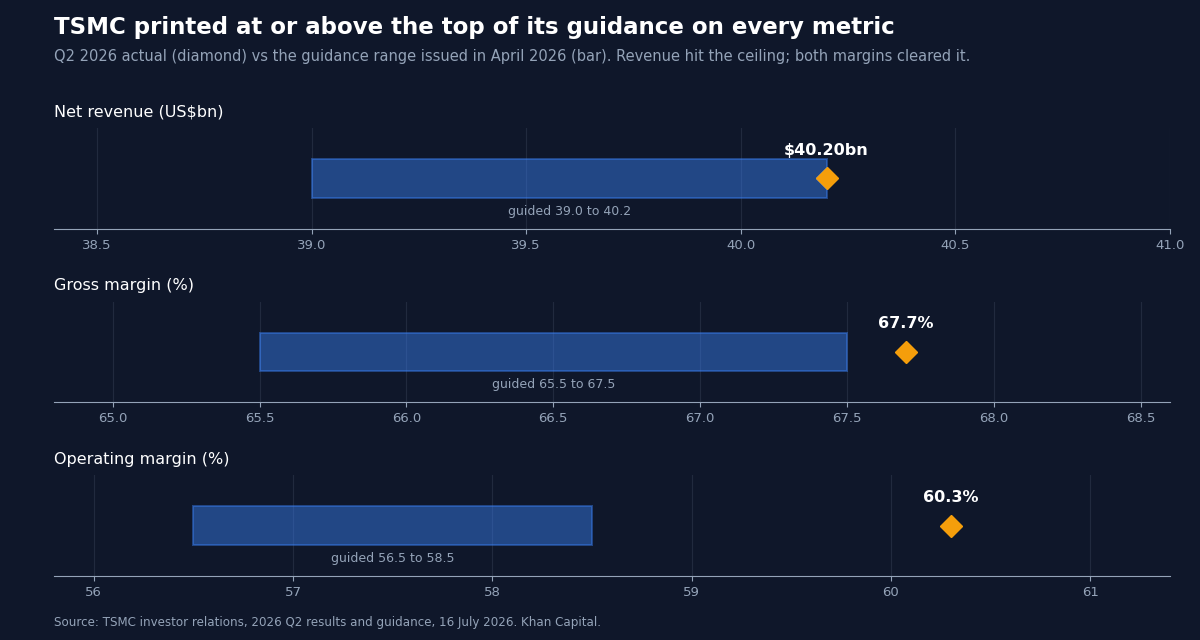
| Metric | Q2 2026 guidance | Q2 2026 actual | Outcome |
|---|---|---|---|
| Net revenue | $39.0bn to $40.2bn | $40.20bn | Top of range |
| Gross margin | 65.5% to 67.5% | 67.7% | Above range |
| Operating margin | 56.5% to 58.5% | 60.3% | Above range |
| USD/NTD assumption | 31.7 | 31.60 | Marginal headwind |
What TSMC Q2 2026 Earnings Say About the Demand Debate
To understand why this release matters beyond one share price, it helps to recall the argument it landed into. Since early June the semiconductor complex has been trading a thesis about deceleration. On 5 June the sector suffered its most violent selloff since March 2025, roughly a trillion dollars of market value, on no bad news at all. In early July Meta announced it would sell excess compute and OpenAI halved inference costs, and the market concluded that the supply premise had cracked: if compute could be resold and models could be run more cheaply, the scarcity that justified the capital expenditure was ending. A week later Samsung guided to a record quarter and fell 7 per cent. Good news had stopped working.
Against that backdrop, the single most consequential line in this release is not a result at all. It is a forecast. Management raised its expectation for full-year 2026 revenue growth to more than 40 per cent in US dollar terms, having already lifted it to more than 30 per cent on the first-quarter call. A company one quarter into a debate about whether demand is peaking has just told the market that its own year will be roughly ten percentage points better than it thought in April. Chief executive C.C. Wei described demand as extremely robust and said customers had provided strong demand signals, adding that “the AI megatrend continues to drive the need for more and more computation, which supports the demand for leading-edge silicon.”
Corporate optimism is cheap and every chief executive in this cycle has supplied plenty of it. What separates a forecast from a claim is whether the company is willing to fund it, and that is where this quarter distinguishes itself from most of what has been said about AI demand over the past eighteen months.
The Answer Came in Capital, Not Adjectives
TSMC raised its 2026 capital expenditure plan to a range of $60 to $64 billion, from $52 to $56 billion. At the midpoint that is an additional $8 billion of committed spending, decided inside a single quarter, on top of what was already the largest capital budget in the company’s history. Wei also said the company would invest a further $100 billion to expand production capacity in Arizona, extending a US manufacturing footprint that sits alongside its Taiwanese and Japanese hubs.
The distinction matters because capital expenditure at this company is not a marketing gesture. A leading-edge fabrication plant takes years to build and equip, cannot be repurposed if demand disappoints, and depreciates on a schedule that runs straight through the income statement whether or not the wafers are sold. Every dollar added to that budget is a dollar of fixed cost the company must fill. Firms facing a demand cliff do not raise capital budgets by 15 per cent; they defer, and they defer quietly, because the option to wait is free and the option to overbuild is not. The decision to spend is the strongest statement in the release precisely because it is the most expensive one to reverse.
The near-term demand signal is equally hard to read as deceleration. Third-quarter revenue is guided to $44.6 to $45.8 billion. The midpoint of roughly $45.2 billion implies a step of about $5 billion, or 12.4 per cent, on the record quarter just delivered. Sequential growth of that size, on a base above $40 billion, is not the shape of a cycle rolling over.

The Margin Is the Message
The most instructive number in the release is the one that goes the wrong way. Having just printed a 67.7 per cent gross margin, management guided the third quarter to 65.0 to 67.0 per cent. The midpoint of that range sits well below what was just achieved. Chief financial officer Wendell Huang attributed the deterioration to what he called an extreme ramp of the 2 nanometre process.
This is the part of the story most likely to be misread, because a guided margin decline reads instinctively as bad news. It is better understood as a receipt. New process nodes are dilutive to margin at the start of their lives: yields are immature, equipment is being commissioned faster than it is being filled, and depreciation begins before volume does. A company ramping a node aggressively will show a worse margin than one ramping it gently, and the more aggressive the ramp, the worse the optics and the better the underlying demand signal. Management is choosing to accept several points of gross margin in order to bring 2 nanometre capacity online faster than a margin-optimising schedule would allow. Companies do not sacrifice margin to accelerate capacity they expect to struggle to sell.
Read the three decisions together and they form a single sentence. Growth guidance up ten points, capital budget up $8 billion, margin guidance down two to three points. That is a company converting profitability into capacity as fast as physics and equipment lead times allow, which is what a genuine supply constraint looks like from the inside. It is also, uncomfortably for the deceleration thesis, the opposite of what a firm anticipating a demand ceiling would do with the same information.
The Currency Did Not Help, Which Matters
One detail deserves more attention than it will receive. TSMC’s April guidance assumed an exchange rate of 31.7 New Taiwan dollars to the US dollar. The quarter actually settled at 31.60. TSMC bills largely in US dollars and carries a substantial share of its costs in New Taiwan dollars, so a stronger local currency compresses reported margin. The company did not clear the top of its margin range because the currency flattered it; it cleared the top despite the currency working modestly against the assumption baked into the guide. The operational beat is therefore slightly larger than the headline comparison suggests.
The same detail cuts the other way looking forward. Third-quarter guidance assumes 32.0, a weaker local currency than either the assumption or the outturn in the second quarter. Part of the guided margin range therefore already embeds a currency tailwind, which makes the guided decline attributable to the 2 nanometre ramp rather more pointed than it first appears.
Why This Is Not Samsung’s Quarter
The obvious objection is that Samsung also reported a record and was sold anyway. The comparison is worth taking seriously, and it breaks down on the question of what each company actually controls.
Samsung’s record quarter was substantially a price event. Memory is a commodity with multiple credible suppliers, and when memory prices rise, every producer’s earnings rise together. That is precisely why the market discounted the result: a number driven by a price that can fall as quickly as it rose deserves a lower multiple than a number driven by a position that cannot be replicated. The same logic runs through the memory supercycle and the price rises now reaching consumers.
TSMC’s position is different in kind. At the leading edge there is no second source at scale, and advanced packaging capacity, the constraint that actually gates how many accelerators reach a data centre, is concentrated further still. When TSMC raises its capital budget, it is not adding to an industry-wide pool of interchangeable supply; it is relieving a bottleneck that only it can relieve. That is why its guidance carries information the rest of the complex does not: it is the closest thing this cycle has to a physical measurement, and it is the reason the same raised forecast should not be discounted the way a memory price forecast reasonably is.
The Case for Caution
None of this makes the deceleration argument foolish, and there are three honest reasons to hold this result more loosely than the numbers invite.
The first is that TSMC’s visibility is derived, not primary. It sees customer orders, and customer orders reflect what hyperscalers and chip designers currently intend to spend. Intentions have been revised before. The company was equally confident at the top of previous semiconductor cycles, and a foundry is always the last to learn that its customers have changed their minds, because orders are placed years ahead of the demand they anticipate.
The second is that a raised capital budget is a demand signal today and a fixed cost forever. The operating leverage that produces a 60.3 per cent operating margin in a strong quarter works with equal force in reverse. A $60 to $64 billion budget assumes a level of utilisation that has to be sustained for years, and the depreciation it creates does not care whether the AI trade holds.
The third is concentration. Both the demand and the geography are narrow. A small number of customers account for a large share of leading-edge orders, and the productive capacity remains overwhelmingly located across the Taiwan Strait from a state that disputes the island’s status. The Arizona expansion addresses the second problem slowly and at a cost to margin; nothing addresses the first.
| Scenario | What it would require | Gross margin path | Evidence to watch |
|---|---|---|---|
| Bull | Growth above 40% delivered and the 2026 capex range lifted again into 2027 | Trough near 65% in H2, recovering as 2nm yields mature | A further capex raise; advanced packaging still sold out |
| Base | Growth lands above 40% and capex holds at $60bn to $64bn | 65% to 67% through the ramp, stabilising in 2027 | Q3 revenue inside the $44.6bn to $45.8bn guide |
| Bear | Hyperscaler budgets trimmed; orders deferred rather than cancelled | Below 65% as utilisation falls against fixed depreciation | Capex guided down; a Q4 guide below the Q3 run-rate |
Investor Implications
For equities, the release re-establishes a distinction the market blurred during the June selloff. The AI complex has been trading as a single instrument, in which a datapoint about inference costs or resold compute moves foundries, memory makers and accelerator designers alike. This result argues those exposures are not interchangeable. Companies selling into a constraint that only they can relieve should not reprice on evidence that a different, contestable input has become cheaper. Whether the market honours that distinction is a separate question from whether it exists.
For the semiconductor equipment chain, an $8 billion increase in the midpoint of the largest capital budget in the industry is a direct read-through, with the majority of leading-edge spending flowing to a small group of tool suppliers. That transmission is mechanical rather than sentimental: budgets become purchase orders on a known lag.
For fixed income, the relevant channel is supply. Capital programmes of this magnitude across the AI complex are increasingly funded in credit markets, which is what made the $35 billion Apollo and Blackstone financing a genuine price-discovery event rather than a curiosity. A step up in industry-wide capital intensity implies a larger pipeline of AI-linked issuance, and the spread at which that paper clears remains the cleanest market test of how the build-out is being underwritten.
Cross-asset, the concentration point cuts both ways. A build-out that runs through a single company on a single island is a growth story and a geopolitical exposure expressed in the same securities, and the Arizona commitment is best read as an expensive, slow attempt to reduce a risk that cannot currently be hedged in size.
What to Watch
- Monthly revenue, from 10 August: TSMC’s July disclosure is the first read on whether the quarter is tracking to the $44.6 billion to $45.8 billion guide, and it arrives two months before the result.
- Hyperscaler capital expenditure, late July into August: the customer side of this order book reports over the coming weeks, and the budgets disclosed there are what TSMC’s raised forecast is implicitly underwritten by.
- The Q3 result, October: the first quarter in which the 2 nanometre ramp hits the reported gross margin rather than the guided one, and the test of whether 65 per cent is a floor or a waypoint.
- Any further capex revision: a budget lifted twice in two quarters would say more about the durability of this cycle than any forecast management offers in words.
Conclusion
The market spent six weeks constructing a case that the AI build-out was approaching its ceiling, assembled from inference costs, resold compute and the treatment of Samsung’s record. This quarter is the first hard evidence from the constraint itself, and it points the other way. The company that decides how much leading-edge silicon exists raised its growth forecast by roughly ten percentage points, raised its capital budget by $8 billion, and agreed to give up several points of gross margin to bring capacity forward.
That combination is not a claim about demand; it is a commitment against it. It can still be wrong, and the mechanism by which it would be wrong is well understood: orders are intentions, intentions get revised, and fixed costs do not. But the burden of proof has moved. Anyone arguing the build-out is peaking now has to explain why the one participant with the least incentive to overbuild, and the most expensive way of being mistaken, has just chosen to spend $8 billion more finding out.
Frequently Asked Questions
What did TSMC report for the second quarter of 2026?
TSMC reported revenue of $40.20 billion, at the top of its $39.0 billion to $40.2 billion guidance and 33.7 per cent higher than a year earlier. Gross margin was 67.7 per cent and operating margin 60.3 per cent, both above the top of their guided ranges. Net income was NT$706.56 billion, up 77.4 per cent on the year and a fifth consecutive record.
Why did TSMC guide gross margin lower for the third quarter?
Management guided third-quarter gross margin to 65.0 to 67.0 per cent, below the 67.7 per cent just delivered, and attributed the decline to what the chief financial officer described as an extreme ramp of the 2 nanometre process. New process nodes dilute margin early in their lives because yields are immature and depreciation begins before volume does. A faster ramp produces a weaker near-term margin.
How much is TSMC spending on capacity in 2026?
TSMC raised its 2026 capital expenditure plan to $60 billion to $64 billion, from a previous range of $52 billion to $56 billion, an increase of roughly $8 billion at the midpoint. Chief executive C.C. Wei also said the company would invest a further $100 billion to expand capacity in Arizona.
What does TSMC’s guidance imply about AI demand?
Management raised its full-year 2026 revenue growth forecast to more than 40 per cent in US dollar terms, up from more than 30 per cent, and guided third-quarter revenue to $44.6 billion to $45.8 billion. The midpoint implies a sequential step of roughly $5 billion on a record quarter. Because TSMC is funding that view with an enlarged capital budget rather than describing it, the signal is harder to discount than commentary alone.
Sources: TSMC 2026 Q2 quarterly results and guidance; TSMC monthly revenue disclosures; Investing.com, TSMC Q2 profit soars to record high on AI demand; CNBC, TSMC reports 68% surge in June revenue; Forbes, TSMC’s second quarter will test whether the AI build-out has a ceiling; TSMC advanced packaging.
Related Reading: TSMC’s raised budget lands in a complex that spent six weeks arguing the opposite case, from the $1 trillion AI semiconductor selloff to the week the supply premise cracked. For the contrast with a record quarter the market sold, see Samsung’s Q2 earnings; for the input TSMC does not control, see Micron and the AI memory supercycle and NVIDIA’s SK hynix HBM deal. For the fundamentals, start with capex vs opex and how guidance moves a stock. For the capital-markets echo of the build-out, see SK Hynix’s record Nasdaq listing. The policy dimension shifted the same week as Nvidia’s H200 China exports began. The demand-side answer arrived a week later in Alphabet’s $205 billion capex quarter. The sector’s latest print is analysed in Intel’s Q2 2026 earnings, the fastest growth in 15 years. For the buyers of that capacity being graded in turn, see the big tech earnings capex verdict.

Leave a Reply