
Khan Capitals | October 2026
Key Takeaways
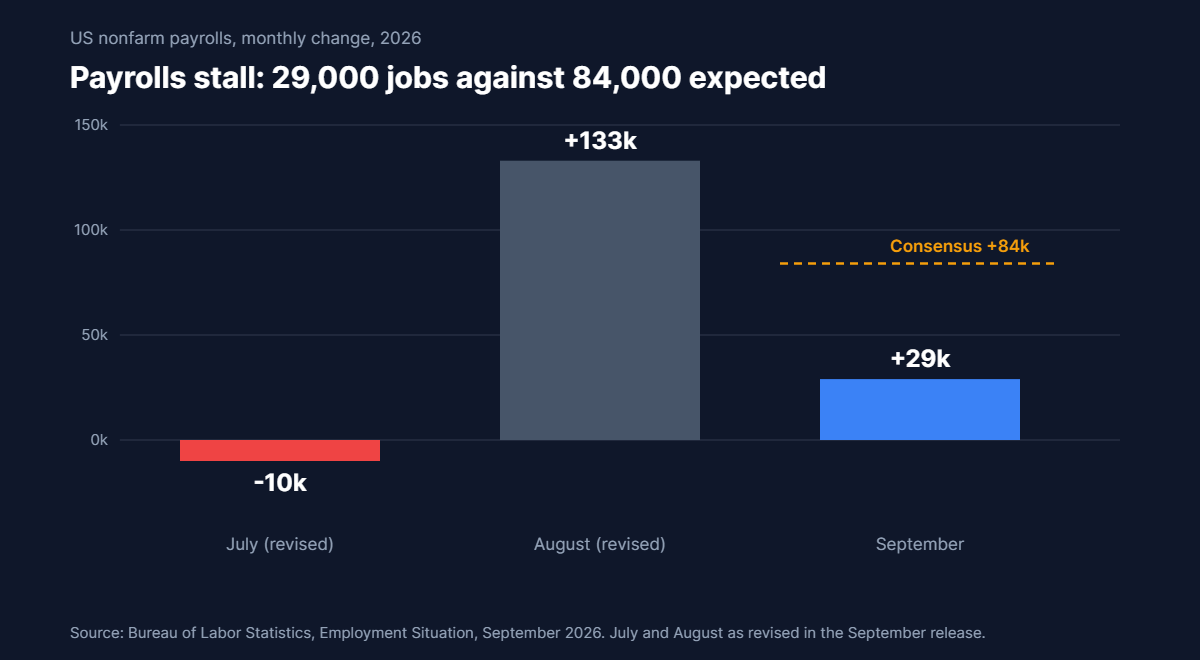
- Payrolls missed badly. The US economy added 29,000 jobs in September against a consensus near 84,000, and the Bureau of Labor Statistics said employment changed little in every major industry. It is the weakest print since July’s decline.
- The revisions cut deeper. July was revised back down to a loss of 10,000 and August trimmed to 133,000, removing 60,000 jobs from the previously reported count. The summer slowdown that August’s report appeared to erase has been partially reinstated.
- Unemployment rose for a good reason. The jobless rate ticked up to 4.2 per cent, but the labour force swelled by 485,000 and participation rose 0.2 points to 61.8 per cent, its highest since May. People are coming back to look for work faster than employers are hiring them.
- Wage growth is the quiet story. Average hourly earnings rose just 0.1 per cent on the month, taking the annual rate to 3.0 per cent, the lowest since May 2021. Whatever is driving inflation in this economy, it is not pay packets.
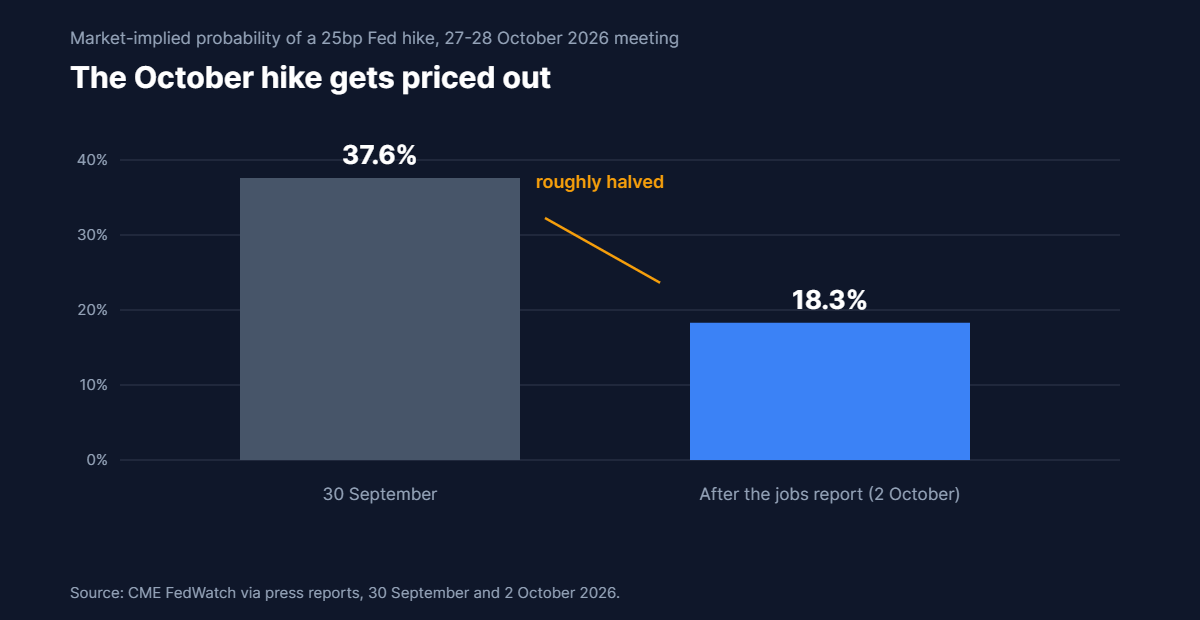
- October hike odds roughly halved. Futures pricing tracked by the CME FedWatch tool fell from 37.6 per cent at the end of September to below 20 per cent after the release, three weeks after the Federal Reserve delivered its first hike since 2023.
Part of: The Fed’s Regime Change — Khan Capital’s hub on the 2026 shift from cuts to hikes.
The September Jobs Report Hands the Fed a Contradiction
Three weeks after the Federal Reserve raised interest rates for the first time since 2023, the September jobs report arrived carrying the strongest argument yet against doing it again soon. Payrolls rose by 29,000, well short of the roughly 84,000 economists expected, and the two prior months were revised down by a combined 60,000. A central bank that hiked in September to insure against oil-driven inflation now faces a labour market that, on this evidence, is barely adding jobs at all. The question the release poses is uncomfortable in both directions: the inflation the Fed is fighting has not gone away, and the labour market it was counting on to absorb tighter policy looks softer than it did a month ago.
The reaction was immediate. Equities rallied as Treasury yields retreated, on the logic that a soft labour market keeps the Fed on hold at its late-October meeting. Futures pricing tracked by the CME FedWatch tool, which had put the probability of a second consecutive hike at 37.6 per cent at the end of September, fell to below 20 per cent. Prediction markets told the same story, with a hold priced at more than 80 per cent. Three weeks of hawkish momentum, built on a unanimous vote and a dot plot promising more, gave a third of itself back in a morning.
The Revisions Giveth, and the Revisions Taketh Away
Regular readers will recognise the pattern. In early September, the August jobs report stunned with 162,000 jobs and revised July’s decline of 23,000 into a gain of 21,000, erasing the data point on which the entire summer slowdown narrative rested. One month later, the September report has revised much of it back: July now stands at a loss of 10,000, and August’s 162,000 has been trimmed to 133,000. The level of employment is 60,000 lower than previously reported.
Each individual revision has a mundane explanation: late survey responses, recalculated seasonal factors. But the cumulative effect is corrosive to confidence in any single print. In the space of two months, July 2026 has been a 23,000-job decline, a 21,000-job gain and a 10,000-job decline. Positioning built on the first print was wrong-footed by the second, and positioning built on the second has now been wrong-footed by the third. We made the point after the August report that first prints near zero carry unusually wide error bands; September’s release is that argument restated with new numbers. The signal is not in any one month but in the trend, and the trend is unambiguous: monthly payroll growth has averaged roughly 51,000 over the third quarter, a fraction of the 150,000 to 200,000 once considered normal.
Inside the 29,000: Narrow Gains, Broad Stall
The sector composition shows an economy where hiring has narrowed to a handful of reliable engines, and even those are slowing. Health care added 17,000 jobs, the largest contribution of any sector, but that is roughly half its twelve-month average of 33,000, and gains in ambulatory care and hospitals were partly offset by a 9,000 decline in residential care facilities. Construction added 11,000, its seventh consecutive monthly gain, driven by non-residential work. Manufacturing added 9,000, a fourth straight increase. Leisure and hospitality contributed 10,000.
| Sector | September change | Context |
|---|---|---|
| Health care | +17,000 | Roughly half the 12-month average of +33,000; residential care fell 9,000 |
| Construction | +11,000 | Seventh straight gain, led by non-residential work |
| Leisure and hospitality | +10,000 | A fraction of August’s restaurant-led surge |
| Manufacturing | +9,000 | Fourth consecutive monthly increase |
| Financial activities | -7,000 | Part of a broader white-collar hiring freeze |
| Government | Down | State and local payrolls shed jobs, reversing August’s education-led gain |
The losses are as telling as the gains. Financial activities shed 7,000 jobs, and white-collar categories including information and professional services declined. Government payrolls, whose local-education surge carried a large share of August’s headline, gave jobs back. The two sectors we flagged last month as the economy’s most reliable engines, health care and public payrolls, have in one case halved and in the other reversed. What remains is an economy hiring builders and nurses, and little else.
A 485,000-Person Asterisk on the Unemployment Rate
The household survey complicates the gloom. The unemployment rate rose to 4.2 per cent from 4.1, which reads as deterioration until the denominator is examined: the labour force expanded by 485,000 people in the month, and the participation rate rose 0.2 percentage points to 61.8 per cent, its highest level since May. The unemployment rate rose not because workers were laid off in large numbers but because people re-entered the labour market faster than the economy could absorb them.
That distinction matters for policy. A rising jobless rate driven by labour supply is a very different object from one driven by layoffs: it adds productive capacity, restrains wage growth and is, in the textbook sense, disinflationary. It is also the kind of detail that separates this report from a genuine recession signal. Layoffs remain historically low; the problem is that hiring has slowed to match. Vanguard economist Adam Schickling described it as a low-hire, low-fire labour market, an equilibrium that produces weak payroll prints without the mass redundancies that usually accompany them, and argued the report strengthens the case for the Fed to remain patient.
Three Per Cent Wages: the Number the Hawks Cannot Explain Away
Buried beneath the payrolls miss is the release’s most important single number. Average hourly earnings rose 0.1 per cent on the month, taking annual wage growth to 3.0 per cent, its lowest reading since May 2021. For a central bank whose September hike was justified as insurance against inflation becoming entrenched, this is awkward arithmetic. A 3 per cent wage trend, allowing for normal productivity growth, is consistent with the Fed’s 2 per cent inflation target. Whatever is keeping headline inflation elevated, and the answer remains energy, tariffs and the pass-through of both, it is not a wage-price spiral.
This is the heart of the Fed’s contradiction, and the reason the September decision drew criticism from doves at the time. The September hike was aimed at a petrol-led CPI the committee feared would leak into expectations. The labour market data now shows the channel through which that leak would normally travel, wages, running at its coolest in more than five years. Tight policy can do little about the price of Brent crude, which remains close to $100 on the Gulf war, but it can do a great deal to a labour market already hiring at stall speed.
From 38 Per Cent to 18: Repricing the October Meeting
The market’s verdict was swift. The probability of a quarter-point hike at the 27 to 28 October meeting, which stood at 37.6 per cent on 30 September, fell to the high teens after the release. Short-end yields dropped, equities rallied, and the good-news-is-bad-news logic of the summer inverted: bad news for the labour market was received as good news for asset prices, because it keeps the second hike at bay.
Yet the repricing is narrower than it looks. Pricing for the December meeting still assigns a high probability to another hike before year-end, consistent with the September dot plot and with New York Fed President John Williams’s observation that there is no need for urgency but that another increase may be appropriate later in the year. In other words, the market has not abandoned the tightening cycle; it has moved the next instalment back by one meeting. That distinction will be tested by the September CPI print and by whatever the Gulf does to oil in the intervening weeks.
The Stagflation Test Case Nobody Ordered
Step back from the month-to-month noise and the September report sharpens the defining macro question of 2026: what does a central bank do when inflation and employment weaken its mandate from opposite sides? Headline inflation remains well above target on energy and tariff pass-through. Employment growth has slowed to a crawl. The textbook answer is that policy should respond to the demand-driven component of inflation and look through the supply-driven component, which argues for patience. The hawks’ answer, delivered at Jackson Hole and embodied in the September hike, is that a prolonged supply shock becomes a demand problem the moment expectations move, and expectations are not willing to wait for payrolls to confirm the damage.
September’s data strengthens the first camp without disarming the second. A 3 per cent wage trend and a swelling labour force suggest expectations remain anchored. But the same report shows the economy still adding jobs, however few, with layoffs low and participation rising, which is not the profile of an economy being strangled by 4 per cent policy rates. The committee members who signed a unanimous hike three weeks before this release can plausibly read it as evidence the economy can bear more tightening, or as a warning that the last hike was one too many. Both readings will be aired between now and the October meeting.
Investor Implications
Equities. The rally on the print reflects relief at the rates path, not enthusiasm for the growth path, and that distinction sets the risk. If weak hiring is the early stage of genuine demand deterioration, the earnings assumptions underpinning record index levels will not survive contact with fourth-quarter guidance. Consumer-facing names face the most direct read-across from a hiring stall, particularly after consumer confidence fell to a 12-year low in September. Rate-sensitive sectors, housing-linked names and small caps carrying floating-rate debt, are the natural beneficiaries of a Fed on hold.
Fixed income. The front end has repriced one meeting, not the cycle; two-year yields remain hostage to the December dots and to oil. Further out the curve, the report changes little: the long end’s problems are supply, term premium and fiscal arithmetic, as the September long-end rout demonstrated, and a soft payrolls print does not amend any of them. A steepening bias, long the front end against the long end, remains the cleanest expression of this report’s message.
Cross-asset. A patient Fed with cooling wages is a mild dollar negative and supports gold’s bid. The larger cross-asset risk is the one this report cannot speak to: oil. Every data point between now and 28 October is provisional until the Gulf decides whether the inflation the Fed is insuring against accelerates or fades. A labour market this soft makes the Fed’s reaction function more sensitive to energy, not less, because the committee no longer has a strong jobs market as cover for either choice.
What to Watch
- Mid-October: the September CPI release, the last major inflation reading before the Fed meets. The petrol and tariff pass-through that justified the September hike is the line to read first.
- 27 to 28 October: the FOMC meeting. With a hike mostly priced out, the statement’s description of the labour market and any dissents will matter more than the decision itself.
- Early November: the October jobs report. After three months in which July’s figure changed sign twice, the revisions to August and September deserve as much attention as the new headline.
- 8 to 9 December: the December FOMC meeting, where market pricing still leans towards another quarter-point increase. A second soft payrolls print would put that pricing under pressure.
Conclusion
The September jobs report does not settle the argument between a Fed worried about oil and a labour market that has stopped hiring; it sharpens it. A 29,000 print with downward revisions, a labour force growing faster than employment and wage growth at a five-year low collectively argue that policy is tight enough. An inflation rate still well above target, driven by forces no interest rate can touch, argues that the committee’s September insurance logic has not expired. Markets have split the difference, pricing out October and keeping December alive. The deeper lesson is the one this data series keeps teaching: in an economy adding jobs at stall speed, every first print is a hypothesis, and the revisions are the peer review. Position sizing should respect how often this year the peer review has overturned the paper.
Frequently Asked Questions
How many jobs did the US economy add in September 2026?
Total nonfarm payrolls rose by 29,000 in September 2026, according to the Bureau of Labor Statistics, well below the consensus forecast of roughly 84,000. Revisions also removed a combined 60,000 jobs from the July and August counts, with July now showing a loss of 10,000 and August trimmed to 133,000.
Why did the unemployment rate rise to 4.2 per cent?
The unemployment rate rose from 4.1 to 4.2 per cent largely because the labour force expanded by 485,000 people, lifting the participation rate to 61.8 per cent, its highest since May. More people looking for work than the economy can quickly absorb raises the measured jobless rate even when layoffs remain low.
Will the Federal Reserve raise rates again in October 2026?
Market pricing moved sharply against it after the report. The probability of a quarter-point hike at the 27 to 28 October meeting fell from 37.6 per cent at the end of September to below 20 per cent, while pricing for the December meeting continues to lean towards one more increase before year-end. The September CPI release is the main remaining input.
Is the September jobs report a recession signal?
Not on its own. Layoffs remain historically low, participation is rising and sectors such as construction and manufacturing are still adding jobs. The report describes a low-hire, low-fire economy in which hiring has slowed to near stall speed without the mass redundancies that typically mark recessions. Sustained payroll declines or rising layoffs would change that assessment.
Sources: Bureau of Labor Statistics, The Employment Situation, September 2026; CME FedWatch Tool; CNBC, Jobs report September 2026; CNN, US economy added just 29,000 jobs last month; Yahoo Finance, September 2026 jobs report; Federal Reserve, FOMC meeting calendar.
Related Reading: This report partially reinstates the slowdown that August’s blowout print appeared to erase, and lands three weeks after the Fed’s first hike since 2023. The household gloom it hints at was already visible in September’s 12-year low in consumer confidence, while the long end’s troubles run through the worst month for global bonds in years. For the fundamentals, start with how the US jobs report works and why payroll numbers get revised. The oil risk hanging over the October meeting is mapped in the week the Pentagon prepared and the barrel shrugged.

Leave a Reply