Khan Capitals | August 2026
Key Takeaways
- Palantir Q2 2026 earnings nearly doubled the business in a year: revenue of $1.94 billion rose 93 per cent against the roughly $1.80 billion analysts expected, and net income more than tripled to $1.07 billion, or 41 cents per share.
- US commercial is now the engine: the segment grew 149 per cent to $764 million in the quarter, and full-year US commercial guidance was raised to more than $3.42 billion, with management citing accelerating demand for AI and sovereign deployments.
- Guidance moved half a billion dollars in one print: full-year revenue guidance was lifted from the $7.65 to $7.66 billion range to $8.15 to $8.16 billion, one of the largest single-quarter raises of this earnings season.
- The market paid up violently: the shares rose 29.5 per cent on Tuesday, narrowly missing their best day on record, against an options market that had priced a move of roughly 12 per cent. The stock entered the print roughly 40 per cent below its high.
- The valuation question has not gone away: at a market value near $388 billion, Palantir trades at roughly 48 times the top of its own new revenue guidance, a multiple that requires years of sustained hyper-growth to justify.
Part of: The AI Infrastructure Supercycle – Khan Capital’s hub on the AI build-out and the AI trade.
The Night the AI Trade Changed Its Mind
For most of July, the AI trade punished good news. Samsung guided to a record quarter and fell 7 per cent. TSMC beat its own ceiling and the semiconductor complex sold off into a bear market. The pattern had become familiar enough that we described it in our coverage of the semiconductor bear market as a regime where record beats were treated as evidence of a top rather than proof of a trend.
Then, after the close on Monday 3 August, Palantir reported its second quarter. The Palantir Q2 2026 earnings print showed revenue almost doubling year on year, a guidance raise of half a billion dollars, and a company generating more net income in one quarter than it produced in entire years earlier in its listed life. On Tuesday the stock rose 29.5 per cent, narrowly missing the best single day in its history. The options market had priced a swing of about 12 per cent. It got nearly two and a half times that.
The move matters well beyond one company. It is the clearest evidence yet that the AI trade has bifurcated: the market is interrogating the hardware build-out line by line, as it did through the Big Tech capex verdict a week earlier, while paying almost any price for demonstrated AI software monetisation. Palantir sits on the right side of that divide, for now.
Inside the Doubling Quarter
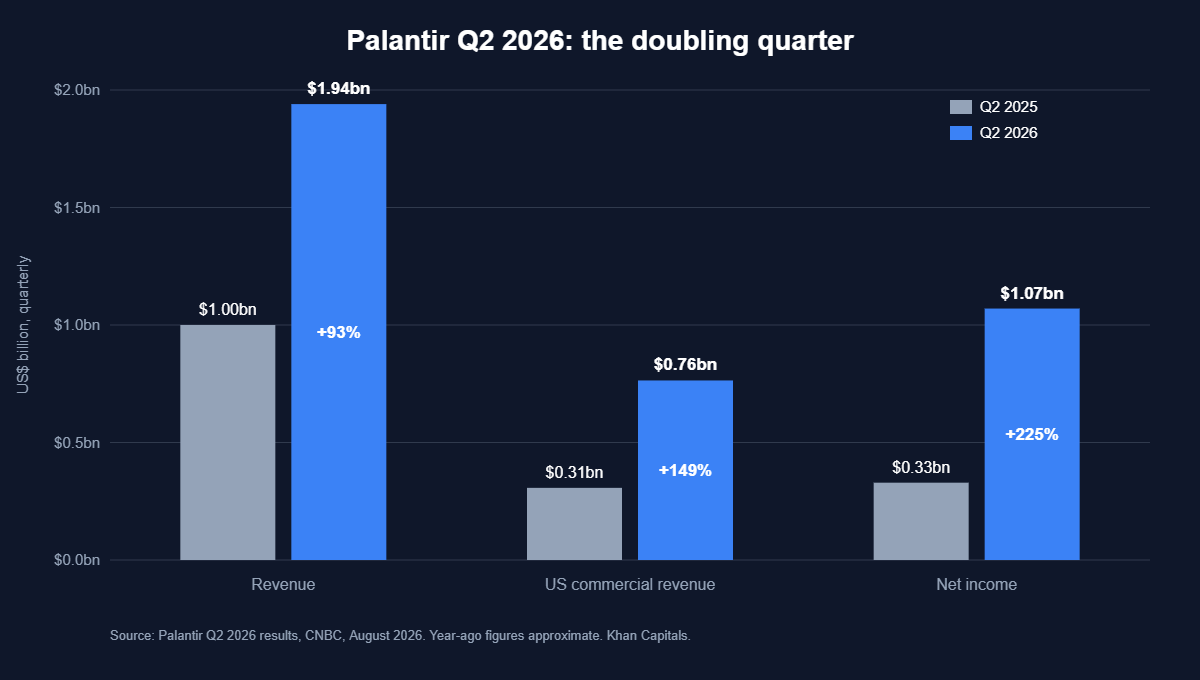
The headline numbers deserve a moment of unhurried attention, because growth of this kind at this scale is rare. Revenue of $1.94 billion was up 93 per cent from roughly $1.0 billion a year earlier. Net income of $1.07 billion, or 41 cents per share, compared with about $329 million, or 13 cents, in the year-ago quarter. That is not a company trading margin for growth: profitability more than tripled while revenue nearly doubled.
The composition matters more than the headline. US commercial revenue, the segment Wall Street watches as the purest read on enterprise AI adoption, grew 149 per cent year on year to $764 million. On the company’s own compounding arithmetic, the segment has expanded roughly 380 per cent since 2024. Management now expects US commercial revenue in excess of $3.42 billion for the full year, up from prior guidance above $3.22 billion.
| Metric | Q2 2026 | Q2 2025 | Change |
|---|---|---|---|
| Revenue | $1.94bn | ~$1.00bn | +93% |
| US commercial revenue | $764m | ~$307m | +149% |
| Net income | $1.07bn | ~$329m | +225% |
| EPS (diluted) | $0.41 | $0.13 | +215% |
| FY 2026 revenue guidance | $8.15-8.16bn | $7.65-7.66bn (prior) | +$500m |
| FY 2026 US commercial guidance | >$3.42bn | >$3.22bn (prior) | +$200m |
The Company the Market Kept Mispricing
Some context explains why this print landed so hard. Palantir has spent most of its listed life being valued on faith rather than arithmetic. It came to market through a direct listing in September 2020 as a two-decade-old company still associated mainly with government contracts, and by mid-2023 revenue growth had slowed to the low teens, seemingly confirming the sceptics’ case that it was a consultancy dressed as a software platform. The launch of its AI platform later that year began the reacceleration; each subsequent year has compounded it. A business that was growing 13 per cent three years ago printed 93 per cent growth this week at nearly eight times the revenue base.
The profitability transformation is the less told half of the story. On this quarter’s figures, net income margin reached roughly 55 per cent of revenue, which on the software industry’s rule-of-40 arithmetic, growth rate plus margin, produces a score approaching 150. The handful of companies that have ever combined near-doubling revenue with majority profit margins at this scale can be counted on one hand. That is the structural fact beneath Tuesday’s move; the catalyst was simply the proof that it was still intact. Distinguishing the two matters, because catalysts fade while structures persist, and the market repeatedly confused them in both directions with this name: extrapolating decline in 2023, and, on the evidence of the past month’s 40 per cent drawdown, extrapolating doubt again this summer.
The Sovereign Bid Behind the Numbers
Two demand stories are compounding inside the print. The first is the familiar one: American enterprises moving AI pilots into production, with Palantir’s AIP platform positioned as the layer that turns foundation models into workflows. The 149 per cent US commercial growth rate is the reason the company keeps raising guidance by amounts that embarrass its own prior forecasts.
The second story is newer. Management attributed a growing share of demand to what it calls sovereign AI tools: governments and state-adjacent institutions buying secure, self-contained AI capability rather than renting it from a hyperscaler. In a year defined by conflict in the Gulf, export controls on advanced chips and a general repricing of geopolitical risk, sovereign demand for controlled AI infrastructure has an obvious macro logic. It is also, structurally, higher-friction and stickier revenue than commercial software: governments that embed an operating platform rarely churn.
Chief executive Alex Karp, never understated, told investors that “for the first time people believe us”. The interesting question for investors is not whether the belief is justified this quarter. It is what the belief now costs.
From 40 Per Cent Drawdown to Almost the Best Day Ever
The scale of Tuesday’s move owes as much to positioning as to fundamentals. Palantir entered the print roughly 40 per cent below its high, dragged down through July by the same unwind that produced the semiconductor bear market and the sell-the-beat reflex across the AI complex. A heavily shorted, heavily optioned name reporting a genuine acceleration into depressed positioning is the textbook recipe for a gap of this size: shorts covering, dealers chasing the gamma they were short, and underweight institutions capitulating back in, all in one session.
That mechanical element cuts both ways. A 29.5 per cent repricing in a day is not a measured judgement about discounted cash flows; it is a market discovering that its prior, bearish position was untenable. The same reflexivity that produced Tuesday’s melt-up would operate in reverse on the first quarter that shows US commercial growth decelerating meaningfully.
What 48 Times Sales Actually Prices
At a market value near $388 billion, Palantir now trades at roughly 48 times the top of its own newly raised 2026 revenue guidance. Not earnings: sales. Multiples of that order are not unprecedented for hyper-growth software, but they are unforgiving. The arithmetic below sketches what different growth paths would imply for the multiple an investor would be holding in 2029, assuming, generously, that the share count and price stay where they are.
| Scenario | Revenue CAGR 2026-29 | 2029 revenue | Implied multiple on today’s value |
|---|---|---|---|
| Bull: acceleration persists | ~60% | ~$33bn | ~12x sales |
| Base: strong but slowing | ~40% | ~$22bn | ~17x sales |
| Bear: growth normalises | ~20% | ~$14bn | ~28x sales |
The point of the table is not precision. It is that even three further years of 60 per cent compound growth, a feat almost no software company at this scale has sustained, would still leave the stock at a low-teens sales multiple in 2029: roughly where the largest, most profitable software franchises trade after decades of compounding. The current price does not merely assume the AI demand story continues. It assumes Palantir remains its single largest beneficiary among pure-play software vendors, without a stumble, for years.
None of that makes the stock a sell on any given day, and the past month demonstrates how expensive it has been to bet against the name on valuation grounds alone. It does mean the margin for disappointment is unusually thin, and that the quarter in which US commercial growth first prints below expectations will be a violent one.
A Season of Violent Verdicts
Palantir’s move is the latest and largest in an earnings season defined by extreme single-day repricings. IBM lost a quarter of its value on a 3.7 per cent revenue miss, the worst day in its listed history. Meta fell 10 per cent and Apple 7 on capex concerns; Microsoft and Amazon each gained 9 on cloud strength. Samsung fell 7 per cent on a record quarter. The common thread is that the market’s tolerance for ambiguity around AI economics has collapsed: every print is being forced into one of two buckets, proof of monetisation or evidence of overspend, and the repricing happens in hours.

That dispersion is itself information. Index-level calm, with the S&P 500 near records, is concealing single-stock volatility that resembles a stock-picker’s bear market. For investors, the season’s lesson is that position sizing around AI-exposed earnings events now matters as much as direction.
Investor Implications
Equities. The bifurcation of the AI trade is the actionable structure: hardware and capex-heavy names are being graded sceptically while demonstrated software monetisation commands a premium. That favours barbell exposure over broad AI baskets. Within software, Palantir’s print will pull peer multiples higher in the short run; investors should distinguish businesses with Palantir-like acceleration from those merely borrowing its narrative. The reflexive component of Tuesday’s move also argues against chasing gaps of this size: entry price discipline matters most precisely when a story is strongest.
Fixed income. There is no direct read-through, but the print reinforces the macro backdrop the bond market is already wrestling with: AI-driven corporate strength is one reason the economy has absorbed policy rates at 3.75 per cent, and every data point of private-sector resilience feeds the September hike debate we covered in the Fed’s triple dissent. Software strength is not disinflationary in the near term when it is funded by record capex.
Cross-asset. A market paying 48 times sales for the AI winner while pricing a possible rate hike is making two bets that sit uneasily together: that growth remains scarce enough to command extreme premiums, and that the economy is strong enough to warrant tighter policy. Both can be true for a while. Historically, the resolution of that tension has come through multiple compression rather than earnings disappointment, which is an argument for watching the discount rate as closely as the growth rate.
Conclusion
The Palantir Q2 2026 earnings report is the strongest single piece of evidence this cycle that enterprise AI demand is translating into revenue at scale, and the market’s response shows how much appetite remains for that proof. A company nearly doubling revenue at a $1.9 billion quarterly run rate, while tripling profit, deserves to be taken seriously rather than dismissed as narrative.
But seriousness cuts in both directions. The stock’s 29.5 per cent surge was amplified by positioning, its valuation now prices years of flawless execution, and the same earnings season that rewarded Palantir has shown how savagely the market treats AI names that fall short of expectations by even a few per cent. The print settles the question of whether AI software monetisation is real. It sharpens, rather than settles, the question of what it is worth.
Frequently Asked Questions
Why did Palantir stock rise nearly 30 per cent after its Q2 2026 earnings?
The company beat expectations on every headline metric: revenue of $1.94 billion grew 93 per cent against roughly $1.80 billion expected, net income more than tripled to $1.07 billion, and full-year guidance was raised by half a billion dollars. The move was amplified by positioning, as the stock entered the print roughly 40 per cent below its high and the options market had priced a move of only about 12 per cent.
What is driving Palantir’s growth?
US commercial revenue, which grew 149 per cent year on year to $764 million as enterprises move AI deployments into production, and rising demand for sovereign AI tools from governments seeking secure, self-contained AI capability. Management raised full-year US commercial guidance to more than $3.42 billion.
Is Palantir stock overvalued after the surge?
At a market value near $388 billion, Palantir trades at roughly 48 times the top of its 2026 revenue guidance, a multiple that assumes years of sustained hyper-growth. Even three further years of 60 per cent compound growth would leave the stock at a low-teens sales multiple in 2029. That does not make the shares a sell on any given day, but it leaves an unusually thin margin for disappointment.
What does the result mean for the wider AI trade?
It confirms a bifurcation: markets are scrutinising AI hardware and capex spending line by line while rewarding demonstrated software monetisation. Palantir’s surge came in the same season that IBM lost a quarter of its value on a small miss and semiconductor stocks entered a bear market despite record earnings.
Sources: CNBC, Palantir Q2 2026 earnings; CNBC, Palantir stock surge and sovereign AI demand; Fortune, Palantir earnings and guidance; Quartz, Palantir raises outlook; Seeking Alpha, Palantir 2026 guidance detail; CompaniesMarketCap, Palantir market capitalisation.
Related Reading: For the hardware side of this week’s divide, see our line-by-line review of Big Tech’s AI capex verdict. The July unwind that set up Tuesday’s squeeze is charted in the semiconductor bear market, and the sell-the-beat reflex it produced in Samsung’s record quarter the market sold. For the other extreme of this earnings season’s verdicts, see IBM’s worst day on record. The index-level backdrop to that week is in Amazon’s $3 trillion market cap and the melt-up’s fine print. For the fundamentals, start with how company guidance moves markets and why share prices move. The week the rotation set records while strong AI results were sold is covered in the small-cap rotation week. The same reflex, a whole category repriced on one qualitative headline, drove the mRNA cancer vaccine breakthrough. Nvidia’s own verdict arrived in the $96 billion quarter the market finally bought.

Leave a Reply