
Khan Capitals | June 2026
Key Takeaways
- The number that moved the market was the backlog, not the beat. Oracle’s remaining performance obligations reached $638 billion at the end of the fourth quarter of fiscal 2026, up 363 per cent year on year and up $85 billion in a single quarter. The Oracle cloud backlog is now larger than the annual revenue of all but a handful of companies on earth.
- Oracle has repositioned itself as a compute landlord. Cloud Infrastructure (OCI) revenue rose 93 per cent to $5.8 billion in the quarter, the engine behind a 47 per cent jump in total cloud revenue. The legacy software licence business, by contrast, shrank 2 per cent.
- The headline earnings beat flattered the underlying run-rate. Non-GAAP earnings per share of $2.111 were lifted by one-time investment gains; stripping those out leaves $2.03, and full-year adjusted growth of 13 rather than 27 per cent. The market noticed.
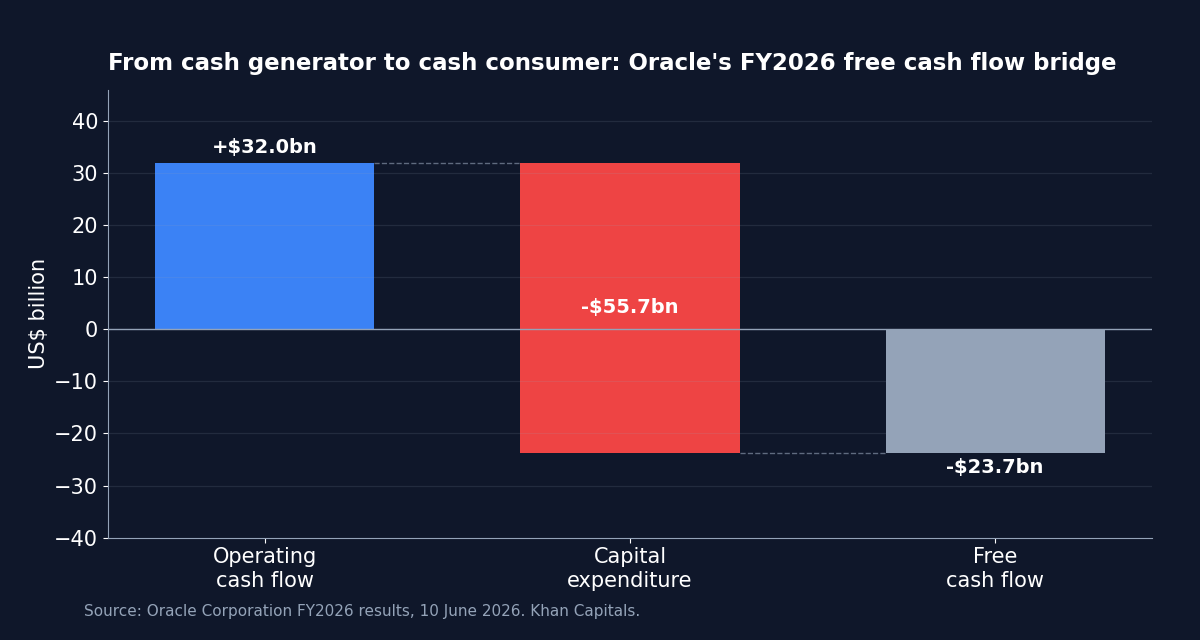
- The build-out is consuming cash at an extraordinary rate. Capital expenditure jumped roughly 162 per cent to $55.7 billion for the year, free cash flow swung to negative $23.7 billion, and Oracle plans to raise around $40 billion of fresh debt and equity in fiscal 2027, including a $20 billion equity issuance.
- Shares fell despite the records. Oracle’s stock dropped close to 10 per cent in the sessions following the report as investors weighed dilution, margin compression and the gap between contracted bookings and realised cash.
Part of: The AI Infrastructure Supercycle — Khan Capital’s hub on the AI infrastructure build-out.
A Record Quarter the Market Sold
Oracle closed its fiscal 2026 on 10 June with a set of results that, on the surface, read like an unambiguous triumph. Total quarterly revenue rose 21 per cent to a record $19.2 billion. Cloud revenue climbed 47 per cent. Earnings beat consensus comfortably. And yet the shares fell sharply in the hours and days that followed. The disconnect between the print and the price is the most instructive feature of this report, and it sits at the heart of the question every professional allocator is now asking about the artificial intelligence build-out: at what point does spectacular booked demand stop being a virtue and start being a liability.
The defining figure was not revenue or earnings but the Oracle cloud backlog, the contracted future revenue the company has signed but not yet recognised. Remaining performance obligations, the formal accounting term for that backlog, ended the quarter at $638 billion. That is not a typographical error. A company that generated $67.4 billion of revenue across the entire fiscal year is carrying a contracted book of business roughly ten times that size. For a business that spent two decades being valued as a mature, slow-growing database incumbent, this is a structural re-rating of what Oracle is and what it might become.
This piece treats the result as a case study in the economics of being an AI infrastructure provider: the leading-indicator value of the backlog, the capital intensity required to honour it, and the widening distance between a signed contract and a banked dollar. The reaction in the broader hyperscaler trade has been to reward demand visibility one quarter and punish capital intensity the next, and Oracle has now experienced both within a single release.

The Headline Numbers
Before interpreting the backlog, the quarter itself deserves a clear accounting. Total revenue of $19.2 billion grew 21 per cent in reported dollars and 20 per cent in constant currency. The composition matters more than the headline. Total cloud revenue, combining infrastructure and applications, reached $9.9 billion, up 47 per cent. Within that, Cloud Infrastructure, the OCI compute-and-storage business that competes with Amazon Web Services, Microsoft Azure and Google Cloud, grew 93 per cent to $5.8 billion. Software-as-a-service applications grew a more pedestrian 10 per cent to $4.1 billion. The traditional on-premise software licence business, long Oracle’s profit centre, declined 2 per cent to $6.8 billion as customers continued migrating to the cloud.
Profitability held up at the operating line. GAAP operating income rose 20 per cent to $6.1 billion and the non-GAAP measure reached a record $8.6 billion. Non-GAAP earnings per share of $2.111 rose 24 per cent and cleared the consensus near $1.89. The catch, disclosed in the company’s own footnotes, is that both the quarterly and full-year figures included one-time net investment gains tied to the disposal of Oracle’s Ampere chip business and Bloom Energy warrants. Excluding those gains, quarterly non-GAAP earnings would have been $2.03 and full-year adjusted earnings growth would have been 13 per cent rather than the headline 27 per cent. The quality of the beat, in other words, was lower than the number suggested.
| Metric (Q4 FY2026) | Result | Year-on-year |
|---|---|---|
| Total revenue | $19.2bn | +21% |
| Total cloud revenue | $9.9bn | +47% |
| Cloud Infrastructure (OCI) | $5.8bn | +93% |
| Cloud Applications (SaaS) | $4.1bn | +10% |
| Non-GAAP EPS | $2.111 | +24% |
| Remaining performance obligations | $638bn | +363% |
What the Oracle Cloud Backlog Actually Represents
A backlog is only as useful as the confidence one has that it converts to revenue, and here the detail beneath the $638 billion headline is essential. The figure grew $85 billion in the fourth quarter alone, on top of a comparable surge in the third quarter. Oracle was explicit about the source: most of the increase came from large-scale AI contracts in which the customer either prepaid for the graphics processing units that power the data centres or supplied the GPUs directly. The prepaid and customer-supplied hardware portions of these contracts now total $75 billion.
This structure changes the risk profile of the backlog in two directions at once. On the reassuring side, a customer that has handed over cash in advance, or shipped its own silicon to an Oracle facility, is not a speculative pipeline entry; it is a committed counterparty with capital already at stake. That $75 billion materially reduces the amount Oracle itself must finance to build the capacity, a point the company was keen to stress. On the cautionary side, a backlog this concentrated in a small number of very large AI customers carries counterparty and concentration risk that a diversified subscription book does not. If a marquee customer renegotiates, delays, or fails to fund the later years of a multi-year contract, the headline number can move violently in reverse.
The leading-indicator value, however, is real. RPO tells investors what the next several years of OCI revenue are likely to look like with far more confidence than any single quarter of bookings. It is the clearest signal yet that AI training and inference demand is not a one-off spike but a multi-year capacity commitment, and it is the metric most worth tracking in subsequent quarters. The question is no longer whether the demand exists. It is whether Oracle can build, power and operate the data centres fast enough, and cheaply enough, to turn that demand into profit.
OCI: From Database Vendor to Compute Landlord
For most of its history Oracle sold software and the support contracts attached to it, a high-margin, capital-light model that threw off prodigious free cash flow. The OCI business inverts that model. Oracle is now in the business of buying land, power and chips, assembling them into data centres, and renting the resulting compute by the hour. It has become, in effect, a landlord for AI workloads, and landlords carry very different balance sheets from software vendors.
The operational evidence that this transition is working is strong. Ninety-three per cent infrastructure growth is a pace none of the larger hyperscalers can match off their bigger bases, and Oracle has positioned its multicloud database offerings, which let customers run Oracle databases inside rival clouds, as the fastest-growing product in the company’s history, up 404 per cent in the quarter. The company also pointed to extremely high utilisation of its installed GPU fleet, the kind of figure that suggests demand is running ahead of available supply rather than the reverse.
This is the same structural shift visible elsewhere in the stack. When Dell reported a record AI server backlog earlier in the quarter, the message was that the build-out economics were moving down from the chip designers into the hardware integrators. Oracle’s result extends the chain one link further, into the cloud operators who house and rent that hardware. The capital is flowing through the entire vertical, and at each stage the recipient must spend heavily now to capture revenue later.
The Capex Question: Can Bookings Convert to Cash
Here is where the market’s unease crystallised. Building compute capacity at this scale is brutally capital-intensive. Oracle’s capital expenditure rose roughly 162 per cent to $55.7 billion in fiscal 2026. Operating cash flow was strong at a record $32.0 billion, up 54 per cent, but it was nowhere near enough to cover the build. The result was free cash flow of negative $23.7 billion for the year. A company famous for its cash generation spent the year as a net consumer of cash on a vast scale.
The funding plan makes the scale plain. In fiscal 2026 Oracle raised $43 billion in debt and $5 billion in equity. For fiscal 2027 it expects to raise around $40 billion through a combination of debt and equity, including a previously announced $20 billion at-the-market equity issuance. That equity sale is the detail that most directly unsettled existing shareholders, because issuing new stock dilutes their claim on future earnings. Management framed the $75 billion of customer prepayments and supplied hardware as a mitigant, reducing how much capital Oracle must raise itself, and committed to issuing no additional debt in calendar 2026. Even so, the picture is of a balance sheet being stretched to fund a land grab.
The conversion question is therefore the crux. A $638 billion backlog is only valuable if it becomes recognised revenue at an acceptable margin, and the gross margin on rented AI compute is structurally thinner than the margin on software licences. Data-centre ramp costs compressed margins in the quarter, and the heaviest spending precedes the heaviest revenue recognition by quarters or years. Investors are being asked to underwrite a large, front-loaded capital outlay against a backlog whose profitability at full scale is not yet proven. That is a different proposition from the Oracle of five years ago, and it warrants a different multiple.
What the Market Is Underappreciating
The reflexive reading of the sell-off is that the market punished Oracle for spending too much. That is part of the story, but it risks missing two subtler points that cut in opposite directions.
The first, in Oracle’s favour, is the financing innovation embedded in the contracts. By persuading customers to prepay for GPUs or to supply their own silicon, Oracle has effectively syndicated part of the capital burden to the very counterparties driving the demand. A traditional cloud build requires the operator to fund the entire stack and then hope to rent it. Oracle has begun to pre-sell the capacity and collect the cheque before the concrete is poured. If this model holds across the backlog, the implied return on Oracle’s own invested capital is considerably better than the gross capex figures alone suggest, and the market is arguably mispricing that structural advantage by anchoring on the headline spend.
The second, against Oracle, is concentration and convertibility. A backlog ten times annual revenue is unprecedented for the company, and history offers few clean templates for how such a book converts under stress. The same pattern, in which a strong report is sold rather than bought, has recurred across the AI complex this year. When Nvidia delivered a record quarter and still saw its shares struggle, the lesson was that the bar had risen faster than the results. Oracle now faces the same dynamic from the demand side: the backlog is so large that anything short of flawless execution on power, chips and customer funding will be read as disappointment. The market is not underappreciating the demand. It is, reasonably, demanding proof that the demand can be financed and delivered at a profit.
Investor Implications
For equity investors, Oracle has become a leveraged expression of the AI infrastructure thesis rather than the defensive software compounder it once was. Positioning should reflect that change in character. The backlog provides genuine multi-year revenue visibility that few companies anywhere can match, but the valuation now embeds an assumption that the spending converts to high-margin recurring revenue on schedule. Investors weighing the name may wish to consider whether they are being compensated for the execution, financing and concentration risk that the new model carries, and to watch the quarterly RPO trajectory and OCI gross margin as the key tells. The broader read-through is to the entire hyperscaler cohort, where the market is now scrutinising the cash cost of growth as closely as the growth itself.
For fixed income investors, Oracle’s transformation is arguably the more consequential story. A company funding a build-out of this scale through roughly $40 billion of fresh issuance in a single year becomes a significant and recurring presence in the investment-grade market. The shift in the funding mix toward equity in fiscal 2027 signals an awareness of leverage limits, but the trajectory of debt issuance, the direction of credit spreads on Oracle paper, and any change in rating-agency commentary all merit attention. Holders of existing Oracle debt face a heavier-supply, higher-leverage issuer than the one they originally underwrote.
At the cross-asset level, Oracle is now a barometer for the financing of AI itself. The episode reinforces a theme running through markets in 2026: capital intensity has become the swing variable in how the AI trade is priced. The same investor base that cheered demand signals through 2025 is now interrogating the cash flow statement line by line. That rotation, from rewarding bookings to scrutinising burn, has implications for power and electricity infrastructure, for the semiconductor supply chain, and for the equity-versus-credit balance across the entire complex, as explored in the recent AI semiconductor sell-off.
What to Watch
- Q1 fiscal 2027 results: whether the 638 billion dollar RPO keeps growing or begins converting into recognised revenue.
- OCI gross margin: whether the margin on rented AI compute holds up as new data centres come online.
- The fiscal 2027 funding plan: the roughly 40 billion dollars of issuance, including the 20 billion dollar equity sale, and the dilution it implies.
- Customer concentration: any renegotiation, delay or non-funding among the small number of very large AI customers behind the backlog.
- Credit signals: the direction of spreads on Oracle paper and any rating-agency commentary as leverage rises.
Conclusion
Oracle’s fourth quarter was, by the numbers, the strongest in its history, and the market sold it anyway. That paradox is not irrational. The Oracle cloud backlog of $638 billion is a genuine and rare signal of multi-year AI demand, and the company’s success in pre-selling capacity and offloading part of the capital burden to customers is a real competitive innovation. But the same report showed a balance sheet swinging to deeply negative free cash flow, a funding plan that leans on dilutive equity, and an earnings beat flattered by one-time gains. The investment case has shifted from the predictability of software to the execution risk of infrastructure. For now, Oracle’s challenge is no longer proving that the demand is there. It is proving that the demand can be financed, built and converted into profit faster than the market’s patience runs out.
Frequently Asked Questions
What is remaining performance obligation (RPO), and why did Oracle’s matter?
RPO is contracted future revenue a company has signed but not yet recognised. Oracle’s reached 638 billion dollars at the end of fiscal 2026, up 363 per cent year on year and roughly ten times its annual revenue. That makes it a leading indicator of several years of future cloud-infrastructure demand, which is why it moved the market more than the quarter’s earnings.
Why did Oracle’s stock fall despite record results?
Because the cost of the growth alarmed investors. Capital expenditure rose about 162 per cent to 55.7 billion dollars, free cash flow swung to negative 23.7 billion dollars, and the company plans a 20 billion dollar equity issuance that dilutes existing holders. The headline earnings beat was also flattered by one-time investment gains, leaving lower underlying growth once those were stripped out.
How is Oracle funding its AI build-out?
Oracle expects to raise around 40 billion dollars of debt and equity in fiscal 2027, including a previously announced 20 billion dollar at-the-market equity issuance. It has also offloaded part of the capital burden to customers: roughly 75 billion dollars of the backlog is covered by prepayments or customer-supplied chips, reducing how much Oracle must finance itself.
What should investors watch in Oracle’s next results?
The three clearest tells are the quarterly RPO trajectory, which shows whether the backlog keeps building or starts converting to revenue, the gross margin on OCI as data centres ramp, and the pace of debt and equity issuance alongside any move in Oracle’s credit spreads.
Sources: Oracle Q4 and FY 2026 earnings release; Oracle Form 8-K (SEC EDGAR); Oracle Investor Relations; CNBC. Figures as reported by Oracle Corporation on 10 June 2026.
The Khan Capital Brief
Understand what moves markets
Analysis like this, free in your inbox. No spam, unsubscribe any time.
Related Reading: Oracle’s compute build-out is the latest chapter in a story Khan Capitals has tracked across the technology complex. For the macro frame on how much the cloud giants are collectively committing, see AI Capex Hits $725bn: Wall Street Splits on the Hyperscaler Trade. For the moment a record result still failed to satisfy a demanding market, read Nvidia’s $91 Billion Quarter: When the Bar Becomes the Beat. The same build-out economics one rung down the stack are examined in Dell’s $51.3 Billion AI Server Backlog, while the violent repricing of AI exposure is dissected in The $1 Trillion AI Semiconductor Selloff and the wider split between capital-light and capital-heavy technology in The Great Tech Divergence: Software Breaks While Silicon Soars. For the upstream memory dimension of the same build-out, see The NVIDIA SK hynix Memory Deal: Reserving the AI Supercycle’s Scarcest Input. For the broader memory-supply story behind these moves, see Micron’s record quarter and the AI memory supercycle. For the fundamentals, start with what RPO measures. The same scepticism was applied in reverse to IBM’s worst day on record.

Leave a Reply